
Gardening gratification comes in two forms: delayed or instant. A recent fall trip to the community garden with my nephew Ben and his support worker Sally-Anne proves the point.
Delayed gratification: Tulip planting. There is no bigger leap of faith than digging in tulips for spring. We are talking a six-month return on investment before tulips put on their spring colour show, following daffodils and even earlier birds such as snowdrops and crocuses. That is if the squirrels don’t get to the bulbs first as a fall snack.
It’s a late afternoon in October and we are headed to Thorncliffe Park Community Garden, located on the hydro corridor just north of Overlea Drive. It’s a little oasis off the beaten track of one of Toronto’s densest urban neighborhoods.
So far, the weather is not co-operating. The minivan wipers are set on intermittent, which means we still have a chance for our late-season gardening session. In fall and spring, our minivan has been dubbed “the shed” by Nadine, as it tends to house a collection of gardening tools, pots, mulch and other stuff in the hatch. Here’s to stow-and-go seating!
As we pull into the community garden and drive up to my 12×20-foot piece of paradise, the rain turns to mist. I’ve brought umbrellas just in case. However Ben assures me, with Sally-Anne interpreting his sign language, that he likes rain, so we are good to go in any case.
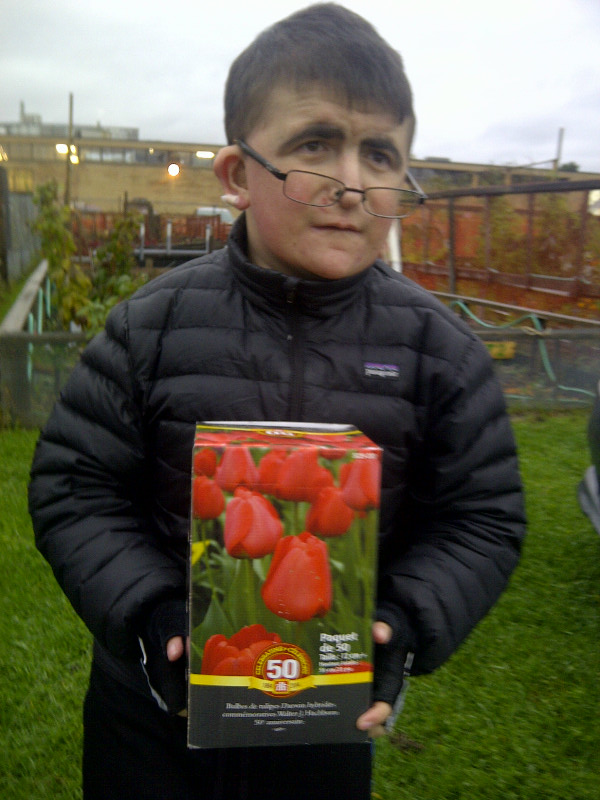
We pull out a box of 50 tulip bulbs. Woven among some perennial flowers and herbs, they will create a bright red border along the west side of the garden in spring.
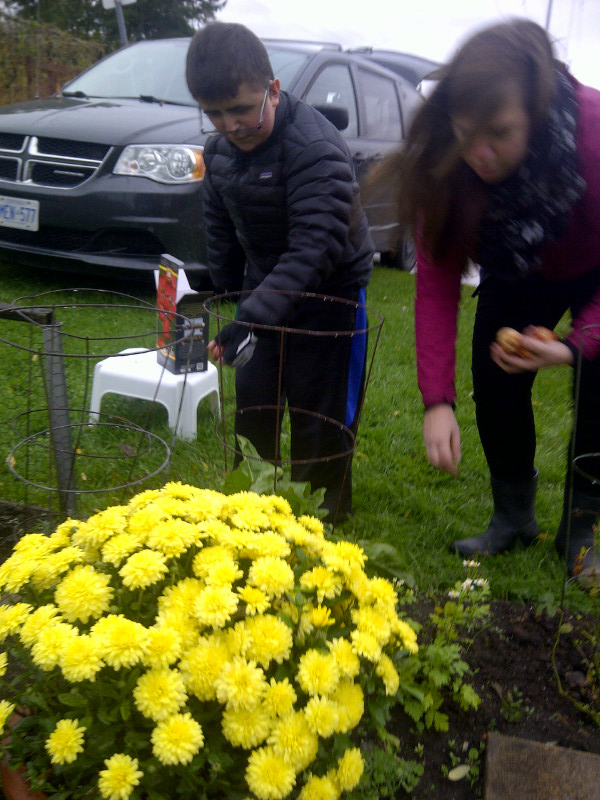
The planting exercise involves an assembly line of sorts. I dig the holes using an old piece of lumber to poke spaces in the soil, about six inches deep. Following me is Ben, who leans on the fence to carefully aim and drop bulbs one by one into each hole. Sally-Anne rounds out our line by making sure each bulb is upright (roots down), and uses a trowel to cover them up with soil. We get in about 40 bulbs, which means there are some left-overs for Ben and Sally-Anne to bring home to plant.
Over the long Canadian winter, the bulbs will set down some roots. They will wait patiently until the time is right to signal spring with their scarlet blooms.
Instant gratification: Sweet September raspberries. When I inherited this plot from a former gardening friend, she left some dwarf raspberry canes in the north-east corner. I can’t say I’ve done much with them except to enjoy the harvest — they put up fruit twice a year. My father-in-law Claus calls the fall crop “Sweet Septembers.” My canes have produced some sweet Octobers this year, so I pick a dozen of the last purple-red ripe raspberries and the three of us split them up for an instant treat. It’s almost suppertime, so the raspberry snack will buy us some time for the next gardening task.
Delayed gratification: the 2014 carrot crop. It’s been six months of weeding, watering and waiting. Now the carrots are ready to harvest. A few of the bigger ones have presented themselves — the orange tops now visible above the soil. I loosen the big ones and Ben hauls them up by their greens.
We head to the water tap to wash off the dirt, revealing a couple dozen healthy but gnarly looking carrots. Healthy, because they seem to have resisted the bugs that sometimes eat into the crop underground. Gnarly, because some of them are looking like something out of a sci-fi movie — the carrot that ate Don Mills.
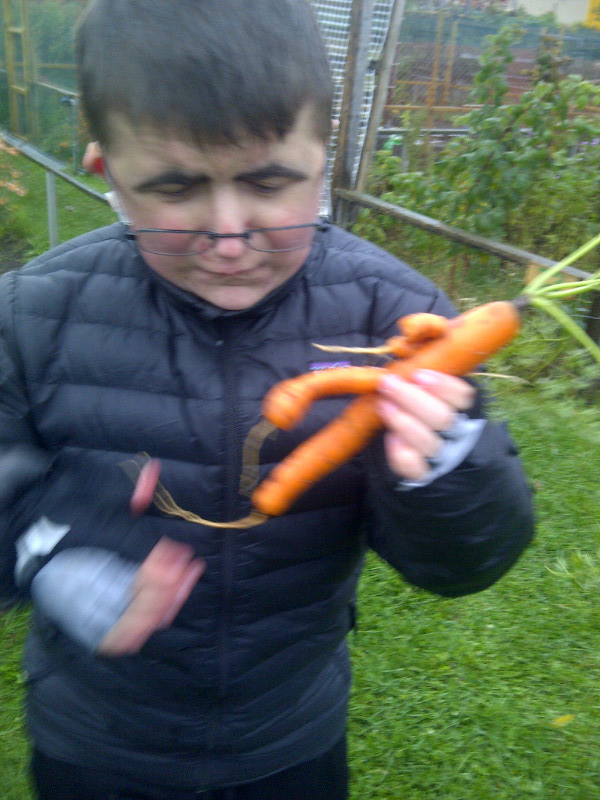
Folks, you will never see carrots like these on store shelves. But they are tasty. We nibble on a couple of the little ones — sweet!
Ben and Sally-Anne each take home a basket, and I will be back for another couple of dozen before the soil freezes. Even after freeze up, if you miss a few carrots, they will generally sit tight over winter and provide a spring windfall when the soil thaws.
Instant gratification: Swiss Chalet. It’s getting dark and Ben agrees that we are done gardening for the day. We wash our hands under the nearest water tap. We’re getting a bit hungry and the raspberries and carrots have only bought us so much time.
As luck would have it, there is a Swiss Chalet located a stone’s throw from the community garden. We are seated by the hostess at a cozy booth, and gaze through the colourful options on the menu.
Ben is a pasta guy but likes his meal plain. When the waitress arrives, she asks Ben for his order. Ben signs and Sally-Anne translates. He has his own sign for pasta, using his index fingers and thumbs to indicate a pulling motion, like stretching a piece of spaghetti. He would like the fettucini, with some butter and salt. The menu shows a fettucini dish loaded with chicken and veggies, and I am reminded of the Jack Nicholson scene where he just wants toast, but has to order a chicken sandwich, hold the chicken, hold the mayo, etc. But Swiss Chalet is stepping up to the plate on Ben’s custom dinner order. The waitress asks Ben if he wants anything else on the pasta and he signs the letter “p” for Parmesan. Ben smiles and gasps when his pasta arrives, and I tuck into my quarter-chicken dinner.
Sally-Anne, who is one of Ben’s support workers, is studying for her sign-language interpretation diploma at George Brown, balancing school with work and being a mom to her five-year-old daughter. She’s heading to Montreal tomorrow for a couple of days for a break and some fun with friends.
Ben is a man who starts what he finishes. HIs pasta plate is clean as a whistle, and he’s making his way through his diet pepsi and chocolate cake while I savour my apple pie a la mode. Ben is interested in the folks in the restaurant, including some retired couples and families. From his booth seat, he has a wide view of the place and is keeping an eye on the goings on.
We finish up and head home — soon I’ll put the garden to bed for the winter. We will all enjoy our carrot crop, and we’ll be back next spring to check out the tulips.
 kinrosscordless