The cows next door to our place at Minden Lake caught me in the act of building a small dry stone retaining wall for our garden this fall. They are a curious bunch. They gathered quietly, just the other side of our fence, and gazed at the little stone wall under construction. It occurred to me that they might have thought it was a salt lick, and come busting through the flimsy wire fence to get at it.
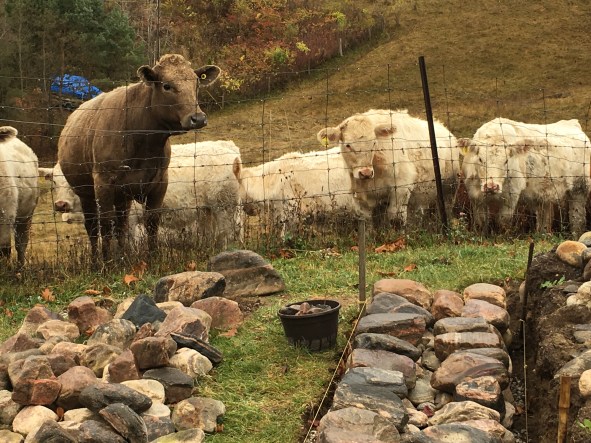
But I’d prefer to think they had some questions about how and why this little wall was rising at the top of the hill. Time was short for some of them — the yearlings would be sold at auction in Woodville in a few weeks. And the clock was ticking for me to get this job done. Soon the snow would fly, shutting down this year’s stone-walling season.
But today, time stood still. I communed, briefly, with the cows. I imagined the questions they were asking me, and tried to answer them patiently. All the while, I kept my eye on a quick escape route to follow if they decided to storm the fence.
Why are you building this wall?
The main reason is to level the playing field for the onions and all of the other vegetables and flowers in the little garden outside our screened porch.
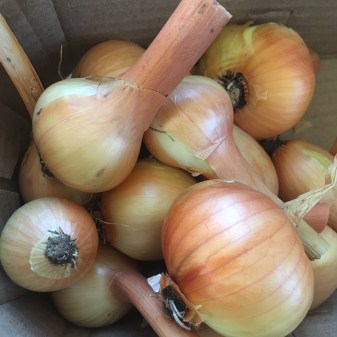
This year’s crop included tomatoes, beans, peas, carrots, cucumber, kohlrabi, lettuce and beautiful flowers from bulbs including dahlia and gladiola. We also have gooseberries and currants. Some of these were gifts from my father-in-law Claus, a master gardener who mixed the beauty of flowers with the nutrition of tasty, fresh vegetables.
The wall will shore up the slope on the south side of the garden, creating a more level playing field and retaining moisture in the soil for those veggies and flowers. Once completed, it will also be a nice place to sit, plant, weed and even take a load off with a cup of coffee.
It replaces a rather crude previous attempt by yours truly. A couple of years ago, without the right knowledge or skill, I had thrown down some stones in a ramshackle pattern in an attempt to retain the soil. Very quickly, the wall started to move, leak and crumble.
Now, I wanted to rebuild the retaining wall to last. To get started, I pulled apart the previous wall, sorted the stone, set in some posts and string to keep straight and level, and put down a base of tamped gravel.
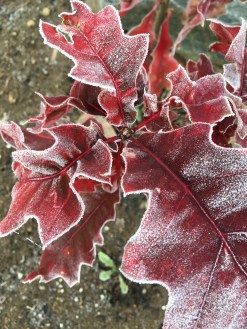
But quick, the frost is coming! It’s lighting up the fall colours — like the red leaves on this cute baby oak tree next to the garden. So pretty.
You don’t use mortar? Why don’t all the stones just tumble down?
Because I am following an ancient and proven tradition, built on a few sound scientific principles. Dry stone walling dates back thousands of years and you can find examples of its durability and beauty in places like the UK, Italy and Peru.
After being inspired by the dry stone terraces in the pretty sea-side towns of Cinque Terra, Italy, I took a course with 20 other students at Haliburton’s School for the Arts. Our instructor was John Shaw-Rimmington, a master mason and dry stone waller. John’s work blends art, engineering and sensitivity to landscape. A stunning recent example is the dry stone footbridge he and his class created last year over a small brook near the town of Haliburton. The arch in the footbridge is solid as a rock — possibly more solid than a mortared arch because gravity and friction will keep the arch stones tight, whereas mortar can crack and heave the structure.
From John, who is president of Dry Stone Walling Across Canada, we learned the importance of principles that include:
— stone selection — curating the stone into a dozen or more categories and knowing the role of each stone size and type.
— gravity — using gravity to our advantage to create integrity in the structure. Typically, the heavier stones on the outsides of the wall tilt inward and are tied together on top with heavy, thick and wide capstones.
— friction and placement — learning how to knit stones together in a pattern that creates multiple touch points and integrity for each stone and for the entire structure. This includes the use of smaller “hearting” stones in the core of the structure.
In addition to the science, we learned some human qualities that support this effort: patience, flow, intuition, teamwork, and the importance of stepping back to get context on progress. Finally, there is the joy of each moment and celebrating a job well done.

In the photo above, you can see the first three course of stone are placed, with smaller heart stones placed inside for each course. These include small wedge stones used to adjust the tilt and lie of the bigger stones. I raise and level my guide string as I go, using it as a reference for stone placement. My guideposts and string also ensure a slight “batter” or slope to the wall — perhaps an 8 to 1 ratio — to help it retain weight from the garden soil it will hold. You can see the soil at the left of the photo. If the wall was to be taller, I would build forms at each end to ensure an exact batter ratio.
It’s particularly important to get integrity at each end of the wall. One trick is to use some of your best stones in the prime spots including the ends. A standard rule of wall building is to place one stone goes over two, and vice versa, to avoid “running joints” that might compromise the structure.
Where do you get all the rocks?
It’s good to have multiple sources. These may include some existing stone on your property. In Minden Hills more than a century ago, the first farmers pulled stones as they cleared land and left the stones in long piles. Some of this farm land has reverted to forest but the stones have not budged. Using a wheelbarrow, I mined some nice stones from behind my in-laws’ cottage garage, an area where stone used to divide farm fields.
A local “clean fill” municipal site often features a few nice pieces of stone that have been dumped along with wood and concrete waste. Finally, a gent named Brent on Horseshoe Lake Road specializes in excavation and aggregates. He has kindly delivered local stone right to our cottage at a reasonable price — a ton of delivered stone can be had for a cost equal to about 25 tall bold coffees at Starbucks.
It must be tough on the back
If you take care, stone building makes you sore but strong. Our stone sensei John taught us several techniques to make the job easier:
- Leverage with a shovel, sometimes combined with an old two by four, can help move heavy stones with less effort and risk. There are more specialized tools but the principles are the same.
- A handcart and wheelbarrow make it easier to move stones around.
- A long piece of 2×10 wood can be used to slide a heavy capstone into place without direct lifting.
- Lifting with your legs and working methodically reduces the chance of injury.
Oh, oh — the snow is flying. Will this wall get done?
Thanks for asking, my bovine friends. And thanks again for keeping to your side of the fence. In fact, this little retaining wall is 90 per cent complete. Four courses of stone are built and the hearting is packed in. A row of slim stones will be the penultimate step before the heavy capstones go on — to lock everything together.
But as the snow flies in Minden, my fingers are getting a little numb. The wall will have to wait for early spring. I’ll temporarily cover it with plywood and the capstones to keep out the elements. Then we’ll complete the finishing touches in 2018. Thanks for your interest, and best of the season to you!

 kinrosscordless