As winter approached, I set a goal of relearning some classic snare drum solos. But my grand plan to practice each night got pre-empted by Netflix. Dreams of drumming were shot down by the Tiger King and a dark Spanish drama: The Grand Hotel. Exacerbating this dilemma was the coronavirus lockdown — TV series and movies were a necessary diversion.

The snare drum beckoned, though. This instrument spans musical genres ranging from a military march to the backbeat in a rock song to a passage in classical music. I learned to play it starting in Grade 6, when my Mom Sheila spotted an advertisement for drum lessons in the Don Mills Mirror newspaper. She encouraged me to give the drums a try.
Rudiments and inspiration
My new music teacher, Glenn Price, started me off with the rudiments of snare drum playing. A rudiment is a musical building block. It can be simple, like a “flam” with its softer grace note preceding the louder strike on the beat. Or more complex, like a drum roll, in which each hand plays two beats that alternate into a buzz ranging from a whisper to a roar.
Flams, rolls, paradiddles, ruffs — these were some of the required rudiments of snare drumming I had to learn before tackling a piece of snare drum music.
I obtained a Remo practice pad to use at home. I beat the hell out of it for an hour each day after school, and got better at reading, and sight-reading, drum scores. The snare drum technique was a foundation for subsequent lessons on drum set and a variety of percussion instruments from timbales to the marimba.
One weekend, Glenn drove me to Long and McQuade’s music store in downtown Toronto to get my first drum kit. It was a beat-up but well-made dark-green-sparkle German Sonor Kit with a cracked Zildjian ride cymbal — the works for $175. I was thrilled.
I studied with Glenn through junior high and high school in the 1970s. In my one-hour lessons, he would push hard on percussion fundamentals and we would work on “independence” of the two hands and two feet on drum set. Then he would play a record album and we would listen and decode the drum part. I recall being mesmerized by Emerson, Lake and Palmer, King Crimson and other bands in his record collection.
Stepping stones
All these years later, I was dealing with a very different hearing system. My brain had to interpret signals from the cochlear implant in my right ear, and a conventional hearing aid in the left. These high-tech devices had helped restore hearing lost to an inner-ear condition called Meniere’s disease.
Understanding human speech was much easier, but hearing or playing music was still challenging. Percussion generally sounded crisp, though.
Perhaps the snare drum could be a stepping stone to get back into some music fundamentals.
In my 58th year, I hauled out my old snare drum and stand from the basement and set it up in my daughter’s room upstairs. In a hopeful touch, I placed a music stand behind it, and a pair of sticks on top of the drum.
Before I could dig into my first snare solo, I reacquainted myself with the drum.
My snare drum is not a purist’s dream. It is not worth much more than a few lattes at Starbucks. But it is solid and has a rich sound.
It is a CB Model, made in Taiwan, likely in the 1980s, in an era when the traditional U.S. drum manufacturers had come under heavy competition from offshore drums. These knockoffs were not necessarily inferior instruments, but they were much cheaper. I believe CB is a cheaper model once made in Taiwan by the Pearl drum company based out of Japan. (This particular drum is actually my back-up snare. How I acquired it would be a story for another day.)
Deconstructing the snare drum
I took a closer look at my CB:
Its shell is deep and heavy, surfaced with what looks like a thick chrome plate. The heads are good-quality U.S.-made Remo and Evans.
The snares themselves are a cluster of thin wires stretched along the bottom head of the drum. When the top (or batter) head of the drum is struck, the wires resonate, sounding like buzzing wasps, against the lower (or snare) head.

A snare control mechanism called a strainer allows me to engage the snare wires, or to disengage them from the bottom drum head, and to adjust tension in both on and off settings. When the snares are turned off, the drum sounds very different — hollower, minus the buzzing wasps.

We don’t usually think of musical pitch in a snare drum, but the drummer can use a key to tighten or loosen the lugs and rims that hold both heads, changing the pitch and fullness of the sound. A circular mute knob can also dampen the top head for a flatter sound.

A tiny air hole plays a huge role — it allows air to escape and the drum to resonate when it is struck. On this drum, the air hole sits just underneath the funky CB “Percussion Internationale” badge.

The stand holding the drum has three adjusters to ensure the snare drum is tightly gripped, tilted according to the musician’s wish, and at the correct height.
My stand is designed for a seated drummer playing a set, so cannot be raised high enough to play standing. To learn a snare passage, I would have to sit on the bed in my daughter’s old room. Luckily, both our daughters would not have to plug their ears — they have left the nest for Scotland and the U.S., respectively.

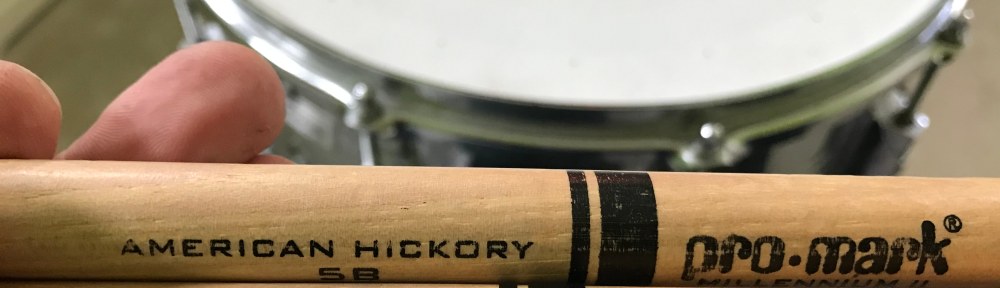
And finally, a pair of sticks. A hardwood, like hickory, holds up to drumming demands. The 5B marking connotes a mid-sized thickness and heft.

The sticks strike the snare drum head but can also be used on the drum’s rim for a tinnier sound. Combining those two options is a “rimshot,” when the stick strikes the rim and head simultaneously. The sticks also have some resonance themselves — you can feel their vibrations in your hands when you play.
Enough talk
After dusting off my old snare drum and reacquainting myself with its components, I made a pilgrimage back to Long and McQuade’s on Toronto’s Bloor Street West. I wandered into the drum section and ogled some vintage kits as well as new electronic drums.
But my real mission was to find sheet music. Upstairs, I flipped through percussion sheet music and came upon a familiar music book of 50 drum solos that my teacher had introduced me to years ago. The wheels were turning.
My CB snare drum had been dusted — its chrome sparkled.
It was time to walk the talk.
 kinrosscordless
so glad you got your drums out. Can’t believe you still had it after all these years. Eagerly waiting for the next installment. Will there be a audio feature?
Thanks Nancy, I may have to tape my first snare drum solo. Stay tuned.
Cool. Wish I had had a teacher like Glenn Price. Mine was horrible and beat the love of drumming right out of me (forgive the pun.) Enjoy your journey!
Thanks D’Arcy, for sure I was lucky. There are some superb music teachers and some bad ones. I would be willing to rustle up some drums for you if you would like to try again. (: