With my snare drum dusted off and sounding crisp, I decided to tackle my first solo in 40 years.
My pilgrimage to Toronto’s Long and McQuade music store had yielded a classic and familiar book: Anthony Cirone’s “Portraits in Rhythm,” comprising 50 studies for the snare drum.
Cirone was an east-coaster. He grew up in New Jersey and studied at the top-flight Julliard School of Music in New York City before landing with the San Francisco Symphony as a percussionist. He went on to a music professorship at San Jose State University and a lifetime of percussion performance and teaching.

Musical potential
Cirone wrote Portraits in Rhythm when he was just a pup — in his 20s — but it set a standard in snare drum and percussion teaching internationally. Cirone explored musical themes, forms, dynamics and phrasing for an instrument that was sometimes neglected in classical circles. Cirone wanted to show the rich variations and musical potential of this core piece of the percussionist’s toolkit.
While studying percussion with my teacher Glenn Price in the 1970s, I had worked through many of the etudes in Cirone’s book
Four decades later, I had some trepidation when I set the book on my music stand and opened it to Etude 1.

I picked up my drum sticks and checked the required tempo. At 132 beats per minute, the piece felt blazingly fast. So I dialled back my metronome to a more leisurely 108. Then I took a crack at sight-reading the piece from start to finish.
It’s a concise study that sets a theme and reprises it in different variations, telling a musical short-story. There are some extreme dynamics ranging from double forte to pianissimo, and speeds ranging from quarter notes to sixteenths. Accents, syncopation and drumming rudiments are part of the story-telling.
I got through Etude 1 at my “Moderato” tempo in less than two minutes, with a bunch of mistakes, but with a smile on my face. I felt some muscle memory kick in, and I enjoyed the piece’s syncopation. There is a certain freedom in sight-reading, knowing you will screw up, but enjoying the ride anyway.
I started booking a daily practice section and broke down Etude 1 into segments, starting with the final passage. Once I had practiced all segments individually, I ran back through the piece several times.
Honeybees and nosy neighbors
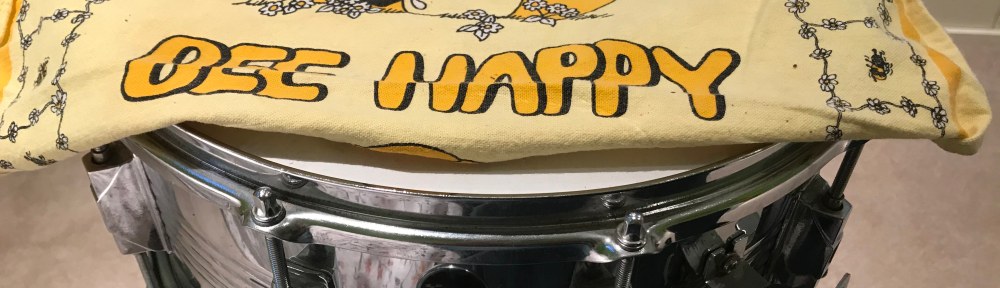
I was a bit nervous about sending shockwaves through the brick wall to the neighbors in our semi-detached house, so started with the snares off and the drum mute on. I also laid a honey-bee-themed cotton tea towel on top to dampen the snare drum’s top head. I folded it to reveal its punny, inspirational message: Bee Happy.

In several passages, I noticed I was tripping up. One was a syncopated segment that is full of flams — drum rudiments where a softer grace note in one hand precedes the strike in the other. So I slowed down that passage and ran through it repeatedly.
My sheepishness at bugging the neighbors subsided and I could open up to full force on the double-forte passages. For the softer sections, I used the edge of the drum head to get a crisper sound. I tried to relax the sticks in my hand and let the piece flow.
Going Allegro
After a couple of practice sessions I grabbed my metronome and set a tempo of 116bpm — approaching the piece’s “Allegro assai” tempo of 132.
I searched YouTube and found some other percussionists playing Cirone’s Etude 1. Surprisingly, one of the videos with megahits featured the piece in what I felt was a dreadfully slow tempo. Hmm; drummer’s prerogative. Then I came across a couple of drummers who played it to the specified tempo of 132bpm, albeit with some of their own interpretation on accents, crescendos and other elements.
Listening to the piece online reinforced the theme and dynamics of the music.
I turned the page of my music book and hacked my way through Etude 2, sight-reading it as best I could. For fun, I mucked about with some drum rudiments like paradiddles and rolls. And a few rimshots.
Playing the drum perked me up during a troubled time. I made a mental note to ask Nadine to videotape me playing the piece. That would put some heat on me to practice more and get it right.
My snare drum was speaking to me.
**********************************
More info:
Anothony Cirone’s web site:
http://www.anthonyjcirone.com/

 kinrosscordless
Hi great reading your bllog
Thank you Eddie! It was neat to rediscover my drums after a few years. I would be interested to know more about you — are you a drummer? Regards, Ian