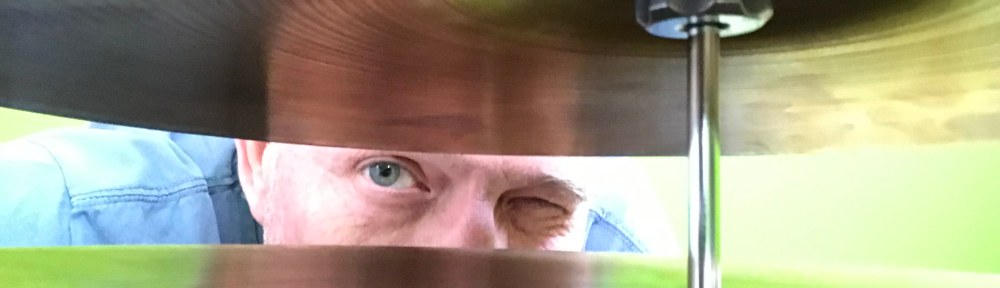
After reconnecting with my snare drum after many years, it was time to get on my hi-hat, so to speak.
The hi-hat can be a drummer’s loyal friend, keeping a simple beat on the two and four of a 4/4 bar. The next moment, it becomes a wild child, exploding in syncopation and synergy of hand, foot and mind, and a medley of sounds.

The instrument is made up of a chrome stand holding two opposing cymbals of matching width. The cymbals are brought together by a foot pedal.
When closed and struck with drum sticks, hi-hat cymbals make a crisp sound. When opened and struck, the cymbals resonate with a symbiotic crash.
You may recall the mysterious intro to The Pink Panther theme song. Accompanying the moody sax melody is a classic jazz beat in which the hi-hat alternates open and closed strikes in a swing style.
Deconstructing my “flat hats”
The strange tale of how I acquired this particular hi-hat would be told another day. Certainly the Sabian cymbals themselves derive from a dark story. It involves a falling out between two brothers of the famed Zildjian family, with its cymbal manufacturing heritage in Turkey.
It’s said that after realizing he would not be tagged as the next company chief, brother Robert took his expert knowledge of cymbal-making to New Brunswick, Canada. There, he opened his own cymbal company in the village of Meductic. The Sabian company gained favour among top drummers globally, and lives on in New Brunswick under the leadership of Robert’s son, Andy. Talk about a Canadian manufacturing success story!

My Sabian “flat hats” are apparently similar to the Zildjian “quick beat” model. By examining and testing the cymbal, I understood what their design was trying to accomplish.
The bottom “hat” on this pair of cymbals has three large holes drilled in it, in addition to the centre mounting hole. The three holes allow air to escape more easily when the cymbals are closed. So when you strike the closed cymbals, you get more resonance than with a pair of non-drilled cymbals.
Not truly flat, my bottom Sabian hat has a shallower concave shape and heavier gauge than its top hat partner.
Brilliant!
For different sound effects, the top hat can be struck on the bell, flat and rim of the cymbal. I found the tone of my cymbals to be bright, and almost too loud or jarring for the cochlear implant in my right ear. Some duct tape might help, I thought. Sabian might not approve, but I knew I had to modify the cymbals’ brilliant but sharp sound.
A pair of these cymbals, in good used condition, will set you back a couple of hundred bucks. I had acquired them for a song, in a tale to be told at a later date.
After I dusted it off from an extended stay in our basement, the Yamaha stand was sturdy and its pedal had a nice action. The hi-hat’s foot pedal can be rocked with the foot and toe, or hammered with full foot and heel, depending on the drummer’s need.
I adjusted the cymbals down to a position where I could get at them better while seated on my daughter’s old bed. That is because, so far, I had yet to re-acquire a proper drum stool.

As I experimented with some beats on the hi-hat, I recalled our high school band teacher, Al Harkness, challenging me to match the hi-hat part in “Birdland.” The instrumental song was a fast and intricate jazz/fusion composition by the band, Weather Report.
The signature drum beat in Birdland required a fast repeated closing and opening of the hi-hat, and a strike on the upbeat while the hi-hat was open. I was frustrated because I could not get it when Mr. Harkness put me on the spot. But I went home to practice the hell out of it. Once I could loosen up on that beat, the song flowed. Our high school band did it justice.
Fast forward to 2020. I decided to try to modify the snare drum solos I was practicing to play them using the hi-hat as well. And possibly adding in the bass drum the following week.
I wanted to get good enough again on my hi-hat to get back on my high horse as a drummer.
 kinrosscordless