Unknown's avatar

About Ian Kinross

I am a Toronto-based writer and communicator. I volunteer at the Thorncliffe Park Community Garden and recently learned the skill of dry stone wall building. I've been known to mess around with bicycles. I would like to thank Karen Maraj and Nicky Borland for their inspiration and support to kickstart this blog. Also thanks to Hannah Materne for design of the kinrosscordless logo. I appreciate your comments.

SIRCH Repair Cafe — A Day in the Life

When it comes to sustainability, talented volunteers at the SIRCH Repair Cafe live the principles of reduce, reuse, repurpose and recycle every month — at events running April to October. The final cafe runs Sunday October 5th from 10 a.m. to 2 p.m. at the SIRCH Bistro in Haliburton. Feel free to drop by with items needing repair, have a coffee and snack, and speak with our fixers! This article gives a glimpse of a day in the life of the SIRCH Repair Cafe.

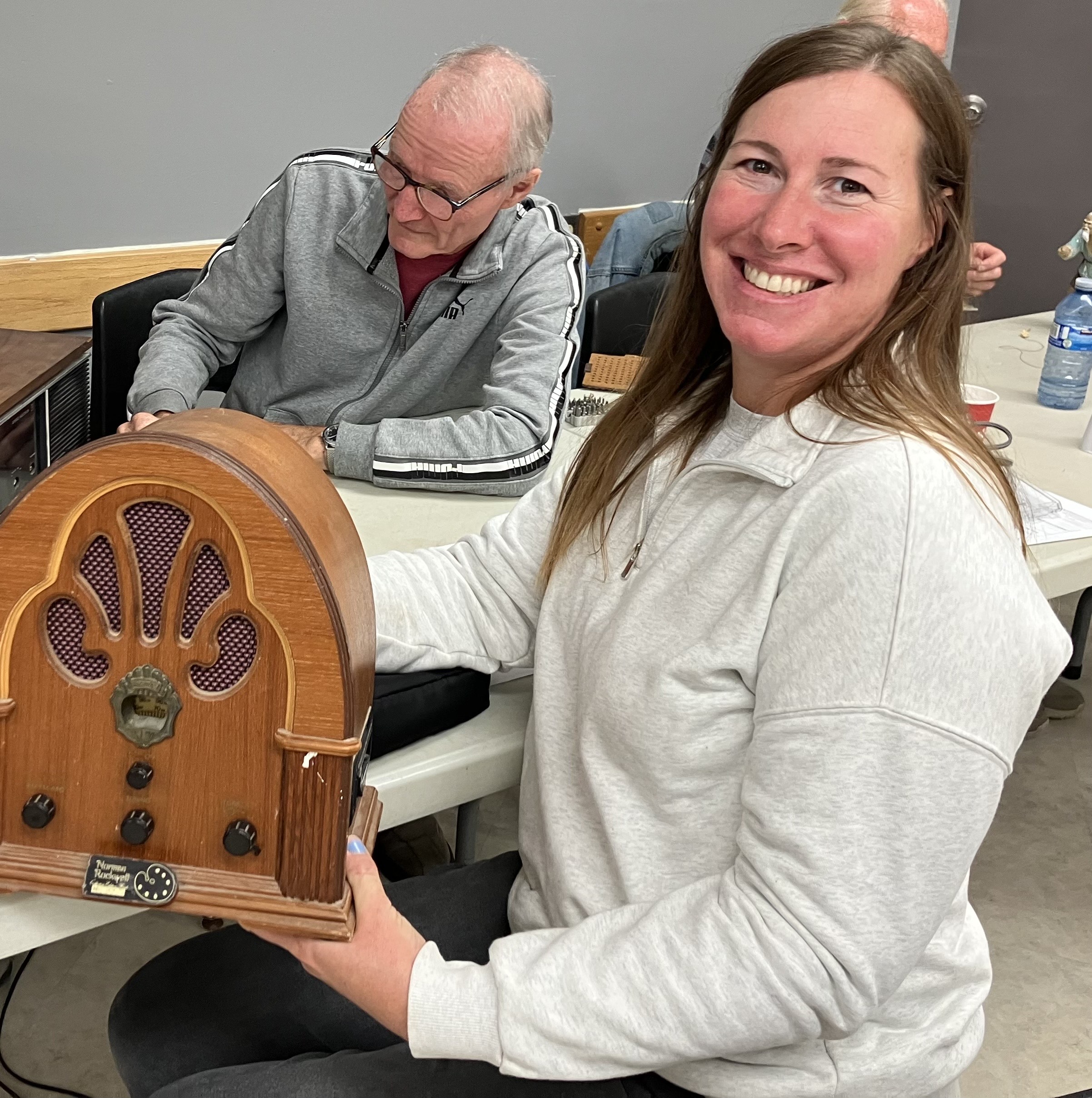
Caleigh arrives at the SIRCH Repair Cafe holding two broken radios. She’s reluctant to toss them out — especially the one that belonged to her grandmother.

Caleigh, who runs a gardening business in the area, checks in at the reception desk and completes a form for each radio. On a sunny Sunday morning, it’s quiet so far. After a short wait, Caleigh is escorted to meet two volunteer fixers.

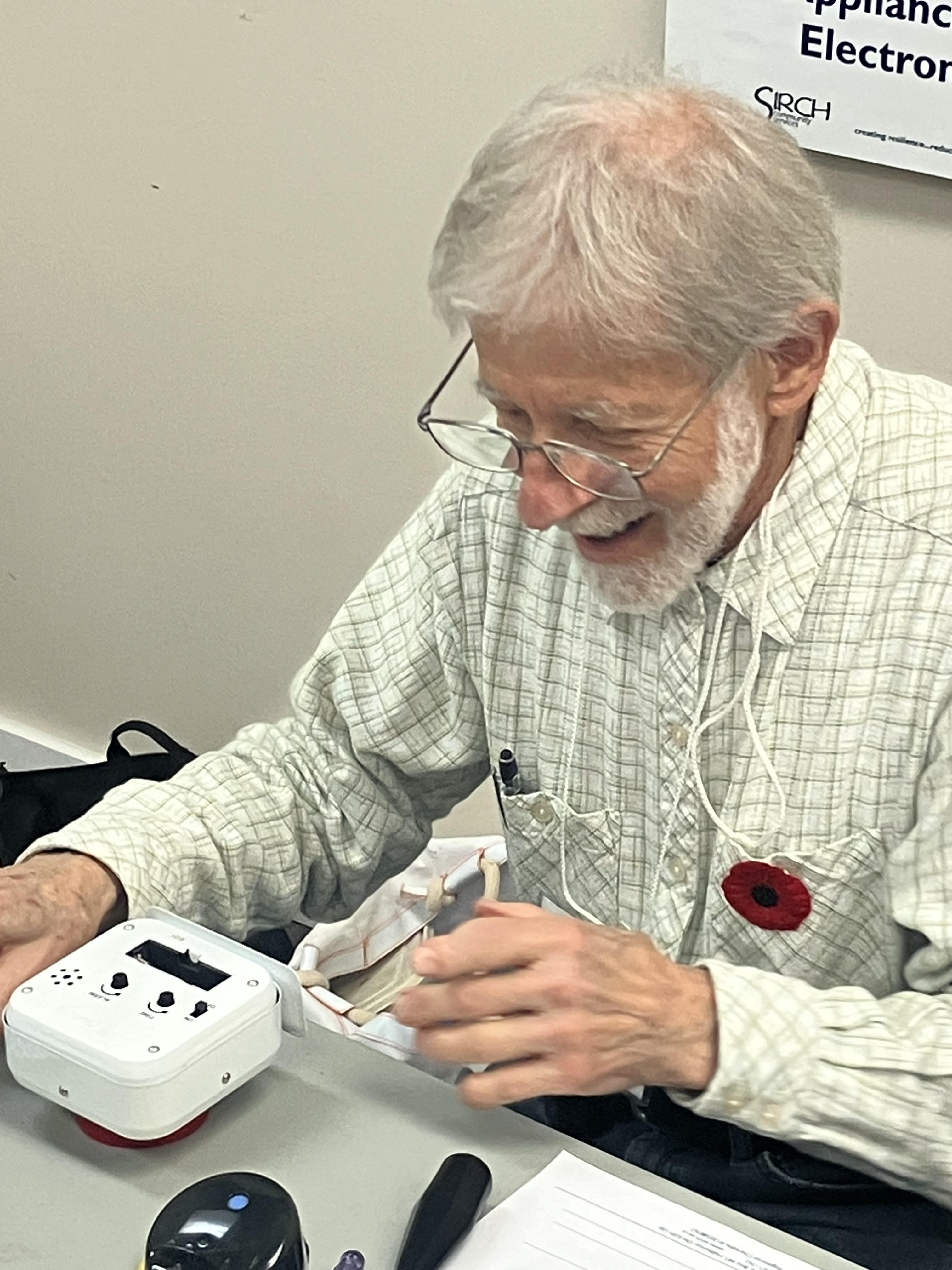
Gary has a look at her smaller radio — it’s a retro-vintage model Caleigh picked up at a yard sale a few years ago. With his background in computers and electronics, Gary tests the radio and quickly determines that a dusty tuner knob is generating static. He takes apart the knob, cleans and lubricates it. Then he powers up the radio again and finds a nice, clear signal on a local FM channel — a DJ is introducing the next song.

Fixed!

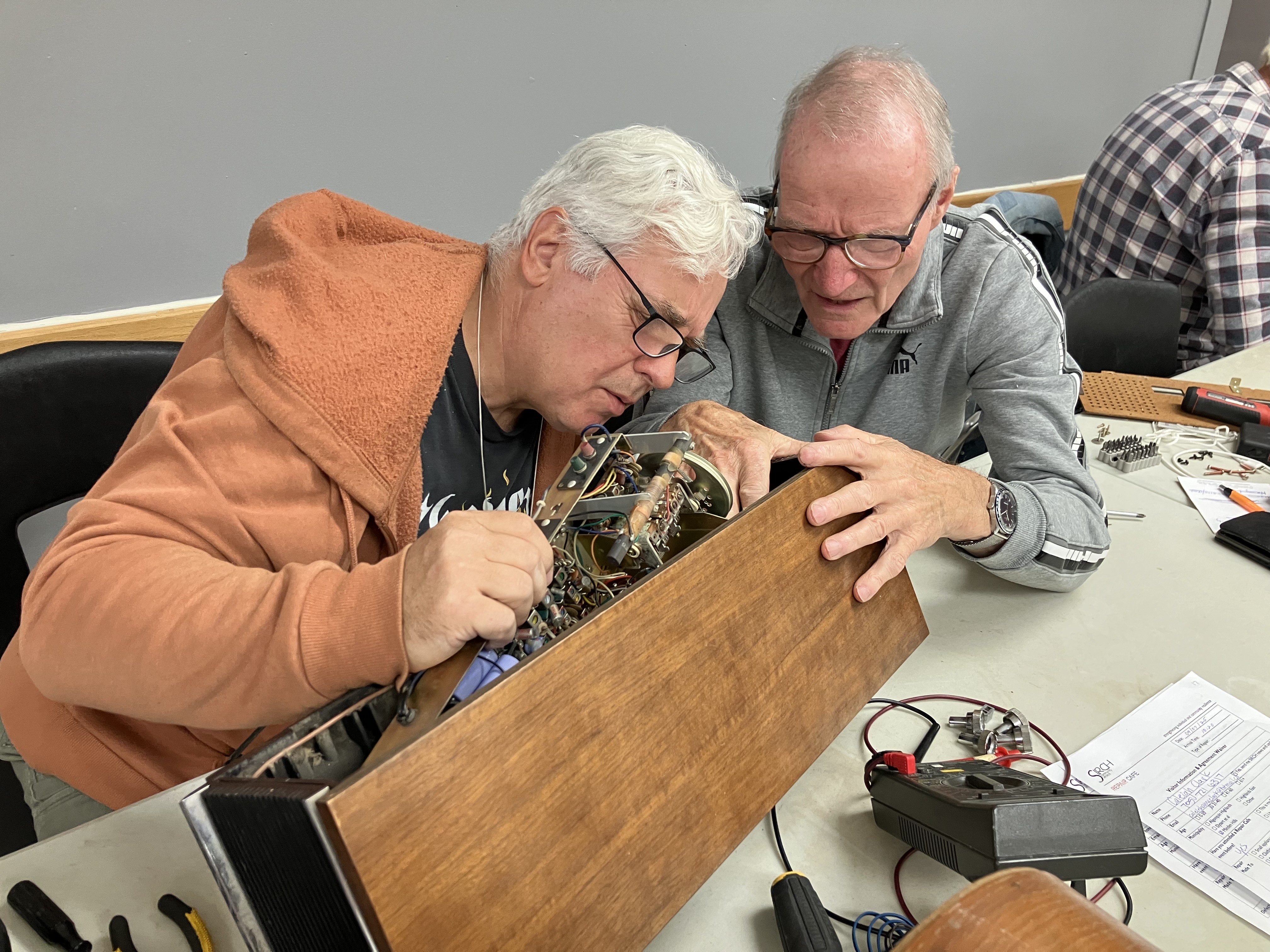
But the next repair is trickier — volunteer fixer Jurgen has been looking at the larger radio. It’s an old AM/FM model with stereo sound. Jurgen and Gary open up the unit, conduct several tests, and confirm that one of the two speakers needs to be replaced.

The radio — a keepsake from Caleigh’s Grandma — can still be repaired, but Caleigh has some homework. She will look for a new speaker and aim to visit the next repair cafe to have it installed. Jurgen and Gary provide the specifications for the speaker including the required OHMs (electrical resistance units).

It’s another day in the life of the SIRCH Repair Cafe…

With its sustainability mandate and skilled volunteers — fixing everything from small appliances to electronics to jewelry — the SIRCH Repair Cafe is running seven events in 2025. Five of them are held at the SIRCH Bistro in Haliburton, and two here at the community centre in neighbouring Minden.

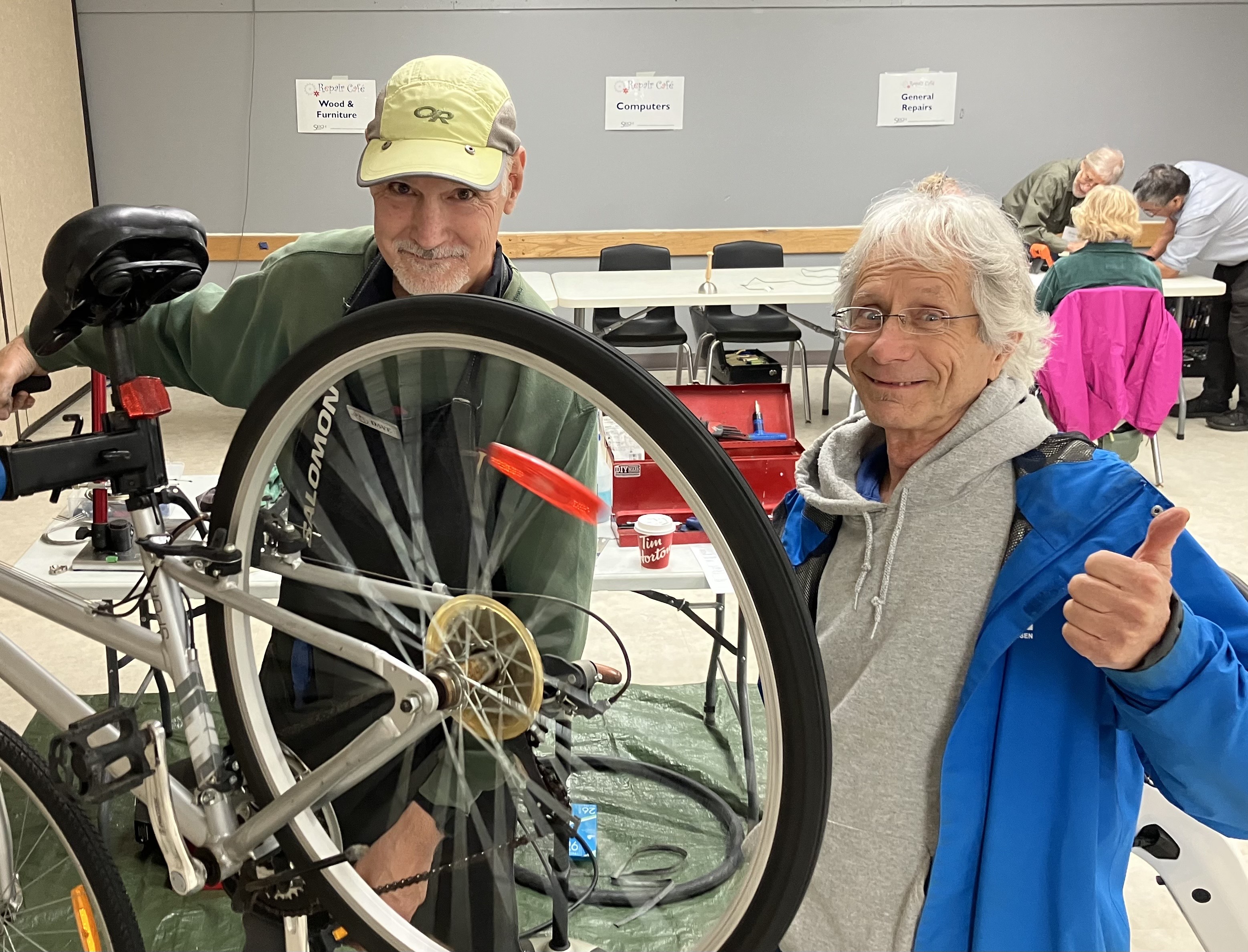
After a quiet first half-hour, there’s a buzz in the air now as more guests arrive with items to be fixed. Volunteer fixer Dave has unpacked his bicycle tools and is testing the “true” of a bike wheel. He’s removed it from the bike and connected it to his truing stand to check the side-to-side and vertical movement. Gary, a local musician, obtained the Raleigh bike from a friend. He enjoys riding it but noticed a thumping in the back wheel.

Dave makes some adjustments to the wheel’s spokes to make it straighter, and also re-seats the tire and tube. He reinstalls the wheel on Gary’s bike.

Back in business! A SIRCH volunteer rings a bell to celebrate another successful repair.

Across the room, fixer Rick tackles an unusual repair — a broken fishing rod belonging to a ceramic Japanese fisherman. The fisherman’s owner, Elisabeth, obtained the whimsical piece from the SIRCH Thrift Warehouse in Haliburton. She realized it would go perfectly with her collection of Bonsai collection.

Rick uses some fast-acting glue to repair the rod, and carefully rethreads the tiny fishing line and lure.

Hook, line and sinker — it’s fixed!

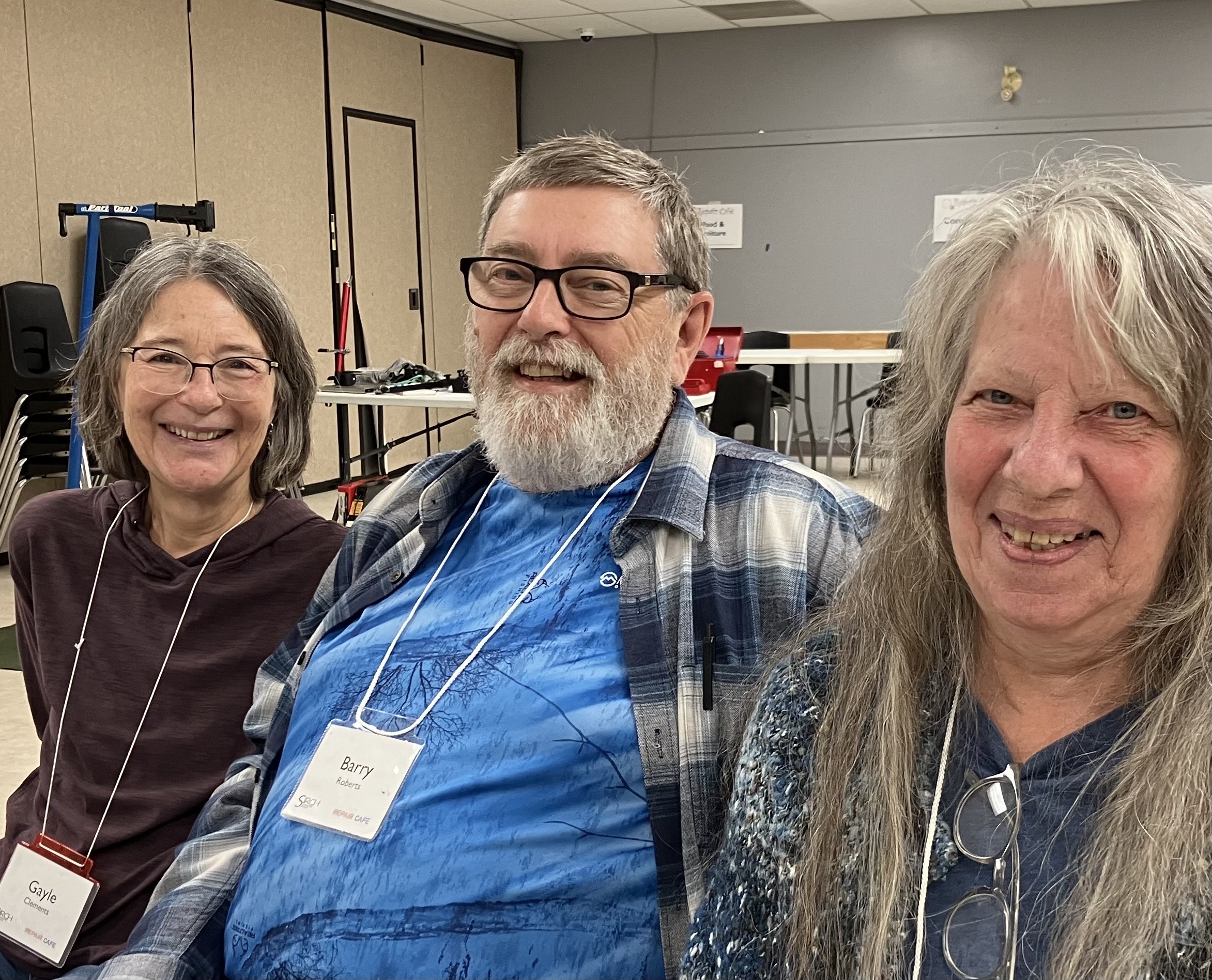
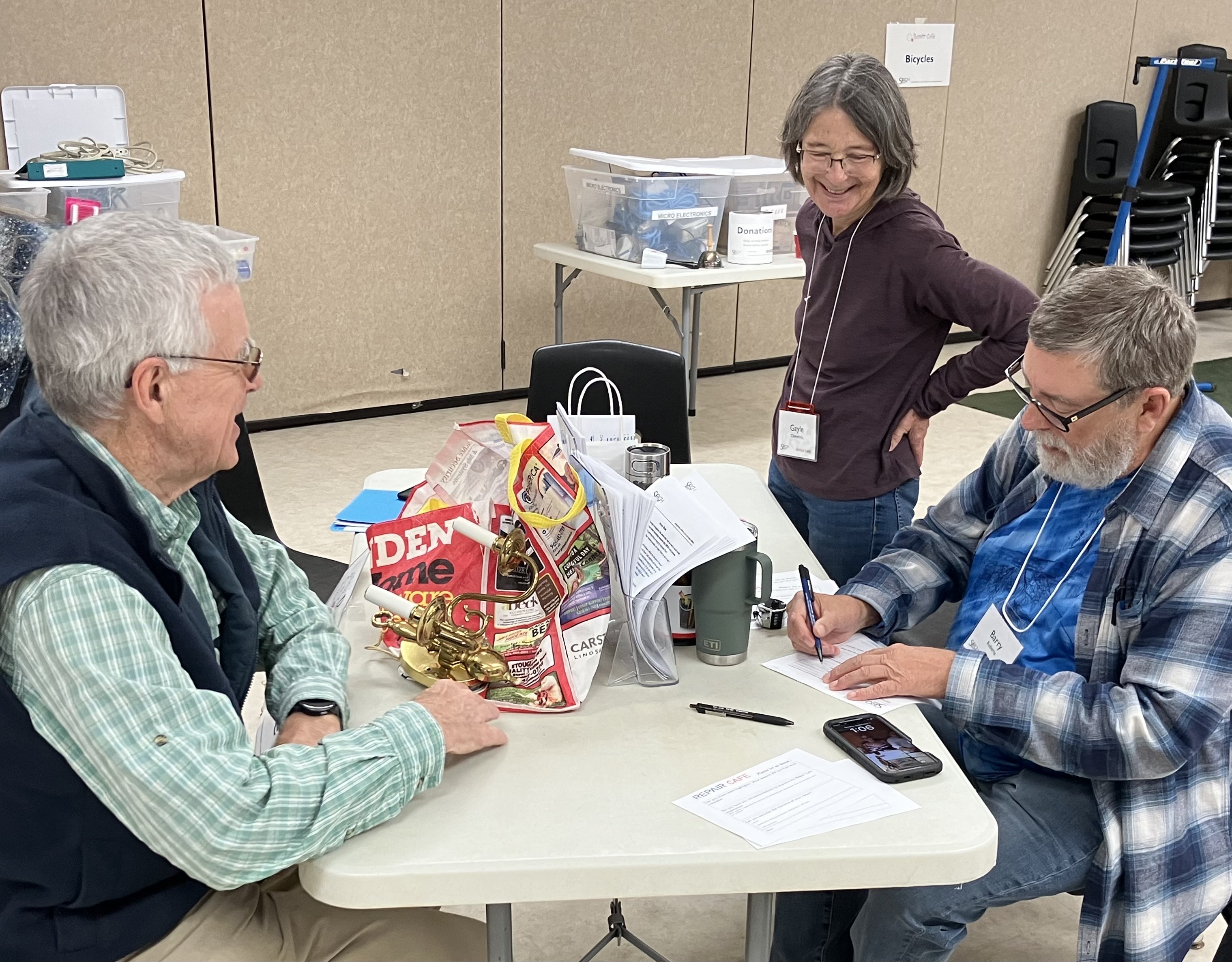
During a pause for lunch, we sit down with volunteer Barry, who’s working the reception desk with his fellow volunteers Gayle (left) and Laurie (right). Barry tallies up the day’s repair forms and reports that 30 guests have brought in 37 items so far.

A former auto mechanic and StatsCan field interviewer and supervisor, Barry doesn’t carry out repairs himself but uses his people skills to welcome and register guests at the Repair Cafe. He wants to establish trust and a comfort level with each guest, and to help triage the items that come in. (Most items, but not all, can be fixed). His day here actually started yesterday, with some prep work to bring materials and signage over to the Minden location.

Barry says the sustainability message — keeping things out of the landfill — resonates with most guests. But that message is further enriched by each guest’s role in the repair of their item. “We want the guest to be part of the repair, to meet the fixer, give some background, sit with them, learn about their item and any parts that might be required.” In a throw-away culture, “it’s important for all of us to know that most things can be repaired.” says Barry.

“So far this year we’ve repaired 170 items,” says Program Coordinator Dianne Woodcock. “Our success at keeping items out of the landfill hovers around 82% of all items brought in.”

Since the program restarted after the pandemic, it is closing in on 700 successful repairs, she notes. Guests have the option of donating to support the good works of SIRCH Community Services.

Did you know? Waste Reduction Week in Canada takes place during the third week of October. “We’re proud to be living the principles of Waste Reduction Week — reduce, reuse, repurpose and recycle — at every single Repair Cafe,” says Dianne.

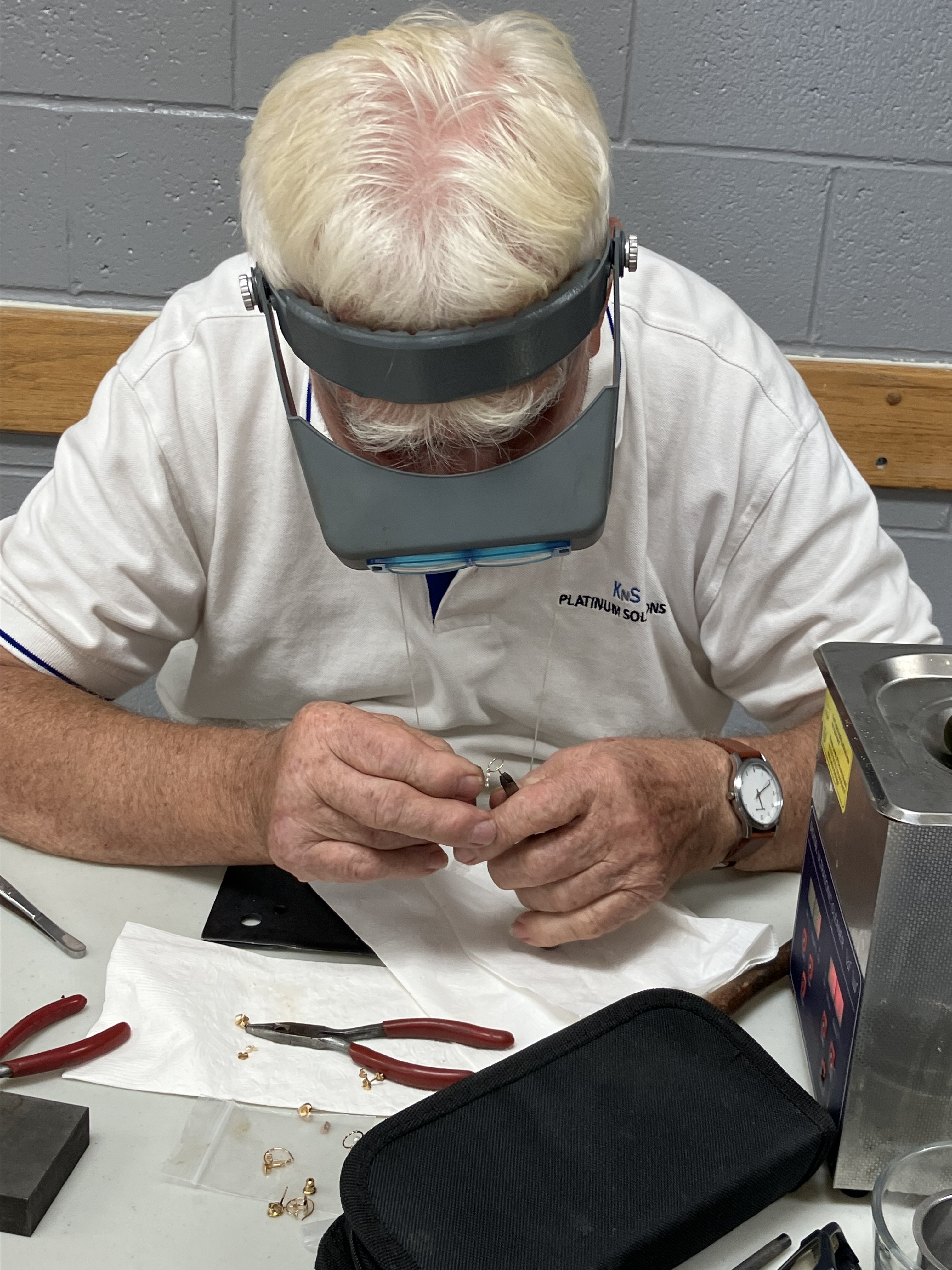
Another loyal Repair Cafe fixer is Henry. A master jeweler and goldsmith, he first apprenticed in his trade in the 1950s. He’s still at it today, repairing an assortment of rings, bracelets and other jewelry brought in by guests at the SIRCH Repair Cafe. Henry dons his jewelers glasses to get a close look at each item, and to make expert repairs.

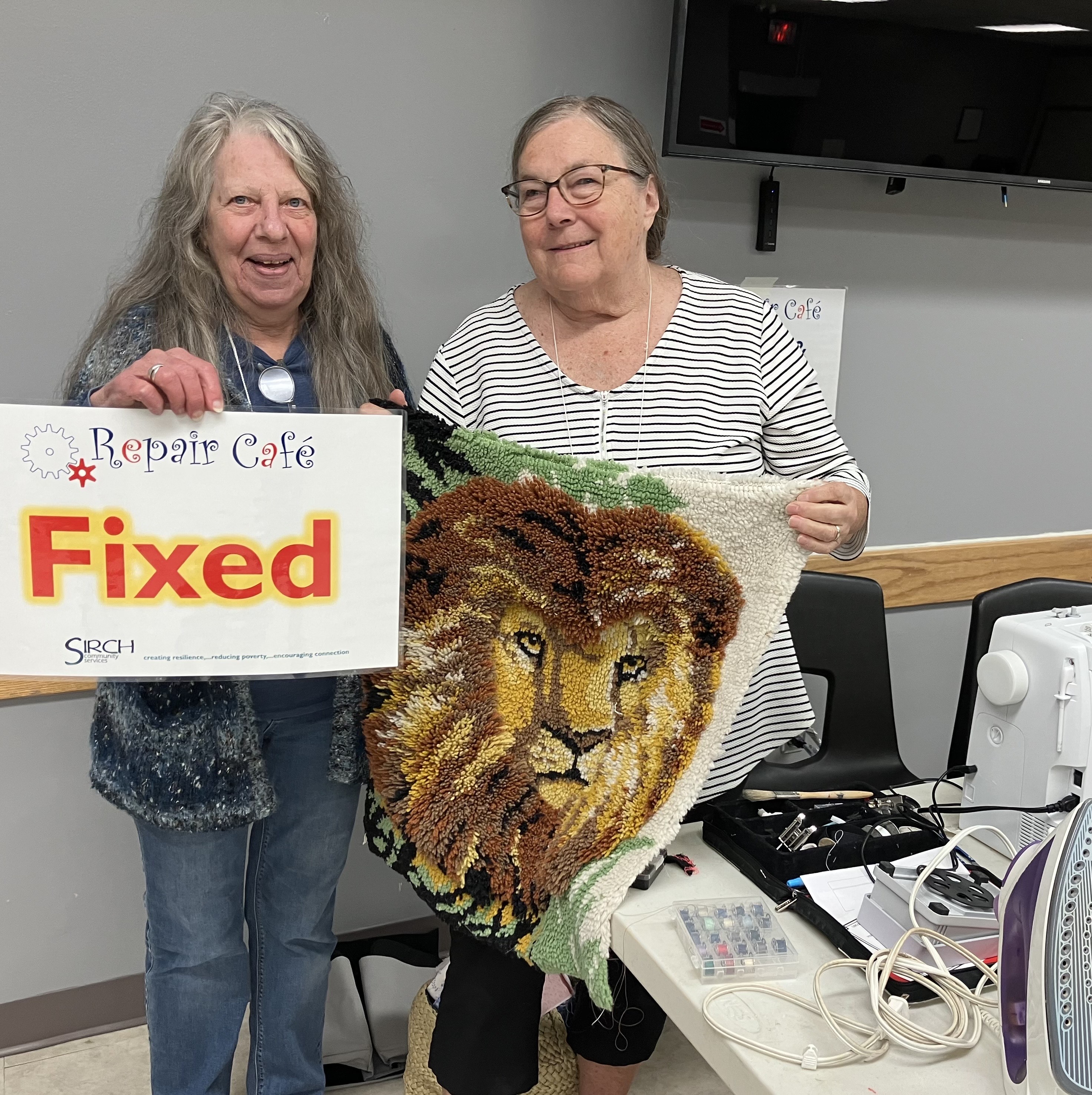
At the table to his right, Sue has been tackling a hooked rug featuring the face of a lion. It’s a two-stage repair involving some handwork to remove loose material, then her sewing machine to repair the frame of the piece.

As the clock ticks towards the 2 p.m. closing time, the Repair Cafe’s volunteers start packing up.

Today, they’ve repaired an amazing variety of items ranging from an electric sander to stereo equipment, bikes to bracelets, jeans to ceramics. Not to mention a soda machine. Along the way they’ve helped guests hang on to items of functional and often sentimental value. They’ll be back on the first Sunday of October in Haliburton, at the SIRCH Bistro.

Toss it? No way!

For more information on SIRCH Community Services and its amazing Repair Cafe, please visit: sirch.on.ca

A River Runs Through it

The Burnt River connects the Dahl Forest — located south of Haliburton, Ontario — to its greater region, watersheds and wildlife.

The river has been an important travel route for native peoples, a conduit for the lumber industry, a water source for farms, and a gorgeous recreation route for travellers of yesterday and today.

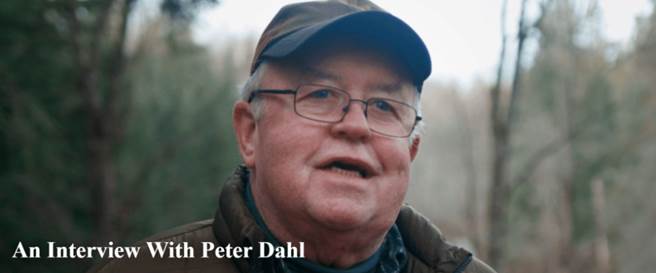
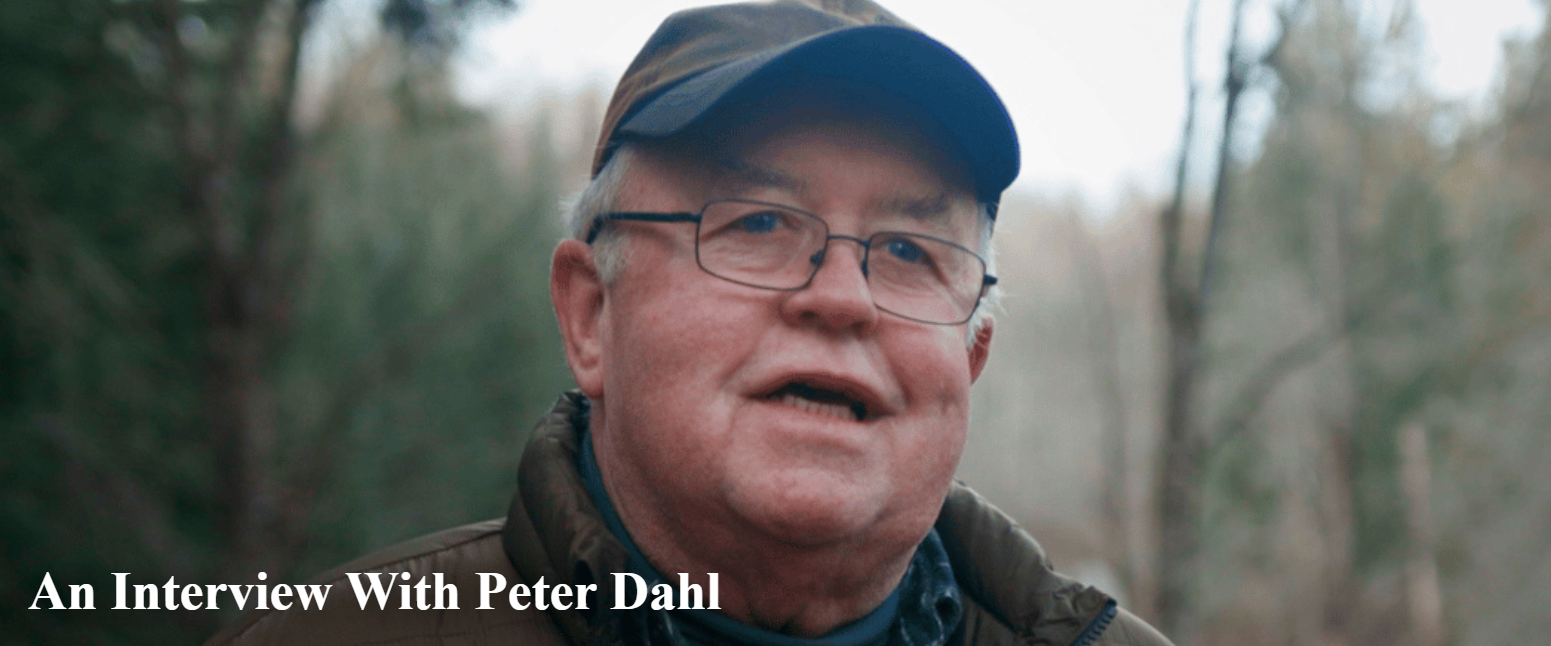
Earlier this year, I had the pleasure of interviewing Peter Dahl, whose family donated the Dahl Forest property to the Haliburton Highlands Land Trust in 2009. Peter spoke of the human history of the Dahl forest and the regeneration of its flora and fauna over the years since his parents purchased it as depleted farmland.

In this third of three interviews, Peter looks at the role of the Burnt River as a focal point in the Dahl’s history and connection to the natural world. (For the complete interviews, please visit the land trust website here: An Interview With Peter Dahl)

Fall colours along the Burnt River, looking downstream from Dahl Forest. Photo by Peter Dahl

How did the Burnt River get its name?

I’ve been told two versions. One is that it was named by early explorers after a big forest fire that came up the valley. The other, which I prefer, is that the gravel bottom and rocks are a very dark colour; I believe this is due to iron minerals staining the rocks.

What does the Burnt River mean to you in terms of the natural world?

The river is the focal point of the Dahl Forest. Everything can be related to the it: your distance from it, your altitude above it. All streams at Dahl Forest flow to the river. If you are walking at Dahlf Forest, eventually you will be standing by the river.

Many plants, animals and birds are found there that won’t be found elsewhere. The river is also a place where wildlife drama unfolds, like the time we saw a deer take to the river to escape a group of coyotes. Beavers are regular visitors making caches of sticks along the banks.

A family of merganser ducks swimming with their newly hatched brood is an annual springtime event. As the ducklings mature, they work as a team to chase small fish into the shallows where they’re easier to catch.

You described the Burnt River as a commerce route for the lumbering of Ontario’s old-growth pine. Did the original homesteaders in the Dahl Forest participate? 

All of the settlers here, to the best of my knowledge, sold off their pines to logging firms, primarily to Mossom Boyd from Bobcaygeon. Logging was winter work for settlers, one of the few opportunities to find a wage income. Some of the men went to work in logging camps, leaving wives and children to tend to the farm and livestock.

The only possible time to get large logs down the river was the spring flood. There is an old mill downriver in Kinmount. I understand that the Boyd operation sent milled logs all the way down to Lake Ontario and the St. Lawrence River, where they would be shipped to Europe and England from Montreal or Quebec.

In the previous interview, you indicated the Burnt River was a major travel route for indigenous peoples. You found a carved stone pipe there dated to the Algonquin culture. If we fast-forward to today – is the Burnt River used for recreation? What about watershed management?

It’s a lovely canoe trip from Haliburton village by canoe down to Kinmount. We see people canoeing and kayaking in the summer, but not as many as I would expect for such a wild and natural river so close to developed cottage country.

Like most watersheds in Haliburton County, authorities control dams that restrict water flow to the south. Their dilemma is to balance lake water levels for cottagers and residents in the county with the needs for flow in the Trent-Severn canal system and Kawartha lakes.

You and your spouse Jan have taken many journeys in North America, including a time when you lived in the high arctic. Can you tell us more about the canoe journeys you took along the Burnt River to Kinmount? 

It takes about four hours to paddle from Dahl Forest to Kinmount, which makes a lovely summer day with a picnic along the way. We have also camped overnight at one of the 2 or 3 camping spots downstream of Dahl Forest.

The river passes through mostly wilderness downstream to Three Brothers Falls. It’s somewhat challenging at spots along the way due to shallow flats and rocky fast water areas. I would not recommend taking a high-end canoe; you’re certain to bash a few rocks along the way. However, because the current moves you along, it’s fairly effortless.

When you reach the falls, you must portage around them, of course. They’re an impressive torrent with three substantial waterfalls.

As you continue downstream of the falls it is a pleasant and scenic trip to Kinmount, where you can buy an ice cream cone to top off your journey.

Photo: Haliburton Highlands Land Trust

Update: The ice storm in early 2025 caused significant damage to the Dahl Forest’s canopy. The land trust has been working diligently to clear trails and re-open them to the public in fall 2025.

An artistic homecoming — Interview with Jacquie Halupka

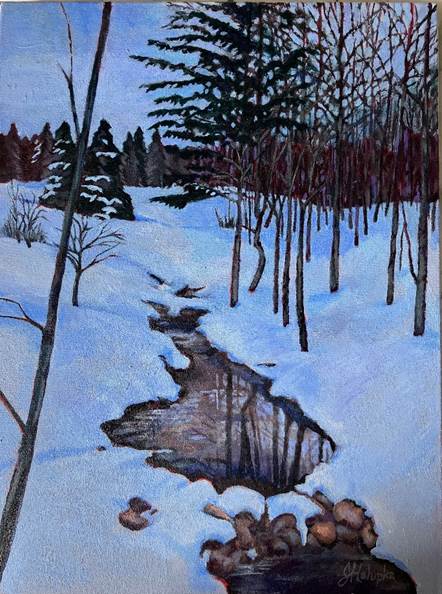
Back in the bush, a tiny creek cascades into a small pond. The water’s surface reflects stark shadows of nearby hardwoods. The forest is mostly bare, but green conifers stand out against the white snow cover.

Artist Jacqueline Halupka interpreted this magic moment at Kinross Creek in a painting, using acrylic on canvas. After a career in information management, Jacquie has experienced an artistic homecoming in retirement – picking up her brush and paints to interpret landscapes in the Haliburton area.

Kinross Creek

Jacquie, her husband Rob, and their faithful hound Mungo, joined me for a trek to Kinross Creek last year. It’s a peaceful spot in the forest, about a 45-minute trek from our cottage on Minden Lake.

I sat down with Jacquie recently to find out more about her artistic style, process and inspirations.

What is your favourite season for painting landscapes?

I have been fixed on winter lately. The colours are muted, but there are lots of them: whites, blues, the green of conifers, purple tinges in the forest, changing colours in the sky.

In early winter, you see diverse colours in berries, grasses, leaves. After the snow falls, there are variations in tree trunk colours that jump out at you against a stark white backdrop. Depending on the light, these colours change — and make it endlessly interesting to render in a painting.

While fall colours are glorious, winter colours are hidden gems.

What is your process for painting a landscape?

I’m not typically a plein-air painter, working outside. My method is to take a lot of photos outdoors. If I’m hiking or driving and see a scene that catches my interest, I’ll stop and photograph it. Then I’ll sort through the photos and find the composition I like and think: “That’s the one!”

Then I paint the scene in my studio. I work in both oil and acrylic paints on canvas, wood boards or paper.

Besides landscapes, I enjoy painting vignettes of people and animals. Each painting, no matter what the subject, presents some challenges, problems to be solved and decisions. For example, for the sake of the composition, I might focus on certain elements and edit out others. Unlike other things in life, you can actually paint over a difficult image.

How do you balance realism and artistic impression?

My landscapes are representational. I don’t paint realism, but I do focus on what I see, and I want the scene to make sense.

For example, I might make edits to define how the trees meet the sky, or the number of elements in the background of a scene. I want to make the scene look right.

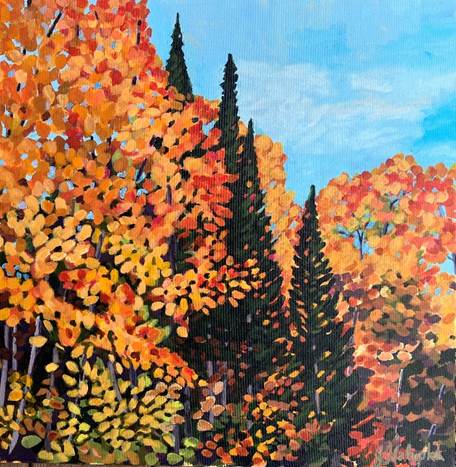
An autumn palette by Jacqueline Halupka

How did you approach the Kinross Creek scene?

What was fun was seeing the patterns and colours of the reflections in the little pond. That became a focal point of the painting.

The surface of the water has a brownish base but when you look closer, there are reflections that incorporate blue, pink and purple. Plus, you have the reflections of the tree branches criss-crossing the water’s surface. The stones have subtle colours and textures.

Where did you get your start in art?

I grew up being the artistic one in our family and had romantic notions of becoming an artist. I studied visual art at York University and might have considered an art college like OCAD, but reality hit – I had to make a living. I obtained a Master’s degree in Library Science and pursued a career in business research and information management. We were also busy raising our family.

Did you keep your hand in painting during your career?

Only for small things like Christmas cards, and only for a few years. My art took a back seat for 25 to 30 years, but I still felt it was part of my identity. In 2013, a friend of mine, Julie Mathews, was taking a mosaics course and, when I joined her there, I got interested in that form, including both glass tiles and stained-glass mosaics.

When I retired in 2016, I took a course in botanical drawing at the Haliburton School for the Arts. I really enjoyed it and realized I had not forgotten how to paint. I then took a course in landscape painting at the Haliburton School for the Arts and started regaining confidence in my abilities.

Where can people see your art?

In Haliburton, my work’s been exhibited at the Rail’s End Gallery and Art Centre, and I’m a member of the Haliburton Arts Council. I am continually inspired by the artistic community in Haliburton. The settings in Haliburton, with its lakes, forests, rocks and plants, are glorious and also inspiring to me.  

In Toronto I exhibit regularly at the Don Valley Art Club shows and I also had a solo show for my mosaics.

Which artists inspire you?

My favourite local artist is Susan Hay; I love her colours, shapes and use of light. And of course I am inspired by the Group of Seven, especially A.J. Casson.

One of my favourite Canadian painters is Clarence Gagnon, who used colour and light in many seasons to capture rural life in Quebec in the 1800s.

How do you see your art evolving?

I want to do more plein-air (onsite) painting to learn how to paint faster to capture scenes in real time. On the technical side, I like to try new techniques such as building a textured surface that takes the paint in a different way. Also to use more oil paints, which handle differently on the brush than acrylics and deliver a different effect on canvas.

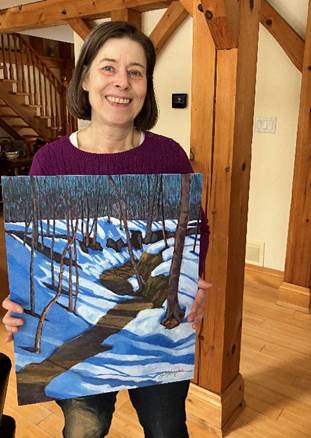
Jacquie with a winter scene she completed in 2025

Special thanks to Jacquie for her interpretation of Kinross Creek. For more information about her art, please visit Jacquie’s website at: halupkaart.com or jhalupka on Instagram.

Jacquie and Rob near Kinross Creek in spring 2024.

Kindred Spirits — the human history of the Dahl Forest

Indigenous peoples and pioneering homesteaders are part of the human history of the Dahl Forest, near Gelert, Ontario. Artifacts signal the presence of indigenous peoples who long ago used the Burnt River as a major travel route. While the homesteaders are long gone, evidence of their toil to farm this rugged land remains.

Peter Dahl was a young boy when his parents purchased the Dahl Forest lands in the 1950s. In 2009, Peter and his family donated the former 500-acre farm to the Haliburton Highlands Land Trust. We asked Peter to share his memories of the Dahl Forest’s human history.

The survey done of Dahl Forest for the land trust showed the remnants of the Strafford homestead in the northwest corner of the property. The Straffords had immigrated from Berkshire, England in the 1870s to accept a “free-grant” farmstead here. What do you remember about this homestead?

The Strafford’s log house still stood when our family purchased the land — I used to play in there as a kid. There was an attic accessed by a ladder from outside. I recall going up there and seeing old newspapers used for insulation. One of them had a headline about the Czar of Russia, so it must have been placed there around the turn of the century.

Inside, I recall a pump organ – the kind of organ you had to pump your feet to play.

Mr. Strafford had been integral in building the S.S. #6 school that still stands nearby, next to Geeza Road. We know that he was a school trustee and a lay preacher, in addition to farming.

The land trust plaque near the foundation of the old homestead says that the Straffords left for Nebraska in the 1890s, after about 20 years trying to make a go of it. What was life was like for homesteaders like them?

They were given free land — but the labour to settle it, clear it and farm it was extreme. On all the homesteads here at Dahl Forest, you can see evidence of the human toil to clear stone, for example.

As a kid, I saw these massive stone piles and long stone fences that the homesteaders had built up while clearing their fields for cattle and crops. Some of the bigger stones must weigh a ton or more.

After all of the back-breaking work they put into it, it must have been a terribly hard decision for a family like the Straffords to walk away from their home and farm here. Nebraska would offer them more fertile soil and a better chance.

Let’s continue our tour of your homestead memories. Were there other pioneers in this north-west section of what is now the Dahl Forest?

The Miles homestead was near what’s now the north gate of the Dahl Forest, east of the Staffords. Almost nothing of it remains today.

When I was young, our family came upon a children’s gravesite towards the Miles homestead. I remember a circular picket fence that sat in a field of rolling grass. Some lilacs had been planted in the middle. There were no markers left, but it was clear that it had been used as a burial site. The site used to appear on aerial photographs as a black dot.

Nobody knows which children lie there. We thought it could be children of either the Miles or Stafford families, or both.

Looking back, we know that the many pioneer families lost children to diseases caused by poor nutrition, polluted well water and weather extremes. And doctors were hard to come by. Pioneer life was even tougher when it came to the survival of children.

You mentioned that when your family purchased this land in the 1950s, you would come up from Lindsay and stay in the former homestead of the Bowhey, then Schrader families. This was near the main entrance to today’s Dahl Forest on Geeza Road.

My dad renovated the Schrader house into a recreational cottage when he first purchased the property in 1955. That was our place until the current cottage, which is now our house, was built in 1976 next to the river. The original homestead was demolished by the land trust for safety reasons a few years ago as it was deteriorating badly.

Were the Schraders still farming when your family purchased the property?

Yes, the Schrader family had still been raising some cattle there. The cattle ranged freely around the hills around the river; I remember hearing their bells in the distance. The cattle wintered in the barn near the homestead.

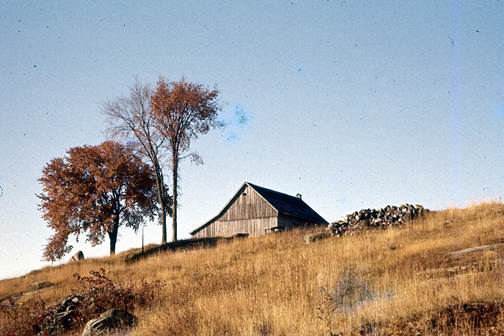
The barn was in good shape, and I played in there as a kid. There were piles of hay and straw and ropes to haul it in. There was an old cutter in there — a horse-drawn sled for trips to town in winter. And the body of a Ford Model A car. My dad didn’t need the barn, so he had it torn down and kept the utility garage nearby. You can still see the stone foundation of that barn next to one of the Dahl Forest trails.

Bowhey/Schrader barn in the 1950s.

I see you’ve kept and displayed some of the farming implements from the barn. I’m sure each one has a story to tell.

The cross-cut saw was used to saw logs by hand before they were split. The cow bells were to keep track of the cattle that ranged freely on both sides of the river. The scythe was used to take hay by hand. Looking at the whiffle-tree harness, you can visualize a pair of horses hauling lumber in winter.

You can imagine a totally different world – almost third-world conditions with no electrical power, plumbing or telephone, no cars, and a tremendous effort to survive. The well was about 50 metres from the house, with water carried by bucket.

How did things change for the homesteaders in this area over the years?

Besides the cattle and some crops, they also looked to make some cash selling gravel and wood-cutting.

But it was a hardscrabble life. People needed steady income. Gren Schrader went to work at the CNR as a telegraphist and railway manager. Likewise, most of younger generation around here heard about good jobs elsewhere – I know some of them went to work for GM in Oshawa for example, rather than stay on the farm.

Gren and his son Rob preserved a lot of history about the Dahl Forest and this area and its people. Rob Schrader is a friend of mine and still visits a cabin he owns further along Geeza Road.

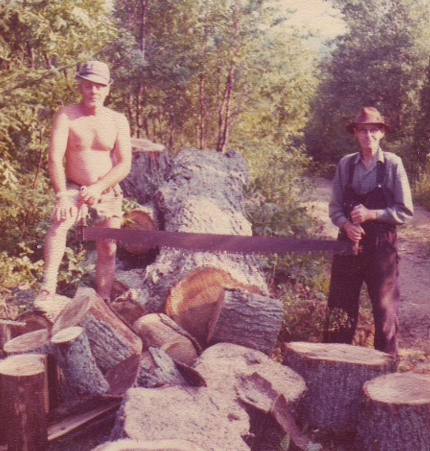
Gren Schrader, left, helps Raymond Geeza saw logs for firewood in 1974. Gren was 44 at the time of the photo; his cousin Raymond was 89 and, as Gren recalled, had more stamina with the cross-cut saw! (Photo courtesy of Schrader family.)

Are you aware of any history of indigenous peoples in the area of Dahl Forest?

My understanding is that the Burnt River was a major travel and trade route for indigenous peoples between lakes in the Haliburton area and the Kawarthas. Almost three kilometers of this river runs through the Dahl Forest.

When I was a child, Tommy Hoyle, whose family lived just north of the Dahl farm, gave my dad a stone axe head that he had found near the river.

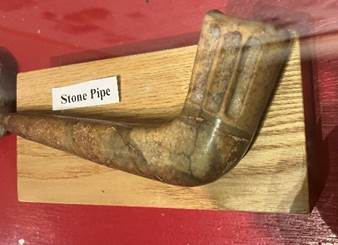
When Jan and I were canoeing down the Burnt River towards Kinmount, I found a marvelous stone pipe lying on the bottom of the river about a kilometer or two downstream of the Dahl Forest. It was about six inches long, with the bowl canted forward a bit. It likely had washed out of the riverbank; it was a stroke of luck that I found it.

I had it examined at Wilfred Laurier University’s archeology department and a scientist there appraised it as being pre-contact, from the Algonquin culture. The pipe is now in the Haliburton museum.

Stone pipe from Algonquin culture found by Peter Dahl near Dahl Forest. It is part of an exhibit of indigenous artifacts at the Haliburton’s Museum. The ridges in foreground were likely once decorated with brightly coloured inlays, and the bowl of the pipe may have had a wooden figure attached, such as a bird’s head. The museum offers a report by David Beaucage Johnson on the history of indigenous settlement in Haliburton County. You can find it at this link: //database.ulinks.ca/items/show/4842

For the complete interviews with Peter including the Dahl Forest renaissance and connection to the Burnt River, please visit the Haliburton Highlands Land Trust website here:

https://www.haliburtonlandtrust.ca/2025/04/peter-dahl-interview/

From forest to farm and back again — interviews with Peter Dahl

Peter Dahl has been connected to the Dahl Forest ever since his parents purchased the former farm in the 1950s. In his lifetime, he’s seen the Dahl Forest undergo a renaissance. Tracts of conifers planted by the Dahl family on depleted farmland are maturing, with a mixed-forest understory emerging beneath. Meanwhile, its natural mixed forests, long ago logged for their massive pine, have regenerated.

In 2009, Peter, with his mother Peggy Dahl and sister Nana McKernan, donated their 500-acre property near Gelert to the Haliburton Highlands Land Trust. Peter and his wife Jan now split their time between a private residence in the Dahl Forest, overlooking the Burnt River, and another home in B.C., close to their son.

With its network of trails, the Dahl Forest is a magical nature reserve, a place to hike, snowshoe, birdwatch… or just get a little fresh air and forest therapy.

As the forest regenerates, its wildlife is returning. Fur-bearing creatures like the beaver and martin are back. Wetlands and their unique wildlife are on the rebound, fueled by many creeks and springs, and cradled by new beaver dams. In winter, the tracks of larger mammals like moose, deer and coyote crisscross the forest.

Peter is also keenly aware of the forest’s human history and the kindred spirits it hosts. The artifacts of homesteader families remain, as does evidence of their toil to clear and farm challenging terrain.

And a river runs through it – the majestic Burnt River, connecting this splendid forest to the greater region, watersheds and wildlife.

On a couple of crisp mornings in February, 2025, Peter stoked the woodstove in the Dahl residence next to the Burnt River, and shared memories and his thoughts about the Dahl Forest’s human and natural history. Following is part 1 of the interview series. For the full story, please visit: https://www.haliburtonlandtrust.ca/2025/04/peter-dahl-interview/

Forest Renaissance

Your family planted more than 100,000 trees on depleted tracts of farmland here. Can you tell us more about this pic of two young tree-planters?

That’s me on the left, with my school friend Bill Szego. Our family lived in Lindsay, and we’d come up to the farm on weekends. In the photo you can see Bill and I seated on a planting machine pulled by a tractor. My dad Eric or a hired hand would have been driving. My dad likely took this photo.

The machine cuts and splits the soil. Bill and I would take turns planting the pine seedlings at intervals measured by a string. The two canted wheels of the machine would then squeeze the soil back together around each new seedling.

Why were the trees planted? Were you ahead of the curve on rewilding?

My Dad’s original intention for planting the trees was to get a cash crop. He was from Sweden, which has a long tradition of managed forests for lumber. In Europe, there was also that mythology about the wild west in North America. He was excited to own a piece of the Canadian wilderness, to have this land as a place to hunt, trap and fish. At the same time, my parents were always open to share the land with others. That idea was also part of his Swedish heritage.

It takes a long time to grow trees for saleable lumber. How did the plans for the Dahl farm change over the years?

Dad lost interest in the lumber cash crop. When we investigated the option further, it wasn’t economically viable.  We did do some thinning of the pine plantations but as time went on, we decided to let nature take its course.

Also, for mom, my sister and I, the farm had always been a place to get away to and enjoy. Mom really loved it here. She was born in Guelph and professionally trained as a violinist. She once worked as a music instructor at a girls’ camp in Algonquin Park. I believe that for a city girl, that experience, including the wilderness canoe trips she went on, was important to her love of nature and the outdoors. When my parents were courting, they canoe-tripped extensively.  Mom loved the natural world that was part of the Dahl Forest. When my parents divorced in the 1980s, Mom retained ownership of the farm.

Mother nature can be a powerful force over time, if you allow it. What we’ve seen over the years is that the natural forests here are thriving again. That includes some of the hardwood areas as well as the original dominant species of pine returning. In the plantation areas, we’re now seeing some self-thinning of the bigger trees, and a new diverse understory of species like maple, poplar and balsam fir coming up.

How does this affect the wetlands and water courses here?

One of the amazing things is the water table has risen! I’ve recently seen springs pop up in places we’ve never seen before. With an expanded forest canopy and roots, the creeks run longer. The wetland and pond areas are expanding – some large ponds are now small lakes.

What about animal species in the Dahl Forest?

The changes we see here with the forest and wildlife are all connected.

The beavers were trapped around here until about 25 years ago but they’re back now and living in the banks of the Burnt River. We know they’re thriving because we can see beaver families from our window next to the river. They’ve also built at least eight new dams in several of the creek and wetland areas.

Many other creatures of the forest are returning, like mink, fisher and martin. We saw our first martin not too long ago – it caught a squirrel near the house. Moose and deer are prominent here now, along with their predator species including wolves and coyotes.

The change is slow, like the tide. When you see new things, you step back and say: “Wow.” It’s gone from forest to farm and back again.

(Peter in winter 2024/25 next to a tree he planted as a child. Photo by Jan MacLennan)

Why is it important for you to talk about the history of Dahl Forest?

I’m in my mid-70s now. I realize that some of my knowledge – like the location and memories of the homesteads here, and how the place evolved in my lifetime – will be important to share with future generations.

The concept of stewardship is important to me. The oversight and protection of the natural world is ultimately tied to the concept of caring. That means caring for the land, its health, beauty and future. The Dahl Forest now belongs to the community, and its spirit will continue and be cared for.

Mapping the Dahl…

Peter shares a diagram from a detailed ecological report on the Dahl Forest. On the map above, created by Glenside Ecological Services for the Haliburton Highlands Land Trust, you can see some of the reserve’s original natural forests that Peter mentioned. The dark areas shown in the south-east corners of the property, for example, represent mostly natural white and red pine forest, mixed with some red maple and balsam fir. There are also large areas of natural mixed forest comprised of balsam fir, red maple, trembling aspen, basswood, sugar maple, white birch, white spruce and nine other tree species.

The main plantation areas – where the Dahl family planted more than 100,000 conifers – are marked in a lighter colour, such as sections in the central/west area near the main entrance, road and river.

Wetlands shown in the north and south areas of Dahl Forest continue to regenerate with the expanding forest canopy and return of species like the beaver.

*****************************************************

Peter throws another log on the fire to keep the place cozy on a crisp winter day. The thermometer showed minus 27C first this morning. But as the sun comes up to break the chill, a few intrepid hikers have already parked near the entrance to the Dahl Forest on Geeza Road. They’re heading out for a winter walk on the forest’s public trails.

(Update: Some areas of the Dahl Forest were hit hard by the ice storm in April 2025. The land trust is assessing the damage and working to clear the public trails and repair other damage.)

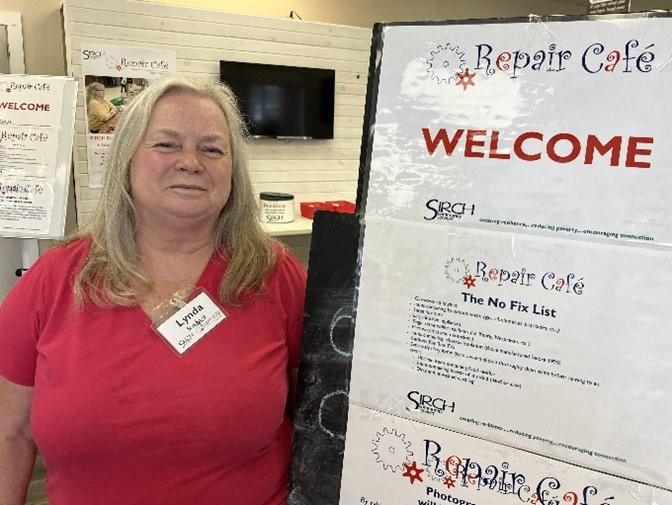
“Compassion makes us civilized” — interview with SIRCH Repair Cafe volunteer Lynda Shephard

Lynda Shephard is busier than ever in retirement. She has taken on a few volunteer roles with SIRCH Community Services, supporting the work of the social services agency in the Haliburton community. She also chairs a local charitable organization that provides community and a healing space for people living with cancer.

Today, Lynda will greet many of the 44 people who come through the doors of the SIRCH Repair Café, bringing with them items in need of TLC such as clothing, furniture, electronics, jewelry, bikes, ceramics and more. After directing a new group towards the registration table, Lynda takes a few minutes to share more about her role and philosophy of volunteering.

How do you describe your role here at the Repair Café.

I am a greeter and jack of all trades. When people come in with their items to be repaired, I want to make them feel comfortable. I chat with them and let them know about the process. I show them to the registration table. I may speak with them when they are in the waiting area, to find out more. Sometimes there are bigger issues than the object they have brought in for repair. One senior shared with me that she was struggling at home with things like yard maintenance. I was able to provide a local contact to enable her to get some assistance.

Do you have a guiding principle in your life and volunteer work?

When the anthropologist Margaret Mead was asked the question: “What was the earliest sign of civilization?”, her student expected her to say a clay pot, a grinding stone or maybe a weapon.

Mead thought for a moment and said, “A healed femur.” The femur is the longest bone in the body, linking the hip to the knee. It usually takes six weeks of rest to heal. A healed femur shows that someone cared for the injured person — hunting, gathering and staying with them.

The first sign of civilization is compassion. This idea that kindness, care and compassion makes us civilized resonates with me.  I also come by volunteering honestly – my dad was a Rotarian and both of my parents always helped others.

Can you tell us more about your roles with SIRCH?

Besides the Repair Café, I volunteer at the SIRCH Thrift Warehouse. I am responsible for curating books, organizing them into categories like fiction, biography, gardening, decorating etc. – to make it easier for patrons to find the books they want. There is a nice connection with the Repair Café, because some items repaired by our fixers are sold at the thrift store, with proceeds to SIRCH.

As today’s Repair Café winds down, Lynda gives well wishes to some of the departing guests. In her professional life, Lynda played a senior role in leadership development with the provincial government, with a focus on best practices and new ideas. She brings those skills to her many volunteer roles in retirement – along with the responsibility she feels to care for others.

For more information on the cancer retreat Lynda chairs, visit brooksong.ca

For more information on Haliburton’s SIRCH Community Services and its amazing Repair Cafe, visit sirch.on.ca

Journey of a master jeweler — Interview with SIRCH Repair Café fixer Henry Schoenke

Henry Schoenke’s passion for making fine jewelry has taken him from an apprentice’s workbench in Germany to the Arctic to his volunteer role today at the SIRCH Repair Café in Haliburton. We spoke to Henry as he was putting on his jeweler’s magnifying glasses to take a closer look at a bracelet, ring and other keepsakes brought in by guests.

How did you get your start as a jeweler?

I started as a teenager out of high school in Germany in 1952. Our school was run by monks, and the monastery had some beautifully made gold objects like cups. I thought I should be able to make beautiful things.

I was a guy who liked to use my hands. I took an apprenticeship with a jeweler for three and a half years, learning on the job on my workbench, repairing and crafting jewelry. To make new jewelry, my boss would give me a sample – like a broach, ring or pendant – and I would make it. Later, I obtained my master’s degree in gold and silver smithing.

What’s your assessment of the bracelet you examined at the Repair Café today?

The piece is not valuable, but it was a gift from the owner’s daughter and has a sentimental value. I will need to make a new pin and reassemble it.

What brought you from Germany to North America?

I founded and operated a jewelry store in Germany for many years, specializing in gold jewelry. At age 54, I wanted to go to the source of this precious metal – I became the part owner of a gold mine in Alaska, north of the Arctic Circle. I opened a jewelry studio in Anchorage, and also began to specialize in platinum. My passion was to design and hand-craft one-of-a-kind platinum jewelries.

Henry crafted his wedding ring of platinum, blue star sapphire and diamonds

I met my spouse Yasmin in Vancouver and we lived and worked in Anchorage. Yasmin handled sales, customer education and accounting for our business. When I retired, I could not stay in the US, so Yasmin sponsored me to live in Canada. We wanted a quieter place to live. We drove around rural Ontario and happened to stop at the Pinestone Inn near Haliburton. The manager’s husband was a realtor – he showed us some properties, and the rest is history. We made our permanent move to Canada in 2006.

What are the challenges and rewards of being a master jeweler in today’s world?

One challenge is that it can be hard to find parts and even tools to repair jewelry. I sometimes make my own tools – for example a small tweezer with curved pincers.

One of my biggest rewards is being asked to create special pieces – such as a custom pendant — for groups such as the hospital, police, Canadian Forces, tournaments and fundraising events in this area. In our world of mass-produced items, people still see the value in a custom-made piece. It’s rewarding to be able to craft a piece you know is one-of-a-kind and will be treasured for many years.

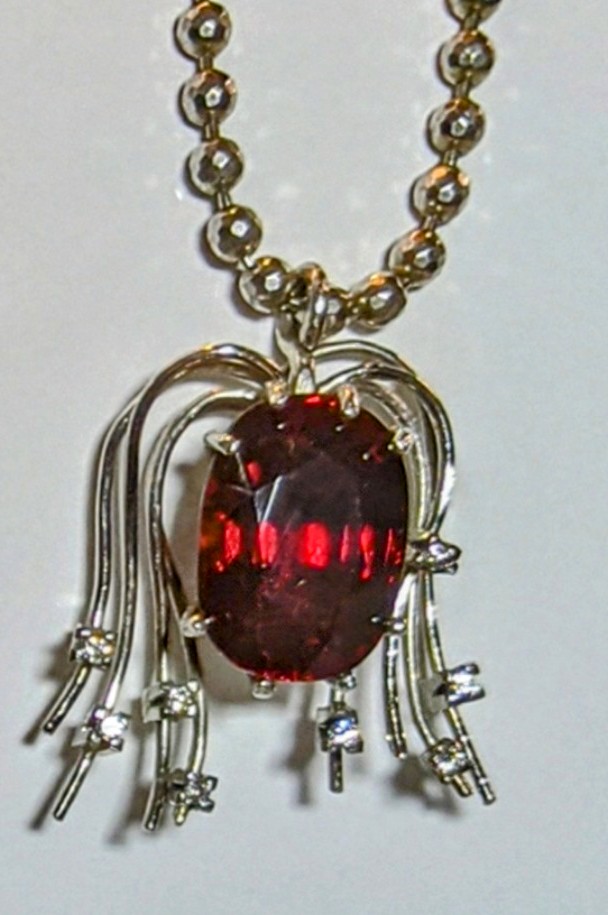
Above: Necklace of rubellite, platinum and diamonds handcrafted by Henry for Yasmin

I also love being able to repair jewelry here at SIRCH for people who may not be able to access or afford a good jeweler. To give a piece of jewelry a new life — that gives me joy.

Heinrich (Henry) and his wife Yasmin are partners in life as well as the jewelry business. Yasmin has also volunteered her time today to provide free henna tattoos for several guests. In the community, she volunteers at nursing homes and in palliative/hospice settings, bringing comfort through friendly visits and foot massages, and joy through sharing her Indian Dancing skills.

In all, Henry and his fellow fixers have repaired more than 50 items at today’s café, ranging from jewelry and ceramics to small appliances and electronics. Toss it? No way!

Or as Henry himself puts it: “SIRCH it? Yes way!”

For more information on SIRCH, please visit sirch.on.ca

Skill and intuition: meet SIRCH Repair Café fixer Michael Kursbatt

Michael Kursbatt’s introduction to electronics pre-dates the era of solid state. In his early teens, the Haliburton retiree built a vacuum tube stereo and enjoyed music played on vinyl records.

After studying electronics in college, he kept up with the rapid evolution of the field in his professional life. At the Bell Computer Communication Group, he worked with teams who installed data transmission systems and modernized communication networks.

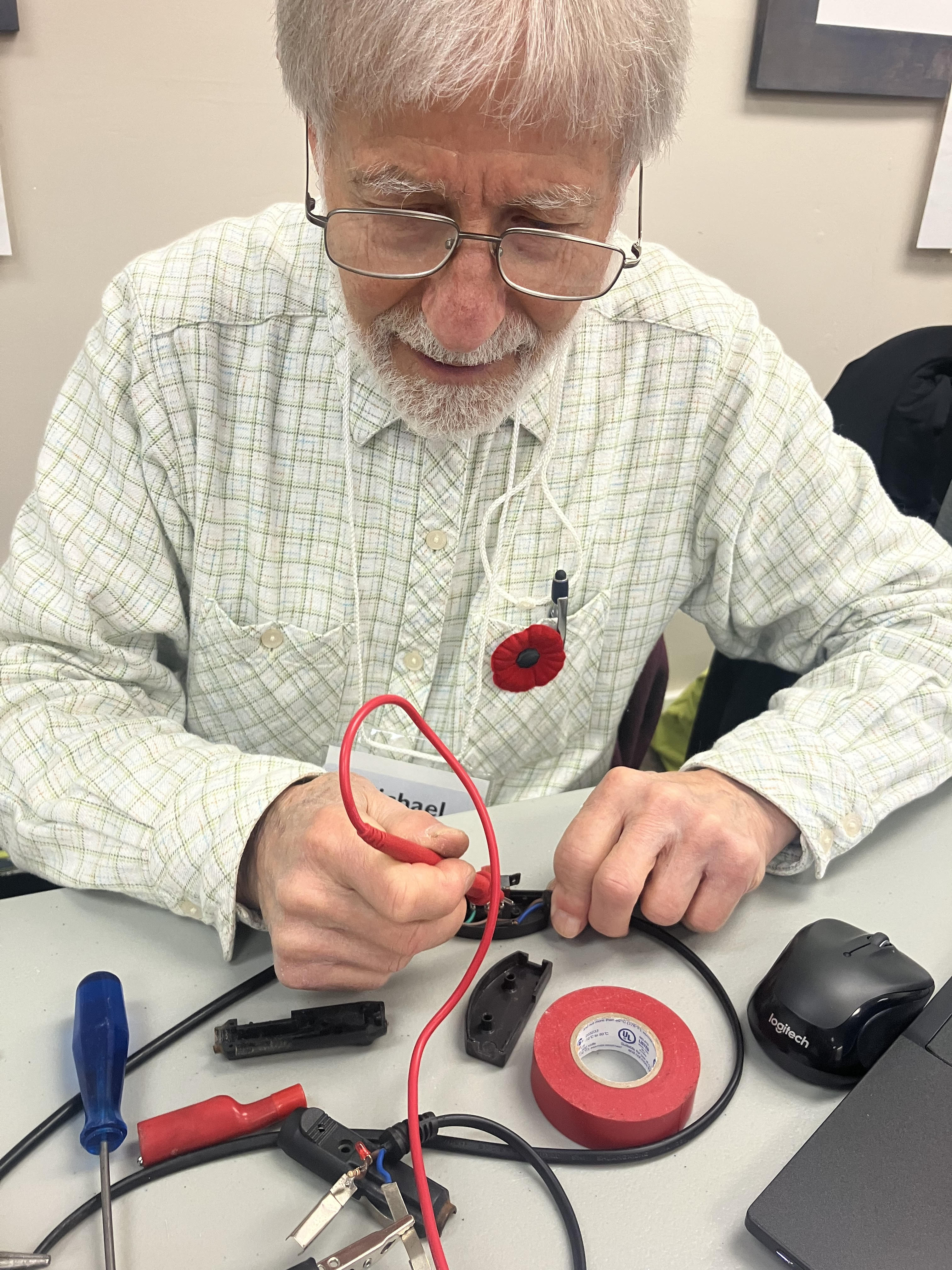
Michael now brings his systems savvy to volunteer roles. Today, he joins about a dozen volunteers at Haliburton’s SIRCH Repair Café to fix a variety of items ranging from electronics to clothing and jewelry. We caught up with Michael when he was disassembling a broken heating pad.

What’s the lowdown on this heating pad you’ve taken apart today? It looks like you are doing detective work.

I started by checking the condition of the plug and power cord, then checked the fuse and circuit continuity. The tests point to a problem inside the pad. There may be a broken connection or a burned-out element.

I’ve seen you here fixing everything from bikes to electronics and even a bedside clock. What is your approach as a fixer?

Part of it is your physical skills with your hands and tools. The main element is using your knowledge and experience to discover the source of a problem. That’s the fun part.

Finally, it requires intuition. There are some cases where an item can be repaired and used for many more years. In other cases, you may need to think about the quality of the item, the time and cost to repair it, and even factors like safety. Is this item worth repairing? I enjoy working through those questions and meeting many great people who visit our Repair Café.

Can you tell us about another recent repair and how it went?

One of our recent guests brought in her mom’s broken Dirt Devil vacuum cleaner. We got it apart. In this case, the good news was the discovery of a replaceable worn shaft and drive belt. Our guest was well-informed and prepared to order and install the replacement parts herself, and I was happy to lend a hand.

Manufacturers don’t always make it easy to disassemble their products, but we’re persistent and often succeed in restoring unusable items back into service.   

Michael uses a pair of scissors to cut open a portion of the heating pad’s fabric. Sure enough, inside the pad his excision reveals a broken wire connecting to the heating element. That’s a safety code issue, so Michael recommends retiring and replacing this heating pad. He explains the situation to the pad’s owner, who agrees it is time for a new one.

No bell tolls for this particular repair opportunity, but by the end of the day, Michael and his fellow volunteers will have repaired over 50 items — some of them functional, others sentimental, all of them given a new lease on life. Every time an item is repaired, a bell rings and folks pause to applaud.

Toss it? No way!

For more information on SIRCH Community Services, please visit: sirch.on.ca

“Putting it back together” — interview with Repair Café fixer Andrew Ablett

Whether it’s a broken bike, projector or even an iPad, SIRCH Repair Café volunteer Andrew Ablett believes he can find a way to fix it. A former auto mechanic, Andrew left the GTA a few years ago for a quieter life in the Haliburton area. He now runs his own property maintenance company while he and his wife raise a young family. We spoke with Andrew just after he finished repairing a broken printer.

Can you tell us about the repair you just completed?

One of our visitors brought in a printer that was jammed. I took it apart and discovered that the felt guide for the printer head had dislodged. I was able to get that piece back into place. We put the printer back together and tested it by printing off some pages. Now it works fine.

What is the approach that you take to fixing things?

The more difficult the challenge, the more I like it. I guess I am a bit obsessive that way — when I take something apart, I am focused on understanding how it works and putting it back together. I don’t have a photographic memory but when I disassemble something I can typically recall exactly where things go. Some of that skill comes from multi-tasking as an auto mechanic.

What are your biggest challenges as a fixer?

Some manufacturers make it hard or impossible to fix their products. They’d prefer you throw something out and buy a new one. Some products have a built-in shelf life – for example a cell phone with a limited life on its software and battery. I found the same thing as a mechanic. My work used to be more hands on, but the automakers now control the repair process more through computer systems. Some repairs are delayed for days waiting for a computer update.

How did you find out about the Repair Café?

From a friend in Haliburton. After moving here, I wanted to be part of the community, and to give back. Volunteering at SIRCH is a great way to do that.

In his first year as a volunteer at the SIRCH Repair Café, Andrew and his fellow fixers and other volunteers have completed more than 500 repairs to items such as electronics, furniture, jewelry, ceramics, clothing, small appliances and more. Sometimes it’s a cherished keepsake like a grandmother’s teacup. Or a functional device like a computer printer. Always, Andrew and the SIRCH team give a new lease on life to broken things, and help the environment by keeping them out of the landfill.

Toss it? No way!

****************************************************************************

Visitors to the Repair Cafe who have their items fixed are asked to make a donation to support SIRCH Community Services’ good works in the Haliburton area. For more information on SIRCH, please visit: http://www.sirch.on.ca

The co-operative crafter — Interview with Michelle Anton

Michelle Anton is finishing up a repair to a ceramic cookie jar lid at the SIRCH Repair Cafe in Haliburton. Just then, another visitor arrives with a 1940s-era gravy boat from her parents’ wedding china set — along with its broken handle. Michelle uses a similar approach to each repair – cleaning the breaks with alcohol, and applying a thin layer of clear Gorilla-brand glue to the broken pieces. She lets the glue set for a few minutes, carefully re-sets the pieces, and tapes them to apply pressure. We asked Michelle – a high-school teacher by profession — to share more about her approach to the potter’s craft and volunteer roles.

What’s your biggest reward as a fixer?

What I do here often allows people to keep a sentimental object – it may be a family heirloom. Now they can continue to enjoy it, and perhaps display it or use it again once it is repaired. That’s a good feeling.

Where did you learn pottery?

When my youngest son was 12, I was looking for programs that might keep him busy in the summer. We were living in Toronto and I found a local pottery studio that offered children’s classes. I enrolled my son and offered to help out with the class.

It turned out it wasn’t a great fit for my son, but I really got into it. The teacher was a nun, Sister Helen. I helped her, and I also learned from her. I started to make my own pots and obtained my first potter’s wheel and kiln. I enjoy making bowls of brown clay with carved lines and glazing.

How would you describe your approach to pottery?

Most important for me is taking a cooperative approach. To help the community, I organized an event recently called Empty Bowls. We had local potters make bowls, and 12 local restaurants make soup. Participants chose a bowl to sample the soups and then took it home as a reminder of world hunger. We were able to raise about $9,000 to support three community programs – the SIRCH Community Kitchen, the Haliburton 4Cs Food Bank and the Fuel for Warmth program.

The repaired cookie jar lid and gravy boat handle will set to touch in about an hour. Then their owners can take them home and remove the tape the following day. What’s ahead for Michelle? She’s looking forward to setting up a full pottery studio at her off-grid home near Haliburton. “Right now, I’m modifying an electric kiln to operate on propane. And I’m always looking to organize more cooperative pottery events or groups in future.”

****************************************

In 2024, Michelle and her fellow volunteer fixers at SIRCH made a big commitment to sustainability. They repaired more than 500 items ranging from ceramics and clothing to electronics and small appliances. Toss it? No way!

For more information on Haliburton’s SIRCH Community Services and its Repair Cafe, please visit: sirch.on.ca