Unknown's avatar

About Ian Kinross

I am a Toronto-based writer and communicator. I volunteer at the Thorncliffe Park Community Garden and recently learned the skill of dry stone wall building. I've been known to mess around with bicycles. I would like to thank Karen Maraj and Nicky Borland for their inspiration and support to kickstart this blog. Also thanks to Hannah Materne for design of the kinrosscordless logo. I appreciate your comments.

Garden visions

DSC_0556 sweet pea

In the dead of winter, we conjure garden visions…

It was a cool but sunny day in April, and an older couple had agreed to meet me to accept their new plot at Thorncliffe Park Garden Club.

Even though I had given my standard note of caution to them, my heart sank a bit as I assessed the plot in advance. The small fence was bent and broken in places. Gaps had opened in the chicken wire intended to keep out critters. A chaotic collection of weeds sprouted from the soil. A few discarded Tim Horton’s cups blew about the 12×20-foot rectangular plot. Clearly, the previous gardener had made a good start the previous year but had been unable to sustain the momentum.

Assigning vacant plots in the spring was often one of the happier tasks I had as president of one of Toronto’s oldest community gardens. Each year, perhaps 10 of the 100 individual plots would come available to new gardeners on our waiting list.

I would speak to each new gardener by phone first, using a standard line — blending caution and optimism — for these occasions: “Each plot is different. Some of them need a little work. Some have some hidden treasures — like a raspberry bush that’s been left behind. Be prepared to roll up your sleeves and spend some time to get your plot in shape.”

On this spring day, I spotted the new gardener couple ambling arm in arm down our garden lane. They were ready to claim their little piece of paradise. I put on my game face and welcomed them: “Hi folks!”

Elena and Frank were long-time residents of the Thorncliffe Park neighborhood. They lived in an apartment with a small balcony but longed for a small garden to grow tomatoes, beans, leeks, onions and other nutritious vegetables. They had been on the waiting list for several years. (The story is true; their names and some details are changed).

Together we walked along a path between some neat and nicely-tilled plots to arrive at their future garden. By comparison to the plots nearby, it looked like a disaster zone.

It’d be an understatement to say that Elena and Frank were processing the sight of their new plot in very different ways. Frank’s face tightened and he inhaled sharply. “Oh no, it’s terrible,” he muttered. His wife Elena, by contrast, had tears of joy in her eyes and a smile on her face. “We can clean it up, Frank,” she gushed.

“So many weeds,” said Frank.

A glass half-full

“It’s going to be beautiful,” countered Elena, whose glass, as the saying goes, was definitely more than half full.

True to Elena’s word, the garden was tilled, the weeds discarded and the fence repaired nicely within a couple of weeks. Frank and Elena visited their plot most days, met some new friends, and brought home produce to their extended family.

Almost out of necessity, and especially with our long winters in Canada, many of my gardening friends are visionaries, just like Elena.

We gardeners dream of spring

In the dead of winter, we dream about the garden in spring. It’s a great time to conjure garden visions:

  • One friend, Robert, imagined the colourful blooms of the many hundreds of tulip bulbs he had carefully planted the previous fall around the perimeter of his Thorncliffe apartment building. His tulip garden would be a gorgeous gift to his fellow residents as well as many people walking or driving through the nearby shopping mall.
  • Ann, a retired teacher, puts pencil to paper in winter to map out next year’s garden — drawing changes to her mix of vegetables and flowers, or occasionally drafting a completely new garden layout. For her, it’s a time to get out the weeds and see the big picture, to take an artistic touch to garden planning.
  • Like Frank, I am a bit pessimistic by nature, so I order a seed catalogue each year to kick-start my garden visioning. With January’s extreme cold weather setting in, I can peruse my colour catalogue from William Dam Seeds in Dundas, Ontario. It lets me garden vicariously through its colourful images of traditional vegetable varieties and new hybrids, berries, as well as annual and perennial flowers.
  • Claus, my father-in-law, would start some seeds indoors in trays. This gave a jump on the growing season to plants such as the sweet pea pictured in the photo above. On a cold winter’s day in Toronto, the seeds sprouted. He could already imagine them winding their way up his stone chimney and along the rough wood siding of his cottage garage near Minden in summer.

Sometimes our garden visions are a single image — like the picture Elena had in her mind of a beautiful and well-ordered garden.

But the reality can be even richer. Our gardens will soon begin to grow and evolve throughout spring and summer — starting in late March, as soon as the ground can be worked.


Stone walling ’til the cows come home

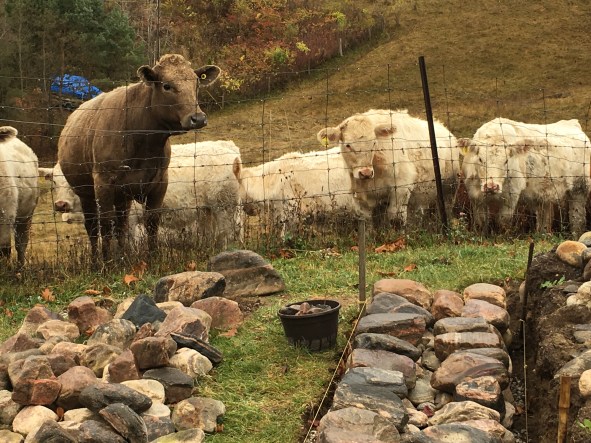
The cows next door to our place at Minden Lake caught me in the act of building a small dry stone retaining wall for our garden this fall. They are a curious bunch. They gathered quietly, just the other side of our fence, and gazed at the little stone wall under construction. It occurred to me that they might have thought it was a salt lick, and come busting through the flimsy wire fence to get at it.

IMG_3210 stone wall with cows

But I’d prefer to think they had some questions about how and why this little wall was rising at the top of the hill. Time was short for some of them — the yearlings would be sold at auction in Woodville in a few weeks. And the clock was ticking for me to get this job done. Soon the snow would fly, shutting down this year’s stone-walling season.

But today, time stood still. I communed, briefly, with the cows. I imagined the questions they were asking me, and tried to answer them patiently. All the while, I kept my eye on a quick escape route to follow if they decided to storm the fence.

Why are you building this wall?

The main reason is to level the playing field for the onions and all of the other vegetables and flowers in the little garden outside our screened porch.

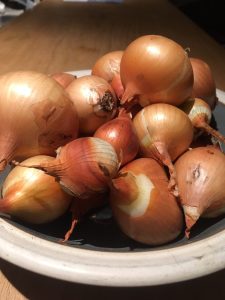
IMG_3248 onions

This year’s crop included tomatoes, beans, peas, carrots, cucumber, kohlrabi, lettuce and beautiful flowers from bulbs including dahlia and gladiola. We also have gooseberries and currants. Some of these were gifts from my father-in-law Claus, a master gardener who mixed the beauty of flowers with the nutrition of tasty, fresh vegetables.

The wall will shore up the slope on the south side of the garden, creating a more level playing field and retaining moisture in the soil for those veggies and flowers. Once completed, it will also be a nice place to sit, plant, weed and even take a load off with a cup of coffee.

It replaces a rather crude previous attempt by yours truly. A couple of years ago, without the right knowledge or skill, I had thrown down some stones in a ramshackle pattern in an attempt to retain the soil. Very quickly, the wall started to move, leak and crumble.

Now, I wanted to rebuild the retaining wall to last. To get started, I pulled apart the previous wall, sorted the stone, set in some posts and string to keep straight and level, and put down a base of tamped gravel.

But quick, the frost is coming! It’s lighting up the fall colours — like the red leaves on this cute baby oak tree next to the garden. So pretty.

IMG_3205 oak with frost

You don’t use mortar? Why don’t all the stones just tumble down?

Because I am following an ancient and proven tradition, built on a few sound scientific principles. Dry stone walling dates back thousands of years and you can find examples of its durability and beauty in places like the UK, Italy and Peru.

After being inspired by the dry stone terraces in the pretty sea-side towns of Cinque Terra, Italy, I took a course with 20 other students at Haliburton’s School for the Arts. Our instructor was John Shaw-Rimmington, a master mason and dry stone waller. John’s work blends art, engineering and sensitivity to landscape. A stunning recent example is the dry stone footbridge he and his class created last year over a small brook near the town of Haliburton. The arch in the footbridge is solid as a rock — possibly more solid than a mortared arch because gravity and friction will keep the arch stones tight, whereas mortar can crack and heave the structure.

From John, who is president of Dry Stone Walling Across Canada, we learned the importance of principles that include:

stone selection — curating the stone into a dozen or more categories and knowing the role of each stone size and type.

gravity — using gravity to our advantage to create integrity in the structure. Typically, the heavier stones on the outsides of the wall tilt inward and are tied together on top with heavy, thick and wide capstones.

friction and placement — learning how to knit stones together in a pattern that creates multiple touch points and integrity for each stone and for the entire structure. This includes the use of smaller “hearting” stones in the core of the structure.

In addition to the science, we learned some human qualities that support this effort: patience, flow, intuition, teamwork, and the importance of stepping back to get context on progress. Finally, there is the joy of each moment and celebrating a job well done.

IMG_3257 stone wall facing cottage

In the photo above, you can see the first three course of stone are placed, with smaller heart stones placed inside for each course. These include small wedge stones used to adjust the tilt and lie of the bigger stones. I raise and level my guide string as I go, using it as a reference for stone placement. My guideposts and string also ensure a slight “batter” or slope to the wall — perhaps an 8 to 1 ratio — to help it retain weight from the garden soil it will hold. You can see the soil at the left of the photo. If the wall was to be taller, I would build forms at each end to ensure an exact batter ratio.

It’s particularly important to get integrity at each end of the wall. One trick is to use some of your best stones in the prime spots including the ends. A standard rule of wall building is to place one stone goes over two, and vice versa, to avoid “running joints” that might compromise the structure.

Where do you get all the rocks?

It’s good to have multiple sources. These may include some existing stone on your property. In Minden Hills more than a century ago, the first farmers pulled stones as they cleared land and left the stones in long piles. Some of this farm land has reverted to forest but the stones have not budged. Using a wheelbarrow, I mined some nice stones from behind my in-laws’ cottage garage, an area where stone used to divide farm fields.

A local “clean fill” municipal site often features a few nice pieces of stone that have been dumped along with wood and concrete waste. Finally, a gent named Brent on Horseshoe Lake Road specializes in excavation and aggregates. He has kindly delivered local stone right to our cottage at a reasonable price — a ton of delivered stone can be had for a cost equal to about 25 tall bold coffees at Starbucks.

It must be tough on the back

If you take care, stone building makes you sore but strong. Our stone sensei John taught us several techniques to make the job easier:

  • Leverage with a shovel, sometimes combined with an old two by four, can help move heavy stones with less effort and risk. There are more specialized tools but the principles are the same.
  • A handcart and wheelbarrow make it easier to move stones around.
  • A long piece of 2×10 wood can be used to slide a heavy capstone into place without direct lifting.
  • Lifting with your legs and working methodically reduces the chance of injury.

Oh, oh — the snow is flying. Will this wall get done?

Thanks for asking, my bovine friends.  And thanks again for keeping to your side of the fence. In fact, this little retaining wall is 90 per cent complete. Four courses of stone are built and the hearting is packed in. A row of slim stones will be the penultimate step before the heavy capstones go on — to lock everything together.

But as the snow flies in Minden, my fingers are getting a little numb. The wall will have to wait for early spring. I’ll temporarily cover it with plywood and the capstones to keep out the elements. Then we’ll complete the finishing touches in 2018. Thanks for your interest, and best of the season to you!

IMG_3296 stone wall winter 2017


Cochlear implant is a new dawn for a person with bilateral Meniere’s disease

Sunnybrook Hospital in Toronto has completed almost 2,000 cochlear implants to restore hearing in adults affected by severe or profound hearing loss — people like me. Of those, about 50 share my condition of bilateral Meniere’s Disease. It’s a condition that puts the inner ear through repeated wash cycles, triggering vertigo and progressive hearing distortion and loss. In some people, like me, both ears are affected.

Gael Kennedy Hannan asked me to write about my experience with Meniere’s and my cochlear implant for her blog: Hearing Health Matters. Gael is also author of The Way I Hear It: A Life with Hearing Loss. After having my cochlear implant surgery at Sunnybrook in fall 2017, it’s a new chapter for me as I get used to a brand new sound pattern in  my right ear and the possibilities of better hearing, better engagement – and even the sound of music.

I was on a deadline for a news story for the Addiction Research Foundation, when the words started falling off the screen of my little Macintosh computer. I was hustling to put the story together, but the words appeared to be jumping off the page like ducks to water. My eyes jerked back and forth but could not catch them.

Pretty soon I was in the hard spin of vertigo – the world whirling around me. My eyes could not control the messages my inner ears were sending to my brain. Hanging on to the wall, I stumbled out of the office, lurched along the sidewalk and caught the bus and subway home.

I was young and strong and could tough it out – the hours of spinning, nausea, vomiting, and finally, a peaceful sleep.

I was back at the office the next day and wrapped up the story. After my morning coffee, life was good. I was working with a great team. Together, we were telling the story of an organization committed to helping people — through addiction treatment and research. (ARF is now part of CAMH, the Toronto-based Centre for Addiction and Mental Health).

At home, in the early 1990s, my wife Nadine and I were raising two beautiful daughters, Alison and Colleen. We tried to appreciate all of the magical moments, the sights and sounds of family life, along with our busy careers.

Changing sound patterns

After the vertigo attacks, I did notice that the hearing in my right ear was becoming distorted. In fact, the sound pattern was changing day to day – from a normal but tinny sound, to a garbled effect, like the sound from a stereo speaker that had a big rip in its woofer.

As the episodes recurred, I sought help from my family doctor, who referred me to the ENT team at Mount Sinai Hospital in Toronto. I was diagnosed with Meniere’s Disease, a condition affecting my right inner ear and consequently my balance and hearing. I was told Meniere’s “took its own course.” There was no cure, but symptoms like nausea could be treated with medication. Vertigo episodes in some cases could be prevented or mediated by a diuretic and other medications.  The condition certainly was not life-threatening and I had otherwise good health to be thankful for. “You are a young man with bad hearing,” the ENT doc told me. I was given a diuretic to take during vertigo episodes and encouraged to consider a hearing aid for my right ear.

Fast forward to 2012. I had taken on an exciting career challenge at the Royal Bank of Canada (RBC) as senior communicator on the bank’s largest enterprise project – tackling an emerging global tax law that targeted tax havens.

One Sunday morning, I woke up practically deaf in my “good ear” – the left ear I had relied on for functional hearing for most of my career. We had a family event that day and I faked my way through it, at the same time worrying about how to face work the next day. As is the case with Meniere’s, some hearing returned the next day. It was distorted, but I got by. After seeing my audiologist, I started wearing two hearing aids as the Meniere’s was now bilateral — affecting both ears.

I was no longer young, but I was still strong and could tough it out. RBC became a leader in engaging the new global regulations, and I was proud to be a big part of the team that made it happen.

Finding allies

I found an ally in an unexpected place. Tech guru Guy Kawasaki was speaking at a communications conference I attended. He told the keynote audience that he was using a cane that day and wearing a large hearing aid to deal with his Meniere’s disease.  It was the first time I had heard someone mention “my” condition in public.  Guy took a refreshing approach to his health challenge.  He used humor to create awareness about Meniere’s – for example, claiming that he was getting deaf and dizzy from listening to too many bad pitches for new high-tech businesses.

I reached out to Guy by email and we had a great virtual conversation. I discovered he was a hockey player, like me, who noticed that the body mechanics of ice skating – its different ballet of angles and gravity – were positive for people like us who had balance problems.

Another ally was Don Lynch, a retired high school teacher who started a support group for Meniere’s patients in Toronto. The words from Don that stuck with me are about making the choice to “stand up” to face the challenge of Meniere’s – or any life challenge for that matter. Don also created a forum for people to share their experiences, fears and hopes.

A moving target

As my audiologist – now at St. Michael’s Hospital – told me, my hearing was a moving target. It could be tested conventionally, but the sound pattern changed daily in both ears. On paper, based on conventional testing at different sound tones, I was a good candidate for hearing aids. And they had helped me. But each day, I was finding it harder and harder to function at work with tasks we all take for granted – speaking on the phone, participating in a small meeting, or having coffee conversation with colleagues.

My hearing loss was in the 60-70 decibel range in each ear, (human speech is about 50 DB). To complicate matters, my hearing aids were amplifying sounds distorted by Meniere’s disease in my inner ear.

With family and friends, I was beginning to withdraw from events and avoid conversations. I was missing the intimacy and humor of being with the people I loved.

In 2015, I returned to CAMH to take on some communications projects in the hospital’s Public Affairs group. I think I did some of the best work of my career in a 2 ½ year stint with CAMH, a world-class hospital integrating mental health care and research.

As my Meniere’s progressed, I became more assertive to disclose my condition to my team and colleagues. I also found some workarounds to be able to continue to function as a hospital reporter and photographer, telling the CAMH story. The organization and my colleagues stepped up to help. In a couple of cases, for example, colleagues joined me at important interviews with patients, to ensure that, as a team, we got the story right. In other cases, I took care of photography first and filled in the gaps on a story with follow-up interviews by email. Especially for a hearing impaired person, it’s hard to imagine a world without the ease of text messaging, bbm, email and social media.

From surviving to thriving

Still, my hearing function – and some recurring vertigo episodes – were making it harder to get the job done. I often felt was surviving when I should have been thriving at work. I had been referred by St. Mike’s to Sunnybrook’s Cochlear Implant program. After extensive testing of my hearing with and without aids by Audiologist and Program Coordinator David Shipp, I qualified and was put on a 12-18 month wait list for the surgery.

I was strong, but not willing to tough it out this time. I needed a change. I took a personal sabbatical from working life to focus on some new challenges and adventures, like home improvements, and learning the ancient craft of dry stone wall building.

At home, my wife, daughters, family and friends were incredibly supportive. I recognized the impact of my condition – and my response to it – had on them. At home the four of us always made a point of eating dinner together and sharing the day. When the kids were in their teens, I was often “out of it” at dinner conversations due to the hearing problem, and to my own lack of focus. I would sometimes retreat into my own zone and miss the buzz and beauty of family life. My mood was affected and I know I was sometimes miserable to my family and others.

Through ups and downs my wife and kids were there for me. I’ve had to lean on them, and I want them to be able to lean on me going forward.

A new hearing system

In October, 2017, Sunnybrook’s Dr. Vincent Lin successfully completed my 90-minute surgery to implant the device. In November, Audiologist Anna Leung activated it for the first time, and started the process to fine-tune it at different tone levels. I had a new hearing system in my right ear, and continued to wear the conventional aid in my left ear.

Sunnybrook Hospital has completed close to 2,000 cochlear implants in adults. About 50 of those patients have my condition: bilateral Meniere’s. I’ve met several of them, either in person or virtually. What I’ve heard anecdotally matches my own experience to date with the cochlear implant:

  • There is likely to be a good result early on following surgery – this may be because people with Meniere’s have already coped with variable hearing patterns. Perhaps our brains can pick up the new pattern quicker. I noticed right away how the implant was filling in high-pitched components of speech, like the letter “S”, and this made conversation easier.
  • The ability to hear in noise may be improved. One of my fellow Meniere’s patients said this was the top benefit from his implant. I’ve personally noticed better discrimination of voices in a noisy environment – specifically the pool hall where I meet some neighborhood friends to have a pint and shoot pool. With my cochlear implant, conversation seems easier and more spontaneous. At the same time, certain environments are challenging and I am starting to experiment with a directional option for noise control on my implant processor.
  • There may be a reduction in symptoms of vertigo. In the first six weeks following my surgery, I thankfully have not experienced vertigo symptoms, apart from surgery-related dizziness that went away quickly. I will continue to track this. A Meniere’s patient I spoke to reported a reduction in the problems he had with balance and vertigo.

These potential benefits deserve further research as cochlear implant programs grow and continue to assist more patients like me who have Meniere’s Disease.

These days, I complete daily homework to improve my new hearing system and my brain’s ability to adapt to it. I’m told this will take some time. My homework includes word recognition exercises, audiobooks, and coffee chats with friends. The chats help me get used to different voice patterns, and to reconnect. To keep things fun, I sometimes stream monologues from Jimmy Kimmel, Jimmy Fallon, Seth Mayers and others directly into my new right-ear hearing system.

Nadine has attended audiologist appointments with me and jumped into the tech side of my new tools – helping set up my new remote microphone pen, and sorting through the pieces of the puzzle of my cochlear implant processor.

Personal allies keep popping out of the woodwork, including cochlear implant patients and friends who have offered support. In turn, I can also help others who are now on the wait list, or who want to share their experience with hearing loss or Meniere’s. I also have learned more about a thriving deaf culture, and the challenges deaf people face in a hearing world. I took my hearing for granted when it was normal, and am still catching up on some of the current issues of advocacy and human rights.

After giving up music a few years ago due to hearing distortion, I am slowly rediscovering it again. I’ve been playing some Elton John songs on our 1920 Heintzman. I am a hacker on the piano – my background is percussion – but I’m appreciating the chords and notes that I am hearing again. I find it a bit easier to hear and “get” music on the radio too.

It’s early days for me as I adjust to the new hearing system. There are steps forward and back. But as the song goes: “It’s a new dawn, it’s a new day, it’s a new life….”

And I’m starting to feel good.

 

Making babies: propagating plants for your garden and others

Fall and spring are good times to think about making babies.  And we’re talking about propagating plants for your own garden or to re-gift to friends and family.

Propagation is such a technical and intimidating term. Sometimes, it’s appropriate for the machinations of creating new plants. One example is the technique of “layering” stems of a living plant; the stems later put down roots and can be separated from the parent plant to become a new baby from the garden. Not too complex really, but some memory and delayed gratification is required. Another example recalls the story of a friend who used an electric toothbrush to stimulate reproduction of his squash. Similarly, a bit complicated, if not slightly provocative.

No, today we will keep it simple. Here are just a few examples of making babies in the garden:

IMG_2370 hydrangia

Hydrangea:

This low-maintenance perennial shrub puts up gorgeous globe-like blooms the size of Tilley Hats. It enjoys sunshine but can tolerate some shade too. We have some white-blooming and a couple of pink-blooming varieties. The blooms create a nice counterpoint to the shrub’s huge green leaves, and can be brought inside for a stunning bouquet, fresh or dried. Making Hydrangea babies: The Hydrangea roots spread vigorously.  I’ve found they benefit from a mulch of large rocks, twisting and turning around the rocks to see moisture and provide a solid base for the shrub.  In fall or spring, dig up some roots, with stems attached, on the side of the shrub’s root ball. Trim most of the leaves off the stems and place in a pot, well watered, until you have decided on a new site to transplant. Use some compost for a nutritional head-start when you replant.

Image result for red bergamot

Red Bergamot (Bee’s Balm):

Like Hydrangea, this perennial flower spreads vigorously by roots. My parents-in-law Ann and Claus acquired some on a walk around Horseshoe Lake. They were dazzled by the red blooms and complimented the gardener, an older gent with a massive garden on Reynolds Road. He promptly offered them some. Now the gift has been given again, as Ann encouraged me to take a couple of plants from Claus’s veggie garden this summer. They had provided chaotic colour at one end of the garden, north of Claus’s orderly rows of beans, kohlrabi, peas and other veggies. Bergamot also has herbal/medicinal qualities. Making Bergamot babies: Dig up some root with stems and leaves in fall or spring, place in a pot and keep well watered until you find a new spot to plant. The leaves may die back a bit, but the plant will put out new leaves once it recovers. Once planted, stick a plastic marker next to the new plant to remember the location. With some TLC, your baby Bergamot will put on a nice scarlet and aromatic show next year.

IMG_2900 Concorde Grape

Concord Grape:

I found a stem of this plant growing as a volunteer in my Thorncliffe Park Community Garden plot, but I have also propagated it by digging up part of a vine from its root. A native Ontario species, it produces sweet small purple grapes in fall.  These were key to Ontario’s wine industry before fancier varieties came along. You can also eat the leaves, steamed or baked, I believe, as we have had visitors making off with bags full of grape leaves. Making Concord Grape babies: Keep an eye for a baby plant or dig up part of the root of an existing vine. Keep it well watered until you find a new location to plant the baby. In future, enjoy a sweet late summer grape-snack or make grape juice or jelly!


The snacking garden

After all that weeding, watering and waiting, it’s harvest time — but in your haste to share your bounty with family of friends, take a moment to reward yourself first.

Depending on the season, a variety of instant snacks await the industrious gardener:

Let’s say it’s a warm late August day and you are stopping by your garden to pick the first of the carrot crop, along with some luscious-looking dark green-and-purple kale, and beefsteak tomatoes. These fresh organic vegetables will be gobbled up this Labour Day weekend by family who have gathered at your inlaws’ cottage.

But a bountiful harvest requires a well-fuelled gardener. So while you start to pick the big tomatoes, you can’t help but binge on some sweet Tiny Tims. These cherry tomatoes have grown as “volunteer” plants from compost you applied to the soil this spring. In fact, this year’s volunteer tomato plants are actually the prize winners — they ripened when the sun finally started to shine consistently late this summer after a wet spring. What’s more, these Tiny Tims are much better for you than that 12-pack of Tim Bits you had your eye on while in line for coffee at Timmies.

Nearby, your perennial spinach is delivering a second crop as fall sets in.  The flowers have died back and a new set of lush green leaves has sprouted.  You learned about this plant — also known as perpetual spinach — from your garden neighbor Pat.  She came by one day and asked to take home a few leaves.  You were puzzled by the perennial as it had been planted by the previous gardener of your allotment plot.  You were accustomed to annual spinach planted from seed each spring.

But Pat set you straight — perpetual spinach is a vigorous producer of spinach-like leaves that pack a spicy punch.  It’s a low maintenance and nutritious snack.  So you follow up your Tiny Tim binge with a chaser of several snacking leaves of perpetual spinach.

And as you admire your first crop of Kale, which will be steamed for dinner on the weekend, you cannot help but notice the first scarlet runner beans that are ripening on your crude bamboo trellis. Your nephew Ben planted the seeds this spring.  You pick a few to snack on — they are tasty and crunchy. And on a more sensible note, they are sure to give the snacking gardener his or her daily fibre requirement.

Now give yourself a pat on the back.  You are taking home some fresh vegetables to share with others. But as the Wealthy Barber once said when he shared his retirement planning secrets…

…you paid yourself first.


Warming up to my gooseberry bush

It’s taken 15 years but I think I am warming up to my gooseberry bush.

I inherited it from the previous gardener at my Thorncliffe Park Community  Garden plot. It was a sprawling, spikey green thing about three feet tall and wide. I gave it sideways glances while I planted more important crops, like tomatoes and beans.

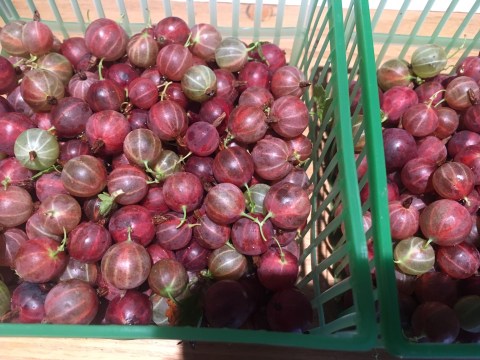
But in July, the gooseberry bush could not be denied. It bore loads of berries, pin-striped, like plump little new suits from Tip Top Tailors. They ripened from green to a deep purple in the full sunshine and long days of summer.

IMG_2393

I got scratched picking hundreds of them. My crop was donated to my father-in-law, Claus, who made gooseberry jam for the family at the cottage.

Through trial and error, I learned how to pick the berries while avoiding the nasty spikes, I would hold the top of one branch in my fingertips, pulling it up and away from the others, and carefully strip it berry by berry with the other hand. The spikes actually drive away birds and other critters — including humans — meaning you keep more berries for yourself.

Counting berries while you pick doesn’t hurt — you can give yourself a goal of 100 or 200 to see past the pain of your sore back and joints while you slowly circle the bush on bended knee. Folks in the corporate world have told you to lean in for success. The same principle applies for gooseberry picking.

I also learned how to propagate my gooseberry bush — this is a fancy gardening term for making babies.  To make a baby bush, grab a low-lying branch in spring, push it into the soil and bury part of the branch a couple of inches down. Leave some leaf exposed to the sunshine at the tip of the branch.

Over the fall and winter, this “layered” branch will put down roots. In spring, you can snip it from the mother bush and plant it elsewhere.  I took one to the cottage, where I now have a second nice mature gooseberry bush. I have given a few baby bushes away to gardening friends.  It`s the gift that keeps on giving.

If you are the foraging type, you can spot wild gooseberries along Ontario roadsides — they even sport spikes on the berries themselves. I`ve heard tell you can somehow defang them and use them for pies and jams. Or maybe just jelly, leaving the fangs in the screen before you boil up a batch. You`d have to google it.

IMG_2392.JPG

This week, Mehtab helped me pick a couple of pints of gooseberries at Thorncliffe Park. Claus passed away this summer and Ann has tried her hand at the jam making, with delicious results. Both Nadine and I have picked gooseberries in Toronto and Minden for Claus and Ann. So this next bunch will go to Ann in the hopes of jam batch number two.

I am sure there are more gooseberry dishes out there for the making. Rather than check Google, I consulted the Joy of Cooking 1997 edition and discovered that Gooseberry Fool was a popular dish in 17th Century England, blending custard and stewed gooseberries. The modern version involves pureed gooseberries and whipped cream.

Call me a gooseberry fool — but I think I am warming up to my gooseberry bush after all these years.


The secret to immortality: multiplier onions

When I started growing vegetables at Thorncliffe Park Community Garden a few years ago, my father-in-law Claus gifted me a few “multipliers.”

These were multiplying onions, and they are the gift that keeps giving.

In fact, because they never stop giving, and because you must keep planting and eating them going forward, they will guarantee your own immortality — much more so than cryogenic freezing, or belief in reincarnation, for example.

img_0418-onionsPlanting: First, let’s talk planting. A single dried multiplier onion bulb planted in spring will give you two bulbs harvested in fall. Eat one, and keep the next for next year. Or leave your second bulb in the ground and it will overwinter and multiply next year.

Harvesting bulbs: Onions are also time travelers. You can harvest in the fall, dirt and all, leave them in a cool dry place, like your basement, and forget about them. Once the excitement of the holiday season is done, you can have a eureka moment when you remember where you left the onions. Then you can process your onions for a mid-winter harvest.

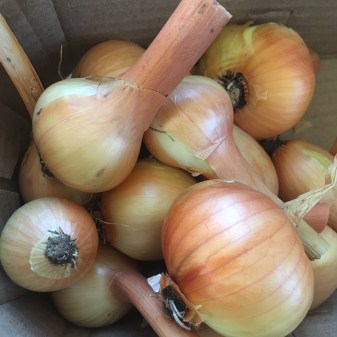
Processing simply involves shaking off any dried dirt, peeling off a few gnarly layers of onion skin, and finding a new container to keep them handy for cooking in your kitchen. The  lazy Susan works well. You can complete your processing on the dining room table while your better half prepares dinner. Careful to tidy up after! Identify multipliers as the ones that are not perfectly round — like the one near the bottom of this photo — it has a flatter side that used to press up against its multiplier twin.

Surprise! So enjoy this surprise winter harvest! To use your onions in some tasty winter dishes, such as crockpots, start with the larger ones first. Any little ones left over in early spring can be replanted. They may even start putting out some green shoots in your kitchen, which shows they are eager.

In spring time, any onions you missed in the fall harvest become volunteers for this season. They will declare themselves in due course when they push up green shoots from the dirt.

Harvesting greens: To get fresh greens close at hand, put a bunch of onion bulbs in a pot to keep handy outside your kitchen door in spring. Keep it watered and exposed to sun. Soon you’ll be out there with scissors picking off some of the fresh greens to put on top of pasta.

Savoring the harvest: Small onions go nicely in a crockpot in a dish such as lamb stew. When will simmered, they give a burst of rich flavor to complement the meat and other vegetable goodies and spices.

Here’s to your hereafter! So much going on with multiplier onions. They start as the gift that keeps on giving, and they end up guaranteeing your immortality.

Gardening gratification with Ben and Sally-Anne

Gardening gratification comes in two forms: delayed or instant. A recent fall trip to the community garden with my nephew Ben and his support worker Sally-Anne proves the point.

Delayed gratification: Tulip planting. There is no bigger leap of faith than digging in tulips for spring. We are talking a six-month return on investment before tulips put on their spring colour show, following daffodils and even earlier birds such as snowdrops and crocuses. That is if the squirrels don’t get to the bulbs first as a fall snack.

It’s a late afternoon in October and we are headed to Thorncliffe Park Community Garden, located on the hydro corridor just north of Overlea Drive. It’s a little oasis off the beaten track of one of Toronto’s densest urban neighborhoods.

So far, the weather is not co-operating. The minivan wipers are set on intermittent, which means we still have a chance for our late-season gardening session. In fall and spring, our minivan has been dubbed “the shed” by Nadine, as it tends to house a collection of gardening tools, pots, mulch and other stuff in the hatch. Here’s to stow-and-go seating!

As we pull into the community garden and drive up to my 12×20-foot piece of paradise, the rain turns to mist. I’ve brought umbrellas just in case. However Ben assures me, with Sally-Anne interpreting his sign language, that he likes rain, so we are good to go in any case.

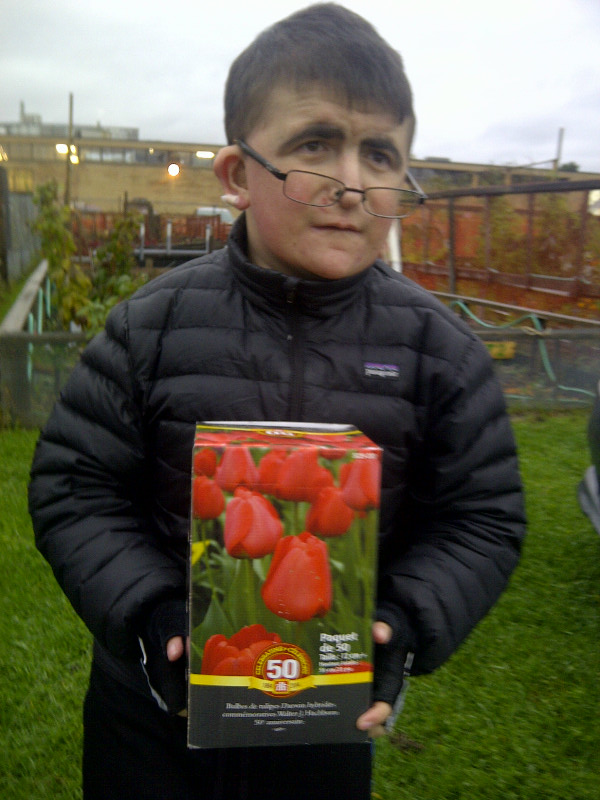
We pull out a box of 50 tulip bulbs. Woven among some perennial flowers and herbs, they will create a bright red border along the west side of the garden in spring.

IMG-20141021-02231

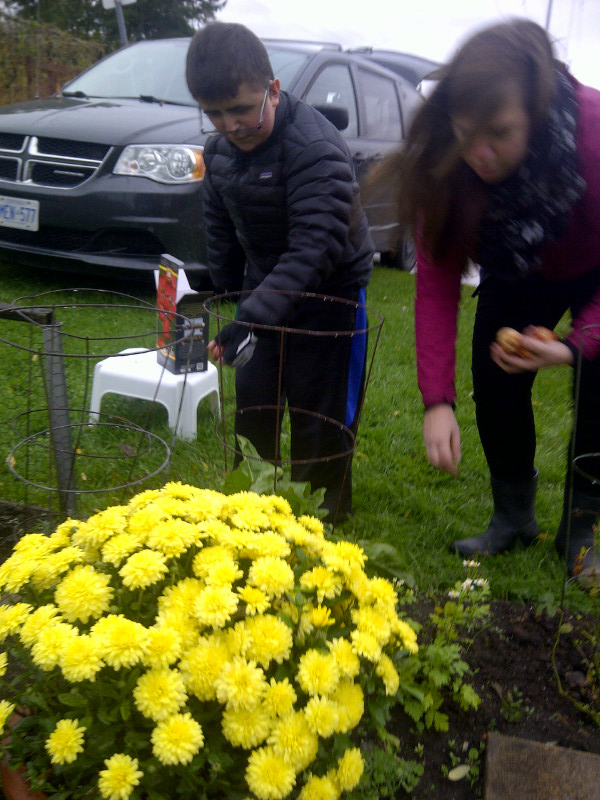
The planting exercise involves an assembly line of sorts. I dig the holes using an old piece of lumber to poke spaces in the soil, about six inches deep. Following me is Ben, who leans on the fence to carefully aim and drop bulbs one by one into each hole. Sally-Anne rounds out our line by making sure each bulb is upright (roots down), and uses a trowel to cover them up with soil. We get in about 40 bulbs, which means there are some left-overs for Ben and Sally-Anne to bring home to plant.


Over the long Canadian winter, the bulbs will set down some roots. They will wait patiently until the time is right to signal spring with their scarlet blooms.

Toronto-20141021-02234


Instant gratification: Sweet September raspberries. When I inherited this plot from a former gardening friend, she left some dwarf raspberry canes in the north-east corner. I can’t say I’ve done much with them except to enjoy the harvest — they put up fruit twice a year. My father-in-law Claus calls the fall crop “Sweet Septembers.” My canes have produced some sweet Octobers this year, so I pick a dozen of the last purple-red ripe raspberries and the three of us split them up for an instant treat. It’s almost suppertime, so the raspberry snack will buy us some time for the next gardening task.

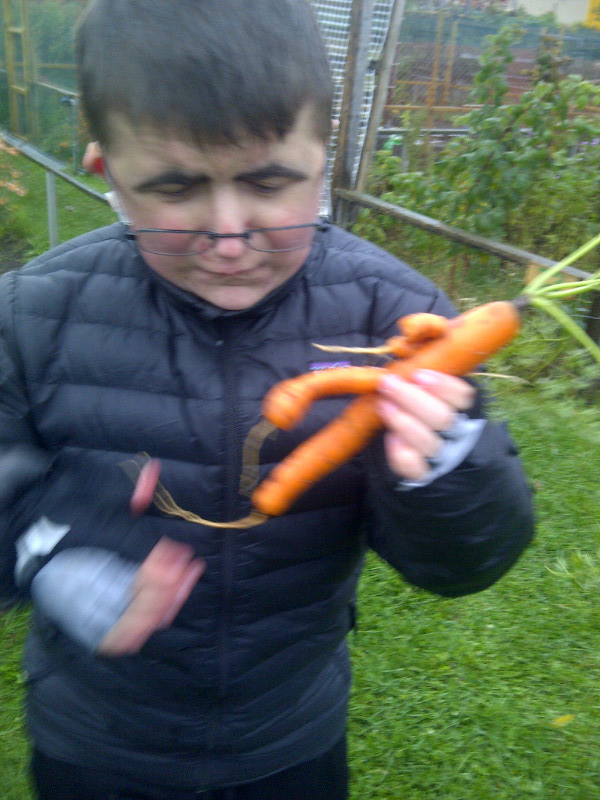
Delayed gratification: the 2014 carrot crop. It’s been six months of weeding, watering and waiting. Now the carrots are ready to harvest. A few of the bigger ones have presented themselves — the orange tops now visible above the soil. I loosen the big ones and Ben hauls them up by their greens.

We head to the water tap to wash off the dirt, revealing a couple dozen healthy but gnarly looking carrots. Healthy, because they seem to have resisted the bugs that sometimes eat into the crop underground. Gnarly, because some of them are looking like something out of a sci-fi movie — the carrot that ate Don Mills.

Toronto-20141021-02238

Folks, you will never see carrots like these on store shelves. But they are tasty. We nibble on a couple of the little ones — sweet!

Ben and Sally-Anne each take home a basket, and I will be back for another couple of dozen before the soil freezes. Even after freeze up, if you miss a few carrots, they will generally sit tight over winter and provide a spring windfall when the soil thaws.

Instant gratification: Swiss Chalet. It’s getting dark and Ben agrees that we are done gardening for the day. We wash our hands under the nearest water tap. We’re getting a bit hungry and the raspberries and carrots have only bought us so much time.

As luck would have it, there is a Swiss Chalet located a stone’s throw from the community garden. We are seated by the hostess at a cozy booth, and gaze through the colourful options on the menu.

Ben is a pasta guy but likes his meal plain. When the waitress arrives, she asks Ben for his order. Ben signs and Sally-Anne translates. He has his own sign for pasta, using his index fingers and thumbs to indicate a pulling motion, like stretching a piece of spaghetti. He would like the fettucini, with some butter and salt. The menu shows a fettucini dish loaded with chicken and veggies, and I am reminded of the Jack Nicholson scene where he just wants toast, but has to order a chicken sandwich, hold the chicken, hold the mayo, etc. But Swiss Chalet is stepping up to the plate on Ben’s custom dinner order. The waitress asks Ben if he wants anything else on the pasta and he signs the letter “p” for Parmesan. Ben smiles and gasps when his pasta arrives, and I tuck into my quarter-chicken dinner.

Sally-Anne, who is one of Ben’s support workers, is studying for her sign-language interpretation diploma at George Brown, balancing school with work and being a mom to her five-year-old daughter. She’s heading to Montreal tomorrow for a couple of days for a break and some fun with friends.

Ben is a man who starts what he finishes. HIs pasta plate is clean as a whistle, and he’s making his way through his diet pepsi and chocolate cake while I savour my apple pie a la mode.  Ben is interested in the folks in the restaurant, including some retired couples and families. From his booth seat, he has a wide view of the place and is keeping an eye on the goings on.

We finish up and head home — soon I’ll put the garden to bed for the winter. We will all enjoy our carrot crop, and we’ll be back next spring to check out the tulips.

Bike stories — A half a bike in Hazelton

Joan Richard was a young girl living near Hazelton, B.C. when she got her first bike in the late 1940s. Actually, half a bike. She had to share the whole bike with her older sister Ann.

Joan is now a retired nurse and champion bridge player, not to mention mom and grandma. She was at home recently about to have a chicken soup dinner when I spoke with her.She was receiving some TLC from her sister Cathy and daughter Cathy after she stopped her treatments for cancer. “I’m being treated like a Queen here,” she said. Joan’s niece, my wife Nadine, had told me about the half-a-bike story, so I asked Joan to share it. Ann has also added some memories.

Joan: My sister Ann and I wanted bikes but money was a bit tight just after the war ended so we started saving. It wasn’t going to get us two bikes anytime soon, so the plan was to share one.

Ann: We saved by sawing logs with a crosscut saw — I think for one cent a log. My parents were happy to give us the job because they supplemented the home heating with firewood. You needed a good stock of firewood because it got pretty cold in Hazelton in the winter. The bike was going to cost us twenty-four dollars, and our parents would pay half, so we figured we went through about 1,200 logs to get the twelve dollars.

Joan: We ordered the bike through the wholesaler Marshall Wells, which served Hazelton. My dad was an engineer and the manager in the Silver Standard lead-zync mine about 8 miles from town.

The bike was an ordinary one-speed with pedal brakes and we just had to share it. Most of the time one of us would ride it and the other would run alongside, and maybe the dog would tag along too. The bike was made by CCM but had some other brand on it which I can’t recall, maybe related to the wholesaler.

We lived in the mining camp so it wasn’t like there were a lot of flat spaces to bike around. It was quite rugged — lots of bumps and humps. You couldn’t go too fast but it was fun.

Ann: Our parents Harry and Mary Gilleland had a nice two-bedroom home at the mining camp, with a basement that had a trap-door entrance. Our younger sister Cathy was about six years younger than Joan. We had to host some guests from time to time, including some of the big mining bosses from Vancouver who needed a place to stay when they visited. So we added a third bedroom at some point. It was a nice home given that we were basically living in the bush.

Joan: The next year, we made a plan to get bike number 2, and we had a deal. We would save for it together and place our order. The bikes came in red and blue but you couldn’t special-order your colour choice. So we agreed that if the bike was red, it would be mine. If it was blue, it would be Ann’s.

Well the bike was red so I was lucky and Ann kept the first one. Sibling rivalry? I don’t remember too much of that.

Ann: We did have our occasional spats. One summer we were sawing wood and Joan was wearing shorts. As the result of some kind of altercation, which was likely partly my fault, Joan got nicked by the saw teeth and ended up with three scars.

Joan: I would have been about 8 and Ann was 10. There weren’t many places to bike around the mining camp but there was an isolated road that ran about 8 miles to town, mostly downhill. We would get on our bikes and a couple of friends might come along, and we would all woosh down the road to Hazelton together.

Of course, it was uphill on the way back so we could usually get a ride home. We would throw the bikes in the back of a truck and catch a ride.

We were like street urchins. We were outside almost all summer. There weren’t many kids our age but I don’t ever recall being bored.

We had our bikes and the run of the place.


We can rebuild her — we have the technology

“Flight com, I can’t hold her! She’s breaking up! She’s breaking—”.

The image of a rusted red two-wheeler rocketing through the atmosphere. The bike hits the ground at 250 mph and tumbles six times.

The 1964 CCM, vintage one-speed. A bicycle barely alive.  Bought for a song at a Kingston antique market after re-entering earth’s atmosphere.

Gentlemen, we can rebuild her. We have the technology. We have the capability to make the world’s first bionic bike. The vintage 1964 CCM Ladies one-speed will be that bike. Better than she was before. Better…stronger…faster.

Cue music as the bike’s frame is lifted up from the makeshift painting booth consisting of a broken 1×6 from the neighbor’s fence and suspended with cheap yellow nylon rope from the rafters of the kinross cordless workshop.

A high-tech imaging machine rattles off diagnostics and rebuild checkpoints:

— bionic legs: the bike’s wheels — check. Bearings are cleaned and repacked, spokes are freed, new rubber and tubes complete the rebuilt wheels.

Toronto-20140526-01955

— a bionic eye — check. The original CCM fork caps complement the bike’s bionic eye — the original CCM head-badge installed when the bike was built at the Weston plant in Toronto. The eye will guide the bike along future roads less travelled.

— bionic arm — check. An aftermarket yet sturdy Swedish kickstand sits the bike up nice and straight when it’s not in motion.

— and finally, the atomic core. The CCM brand is built into the architecture of the pedal crank, and the elegant one-piece pedal arm is back in place with clean bearings. The bike’s frame and forks are restored to their original true-blue tone.

Toronto-20140603-01961

Cue slow motion visual sequence and electronic “dit dit dit” synthesized sound effects.

The bike is back in motion heading west-bound on Nealon Avenue. Kids playing ball hockey sweep their net back to let the CCM pass. Their eyes zoom in like telephoto lenses on the sharp new period decal on the bike’s downtube, obtained from a gent in Truro, Nova Scotia.

The mechanic stands up in the pedals, sweeps southbound on Arundel Avenue. The new wheels and tires give a smooth ride. A pounding sound creszendos to fill the soundtrack — it is the beating heart of the bicycle mechanic, riding one-handed and fumbling with his blackberry to take photos of the test ride while an automobile tries to squeeze by headed east on Browning. Flight com, this is no time to drop the bike.

Toronto-20140603-01980

Finally we are headed back north on Logan. The Norway maples in Riverdale are in lush green bloom following a hard Canadian winter. Soon the bike will be headed back to Quinton and the Blue-Bradshaws in Kingston for some summer fun.

The 1964 CCM vintage one-speed is back in motion, 50 years young, better than she was before.

Better… stronger… faster.


Toronto-20140603-01976