Unknown's avatar

About Ian Kinross

I am a Toronto-based writer and communicator. I volunteer at the Thorncliffe Park Community Garden and recently learned the skill of dry stone wall building. I've been known to mess around with bicycles. I would like to thank Karen Maraj and Nicky Borland for their inspiration and support to kickstart this blog. Also thanks to Hannah Materne for design of the kinrosscordless logo. I appreciate your comments.

The bluebirds were calling

As we experimented with gardens on our stone terraces, we continued to keep an eye on the eastern bluebird family in our small red bird box.  They were busy feeding chicks, the mother and father bluebirds swooping in with food and out with guano.

Earlier in the year, I had attended a naturalist group lecture about bluebirds and learned about a study underway in the Minden area. Local volunteers had built and set up many bluebird boxes in nearby Gelert, Ontario.  They were monitoring the effectiveness of the boxes to attract bluebirds, and a university student was preparing a report on the results.  The intent was to turn around recent declines in the eastern bluebird population.

I contacted a reporter at the Minden Times, a small but feisty local paper still practising old-fashioned journalism with news, features, and commentary on local affairs. On a sunny Saturday morning, reporter Vanessa Balintec dropped by with her camera and tape recorder.  Nadine and I sat with her in our screen porch.  As she asked us questions about our experience with hosting bluebird families at Minden Lake, we would occasionally point to the box outside our cottage when one of the adult bluebirds alit on the box: “Oh, oh, oh — look!!”

Vanessa took a nice close-up photo of  the male bluebird, with its orange breast and bold blue wings. She wrote the following piece about this small initiative in Minden that hopes to understand the impact of nesting boxes — and to give these birds a fighting chance for the future…

(You can also find this story online at the Minden Times website.)

bluebirds

Eastern bluebirds: A story of success

By Vanessa Balintec
For Ian Kinross and his wife Nadine Wirsig, it was a pleasant surprise to hear that the Haliburton Highlands Field Naturalists were launching an eastern bluebird bird box program along Gelert Road, as they’ve been housing two boxes of their own for over five years at their property in Minden.
“I saw it in the Minden Times and I went to the seminar,” said decade-long cottager Kinross. “I chatted to the guys and I really support their work.”
For years they’ve been watching eastern bluebirds use two little boxes on their property to nest and raise their young. Although they were out of town by the time the HHFN called for their support in putting up the boxes, Kinross arrived back home in time to see a new family of bluebirds getting ready for nesting season.
“They’re just beautiful creatures,” he said. “And it’s kind of like, you feel good that you made this small step of putting up a little box and it actually works, it’s actually attracted the birds. So that’s pretty cool.”
Local teamwork, broader impact
Although they were at it years before the HHFN, the non-profit organization took it to new heights. With the help from U-Links, they paired up with Anna Robbins, now a graduated Trent University biology student, to launch their project. The group has been working since fall to get around 20 boxes erected for this and next year’s summer.
“The field naturalists, we used to have one of our members that had a bluebird trail with nesting boxes and some of the members would go out and do some monitoring,” said Gord Sheehan, treasurer for the HHFN. “So then, when he left the club, we decided we would like to try one of our own, and decided a good route would be along Gelert Road.”
With Robbins’s help, they were able to determine 39 ideal locations for bluebird boxes. While building them is just one part of the process, putting them up proves to be more challenging as some of these locations are privately owned, requiring the HHFN to get permission to build and monitor the boxes for long periods of time.
“All these things, getting people together, getting time, it’s much more of a project than it appears to be,” said Sheehan. “Putting up houses, it’s a piece of cake, right? I’m glad we didn’t do 20 houses on our own.”
Robbins was thrilled to see the enthusiasm of the group behind the project, and was drawn to them because of it.
“I think this one stood out to me the most because it was such a small organization of people who weren’t being paid to do anything, it was all volunteer,” said Robbins. “It was a great little community, and I really liked that.”
Stabilizing the bluebird population
But another big motivator behind the project was to monitor the bluebird population.
“When Shirley was working with bluebirds about 30 years ago, their populations were really low,” said Robbins about HHFN director Shirley Morden. “Now they are increasing, so she wanted to monitor to see how that was going.”
According to Canadian Geographic, during the mid- to late-1900s, the eastern bluebird had a declining population due to the introduction of two competing birds, the house sparrow and the European starling, and loss of habitat due to human development.
It was the work done by bird watchers and bluebird lovers, who began the initial movement of building bluebird birdboxes to aid in their chances of survival, that the population was able to slowly stabilize and become a species of least concern today.
“In addition to that, bluebirds are just loved among bird watchers,” said Robbins. “They’re very beautiful, they have this vibrant blue colour. When you see one up here, it’s very exciting.”
Monitoring the new bird boxes
Today, according to the HHFN, there are 16 bluebird boxes up in total: four along Gelert Road, six along HHFN member Don Kerr’s property, and the other six at Walkabout Farm on Spring Valley Road. Although the other four boxes have yet to go up, Sheehan has already been receiving reports about some of them being in use.
“We have one of the four nests occupied by bluebirds, and last report there were five eggs,” said Sheehan. “The other boxes are empty at this time. We will continue to monitor them for more results.”
Kinross says watching the bluebirds finally fledge and leave their nest is something that reminds him of his own role as a parent.
The cycle of life
“They’re always dealing with these little challenges and it kind of makes you realize that life is a little bit precarious,” said Kinross, who says out of close to six to seven cycles of bluebird watching, only four to five of them have been successful. “‘Cause the parents are busy building the nest, and she’s got to lay the eggs, and they’ve got to raise the chicks and help them fledge successfully. It’s a sweet moment that makes you think about the cycle of life. Also, as us as parents. These are parents working so hard to raise these little babies, and they have a much tougher time.”

For more resources on how to build your own bluebird bird box, visit the Ontario Eastern Bluebird Society at oebs.ca.


Stone terrace gardeners

After being inspired by the terraced hillside gardens of Cinque Terre, Italy, Nadine and I took a trial-and-error approach to gardening our emerging stone terraces at Minden Lake.

In the sunnier area near the lake, a hydrangea flourished, delivering large white blooms as big as sun hats. Hydrangeas love stone — their roots slither under and around it, seeking the cool soil. The big, healthy hydrangea bush was temporarily subdivided while a new terrace was built around it. The baby hydrangeas resulting from the division were gifted to a few of our neighbors. Part of the original root was replanted and will flourish again in the next year or two.

Along with the gardening miracles came a few disasters. A groundhog burrowing near the lake wreaked havoc on our begonias, for example, nibbling the leaves each time the plants attempted to grow.  We ended up with some stunted begonias, and none of the colour we thought they might add to the terraces. Live and learn.

Nadine took a page from her parents’ garden at Horseshoe Lake, and planted gladiola bulbs in spring.  Their multi-coloured spikes dressed up our hillside garden in summer. The bulbs — and any new bulbs generated that year — would be taken inside to be stored over winter in a cool spot in the basement, then set out again each spring to bloom again.

Butterfly blooms

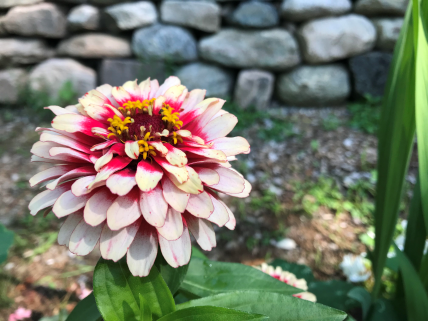
Likewise, multi-coloured zinnias, grown from seeds saved from Nadine’s parents’ garden, attracted Monarchs and other butterflies.  We learned they would produce even more flowers if the first few blooms were nipped off, stimulating the plant to grow more stems sideways and upwards. Zinnia seeds could be easily saved over winter and replanted.  We also experimented with a couple of perennial flowers, including a butterfly bush, purchased and grown from seed from a company called William Dam Seeds near Hamilton.

zinnia.png

Nadine’s Mom suggested Nasturtiums, which would cascade in green over the stone while putting out bold orange and red blooms. As a bonus, the blooms were edible, with a fresh but mild flavour, perfect for a quick snack near the lake.  Further below on a rough stone amphitheatre near the lake, Nadine was nurturing plants including lilies, creeping thyme, perennial geraniums, phlox and other flowers that had taken to the site and climate of Minden Hills.

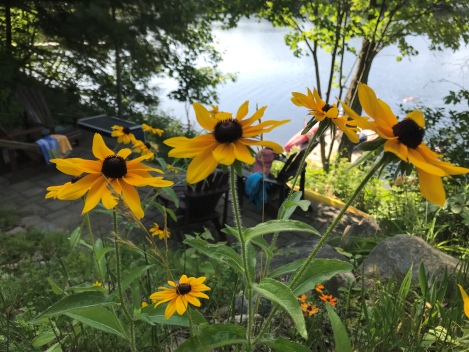
Wildflowers such as brown-eyed susans and daisies complemented the mix. Wild milkweed was another big draw for the Monarch butterflies.

brown eyed susans.png

A taste of Italy

To tip our hat to the terraced gardens of Italy, we set out a couple of small fig trees in pots. They would be brought inside over winter.  Nearby I found some wild grape vines, resembling Ontario’s native concord variety.  These were replanted next to the farmer’s fence alongside our lot in the hopes they would grow and produce some sweet fruit.

On the stone terraces, the new plants did well.  The terraces held moisture and were partially shaded by some young oak and poplar trees. We continued to enrich the sandy soil with some peat moss, worm castings, and home-grown compost.

While most flowers flourished, we also learned what did not work in the sunny spot.  After the groundhog had his way with the begonias, we discovered that colourful impatiens were too tender for this hot spot.

An organic approach

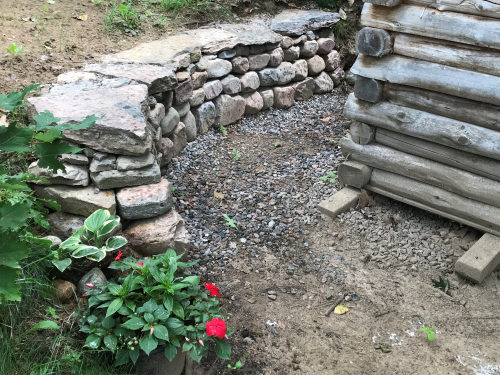
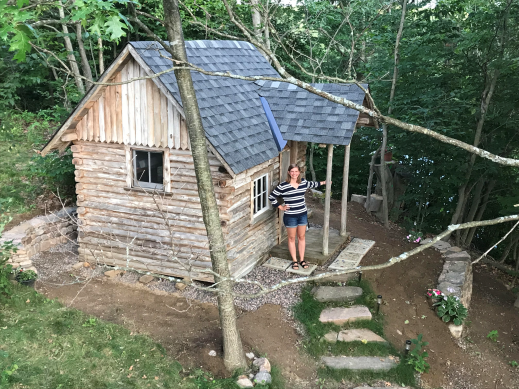
Further up from the lake, at the new terrace fronting the little log cabin, we planned a garden that could accommodate more shade. We decided on a natural approach, letting the new terrace area green up by itself, and adding just a few subtle garden accents. These included hostas, propagated from our home in Toronto, and some small pots of shade-tolerant impatiens. These were planted at each end of the new terrace fronting the cabin. To accessorize, we placed the same plants in pots on the stumps of the old beech tree nearby.

Colleen and cabin.png

Meanwhile, the forest was declaring itself on and around the site of the cabin.  A maple tree that been cut down to squeeze the cabin into its new forest home was shooting out stems again.  It looked like it would regrow nicely to the north of the cabin.  Similarly, some smaller beech trees that were taken down next to the cabin site were starting to bud out from the stumps.

A life force

The Minden flora and fauna were relentless, nesting the human-made structures of wood and stone in their life force and life cycles.

Behind the cabin, a groundhog had established its home, with its circular hole marking the entrance to its underground lair in the sandy soil. In the oak trees above, squirrels chewed off small branches, which would drop to the cabin roof and forest floor, where the acorn bounty could be claimed.

Beneath the soil, tiny blind moles made subterranean tunnels next to the new terrace capstones, pushing up the backfilled sand in a telltale pattern. Chipmunks established new tunnels around the site that would keep them warm in winter. The nesting bluebirds in front of our cottage made regular trips to sit in an old oak branch above the cabin, as if to check our progress.

The final push for the stone terrace project was a second dry-stone retaining wall behind the cabin. By early August, I had got most of it built. I was down to the “B-grade” stone in my pile but I still found a few gems to piece the terrace together.

The design echoed the first terrace built just to the west of the cabin — a straight line with freelance curve ending in a small tree cluster. This would afford breathing room and a safe gravel pathway against the hill sloping above the cabin. The second terrace would also keep away ice in winter.

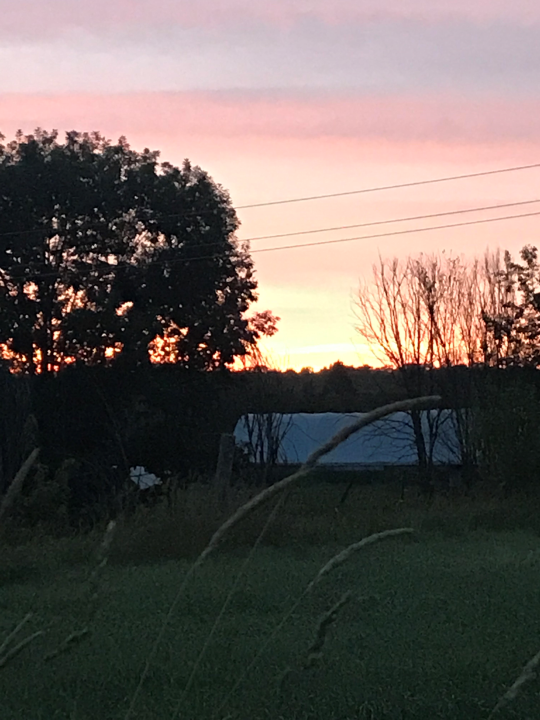
More sun cut through the trees here, especially in the morning, so we imagined some sun-loving flowers to dress up the terrace there once it was complete. The days were getting shorter in August, and the sky cast shades of pink and purple as the sun set over the Cox barn next door.

sunset in August.png


“The kids’ cabin”

In the mid-90s, Nadine’s parents Ann and Claus were hosting a growing brood of grandchildren at their cottage on Horseshoe Lake. Where to put them all? They needed a tiny cabin movement.

Claus had been looking at a book of cabin designs and, before you knew it, the wheels started turning. He was planning a small 8 x 12-foot log cabin, one that would be built to last and would honour the 150-plus-year homestead cabin that formed the core of their cottage. And at 96 square feet, it would be just small enough not to require a building permit. He ordered cedar logs from a local farmer.

When the logs were delivered, they needed the bark stripped. Claus’s father, Oscar, then into his 90s, was on hand to help.

Cedar and chocolate

Oscar was seated in a lawn chair, wearing a fedora and sports jacket, and a black patch over a wonky eye.  In his hands he had a debarking tool and was stripping bark vigorously one log at a time. As a long-time farmer and lumberman, Oscar knew his way around wood. Nadine and I pitched in to help.

From time to time, the kids would come by, and Claus would prompt Oscar about the chocolate. Oscar had brought a shopping bag of at least a dozen bars of fine chocolate along with him, ready to offer up as a treat to the little people when the moment was right.

Claus found a site for the cabin in the woods just across from the main cottage. He set down a gravel base and levelled it up with the help of a few flat stones from the bush.

cabin gravel bed.png

The cedar logs were stored to dry over winter.

The cabin-building started in earnest the summer of ’97. Claus had the cedar logs milled to four-inch widths so they could be stacked cleanly. As the log walls came up, he notched the ends, knocked in metal spikes, and caulked each log for a tight fit.

Claus with joinery.png

Pitching in

Claus had obtained several old wooden windows from his parents’ former place in Grey Creek, B.C., including a two-part solid casement window.  They would be a sentimental link to the past, and functional for the future. He took measurements and left space for four windows and a door in the structure. Two windows could be opened for a through breeze.

Claus and kids.png

Colleen in cabin window.png

The wheels were turning on the door too — he had plans for a sturdy but decorative door with diagonal strips that would complete the picture once the structure was built.

Friends and family pitched in.  Our brother-in-law Frank worked on the electrical — including supply, lighting and sockets. Nadine and I installed the red shingle roof to match the cottage, working our way around the dormer over the front porch that Claus had added. Nadine figured out the math to get the shingles aligning correctly as we roofed the dormer channel. Claus cut some decorative cedar siding strips to adorn the peak underneath the porch roof.

Roofing the cabin

Meanwhile, Ann and Claus continued to host friends and family who watched the construction unfold. Neighbors dropped by to check progress, offer advice, be inspired, and have a beer.

Finishing touches

During the third summer, in ’98, Claus finished the interior with several beds. The cabin was nestled nicely into the woods, built solid and ready for grandkids. Nadine and Ann sourced some mattress foam and covers. Linens and pillows were procured for a proper nesting of the interior. Claus asked for contributions for a time capsule that he would hide in a secret spot in the cabin for posterity. As he finished up the cabin interior, he placed a coffee tin inside and asked the kids to put their contributions into the tin time capsule.

Some flat heavy granite steps fronted the cabin porch to the green space outside the cottage. “It’s a 100-year cabin,” Claus declared proudly.

Cabin christening

Ali remembers some unique details of the first sleepovers: “We were given little bowls of Cheerios that we were supposed to eat in the morning to distract us for a little while so the adults could sleep in past 6:30 a.m.!” The kids also played tricks with an electronic baby monitor device. It was installed with good intent to monitor signs of life in the cabin, but the kids got devious, hamming it up over airwaves so that the adults would have to investigate.

Anna recalls the excitement of having her own cabin: “I remember running into the cabin during particularly dramatic rainstorms and listening to the rain and thunder, feeling very cozy but also closer to the storm.”

Cabin for 7

The tiny cabin movement had begun.  As more grandkids came along — Chantal, Paul, Rachel, Felix — Claus would continue to add sleeping quarters, turning double bunks into triple bunks with some ingenious carpentry, and adding a small bunk on the west side.

“My favourite was when the middle lower bed was added as the entire lower level was like a big sleepover,” recalls Ali. “The smallest kid had to sleep on the bench bunk, so both Rachel and Felix had to put up with that for awhile.”

“We would play all sorts of games like Ghost Town trying to get everyone settled down but it was tough as everyone was so excited.”

Colleen remembers: “We had quite a book craze with the Goosebumps series. Someone would read aloud and we would discuss what to pick for the “choose your own adventure” challenge. We often had adult visitors who would read a story or two as we were going to bed.”

“As an early-to-bedder I enjoyed many nights hidden away on the cozy top bunk while the chatting continued late into the night between my sister and cousins.

Anna recalls every summer feeling “a bit intimidated to try to get into the top bunks and feeling very proud once I finally got up there!” The kids dressed up the cabin for parties and special occasions: “I remember carrying Rachel into the cabin on a ‘stretcher’ (boogie board) so that she could safely deliver stuffed animals to the ’emergency room’ we created there.”

The cabin also hosted a few adults, and was popular with the children of guests Ann and Claus entertained over the years.

Claus and Ann.png

Cabin complete

All in the family

Before he passed away, Claus asked that the cabin be kept in the family if possible. With Nadine, he scouted out a possible site in the woods next to our cottage. Ann was preparing to sell the cottage on Horseshoe Lake and kindly offered to move the cabin. Local crane operator Chuck Hopkins obliged, taking the log cabin on a 5K road trip to its new ‘hood.

The tiny cabin movement would continue — on a site nestled in a grove of oak and beech, overlooking a pretty corner of Minden Lake.


Granite capstones: Icing on the cake

A nice capstone will make a stone waller salivate. They are hard to find, but they are the icing on the cake for a dry stone wall, adding architectural detail as well as structural integrity.

As my dry stone terrace rose, I was on the lookout for capstones. Brent Coltman, a neighbour on nearby Horseshoe Lake Road who supplied much of my stone for the terrace project, suggested I pay his Dad a visit.

I met Wayne Coltman at his place south of Minden, in old farm country along the winding Deep Bay Road. In his early 80s, Wayne still works full time in the aggregates business, providing excavation and supplying materials such as gravel and sand for construction.  Wayne also keeps his hand in music, playing electric bass for a local band.

Finding a stone mecca

We hopped in Wayne’s white pickup and drove through the old farm on his property, touring his gravel pit before heading up a hill through the forest. We arrived at a small granite quarry littered with gorgeous slabs of pink and grey granite.

wayne with truck.png

I could have my cake and eat it too!  The first granite stones that caught my eye would work perfectly for some extra steps leading to the cabin, I thought.  They were about four feet wide, two inches thick, and heavy. Wayne and I grabbed the ends, picked them up and walked them to the road.

“I have to take care of the fingers so I can keep playing music,” he joked, as he lifted half of a stone that must have weighed over a hundred pounds and was making my back ache. While he went back to get a bigger machine to haul the stone, I scouted out capstones for the terrace.

The June mosquitoes were feasting on me and seemed to especially enjoy the area behind my ears. I zipped up my jacket and started hauling capstones — picking them up and treading carefully back to the road, or sometimes dragging them if too heavy.

Special delivery

When Wayne returned, we lifted them into the bucket of his front-end loader and bounced back along the road to his house. I got about half of the stones into the back of our minivan, and drove them home carefully along the highway, making sure I did not have to brake in a hurry with the heavy load.

Later, Nadine and I came back to get the other half. Wayne was in his garage doing some welding repairs. He lifted his welding goggles, and put down his torch. We had a nice chat about his farm, which includes a gorgeous pond next to his house.

wayne and stone.png

Back at our cottage on Minden Lake, I used a hand trolley to wheel each stone down to the project site. The terrace was coming up nicely but went slightly off level around its curve.  I knew I could bring it up to a better level with some thicker capstones on the curved end.  So I got busy getting the thickest stones over there first.

The summer side of life

Across from the cottage, the Bluebirds were busy feeding their chicks — swooping in with the food, and out with the guano. Under our cottage porch, Swallows had nested. The birds were active mornings and evenings, flitting around the farm fields next door.

While the female Swallow was away, I used a stepladder to climb up and see what was going on. The parents had created a soft nest of feathers and twigs on top of their sturdier foundation on top of our porch column. The first chick had broken its speckled egg and hatched, a tiny pink thing with a black beak. Three unbroken eggs showed that three more chicks were on the way.

swallow nest.png

Capstone dreaming

Working with the capstones, I used a chisel hammer now and again to chip off unruly edges, to get the stones to fit together better. When a stone was a bit wonky, I used little wedges to stabilize it.  To get the back edge straight, I fit in some small cheater stones that would look okay once the terrace was backfilled. Finally, I packed in a few small heartstones around the heavy capstones.

You can get into a trance while stone walling — the process triggers a kind of Zen state. You forget the mosquitos and keep walling. In your trance, you investigate, touch and place every piece of stone. There may be thousands in a small terrace like this one, a cascade of shapes, heft, tactility and colour. That night, it’s no wonder you may dream of stone.

Pretty soon the capstones were fitting together nicely on top, bringing the terrace up to a nice level of about 3 feet high. I would have more work to do with the terrace garden, and another retaining wall behind the cabin.

But for now, the icing was on the cake.

cabin with caps.png


Pieces of the puzzle

With a sturdy foundation in place, it was onwards and upwards for the stone garden terrace.

Inside our cottage, Nadine, her mom and a friend were grouping like-minded pieces for a jig-saw puzzle depicting a classic canoe. Outside, I was using the same approach for the stones that would form the second and third courses of the terrace. With like-minded stone close at hand, I could move faster once I started building each course.

canoe puzzle.png

Smelling the roses

My dry-stone mentor John Shaw-Rimmington had advised our class at Haliburton School for the Arts to step back now and again — to see from a distance how the stones fit together.

This was the stone-walling equivalent of smelling the roses. Sometimes a stone that looked good up close was clearly out of order when seen from afar, and could be adjusted or replaced before it became embedded in the structure.

So I did a lot of stepping back and peering at the little stone terrace as it rose next to the cabin. In fact, whenever Nadine caught a glance at me stone-walling, she said I usually had my hands on my hips, arms akimbo, peering at the stones. For inspiration, I nestled a pot of pink and white impatiens next to the terrace.

course number three.png

Rocking and rolling

By nudging up the string next to the straight section of terrace, and checking its level, I could chase it upwards in slow motion with the stone-building. Stones that rocked and rolled a bit too much were wedged with thin stone shims to get them to settle down. Each course was carefully packed with hearting to get it tight and ready for the next course.

Next door, the farmer was raking his hay.  I could hear the drone of the machine as he swept by. The next day, he came back with the baler and wound the dried hay into huge bundles.  They would be wrapped in white plastic, resembling massive puffy marshmallows, and stored outside to give his cows feed through the long winter.

On a misty summer morning, the hay bales loomed large outside our cottage front door.

hay bale.png

A special blend

As the terrace wall came up with each course, I began to backfill it with some better soil. I trundled with the wheelbarrow over to our nearby veggie garden. There a special blend of quadruple mix was concocted, using equal parts of garden soil, compost, peat moss and some worm castings.

This new soil mix was a step up from the sandy clay next to the cabin, and would provide a nutrient-rich bed for the terrace garden, once complete.

To get the terrace as level as possible for the final layer of heavy capstones, I used slimmer stones in the fourth, and penultimate, course. For the freelance curve at the south end, I had cheated, using just three layers of larger stone. The curve dipped slightly off level, but I made a mental note to try to fix that with the capstones.

Piece by piece

The pieces of the puzzle were falling into place. Inside our cottage, the wilderness image of a cedar canvas canoe slowly emerged on our card table as Nadine, Ann and Mary Jo worked on the 1,000-piece jigsaw, after some swimming and kayaking in Minden Lake. Outside, the stone wall was rising.

course four with cabin.png


The eagle has landed

My father-in-law Claus had asked that the little log cabin he built for his grandkids at Horseshoe Lake stay in the family. Before he passed away in 2017, Claus had joined Nadine to scout out a possible site for it in the woods near our cottage on Minden Lake.

The next summer, my mother-in-law Ann was preparing to sell the family cottage. She kindly offered to pay for the cabin move.

This promised to be a one-of-a-kind road trip, with a few twists and turns.

Built to last

It was a tiny, pretty cabin, yes.  But it was built to last — for at least 100 years, Claus had predicted. The cabin weighed many tons — not a job for few friends over a case of beer on a sunny Saturday.

We spoke to our contractor Bob, who had built our place at Minden Lake. There were two options — dismantle the cabin piece by piece and rebuild it on site, or pick it up intact and move it. Option two had a few challenges attached to it, but seemed the better way to go to keep it simple, and to honour the cabin’s integrity.

Bob referred us to a crane specialist in the Minden area.  Chuck Hopkins lives just down the road from us and owns several massive cranes used in construction around the Minden-Haliburton area.

Sizing up the job

Chuck came by to take stock. The cabin would need to be wrapped in a giant sling — like a baby carried by the proverbial stork.  It would then be craned on to a trailer and trucked to our cottage. Finally the cabin would be picked up again by crane to be set on its new site.

Chuck advised to leave the front porch intact even though the wider load presented some potential challenges. We did a final clear-out of the cabin’s contents and disconnected the power.

Chuck advised he would  move the cabin during a break in his construction schedule. One fateful morning in summer 2018, I got a ping on my phone with this photo attached:

bunkie on McCracken Lane

The cabin was on the road!

Earlier that morning, Chuck and his crew had roped up the cabin with heavy straps and lifted it onto a flatbed trailer:

bunkie horseshoe 1

bunkie horseshoe 2

Over hill and dale

The cabin was hauled by Chuck’s pick-up truck up a very steep section of McCracken’s Lane at Horseshoe Lake.  It wound its way past the world-class white-water rapids of the Gull River, then hung a left on our cottage road: Summer Lane. When the cabin hit a tight spot on our lane, our neighboring farmer, Casey Cox, came with heavy equipment to bend over a tree to let it pass. The only stop missing on this five-kilometre drive was a detour to the Minden Timmies drive-through.

All told, it was a fine bit of motoring for the little cabin that could…

bunkie on Summer Lane

Chuck and his crew used the crane to place the cabin temporarily on our front lawn, then came back the following week, this time with two cranes. In a delicate demonstration of mighty-machinery skills, they “walked” the cabin inch by inch down a slope next to our cottage to its new site on a level gravel base in the woods. Half the battle was keeping the cranes properly positioned so as not to topple along with their load.

bunkie placement

bunkie has landed

The mission was complete — the eagle had landed. Thanks Ann and Claus!

Nadine and I rolled up our sleeves and spent a morning digging a 40-foot trench, 2 feet deep, to house a new electrical supply. The 1990s red shingle roof was updated. Beds were made and the interior dusted and nested. Next spring we would work on some stone steps and a little garden terrace to nest the cabin in place.

The log cabin was ready for its first winter on Minden Lake.

bunkie in winter


A sturdy foundation

The stones were speaking to me…

With the site excavated and gravel base in place, it was time to build the foundation for the stone terrace garden.

I had been “mining” my new five-ton stone pile for the biggest, squarest stone I could find. It wasn’t quite like finding a needle in a haystack, but I would smile whenever I dug out a nice foundation stone.

A palette of stone

As the stone migrated to the job site by wheelbarrow and hand-trolley, I grouped like-minded stone in clusters.  If stone-walling is like oil painting, I wanted a nice palette to choose from. I also wanted a surplus of stone close at hand, so I could keep on a roll. A few of the absolute best stones were earmarked for the corners — they would act as anchors for the foundation.

Our resident blue birds kept busy flying in and out of their bird box with nesting material. It had been a late spring and we hoped the female would settle down soon to lay her eggs.  Meanwhile, swallows had nested on our front porch and would make a racket and fly away whenever we opened the front door.

Next door, a few cows roamed the pasture at Cox Farm.  Rhubarb was sprouting in our garden, and lilac bloomed in our front yard. After a long winter, summer had truly arrived.

lilac.png

The gravel base for the terrace was a straight seven feet, with a freelance curlicue at the end for architectural interest. I dug in and started to rough in the bigger stones, and used a rubber mallet to tap them together as tightly as possible.

Keeping a tight fit

In a few cases, I chiselled off small edges for a tighter fit. The gravel base had some give, so when a foundation stone was slightly misshapen I could work the flaw into the base; that way, the upper side stayed as level as possible for the second course. Once in awhile, I took a break to back to spot and correct any serious flaws in level or placement.

The next task was hearting — carefully packing in smaller stones to create integrity inside the structure.  I worked my way on bended knee along the line of foundation stones, packing about six buckets of heartstones inside.

foundation from beside.png

I checked the wall from above.  A light rain brought out the variegated colours of the stone foundation, including its curlicue at the south end. The muted pinks, greys, blacks and blues of the stone stood out nicely against the green of the oaks, birch and ironwood trees nearby.

So pretty — but also a pattern that would be hidden forever once the terrace was fully built. Better get a photo for posterity!

foundation from above.png

The stone terrace garden now had a sturdy foundation.


Five tons of stone

If you had two hundred bucks in a sock, would you use it to buy:

a) 25 latte ventis at Starbucks?

b) a nice car wash and detailing for your old minivan?

c) or five tons of Haliburton stone?

If you were a dry-stone waller, the correct answer goes without saying.

I had scrounged stone from a number of sources at our cottage on Minden Lake, but the cupboard was bare, so to speak.  To be ready for the garden terrace project this summer, I needed a fresh supply. So I put in a call to a guy who knows stone.

Brent Coltman provides excavation services in the Minden-Haliburton area.  He comes by the profession honestly — his Dad, Wayne, still works in the “aggregates” business into his 80s — quarrying stone, sand and gravel and other materials for construction in the area.

Stone riches

The Minden-Haliburton area is rich in Canadian shield stone, including granite with its rich reddish-grey hues, and older sedimentary stone.  The area is crisscrossed by a fault line that has pushed ancient stone into view. A trip north on highway 35 features some stunning granite rock cuts — such as the one near Miner’s Bay.

Brent has a gravel pit on 100 acres of bush, where he processes material from excavations. Sand, for example, is screened in a giant mechanized machine. The final product is used as a clean and porous bed for new septic systems.

I visited Brent at the pit and we agreed on a nice pile of small and mid-size stone, as well as the price —  $200 dollars. The next morning, as I watched a pair of bluebirds build their nest in a box near our cottage, I heard Brent’s large dump-truck chugging down our small cottage lane.

The eagle had landed

Despite a tight space, Brent backed up expertly to the delivery site, and tipped five tons of stone onto our cottage lawn. He also gave me the contact information for his dad, as I needed some special stone for stairs and capstones. I would get that later.

five tons of stone.png

The eagle had landed. On this multiple choice question, I had selected option c).

Nesting instinct

With a good supply of stone, it was time to start excavating the site for the stone terrace garden.  The stonework would create a kind of nest for the pretty little log cabin that Nadine’s dad built years ago.  The cabin, situated on a sloping hill in the woods, would get a stone terrace in front. A few shade-loving plants would green up and beautify the area in front of the porch. The log cabin would also be shored up in the back with a dry-stone retaining wall, to create some breathing room and better drainage against the slope behind it.

hosta.png

Nadine and I scoped out the stone terrace area.  With a tape measure, I marked two spots for a line parallel with the cabin’s front. Using a standard round-edged garden spade, I started excavating the area for the first terrace, one shovelful of sand at a time.

Once I got the excavation area roughed in, I put in two posts and tied a string in between. This would guide the building of a straight and level wall.

I continued excavating the site to allow a wall roughly seven feet long by 2 1/2 feet wide at the base.  The terrace would rise to about three feet high, to create the little green space level with the cabin front porch.

excavation 1.png

For a porous and flexible base for the dry stone wall, I put down a couple inches of gravel and tamped it down using an 8×8-inch hand tamper, all the while checking that the site stayed level.

Curating stone

Next up was stone selection. Using a small but sturdy hand-dolly, I started to load up the bigger stones and deliver them to the site. These would comprise the terrace foundation. To save my sore back, I tried to use gravity and leverage to my advantage, and trundle the material carefully down the hill on the dolly. Stones of similar heft and shape were grouped together near the site. Most of these foundation stones weighed 30 to 50 pounds and would provide a integral footprint for the terrace.

As the bigger stones were pulled from the pile, I also looked for mid-sized building stones to be used later, as well as the small “heart-stones” that would pack the centre of the structure.  These were all delivered to the job site by dolly or wheelbarrow.

To get a sense of the utility of each stone, you can flip it around. Ideally it has two straighter opposing sides, and a front that will give a gentle angle, or “batter” for the face of the wall. Each stone has its own beauty, heft, colour, character and faults. After a while, the stones start to speak to you. A stone waller in the stone selection phase might even admit to dreaming about stone.


foundation stones.png

A moveable feast

As I concentrated on finding nice stones, the first wave of June blackflies feasted on my neck and a hot sun found its way through the trees. Curating stone can be a dreamy but prickly business.

As stones were sorted and delivered to the job site, my 5-ton, $200-dollar pile of stone was slowly starting to shrink.

excavation 2.png


Stone wall spring training

Like a ball player getting ready for the summer season, I went into spring training — in this case, to flex my dry-stone-walling chops. I needed to be in top shape to tackle a bigger project this summer — a pretty garden terrace to go around the little log cabin Nadine’s father built.

Log cabin in spring.png

Little cabin awaits its stone terrace. This cedar log cabin was built by my father-in-law Claus for his grandkids.  He and my mother-in-law Ann wanted to keep it in the family, so gifted the cabin to our Minden Lake cottage last year. 

At the edge of Minden Lake, our stone patio and terraces have been emerging over the past couple of years. Slowly, they’ve brought some order and easy access to a jumbled bit of land near the corner of our lot. We’ve even started to dress up the Italian-inspired terraces in summer with some cascading annuals like orange nasturtium and some lush perennial shrubs such as white hydrangea.

A little piece of Italy…

To bring a little piece of Italy to Minden, Ontario, we had overwintered two fig trees in pots in our cottage basement, ready to put out in the warmer weather. After going into hibernation in the winter months, the fig stems had started to bud out with the warmer March sun through the cottage windows. As well, we had found some hardy Ontario grape vines that might add a Tuscan feel to our Canadian terraces. These had been planted — somewhat optimistically — the previous fall.

Some lemon and fig trees would complete the Italian picture, I thought, but that might be pushing it.

My spring training goal this year was to finish up a little terrace I had started the previous year. Nadine, who was eager to plant gladiolus and dahlias in that area, had flagged this little terrace as a priority. Check!

Foraging for stone

Half the battle in dry stone walling is staging the site — getting the right stone materials in place, close at hand. It had been a tough winter and I began to scrounge for stone on our property.  Some was still stuck in ice, but each time I found a nice stone, I flung it towards the spring-training site, and organized it there in rough piles on the snow. For bigger pieces, I carted them in a wheelbarrow across the hard snow-pack.

I foraged for heavier foundation stones, and laid them out side by side to get a sense of how they would fit together.  Smaller building stones, and the flat cap stones, were organized in piles. Tiny heart-stones sat in buckets nearby, to be packed in the core of the wall later.

While the Toronto Blue Jays players were playing catch in Florida, Mallard Ducks were perched on the edge of large ice flows on Minden Lake.  Deer came out of the woods hungry for spring greens. Canada Geese in honking “V” formation were flying northward.

hungry deer.png

Deer in early spring on Horseshoe Lake Road, Minden.

After five months of deep freeze, the frost was coming out of the ground.

No spring-training jumping jacks for me, but I did get a workout excavating the stone terrace site with a shovel, and moving wheelbarrows full of sandy soil further up the hill. This would be used later to backfill the terrace.

Then I made some measurements to get the site straight, and used a mallet to pound marker posts into the ground. These would denote the outer border of the wall. A string between the posts gave me an exact level, as well as the terrace boundary.

A solid foundation

Next came the gravel foundation. While the Jays took batting practice, I was thumping down the gravel base of the terrace with a hand tamper — a heavy, square metal tamper attached to a straight wooden pole.

A groundhog nibbled nearby on the first grass exposed by the thaw, and bolted when he saw me. Cows from the neighboring farm ventured further into the valley next door; they too searched for spring grass and gave me puzzled looks through the fence.

cow.png

Slowly, the little spring-training terrace wall took shape.

spring training wall.png

I wasn’t feeling much like an athlete.  In fact, my back and hips were stiffening up.  Besides the stone walling, my recreational ice hockey season was in its home stretch and, in my mid/late-50s, I sometimes felt like a bag of bones after a game.

I took a few stretch breaks to loosen up.  A couple of cups of coffee didn’t hurt. Deep breaths of the cold spring air felt like fuel to keep at it. My Dad, Douglas, taught me that trick when I was a kid, well before mindfulness caught on. Stop, close your eyes, take a deep, cool breath through your nose.

And I reminded myself that moving around stone is often more of a mental than physical exercise. Wherever possible, I used leverage and gravity, and tried to go easy on my back.

Blending Zen and elbow grease

Stone-walling itself is the ultimate mindfulness practice — a nice blend of Zen, jig-saw puzzle patience, and some elbow grease. For a small terrace wall like this one, you might go through a tone of stone — and each one has its unique characteristics, colour, heft and purpose.

I was getting there. Nadine dropped by to do some garden cleanup of the area next to the lake.  I took a breather, sitting on the unfinished wall as I got ready to put on the final courses of stone.


Ian spring training.png

I was still short a couple of heavy capstones.  While driving into town, I spotted some jumbled stone that had been dumped in a “clean-fill” construction waste site next to the road.  Eureka!  I stopped and completed a lightning-fast SWAT mission to load a couple of fine flat pieces of discarded granite into my minivan.

With the caps in place, my stone-wall spring training was complete.

spring terrace lake view

Now we could sit back for a moment, and visualize the bigger project on tap this summer — a pretty stone garden terrace for the little log cabin that Claus built.


Stone terrace inspiration

manarola

Over centuries on the rugged Italian Riviera coast, stone craftsmanship turned steep slopes into sturdy terraces. In turn, the terraces supported a string of colourful seaside villages and vineyards: Cinque Terre.

Italian for “paradise,” in my opinion.

Nadine and I were headed to Italy to attend my cousin’s wedding anniversary near Lucca.

Before our trip, our friend David showed us pictures of the coast he had visited at Cinque Terre, noting that “the stone terracing is pretty stunning.” Looking back, I know I didn’t fully appreciate his comment. Perhaps, I had mused, David was a little too obsessed with stone. Certainly, I had not yet developed my own stone-building obsession.

Taking the mule trail

After a wonderful family event in an elegant villa near Lucca, Nadine and I travelled to the tiny, pretty coastal town of Volastra. it is perched high on the hills overlooking Cinque Terre. Our hotel owner, knowing our Italian vocabulary totalled perhaps 15 words, pulled out a map. She proceeded to give us walking directions in enthusiastic English to the nearest coastal Cinque Terre village, Manarola. “You can take the path here!” she added — pointing to the spot.

We started off on a small road, then caught an ancient set of wide stone steps heading down to the ocean. The steps themselves were tightly constructed of dry stone, originally built to withstand daily mule-trains up and down the hill. After centuries of use, the steps were flattened and polished.

Rounding a corner on the mule trail, we saw the full scope of the stonework that was the foundation for life in Cinque Terre — sweeping curved terraces tracking the coast like elevation lines on a topographical map.

Orchards and gardens occupied the terraces, as well as vineyards that used a small monorail-like system to move the grape harvest up and down the steep hills. Below, the colourful homes and buildings of Manarola clung to the steep coast next to the ocean, also buttressed by stone terracing.

How steep was it? We continued down to the main street and small port of Manarola, where fishers still plied their trade in small ocean-going boats. It was so steep that each boat had to be stored on its trailer on main street, then lifted by a small crane and winched down into the rocky but well-protected harbour.  At the end of a fishing day, the boat and catch would be winched back up. Visitors hiked into the rocky harbour for a dip, then relaxed in trattorias in the small town square, enjoying local specialities of pesto, fish and wine.

sailboat

A fishing boat is lowered by winch into the harbour at Manarola

Interconnections

The five towns of Cinque Terre, and larger hub of La Spezia to the south, are connected to each other by rail, road, boat and walking trails. Knowing we could return by train or boat, Nadine and I set off on hikes each day to explore the interconnected villages. Paradise can be crowded in summer, so we avoided some of the visitor traffic in the towns by hiking through the country.

As the area’s commerce now favoured tourism, some of its original vineyards had gone fallow, and pine trees were putting down roots on the ancient stone terraces.  In other areas, farmers continued to nourish grape vines, fruit trees such as lemon, olive and apple and lush vegetable gardens.

town on cliff

Cinque Terre clings to the cliff. In foreground: a fruit tree is harvested

Here and there, we came across masons repairing areas of terracing that were occasionally damaged by flash floods on the steep coast.  They used wheelbarrows to transport their tools and stone. There was very little room here for motorized construction machines, so much of the work was by hand. They used a dry stone construction method — carefully stacking the larger stones one-over-two and two-over one, and sloping back into the hill. Behind the face stones, they packed in smaller stones to give the wall integrity. On the wall’s face, they tapped in little wedge stones to keep it tight. On top, they placed heavy stones to keep the wall in place.

stone terrace closeup

A stone terrace gets its close-up.

Solid as a rock

Along its coasts and in its mountains, Italy is said to have 100,000 miles of dry stone walls.  Because they are permeable, they retain soil and some moisture while allowing heavier precipitation to wash through. Many have lasted untouched for centuries — works of art and engineering, without mortar — solid as rock. A New York Times article described how citizens of Cinque Terra are reigniting stone building traditions to monitor and repair ancient terraces — to prevent them from washing into the sea. (See NY Times photo of Manarola, included at top of this post).

The road less travelled

We took a bad fork in the trail and ended up clinging to the side of a cliff on a path that was getting narrower by the second.  A young Swedish couple hailed us, and gestured for us to turn back — they directed us back to the main trail. We thanked them, and during a brief chat, learned that they were on their honeymoon in Italy.

At the end of a gorgeous hike, we arrived hot and tired in the town of Vernazza. We  made a beeline for seats in a breezy patio in the town square. Cooling off with a glass of local white wine, we ordered some pasta to reward our hiking efforts. At the other side of the restaurant, we spotted the young Swedish couple just sitting down, also red-faced from the hike. We paid our waiter to send some wine their way as a surprise.

They caught our eye and smiled at us, and we raised a toast to them. “Cheers! Well done! And thanks again for setting us straight!”

Cooling off

Back in our small hotel in Volastra that night, we wandered over to the town’s only restaurant. Most of the staff were still having a pre-shift chat and smoke, sitting just outside. So we continued through the old part of the town, where a narrow promenade and high stone buildings afforded a cool walk on a warm day.

It was mid-summer and days were above 30 Celsius. The use of stone’s thermal properties to moderate heat are even more important in the heat spikes of the Italian summer, when temperatures can approach 40 Celsius in some spots.

After circling back through the courtyard of the town’s old stone church, we sat down to a local speciality of small whole fish and pasta — and more local wine to wash it down. There we plotted our next set of hikes — including an ambitious one with some steep stretches connecting to the last village of Monterosso al Mare — the only one of the five villages boasting a beach. And we could not miss Riomaggiore, where couple declare their love by placing padlocks on gates along the seaside stroll.

locks

Lovers’ locks on the Oceanside promenade at Rimaggiore


A little piece of Cinque Terre…

Trying to take in all the beauty and expanse of the Italian coast, I thought about the lakeside place we had purchased near Minden, Ontario, north of Toronto, with its steep slopes towards the lake. Not exactly gravity-defying slopes like those in Cinque Terre, but in sore need of some stone garden terracing. Nadine and I had already rolled up our sleeves and built a little stone patio by the lake.

Perhaps I could bring back a little piece of Cinque Terra to our new place in Minden, Ontario?

flowers and terraces

A purple Hydrangea blooms and thrives on a stone terrace garden in Cinque Terra