On the road with Bruce the Moose

“Break it to them gently.”  That’s what the owner of a roadhouse in Geraldton, Ontario did when he fired our rock band, Bruce the Moose.

We had been booked for a one-week gig, way up in Lake Superior country, playing rock, blues and a few original songs for a motley crowd of forestry and hydro crews, bikers, and locals. We thought it had been going well.  We made a few fast friends in the audience and even allowed some enthusiastic patrons to join us on stage to belt out their favourite songs, or jam with us on harmonica.
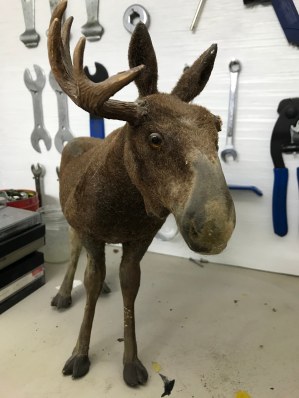
Bruce the Moose

The original Bruce the Moose, minus one antler, poses in front of some old guy’s bike tools.

But after we played the Monday to Thursday segment of our gig, the hotel owner dropped the bomb.

“Hey guys, you’ve been great, but I’ve got strippers coming in this weekend, so I don’t need the band.”

Gulp. We had been usurped by exotic dancers.

“But listen… My buddy runs the hotel in Beardmore down the road. He’s taking you on for the weekend for $500. You’re going to end up making more dough this week!”

Now you’re talking. We would end up making $1,300 for the week instead of $1,100.

We packed our gear into our brown van, the one with the brown shag carpeting inside, floor to wall to ceiling and back again. Some of the letters had fallen off the nameplate on the front hood. So now instead of being a Dodge, our van was a Dog. Our enormous brown Dog was powered by an undersized but sturdy slant six engine that burned oil.

The town was buzzing

We got to Beardmore and set up for Friday night.  The place was buzzing as the town had not had a live band play in its hotel for several years. Two young women came by to chat.  “We hear you guys stopped for Coke and O’Henry bars at the variety store.”

“Oh hi, wow. Actually, how did you know that?”

“Everybody knows there’s a band coming to town; word travels fast I guess,” replied one of them, Donna, whose nickname was Cowboy, matching the big hat she wore. Her friend was Penguin.  I was a bit confused by the nicknames but they were really nice.

We knew we had to step up, and for the next two nights we had a lot of fun. It seemed like the whole town came out to see us play, to dance, sing along and kibbitz.

We had a good long set list, so kept it fresh night to night.  We had a blues set, in which we all donned sunglasses like the Blues Brothers. We played a couple of songs from the classic Dan Ackroyd/John Belushi album popular at that time. We hammered out a couple of ZZ Top songs, some slick Powder Blues, and some original blues songs. John played keyboard and lit into the blues vocals; he sent his synthesizer soaring on solos, eyes closed.

We were high school friends from Don Mills Collegiate Institute. We had practiced in the band room there after hours, thanks to our talented, dedicated, generous, if sometimes grumpy, band teacher, Al Harkness. Our parents also had extreme patience as we honed our craft playing amplified music in their basements and garages. We would play ZZ Top’s “Tush” at full power in John’s basement, then afterwards his sweet British parents would offer us tea and biscuits and tell us: “Well done boys, it’s sounding quite good!”

The Moose’s backstory

The name of our band was derived from an antique moose handed down from the Kinross side of my family.  It’s the type of artifact you’d take to the Antiques Road Show.  John, who would go on to a career in music performance and recording, used his artistic skills to paint the band name on the front skin of my Ludwig bass drum: Bruce the Moose.
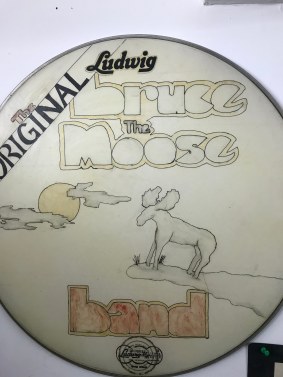
Bruce bass drum

Music is a about feeling and we gelled on those songs on our summer road tour. We had practiced hard and had been playing five or six days a week. We could lose ourselves in the feeling of the music, like The Doors songs we performed. “Try to set the night on fire!” You can’t help but get hypnotized by that song.

Or “L.A. Woman”, where Steve, on bass guitar, channelled Jim Morrison on the lead vocal. Steve laid down a nice bass line on his blond lefty Fender, but because lefty instruments had been hard to find, he could also switch-hit if necessary on a righty bass played upside down. Joe played rhythm guitar and then would speak in tongues on his lead guitar solos, sometimes venturing into wild territory on key signatures, rhythm and scales: major, minor, mixolydian, you name it. He got a nice ovation from the crowd for his work. I was back on drums keeping the beat and sometimes singing some backup vocals.

Turn me loose!

The good folks of Beardmore were dancing and wanting to party with us during break. They had song requests, some of which we could take. We had to disappoint one of our biggest fans though. Through most of the night, in between songs she kept screaming out: “Turn me loose!”

Hey, it’s a great song, but we hadn’t practiced Loverboy.

Steve recalls: “The Roxy Hotel in Beardmore was packed and rockin’. We finished a song and some older dude comes from the back of the room shoving his way to the stage. He’s got a drunken grimace and a clenched fist in the air. He gets closer and I think we were ready for some kind of altercation but instead he reaches up and shouts “you guys are fuckin’ great!” and hands me a US 20-dollar bill!”

Late at night we hung out and watched some spectacular Northern Lights streak the Northern Ontario sky with shades of green.

The next morning Steve was wearing a red bandana around his neck, obscuring a hickey from Donna. I was jealous. Steve looked like Jim Morrison. I was still in my Richie Cunningham phase. Penguin apparently was not a fan of Ron Howard.

Let’s not think we were too cool. We were fresh out of high school. Two of us were still underage. When one bar owner asked Joe to produce ID, he gave them his North York Public Library card, which did not have a birth date on it. They accepted it and we played the gig.
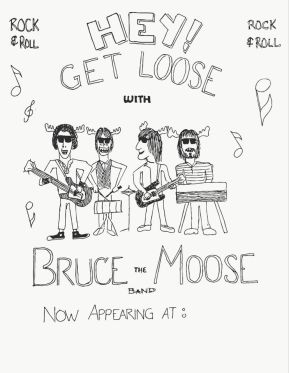
btm poster

That summer of 1981, our trusty Dog van propelled us across Ontario, from Niagara Falls to Minden to Huntsville to Chelmsford to Wawa to Blind River, Geraldton and Beardmore.  And then back south to the Rockcliffe Hotel in Minden, where a bunch of our friends showed up to join camp counsellors, cottagers, locals and, of course, bikers in the audience.

Redcap and vitamin C

We stayed in grungy rooms upstairs with a closet big enough to hold a 24-case of Redcap Ale.  Typical of Ontario hotels, there was a single washroom accompanying the rooms upstairs, so when we took a shower we had to make sure the coast was clear of the old guys whose Canada Pension Plan cheques funded their semi-permanent stay at the Rockcliffe.  One of these characters once came down the stairs in the middle of our set and bellowed: “Can’t you play any country music?”

The bartender at the Rockcliffe was a guy nicknamed “T.R.” from California who drove a Corvette and claimed to be a Vietnam veteran with a metal plate in his head from a war wound. When one of our visiting friends challenged his claim after too many drinks, some quick mediation and changing of the subject was in order to prevent a scene from Platoon.

“It was a wild ride that summer and I didn’t want it to end,” says Joe, now a professional guitarist in south-western Ontario. It was also a blur for Joe because he played many of the same bars with different bands in later years — “same bars, sometimes different names.” Joe recalled an incident in Huntsville where a friend of our band took off at night in a canoe and we were scared for his safety. The police were called and “it could have been a case of CUI — canoeing under the influence.”  However the police took kindly to the situation and let our friend off with a warning.

A quick note about nutrition. As we were on a shoestring budget, we ate just two meals a day.  Waking late, we would go for a big breakfast, typically bacon and eggs and coffee.  Then a western sandwich or burger or grilled cheese special for supper.  A couple of venues offered us beer at cost during the show; those calories were welcome. Finally, we tucked into Joe’s huge supply of Vitamin C pills at all hours.

That Rockcliffe gig was the highlight and twilight of our summer road tour.  We packed up our instruments and sound system and took our last trip home in the Dog. School and jobs and girlfriends and new destinations beckoned in the fall. We were mostly broke and could use a short break from each other after being together 24/7.

We were moving on, like the line in the Burton Cummings ballad:

“Break it to them gently when you tell them that you won’t be coming home again.

*************************************************************************

Epilogue: And I heard from our keyboardist and singer John Brocksom, who has played many roadhouses over his career in music writing, performing and recording:

“It’s all just a blur, or even a remnant of a blur that I might have heard about second hand — seeing the impressive countryside and rolling hills in Norther Ontario, a foggy view from a window in Wawa, throwing myself to the stage during a song (Automobile?) and your shocked looks, sleeping in the van in a hotel parking lot somewhere outside of Chelmsford, staying up all night with Steve writing in Huntsville. Also the hitchiker we picked up somewhere who promptly sat on our cooler and snapped the lid.

I agree the highlight was the Rockcliffe, though I can’t for the life of me figure out how (and why) all those Don Mills friends got there.”

Editor’s note: The Rockcliffe Hotel closed just a few years ago. A Canadian icon, it is in dire need of TLC and can be had for a song: under $400K. Here’s to more music memories at the Rockcliffe and Ontario’s hotels and roadhouses that have supported live music for so many years. 
Music magic with Barry’s band

Saxophone getty image

For his 75th birthday, Barry had treated himself to a gorgeous shiny-black grand piano. I sat on the drum kit just to his right. Just across the room, Barry’s wife Lois was putting on the strap of her banjo, which she strummed in a jazz rhythm style. Completing our rhythm section was a bass player, busy tuning his gargantuan stand-up instrument.

Barry had arranged the scores for that evening on his piano stand and, as band leader, he would call out charts and tunes.

I was lucky to be the back-up drummer in Barry Cartwright’s weekly jam session in North York. It was my last real music gig.

Barry’s the father of one of my high school friends, John Cartwright. John and I had played in our high school stage band; he had a sure touch on tenor saxophone, and I was back on the drum set keeping the beat.

Barry is a long-time jazz pianist who brought together musicians for weekly jam sessions at his home for many years.

“I’ll be there”

As back-up drummer, I was a bit like that Zamboni-driving emergency goalie who helped Carolina defeat Toronto awhile back. Once in a blue moon on a Wednesday night, I’d get the call from Barry:

“Ian, we need a drummer tomorrow. Can you make it?”

It was nice to feel wanted, knowing I could step up when the regular drummer was on the shelf. And unlike the emergency goalie, I got to play dozens of times over the years. “Okay Barry, I’ll be there.”

A typical night with Barry’s band started late, around 8 p.m.  My Ludwig drum kit was on long-term loan in his basement, so I just showed up with a pair of sticks and brushes.

Structure and soul

Over the course of the next four hours, Barry’s band would work its way through many charts and music styles from jazz to dixie to latin. Take a typical jazz standard like “All of Me.” The beauty of the song is the mix of verse and chorus, structure and freestyle.  The band plays together through a verse and chorus, then one by one, musicians playing instruments such as trumpet, trombone, clarinet and saxophone would have a go at soloing.

I recall Mr. Hallam, another father of a high-school friend, playing soulful clarinet solos, his sound soaring over the band while his torso twisted in empathy.

An elderly trumpet player — I will call him Bill — blew confident, melodic solos, sometimes using his mute to give sensitive contrast. When Barry called out a chart, Bill would give his thoughts on the mood of the song, to get his head around it before he played — “That’s a dreamy kind of number.”

Barry would take a turn at a piano solo, his adrenaline up, his arms and white hair flying. And once in awhile, the rest of the rhythm section would also get to freelance. For me on drums, sometimes the band “traded fours,” giving me alternating four-bar spots to adlib my way around the drum kit.

Then the full band would fall back into formation and go full power for the final chorus and finale.

Our motley musical crew played until midnight! We enjoyed a rollicking evening of music, breaking only for a chat over beer and beer nuts. During break, some of the musicians recalled their gigs in the glory days of big bands, back in the day when a trumpeter could earn money as a professional musicians. A few still played gigs from time to time at special events.

Midnight magic

When the clock hit midnight, more magic.

Lois would have put down her rhythm banjo around 11:30 p.m to sneak upstairs to the main floor of the couple’s spacious split-level home.

When the music stopped, we also headed upstairs to a midnight feast prepared by Lois — apple pie, cheese, coffee and other goodies. A chance to reminisce, recap the evening, talk about music, wish others well.

I was the “young guy” in my 40s and 50s, while many of the musicians in Barry’s band were well into their 80s. But they would tire me out. I’d be sitting eating apple pie afterwards, in the wee hours of the morning, thinking, “I gotta work tomorrow.” Then I would drive home in a blissful state through the darkened and empty streets of T.O.

I recall the last time I saw Bill the trumpet player, he of the dreamy touch on muted trumpet. I noticed he had small IV tube in his arm.  He had brought along a few favourite record albums that he wanted to give away, and during the break he got a few takers.  About a month later, Bill passed away in his sleep one night, after playing his final evening session with Barry’s band, and taking his coffee and pie at midnight as usual.

I ran into Mr. Hallam the clarinetist a while ago. He was doing well, still playing, although he told me Barry’s weekly jam session had ended. My phone no longer rang on a Wednesday night. I had been out of the loop for awhile. Sadly, Lois had passed away.

What a legacy. Barry had propelled his jazz band into his early ’90s, his fingers dancing on the keys of his grand piano. So much music over the years. So much pie, coffee and midnight chats, so much joy.


Doing my hearing homework

Would you consider it “work” to listen to a favourite album?

That’s how it felt as I slowly became accustomed to the new sound system in my right ear. The cochlear implant had been installed surgically by Dr. Lin and the team at Sunnybrook Hospital in late 2017. Hearing speech in that ear was better already, but music tended to sound chaotic; I avoided it.

The first few months, my homework had been focused mostly on the sound of language. I streamed two programs directly into my right ear from my Ipad, and made educated guesses about the words, sentences and sounds I was hearing.

An online program called Speech Banana focused piece by piece on all the consonants and vowels in the English language. Another program, Angel Sounds, explored language as well as environmental sounds such as a dog barking, or a siren wailing.  It also featured a music test to distinguish different pitches. I had a tough time with that one, often hearing the same note when, in fact, it had risen a whole tone or two (shown on a visual chart). Gah!

speech banana

But with practice, I got better. My brain was getting accustomed to a new auditory input. I tried to put in an hour or two of listening homework each morning. My scores increased. I added my left ear to the mix, with its conventional hearing aid and sometimes distorted hearing.

To inject levity, I watched Stephen Colbert’s daily YouTube clip — basically his take on world news and clever skewering of the orange-haired one and his antics in the U.S.  Then I added the two Jimmys — Fallon and Kimmel — to my hearing homework.

The combo of video and sound helped a lot. Even for a person with normal hearing, seeing someone’s lips improves comprehension.

I was nervous about adding music to the mix, as the Meniere’s condition in my left ear still created distorted sound. Singer Huey Lewis recently spoke about the impact of Meniere’s, and how he had to stop performing when he could no longer sing in key. I posted a comment to Huey’s Facebook page wishing him the best, hoping his condition may stabilize or he may find hearing technology that will bring the music back.

Stories and emotions

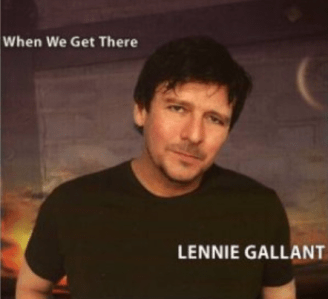
YouTube certainly had a tempting variety of music. I searched for Lennie Gallant, an east-coast folk musician we had seen perform live a couple of times. Once, during a break in his performance at Toronto’s Hugh’s Room, I had found myself side by side with Lennie at the urinals in the men’s room. Thinking it was not the best time to bother him, I chatted with him later that night and bought his CD, When We Get There.  I grew to love its mix of stories and emotions, including songs sung in both English and French. A musical craftsman.

Lennie

My daughter Ali had once played Lennie’s music on her laptop for me while we drove to her university home in Hamilton, Ontario — holding the device close to me in the car while I was having a rough spell with my hearing.

Now with my YouTube search, up popped Lennie’s song about love and loss: Pieces of You. I pressed play. I had not heard it in a couple of years but knew the song well and could immediately lock on to the pitch and melody of his vocal.  Seeing Lennie sing it helped me hear it as well. The music mix slowly came into focus in the background. I felt hairs tingling on my neck, knowing that there was some hope to enjoying listening to music again.

Listening to music is work, though. Another favourite album was Gordon Lightfoot’s A Painter Passing Through.  It is a hidden gem among his more popular songs and albums. I dropped my CD into the player in our kitchen and winced at first when I heard the first song, Drifters, a tribute to the cast of characters in bars and music joints. Focusing on Gordon’s vocal, I could slowly put the rest of the mix into place.

A fuzzy image comes into focus

I could follow the bass progressions a little bit.  The percussion sounded crisp. The song was coming together like a fuzzy photograph coming into focus.  I was hearing it through the triangle formed by 1) my memory, 2) some amplified hearing in my left ear, and 3) a new implant in the right ear, delivering sound straight into the cochlea:  “Whether it’s right or wrong, the words of every song, remind us of the love we knew when love could not go wrong, in yesterday…”

When I say that the first factor to hear a familiar song is my memory, what I mean is that my brain knows what the song should sound like.  Somewhere in between that memory and the actual new sound input, there is a fusion of sorts.

I made a habit of playing the CD while preparing supper. Each time I listened, Lightfoot’s musical tapestry became more vivid.

I had a few hearing homework setbacks, like “The Completion Backwards Principle,” a classic album by The Tubes. It is a zany, rock music spectacle with a satirical premise, but music better left intact in my memory at the moment.  Too chaotic for me to follow these days.

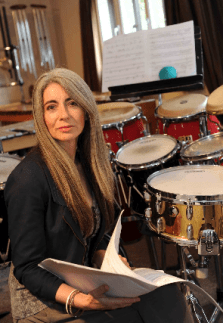
Finally, a friend had mentioned a top-flight Scottish percussionist who also happened to be deaf: Evelyn Glennie. I found her TED talk on line….

Evelyn Glennie

Evelynn had lost most of her hearing as a young girl. As she pursued a career in percussion, she experienced music not just through sound but through sight, feeling, intuition, and the kinetics of the human body.

In her TED talk, as she approaches the marimba to perform, Evelyn takes off her shoes. Percussion and music can be experienced through the feet, arms, hands, head.  The body as a resonator — the mind open to experiencing music in multiple ways.

Evelyn is not just an internationally known percussionist, but a champion of music for all, including people with different abilities. She has pushed the music education system and community to see beyond prejudice, to see a universe of musical opportunities for us.

Such rich musical artistry and ideas. So much hope.


Maximum percussion

I was a teenaged kid clutching a pair of claves — two wooden sticks — on stage at an international music festival. There was nowhere to hide.

With four of my fellow North York Percussion Ensemble musicians, we got ready to perform “Pieces of Wood” at a packed concert hall at the University of Western Ontario.

The composition by Steve Reich introduces and develops a rhythmic theme, syncopated through five performers as each joins in. There is also interplay between the different tone and pitch of each pair of claves.

Usually, us drummers are holed up at the back of the band. We are part of the bedrock of a musical composition, holding and advancing the rhythm, but often hidden behind cymbals, massive copper tympani, music stands, or even tubular bells.

On this day, I felt a little more exposed. I recall my forearms tightening up with nerves before we went on stage. But we had practiced the piece and our program relentlessly.

A rhythmic river

The sound of each clave striking its pair is enriched by cupping the palm under the receiving clave — to create a small echo chamber. Reich’s composition unfolded beat by beat into a rhythmic river, echoing throughout the hall. Hypnotic for us performers, and for the audience.

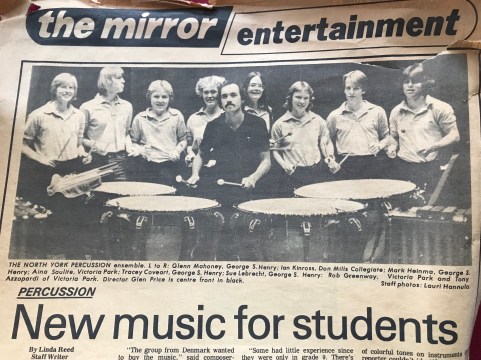
Our musical mentor and percussion guru was Glenn Price. Many of us had taken drum lessons with him. Then he raised the bar by establishing a percussion ensemble at his high school, Toronto’s Victoria Park Collegiate. While studying music at the University of Toronto, he expanded the group into regional collective, bringing together percussionists from many North York public schools. We performed across Toronto and at music festivals including the Kiwanis.

IMG_2450 Mirror photo

Glenn drove us to experience maximum percussion.  That meant going beyond traditional instruments such as a snare drum, to a medley of keyboard instruments such as the xylophone, and learning the music theory, chords, and melody techniques behind them.

Instruments in the percussion family create a palette of musical sounds and textures. “Bells ring, raindrops fall on water and deep chimes sound when these kids get  together,” wrote Mirror reporter Linda Reed in a feature article about the ensemble.

As we practised in advance of concerts, Glenn scrounged percussion instruments from several high schools and his own personal collection to loan to us so we could practice at home — I recall a checklist of vibraphones, marimbas, glockenspiels and other instruments in constant circulation with our group. Glenn and his girlfriend Debbie would ferry us to concerts, cramming musicians and various percussion instruments into old station wagons.

Musical fusion

Maximum percussion also meant bridging classical, latin, pop and other musical forms. It meant rehearsing and performing to achieve the synergy of an ensemble.

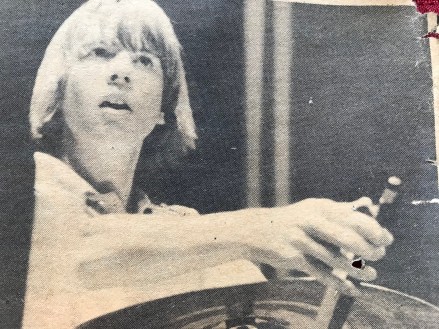
IMG_2446 Ian with cymbal

A violin bow resonates a Turkish cymbal

“We benefited from the discipline of practicing regularly as a group with a very organized and professional teacher,” recalls Ward Cornforth, a percussion compatriot and former member of the ensemble. “I think what I gained the most is the love of performing publicly — the excitement and feedback from the audiences,” said Ward. He also recalls a U.S. road trip with the ensemble, including participation in a drum clinic at the Eastman School of Music in Rochester, NY.

Ward went on to a lifetime of musical performance, most recently as the lead singer and guitarist in a Johnny Cash tribute show — We Walk the Line. Ward added that lessons learned from the ensemble have carried on to the next generation in new ways — his teenaged daughter is pursuing track and field. Her family ensures she has full support as a member of a high-level team.

Glenn certainly pushed us to find new musical opportunities — for me, that meant playing with the North York Concert Band, a gig with at the Canadian Opera company’s summer dinner theatre house band, and touring Ontario with our high school rock band, Bruce the Moose. After university, my percussion performing waned, but I picked up the guitar and piano for fun, and continued to appreciate percussion in any music I listened to.

The beat goes on

Through social media, many of my percussion ensemble musicians reconnected, and had glimpses of how music became a thread in our lives. Rob G. and Tracey recently formed a duo — Hush and Rust — putting new spins and moods on classic songs. Both continue to write and perform original music. Sue shared a video of an all-women band she had just joined as drummer. Ward was touring with his tribute band, channelling 1960s-era Johnny Cash. In the footsteps of two musician parents, Tony’s daughter had become a singer-songwriter. She had recently asked her Dad to play drums on two new tracks in the studio. Barry was subbing in as a blues drummer in the UK, while his son was drumming for a dynamite rock band in Europe. Rob P. was hosting and playing in jazz jam sessions at a coffee shop he owns. And Nick’s daughter sang gorgeous jazz vocals.

Meanwhile, our mentor Glenn had continued his career as a music educator and conductor internationally, inspiring many generations of musicians. He is now Conductor and Director of Performing and Visual Arts at California Institute of Technology (Caltech).

*******************************

On stage at the international music festival on that day in the late 1970s, my forearms had loosened up. The house was packed with musicians from 40 countries at that event, organized by the International Society of Music Education.

Our ensemble was in the zone, arms and hands flying. Reich’s “Pieces of Wood” built to a percussive climax, a wall of sound. Then it ended on a dime — to stark and serene silence.

The audience came out of its trance. A flood of applause. The forearms tingling.


IMG_2448 Poster

Vintage poster from a show we performed at Seneca College’s Minkler Auditorium


Hearing the drums: Who is your favourite?

“Who is your favourite drummer?”

The question caught me off-guard. I was having a post-game beer with three recreational hockey buddies at Amico’s, a gritty Italian eatery on Queen Street West in Toronto. The joint is known for its delicious $10 pasta specials, pizza, and selection of beverages, as well as for its cast of characters and 4 a.m. closing time.

I had set music aside about five years earlier after my remaining good ear — the left one — went haywire from a condition called Meniere’s disease.  I had stopped listening to music as the distorted sound was too painful, physically and emotionally. I could no longer hear the musical tapestry or pitch of a Beatles’ song, or a big band number.

I had also stopped playing music — no longer hacking around on piano and guitar at home. My drum kit was on permanent loan with the band of a jazz pianist I used to play with occasionally. Playing drums with rock bands, concert bands and a percussion ensemble were distant memories.

But after receiving cochlear implant surgery a couple of years ago in my right ear, and using a conventional hearing aid in my still wonky left ear, the music was slowly coming back.

IMG_2410 drum pic

Steve Smith took this freeze-frame image of my hands playing the snare in the mid-80s. Reflected in the background, some older guy uses his iPhone to recreate the photo. 

So when my friend Joe — the stalwart goalie of our McCormick Arena hockey group — asked about drummers, I had to pause.

“I guess I have to go back a few years,” I told him. “Some of my favourite drummers were not virtuosos — they were part of the sound of some of my favourite bands: The Guess Who, Max Webster, and April Wine.”

Sound and mood

Take Garry Peterson, the drummer for Winnipeg’s The Guess Who. His crisp, cool and economical style was the cornerstone of a mesmerizing sound on songs like “No Time” and “American Woman.” He didn’t get in the way, or take the spotlight in tumultuous solos — he was a key part of a special musical fusion. Same goes for Gary McCracken, the original drummer for Max Webster, an innovative and zany rock band out of Sarnia, Ontario. He had an energetic but fluid style that seemed effortless through mood and time changes on a song like “The Party.”

I was blanking on the name of April Wine’s drummer. My friend Steve, who has an encyclopaedic knowledge of rock, quick thumbs on google search, and a heavy slapshot, came to the rescue: “Jerry Mercer.” Jerry lays down a powerhouse beat on “I like to rock” that is a key part of the musical mix. The YouTube video of that song is heavy, campy and joyous. You can google it.

A drumming showman

I said that I did appreciate one virtuoso — jazz drummer Buddy Rich. I was lucky to see Buddy live several times in Toronto, at Seneca College’s Minkler Auditorium. He was a grouchy taskmaster, slumped over his drum kit, leading a band of hot young players from across the U.S.  He would lay into an opening beat and shout out the score number — sending his bandmates flipping through their musical charts to be ready.

buddy rich

Buddy Rich — in the zone

In his drum solos, Buddy was a showman.  He set musical themes and used contrasting times and volumes to develop them, often with high drama — like when he brought his snare roll to a bare whisper, or used only his cymbals to repeat the theme.  The thing that was obvious about Buddy: musical was a language he learned at a very early age. Through his drum solos, he told stories.

As we chatted over beer and pizza, my friend Dwayne mentioned the modern-day You Tube musical café of rock-soul singer Darryl Hall — he of Hall and Oates fame. Dwayne, who had played high-level hockey in his home province of Saskatchewan, noted that Darryl would team up with musical friends. They were reinterpreting old hits with a mix of new and old talent, including some great drummers and percussionists.

I replied that as my hearing came back I had gotten hooked on YouTube videos where drummers break down classic beats.

Mastering the half-time shuffle

One example is Jeff Porcaro’s half-time shuffle on Toto’s hit, Roseanna. Jeff was in the spotlight as Toto’s drummer and was also a sought-after studio musician.  He invented complex rhythms that came off clean and understated in his performance. His half-time shuffle, which he adapted from other drummers he loved, uses a tricky triplet hand pattern and a hard snare back beat on the third note of a four-four bar. In addition, the bass drum plays a kind of bossa nova syncopation over two bars.

Jeff died young unfortunately, but his inspiration keeps the beat. Many drummers have celebrated Jeff’s half-time shuffle by breaking it down on their YouTube clinics. After watching a few of those videos, my hands and feet were twitching. I realized I could play Jeff’s shuffle in my mind, albeit at a very slow pace.

At our Italian eatery, I could hear my friends better, and even catch the pasta specials when Melissa came by to take our order. (This particular evening was the second last before our ice rink and bar were shuttered for the coronavirus pandemic).

Blazing drum battles

Joe said he had been more into sports than music in his youth but remembered the joy of competitive ballroom dancing to swing music as an adult. Dwayne recalled watching Gene Krupa, another top-class showman drummer of the jazz era, and some of the drummers showcased on Johnny Carson’s late-night show. Carson himself was a decent drummer, but his house band, including drummer Ed Shaughnessy, became an incubator for some great drummer wizardry over the years. Shaughnessy went toe to toe with Buddy Rich, for example, in a blazing duel of drumming talent. Then Buddy took a comfy seat with Johnny to trade jabs about music and life.

One of Steve’s favourite drummers was the late Neil Peart, top-flight drummer of the Canadian progressive rock band, Rush. Neil and his bandmates Geddy Lee and Alex Lifeson “had the chops and sounded way bigger than a three-some,” Steve said. Interestingly, one of modern drummer Neil’s big influences was… jazz legend Buddy Rich. When Buddy died, Neil paid tribute in a drum solo channeling Buddy’s style.

Our talk triggered many musical memories. I was starting to listen again, and dream about drumming.