Cramming them in at the Kids’ Kabin

Around 2007, my father-in-law Claus was under the gun to squeeze even more grandkids into the little log cabin he had completed in 1998.

Claus and Ann were lifelong learners, enjoying courses at Haliburton’s School for the Arts in summer. Ann honed her pottery and art skills, while Claus learned about the fine art of woodworking — including a course specializing in the use of the router. 

Another course that caught Claus’s eye was memoir writing. During that one-week course, he told stories about his childhood in Manitoba, school days, his volunteer work in Africa — and about the little problem he was having fitting all the grandkids into the log cabin. 

The title and story are his original; I have added a few subheads and photos. I would add an editor’s note: I recall Claus joking that there was sometimes an excess of emotion when his memoir-writing classmates read their stories — tissues had to be close at hand.  Claus, by comparison, shared stories of his life and family with his own sense of humour, and carefully crafted details, without shedding a tear. The emotion — his love of family and pride in his craft — was implicit.

Here is the story he titled: “Cramming them in…” 

First five kids.png

By Claus Wirsig:

While large and rambling, our log cottage has only two bedrooms and a bunkie. Though a huge living room also lends itself well to accommodation of a pullout double or twin bed in one corer, the growing family size signalled trouble ahead.

All four of our daughters, scattered across the continent, wanted to gather at the cottage for their annual get-togethers. There were also friends to accommodate and the two oldest, Denise and Nadine, were married and already had three children between them. The first grandchildren were aged four and two in the summer of 1996. They liked to romp in the woods, play house, of course, swim when possible, and so on. Their mother, Nadine, suggested what they would really enjoy was a playhouse in the bush they could call their own.

Scouring the hills for cedar

Someone guessed they might even want to sleep in such a house. An idea started to take shape in my mind. Wouldn’t it be nice to build a small cedar log structure with a proper roof, door and real windows? I spend the summer scouring the Haliburton hills and found old, very old, Harvey Macintosh with a fence-post cutting business and a small sawmill operation. Perfect. A descendent of Macintosh apple creator, he had stacks of eight-foot cedar posts and 12-foot brace rails. I picked out about 80 posts of the rather small size I needed and a dozen brace rails of similar diameter.

Peeled, sawn on two sides to a uniform thickness of three and one-half inches, another long story, and dried over the winter, they were ready for my construction project to begin the next spring. In the meantime, I had built a solid full one-inch cedar floor in my garage workshop. It was the exact size, nine feet by 11, to fit within the hundred square feet exemption cut-off for a building permit in the county. The floor boards were solidly mounted on four pressure treated four-by-fours.  I also prepared a site behind the cedars quite close to the cottage and hauled in a solid crushed gravel base. That was year one.

Claus with joinery

The logs fall into place

First thing in spring of 1997, after gardening was properly underway, we hauled the floor to the building site. Then, one by one, the logs were put in place with spaces for the door and four windows, all of which were installed as the building went up. The door I constructed of solid cedar planking. The windows were recycled from an old fruit packing shed in B.C. which my dad had demolished many years earlier and I was able to have transported to Toronto. The three grandchildren, all girls, were delighted to climb over the construction site with growing anticipation of the time they had a real house of their own.

claus on ladder.png

To finish off I designed gable ends that looked like logs set vertically and an asphalt shingle clad roof, all specially designed to be air tight and animal proof. One son-in-law, Ian, helped with shingling the roof. Another, Frank, installed the electric service on an underground line from the switch box in the main cottage that Ann had helped me bury under our front lawn. All was in readiness for the interior finishing — but next year.

Design dreams in the wee hours

The workshop was humming in May and June of 1997. During the winter, I had worked out the designs in my head for four sleeping bunks and other fixtures that would be needed. These design sessions usually came upon me in the middle of the night and robbed me of many hours of sleep, just as they had done the previous winter when I had worked out the plans for the bunkie itself. In my mind, I always thought of it as a bunkie. When it was finished, the kids quickly baptised it “The Kids’ Kabin” with two K’s.

With three grandchildren underfoot and a fourth underway, clearly the least number of sleeping bunks required was four. So, the design provided one set of upper and lower bunks on each side of the cabin. All were attached to the wall with hinges so they could be tucked out of the way against the wall when not needed. The ground floor bunks each hid a large roll-out drawer and had additional space on the floor for other storage including a ladder needed to get to the top bunks.

Windows front and back had hinges and screens for fresh, cooling night air. The window on the side facing the cottage gives a good view of the cottage past the cedar tree trunks. Against the blank wall at the foot of the bunks, I built a corner bench along two sides stretching from the end of the bunks around to the small closet in the opposite corner where the door opens in a tight spot between the closet and the bunks on the other side. I made a bookshelf high over the bench and window at the open wall. The drawers are rarely used and the main function of the closet has been to house the potty that is so handy for the younger children.

“Their eyes sparkled…”

The best inspiration I got in my nocturnal mental wanderings was the construction of a collapsible table between the two sets of bunks, reminiscent of dining tables seen typically in travel trailers. Hinged about 12 inches from the wall, when the single but sturdy supporting leg is clapped inward, the table provides a marvellous card or other game playing space between the bunks and is readily collapsed into a small night stand. Four covered foam mattresses, each 30 inches wide and 72 inches long, and voila! The Kids’ Kabin was ready for business.

The two oldest grandchildren, Alison and Colleen, arrived on Friday evening of the July 1st long weekend. Their eyes sparkled as they came down the lane and I opened the door to the building I had finished not 10 minutes before. They could hardly wait for bedtime. After some excited chatter which we followed on the  baby monitor beamed to the cottage, at the age of only five and three, the girls slept right through to morning. They have only rarely spent a cottage night anywhere else since.

three girls.png

The grandkids keep coming!

Two weeks later, their cousin Anna from New York arrived. And so did Chantal, the daughter of Karen’s partner, Stefan. All four bunks were filled each night!

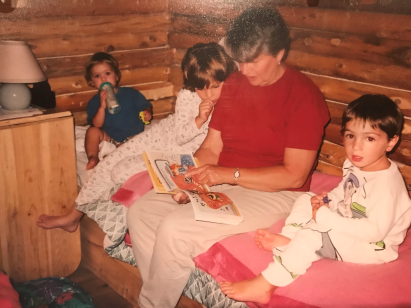
By the spring of 1999, trouble arrived in the shape of newest grandson, Paul. Where were we to put him? The four bunks were occupied. With some reluctance, I converted the nice bench at the end wall to a bed with a 24 by 60 inch foam mattress. It worked like a charm. This was Paul’s special bed.
Ann and kids.png

But life and laws of fertility being what they are, the next year brought another body to the house in the Kids’ Kabin in the form of Rachel. What to do? I designed a slat frame similar to the bunk beds that could be fit between the two lower bunks. Rachel was delighted to be able to sleep between two big cousins. Problem solved. Six kids housed in a four-bunk cabin.

Colleen and Rachel.png

A few years later, yet another challenge arrived in the firm of Karen and Stefan’s new son, Felix. Suggestions anyone?

Claus and Felix.png

kids on dock.png

Epilogue

Now let’s hear from more of the grandkids…

Rachel, now an engineering student, recalls:

“The cabin had an assortment of blankets — the tiger, the red plaid etc. — and Paul and I would call dibs on the best ones.  There was always a rotation of Archie comics that travelled between the cabin and the cottage, and I would hunt down the ones that I hadn’t read yet (that summer) all over the property and bring them back to the cabin.”

“It was always the most fun when the cabin was full of cousins; I would stay up late to listen to all of the gossip.”

Felix, the youngest, and now the tallest, writes:

The first memory I have of the cottage is the cabin and the sand box outside of it. I was the youngest of the kids so I slept on the small bench at the edge of the cabin.
I remember having a lot of fun as a young boy. I would sleep with my older sister and my five cousins in a confined space. The cabin reminds me of summer and of nature. I spent a lot of my summer at the cottage in which I slept in the cabin. We swam, went on boat rides, did treasure hunts, had marshmallow fires, played cards and name games and had many fun and memorable moments at the cottage.
I was always amazed that the cabin was built by Claus (grandpa). I remember waiting for the other kids to have pancakes, porridge or eggs and bacon. We would have great conversations late at night. 
I was so sad when we could no longer go to the cottage. A big part of my childhood was spent at the cottage and in the cabin so I was glad we could keep a big piece of the cottage. Nadine and Ian’s cottage is very close to the old one. When the old cottage got sold, Ian and Nadine decided to move the cabin to their cottage. Although we cannot go to the old cottage, we can still go to the cabin. 


Stone terrace twilight

Our bluebird family had flown the coop for warmer climes and the Canada Geese were flying circular training runs in the farm field next to our cottage. Honking in their traditional V-formation, and weaving expertly through a set of hydro lines, they prepared for the journey south.

canada geese
oak with frost

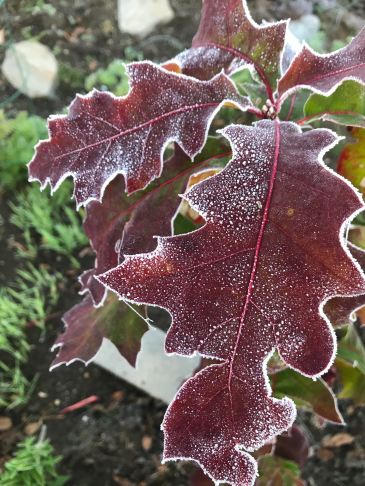
First frost shimmered on fall colours in Minden Hills, lighting up the leaves of the baby pin oak tree next to our garden.

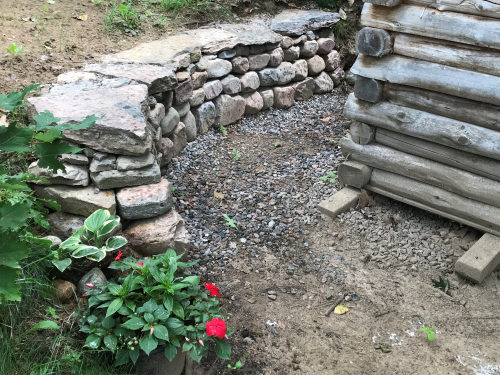
Several tons of stone and a special order of granite that I had obtained from Brent Coltman and his father Wayne had been formed into new dry-stone terraces surrounding the little cabin in the forest.

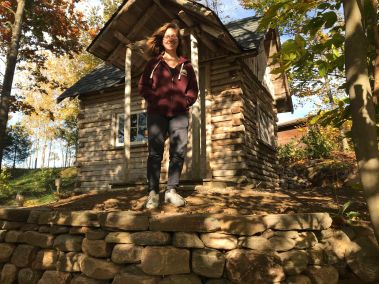
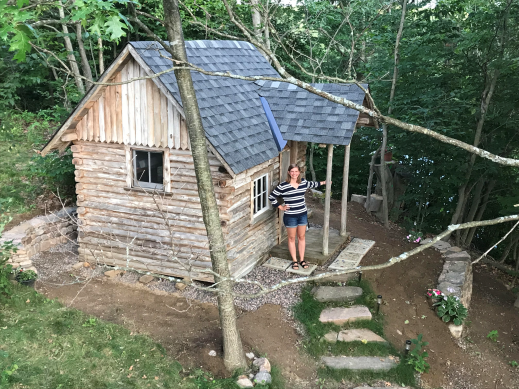
The cabin, originally built by my father in law, Claus, and later moved to our place by truck and crane, now had some breathing room in front and back. It would stay higher and drier in the long winter, and it sported a new extended front porch area for future occupants.

For my stone work this year, I had channeled learnings from master stone waller John Shaw Rimmington and my classmates at Haliburton School of the Arts.  Working with sometimes gnarly and ancient stone once rolled by glaciers, I had come to appreciate its beauty and history. And yes, as I got into a rhythm, putting the pieces of the dry stone puzzle together, I occasionally dreamt of stone.

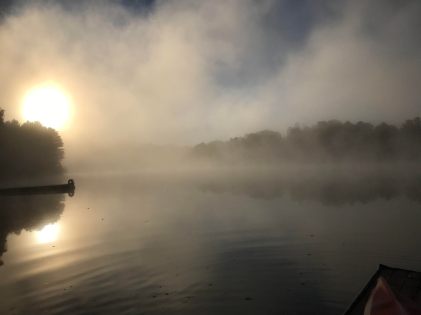
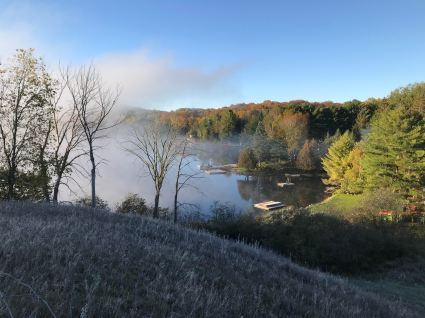
The morning frost sent a mist off the lake and up the hill.

misty lake

fall lake view

Around the cabin site, new perennial hosta plantings blended with a grove of smooth-barked beech. Annual impatiens flashed their final colours of white and pink. Sturdy oak trees continued to rain down their motherlode of acorns for local critters.

By the lake, our stone terrace gardening efforts had yielded some new perennial plants that were now established and should survive the winter. Nadine’s gladiolas and hydrangeas continued to produce beautiful blooms for table arrangements. Annual orange nasturtiums cascaded and collapsed over the stone, touched by frost. The fig trees I had put out in pots for an Italian garden touch would need to be brought inside soon to hibernate during the long Canadian winter.

We were missing our two daughters Ali and Colleen, who were living and working far from home — in Scotland and the U.S..  For this Canadian Thanksgiving, we were joined in Minden by four young adults — two of our nieces, Rachel and Katie, and two family friends, Mehtab and Alva — and Nadine’s mom Ann. They checked out the log cabin in its new stone nest in the forest.
rachel at cabin

On tap that weekend were some board games, a tour of local artists, and some homework for the youth movement — they were studying engineering, political science, commerce and social work respectively. The highlight was a splendid turkey dinner prepared by Nadine and Ann.

Next to a roaring fire outside, we roasted marshmallows, then coaxed embers around a big beech stump that was slow to burn. Night fell and stars came out across Minden Lake. As the air chilled, we fed the fire and nudged our chairs closer to its warmth.


Haliburton stone — so Gneiss!

As the terraces came into shape, I learned more about the stone I was working with.

“Your geology in Minden and Haliburton is quite different than ours,” explained Nadine’s cousin Jay, who lives with his family in Kingston, Ontario:

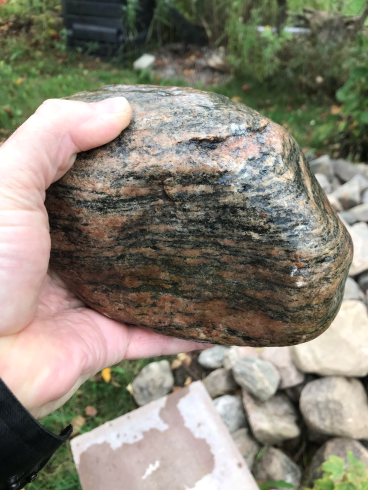
“Your stones are well-rounded because they were tumbled in the glacier melt, thousands of years ago. They were left to be found in the sand-glacial till mix.”

Gneiss in hand.png

Stone farmers

Farmers here know this, as they have been plowing up rocks with rounded edges of all shapes and sizes, and leaving them in rough fencerows, for more than a hundred and fifty years in the Minden area. In fact, I had pilfered quite a few of these beauties from an old farm field boundary behind Nadine’s parents’ cottage on Horseshoe Lake years ago.

As the stones often have a rounded look to them, sometimes they are referred to as “river rock.” Fortunately, many of these tumbled stones do lend themselves to dry stone walling, as they may have at least one set of parallel edges.

Different parts of the country each tell their own stone stories. In contrast to the Minden/Haliburton area, the stone near Jay’s home in Kingston “is still being calved by the freeze/thaw cycle from the original rock,” he noted.

Metamorphosis

My friend Rob had seen the big pile of stone on our front lawn, delivered that spring by local aggregates supplier Brent Coltman. Rob had a closer look and identified the stone as mostly Gneiss (pronounced “nice”).

It’s a metamorphic rock — meaning it has been transformed under high pressure and temperatures. And it was rolled along on journeys propelled by the glaciers that once covered Ontario.

Not only is Gneiss nicely-rounded, but it has a banded, layered texture and splits fairly well.  In a few cases where I needed to remove imperfections from a stone, I was able to find the seam of the stone and split off the bad bits with a hammer and stone chisel, and some patience. With a little more skill and practice, I could split more stone where needed to get flat edges.

“You can actually split it like firewood,” said Brent, who had dropped five tons of stone next to our cottage earlier that spring.

So the new terrace walls rising around the log cabin at our cottage were mostly made of Gneiss.  And the thicker, heavier capstones I had obtained to top off the walls were from granite seams of rock that had been untouched by glaciers.

An ancient fault-line

Feeding my addiction to dry stone walling, my mother-in-law Ann gave me a book telling the fascinating backstory of stone in Ontario.

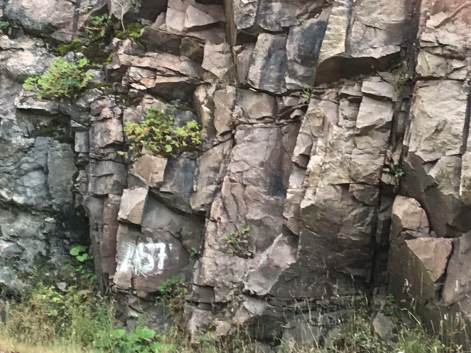
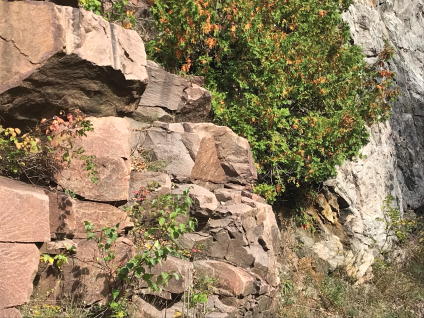
I learned about a giant fault line that bisects the tiny town of Miner’s Bay, just a short drive south of our cottage on Highway 35.

Miners Bay rock cut 1.png

Nick Eyles, author of Road Rocks Ontario, describes the clash of two major divisions of the Canadian Shield, seen in the road cut on the highway there.  One is the Central Gneiss Belt. The second is the Central Medisedimentary Belt. The contact between these two belts comprises rocks “that were stretched like warm toffee at temperatures up to 800C at a depth of up to 25 kilometres,” Eyles noted. Some Canadian Shield stone in Ontario is more than a billion years old.

The site at Miner’s Bay, which houses a popular old-style lodge between two lakes, “shows a superb outcrop of highly deformed marble.” This is made up of Gneiss and Granite — some of it marbleized and some busted up from tectonic activity. The tiny town also has a pretty church, its walls showcasing the beauty and diversity of local stone.

Miners Bay Church.png


Eyles hypothesizes about earthquake potential in this area: “It’s an inexact science but (this fault line) may be capable of creating a magnitude 7 earthquake every couple of thousand years.  The trouble is we don’t know when the last one was.”

Batten down the hatches!

Learning more about the stone from friends, family, and experts, made me appreciate the material I had been working with that summer to build terraces — its history, composition, and the beauty of its pink and grey layers.

So Gneiss!!

Miners Bay rock cut 2.png

Building with B-grade stone

The log cabin needed some breathing room behind it, to the east, where it nestled into a fairly steep hill.  A little terrace there would keep it high and dry in winter, and allow a walk-about around the exterior.

But I had used up the best stone on the first terrace. It now propped up the cabin’s entrance area. I would have to dig deep for more stone.

Many years ago, when our young family had moved into our home on Fulton Avenue in Toronto, the contractor had recommended “tavern-grade” oak for a reno on the main floor. “The B-grade stuff is half the price but actually looks nicer with the variations in grain and colour,” he had told us. Sold!

So my task now was to build a pretty and functional retaining wall out of the remaining B-grade stone. This one would be a book-end to the first terrace, with a straight stretch tracking parallel to the cabin wall, and a freelance curve ending next to a tree.

Working with gravity and gnarly stone

I got the area excavated with a spade, and put down some gravel.  With my old wheelbarrow and the benefit of gravity, I trucked the stone downhill to the job site.

The stone was local Gneiss, which had been washed by glaciers here thousands of years ago. The B-grade stone was gnarly, generally less straight than the first batch I had picked, and with rougher edges that sometimes needed to be knocked off with a chisel.  Its colours were motley, ranging from pink to dark blue-grey. But as I got the stone sorted, and a straight and level line put in as my guide, the wall started to come together.

gang by rapids.png

Cross-cultural fun

Our younger daughter Colleen had arrived, with her boyfriend Tim, and his family from France. Tim and Colleen stayed in the log cabin, getting a nice view of the lake each morning through the trees. The two families enjoyed some cross-cultural fine dining, both with home-cooked meals and at some nearby eateries.

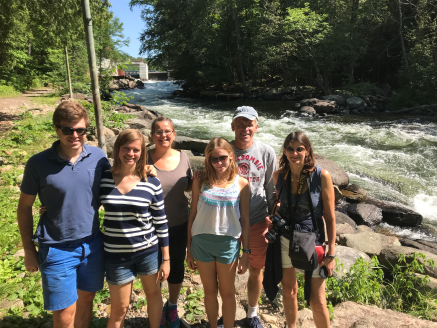
We also took advantage of a great stretch of weather to swim, canoe and kayak in Minden Lake, and walk to nearby rapids. One day, the gang swam about an hour down the Gull River — an annual tradition known as “floating your hull down the Gull.” We treated ourselves to some Kawartha Dairy ice cream as a reward — gazing at dozens of flavours and their mouth-watering descriptions as we stood in line outside the dairy. Muskoka Mocha, Death by Chocolate, Moose Tracks — there were way too many choices.

Flexing to the flora

The following week, I kept at the stone-walling, building up the second terrace course by course, and packing it with heart-stones. The wall behind the cabin was interrupted by two conjoined trees and their large root-ball — I walled around it rather than remove the trees and roots.  They gave the cabin some privacy from the neighbor to the east.

impatiens on beech stumps.png

A big old Beech tree had been taken down nearby due to disease, and Nadine suggested some flower pots to go on the tree stumps. We kept it simple, with colourful and shade-tolerant impatiens — by mid-summer they had come into their prime.

I still had some nice heavy capstones left to crown stone terrace number two.  The little terrace curved to end at the foot of a young maple tree, which was growing fast. It would add to the forest colour around the cabin, especially in fall.

From B-grade stone had come a cute and functional little A-grade terrace!

east retaining wall.png


The bluebirds were calling

As we experimented with gardens on our stone terraces, we continued to keep an eye on the eastern bluebird family in our small red bird box.  They were busy feeding chicks, the mother and father bluebirds swooping in with food and out with guano.

Earlier in the year, I had attended a naturalist group lecture about bluebirds and learned about a study underway in the Minden area. Local volunteers had built and set up many bluebird boxes in nearby Gelert, Ontario.  They were monitoring the effectiveness of the boxes to attract bluebirds, and a university student was preparing a report on the results.  The intent was to turn around recent declines in the eastern bluebird population.

I contacted a reporter at the Minden Times, a small but feisty local paper still practising old-fashioned journalism with news, features, and commentary on local affairs. On a sunny Saturday morning, reporter Vanessa Balintec dropped by with her camera and tape recorder.  Nadine and I sat with her in our screen porch.  As she asked us questions about our experience with hosting bluebird families at Minden Lake, we would occasionally point to the box outside our cottage when one of the adult bluebirds alit on the box: “Oh, oh, oh — look!!”

Vanessa took a nice close-up photo of  the male bluebird, with its orange breast and bold blue wings. She wrote the following piece about this small initiative in Minden that hopes to understand the impact of nesting boxes — and to give these birds a fighting chance for the future…

(You can also find this story online at the Minden Times website.)

bluebirds

Eastern bluebirds: A story of success

By Vanessa Balintec
For Ian Kinross and his wife Nadine Wirsig, it was a pleasant surprise to hear that the Haliburton Highlands Field Naturalists were launching an eastern bluebird bird box program along Gelert Road, as they’ve been housing two boxes of their own for over five years at their property in Minden.
“I saw it in the Minden Times and I went to the seminar,” said decade-long cottager Kinross. “I chatted to the guys and I really support their work.”
For years they’ve been watching eastern bluebirds use two little boxes on their property to nest and raise their young. Although they were out of town by the time the HHFN called for their support in putting up the boxes, Kinross arrived back home in time to see a new family of bluebirds getting ready for nesting season.
“They’re just beautiful creatures,” he said. “And it’s kind of like, you feel good that you made this small step of putting up a little box and it actually works, it’s actually attracted the birds. So that’s pretty cool.”
Local teamwork, broader impact
Although they were at it years before the HHFN, the non-profit organization took it to new heights. With the help from U-Links, they paired up with Anna Robbins, now a graduated Trent University biology student, to launch their project. The group has been working since fall to get around 20 boxes erected for this and next year’s summer.
“The field naturalists, we used to have one of our members that had a bluebird trail with nesting boxes and some of the members would go out and do some monitoring,” said Gord Sheehan, treasurer for the HHFN. “So then, when he left the club, we decided we would like to try one of our own, and decided a good route would be along Gelert Road.”
With Robbins’s help, they were able to determine 39 ideal locations for bluebird boxes. While building them is just one part of the process, putting them up proves to be more challenging as some of these locations are privately owned, requiring the HHFN to get permission to build and monitor the boxes for long periods of time.
“All these things, getting people together, getting time, it’s much more of a project than it appears to be,” said Sheehan. “Putting up houses, it’s a piece of cake, right? I’m glad we didn’t do 20 houses on our own.”
Robbins was thrilled to see the enthusiasm of the group behind the project, and was drawn to them because of it.
“I think this one stood out to me the most because it was such a small organization of people who weren’t being paid to do anything, it was all volunteer,” said Robbins. “It was a great little community, and I really liked that.”
Stabilizing the bluebird population
But another big motivator behind the project was to monitor the bluebird population.
“When Shirley was working with bluebirds about 30 years ago, their populations were really low,” said Robbins about HHFN director Shirley Morden. “Now they are increasing, so she wanted to monitor to see how that was going.”
According to Canadian Geographic, during the mid- to late-1900s, the eastern bluebird had a declining population due to the introduction of two competing birds, the house sparrow and the European starling, and loss of habitat due to human development.
It was the work done by bird watchers and bluebird lovers, who began the initial movement of building bluebird birdboxes to aid in their chances of survival, that the population was able to slowly stabilize and become a species of least concern today.
“In addition to that, bluebirds are just loved among bird watchers,” said Robbins. “They’re very beautiful, they have this vibrant blue colour. When you see one up here, it’s very exciting.”
Monitoring the new bird boxes
Today, according to the HHFN, there are 16 bluebird boxes up in total: four along Gelert Road, six along HHFN member Don Kerr’s property, and the other six at Walkabout Farm on Spring Valley Road. Although the other four boxes have yet to go up, Sheehan has already been receiving reports about some of them being in use.
“We have one of the four nests occupied by bluebirds, and last report there were five eggs,” said Sheehan. “The other boxes are empty at this time. We will continue to monitor them for more results.”
Kinross says watching the bluebirds finally fledge and leave their nest is something that reminds him of his own role as a parent.
The cycle of life
“They’re always dealing with these little challenges and it kind of makes you realize that life is a little bit precarious,” said Kinross, who says out of close to six to seven cycles of bluebird watching, only four to five of them have been successful. “‘Cause the parents are busy building the nest, and she’s got to lay the eggs, and they’ve got to raise the chicks and help them fledge successfully. It’s a sweet moment that makes you think about the cycle of life. Also, as us as parents. These are parents working so hard to raise these little babies, and they have a much tougher time.”

For more resources on how to build your own bluebird bird box, visit the Ontario Eastern Bluebird Society at oebs.ca.


Stone terrace gardeners

After being inspired by the terraced hillside gardens of Cinque Terre, Italy, Nadine and I took a trial-and-error approach to gardening our emerging stone terraces at Minden Lake.

In the sunnier area near the lake, a hydrangea flourished, delivering large white blooms as big as sun hats. Hydrangeas love stone — their roots slither under and around it, seeking the cool soil. The big, healthy hydrangea bush was temporarily subdivided while a new terrace was built around it. The baby hydrangeas resulting from the division were gifted to a few of our neighbors. Part of the original root was replanted and will flourish again in the next year or two.

Along with the gardening miracles came a few disasters. A groundhog burrowing near the lake wreaked havoc on our begonias, for example, nibbling the leaves each time the plants attempted to grow.  We ended up with some stunted begonias, and none of the colour we thought they might add to the terraces. Live and learn.

Nadine took a page from her parents’ garden at Horseshoe Lake, and planted gladiola bulbs in spring.  Their multi-coloured spikes dressed up our hillside garden in summer. The bulbs — and any new bulbs generated that year — would be taken inside to be stored over winter in a cool spot in the basement, then set out again each spring to bloom again.

Butterfly blooms

Likewise, multi-coloured zinnias, grown from seeds saved from Nadine’s parents’ garden, attracted Monarchs and other butterflies.  We learned they would produce even more flowers if the first few blooms were nipped off, stimulating the plant to grow more stems sideways and upwards. Zinnia seeds could be easily saved over winter and replanted.  We also experimented with a couple of perennial flowers, including a butterfly bush, purchased and grown from seed from a company called William Dam Seeds near Hamilton.

zinnia.png

Nadine’s Mom suggested Nasturtiums, which would cascade in green over the stone while putting out bold orange and red blooms. As a bonus, the blooms were edible, with a fresh but mild flavour, perfect for a quick snack near the lake.  Further below on a rough stone amphitheatre near the lake, Nadine was nurturing plants including lilies, creeping thyme, perennial geraniums, phlox and other flowers that had taken to the site and climate of Minden Hills.

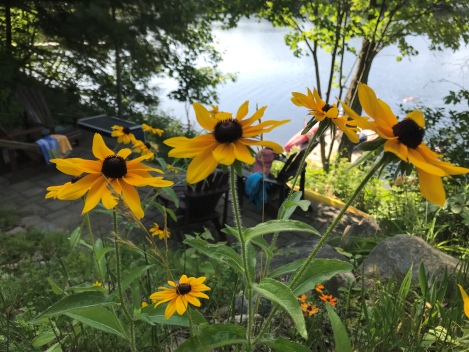
Wildflowers such as brown-eyed susans and daisies complemented the mix. Wild milkweed was another big draw for the Monarch butterflies.

brown eyed susans.png

A taste of Italy

To tip our hat to the terraced gardens of Italy, we set out a couple of small fig trees in pots. They would be brought inside over winter.  Nearby I found some wild grape vines, resembling Ontario’s native concord variety.  These were replanted next to the farmer’s fence alongside our lot in the hopes they would grow and produce some sweet fruit.

On the stone terraces, the new plants did well.  The terraces held moisture and were partially shaded by some young oak and poplar trees. We continued to enrich the sandy soil with some peat moss, worm castings, and home-grown compost.

While most flowers flourished, we also learned what did not work in the sunny spot.  After the groundhog had his way with the begonias, we discovered that colourful impatiens were too tender for this hot spot.

An organic approach

Further up from the lake, at the new terrace fronting the little log cabin, we planned a garden that could accommodate more shade. We decided on a natural approach, letting the new terrace area green up by itself, and adding just a few subtle garden accents. These included hostas, propagated from our home in Toronto, and some small pots of shade-tolerant impatiens. These were planted at each end of the new terrace fronting the cabin. To accessorize, we placed the same plants in pots on the stumps of the old beech tree nearby.

Colleen and cabin.png

Meanwhile, the forest was declaring itself on and around the site of the cabin.  A maple tree that been cut down to squeeze the cabin into its new forest home was shooting out stems again.  It looked like it would regrow nicely to the north of the cabin.  Similarly, some smaller beech trees that were taken down next to the cabin site were starting to bud out from the stumps.

A life force

The Minden flora and fauna were relentless, nesting the human-made structures of wood and stone in their life force and life cycles.

Behind the cabin, a groundhog had established its home, with its circular hole marking the entrance to its underground lair in the sandy soil. In the oak trees above, squirrels chewed off small branches, which would drop to the cabin roof and forest floor, where the acorn bounty could be claimed.

Beneath the soil, tiny blind moles made subterranean tunnels next to the new terrace capstones, pushing up the backfilled sand in a telltale pattern. Chipmunks established new tunnels around the site that would keep them warm in winter. The nesting bluebirds in front of our cottage made regular trips to sit in an old oak branch above the cabin, as if to check our progress.

The final push for the stone terrace project was a second dry-stone retaining wall behind the cabin. By early August, I had got most of it built. I was down to the “B-grade” stone in my pile but I still found a few gems to piece the terrace together.

The design echoed the first terrace built just to the west of the cabin — a straight line with freelance curve ending in a small tree cluster. This would afford breathing room and a safe gravel pathway against the hill sloping above the cabin. The second terrace would also keep away ice in winter.

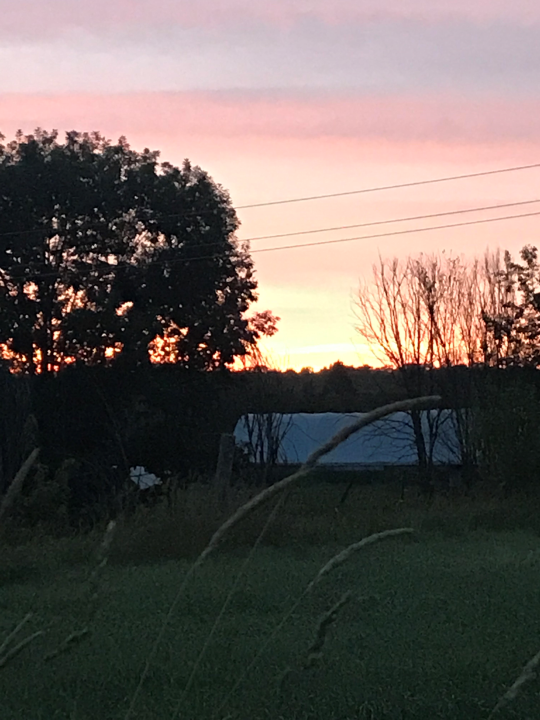
More sun cut through the trees here, especially in the morning, so we imagined some sun-loving flowers to dress up the terrace there once it was complete. The days were getting shorter in August, and the sky cast shades of pink and purple as the sun set over the Cox barn next door.

sunset in August.png


“The kids’ cabin”

In the mid-90s, Nadine’s parents Ann and Claus were hosting a growing brood of grandchildren at their cottage on Horseshoe Lake. Where to put them all? They needed a tiny cabin movement.

Claus had been looking at a book of cabin designs and, before you knew it, the wheels started turning. He was planning a small 8 x 12-foot log cabin, one that would be built to last and would honour the 150-plus-year homestead cabin that formed the core of their cottage. And at 96 square feet, it would be just small enough not to require a building permit. He ordered cedar logs from a local farmer.

When the logs were delivered, they needed the bark stripped. Claus’s father, Oscar, then into his 90s, was on hand to help.

Cedar and chocolate

Oscar was seated in a lawn chair, wearing a fedora and sports jacket, and a black patch over a wonky eye.  In his hands he had a debarking tool and was stripping bark vigorously one log at a time. As a long-time farmer and lumberman, Oscar knew his way around wood. Nadine and I pitched in to help.

From time to time, the kids would come by, and Claus would prompt Oscar about the chocolate. Oscar had brought a shopping bag of at least a dozen bars of fine chocolate along with him, ready to offer up as a treat to the little people when the moment was right.

Claus found a site for the cabin in the woods just across from the main cottage. He set down a gravel base and levelled it up with the help of a few flat stones from the bush.

cabin gravel bed.png

The cedar logs were stored to dry over winter.

The cabin-building started in earnest the summer of ’97. Claus had the cedar logs milled to four-inch widths so they could be stacked cleanly. As the log walls came up, he notched the ends, knocked in metal spikes, and caulked each log for a tight fit.

Claus with joinery.png

Pitching in

Claus had obtained several old wooden windows from his parents’ former place in Grey Creek, B.C., including a two-part solid casement window.  They would be a sentimental link to the past, and functional for the future. He took measurements and left space for four windows and a door in the structure. Two windows could be opened for a through breeze.

Claus and kids.png

Colleen in cabin window.png

The wheels were turning on the door too — he had plans for a sturdy but decorative door with diagonal strips that would complete the picture once the structure was built.

Friends and family pitched in.  Our brother-in-law Frank worked on the electrical — including supply, lighting and sockets. Nadine and I installed the red shingle roof to match the cottage, working our way around the dormer over the front porch that Claus had added. Nadine figured out the math to get the shingles aligning correctly as we roofed the dormer channel. Claus cut some decorative cedar siding strips to adorn the peak underneath the porch roof.

Roofing the cabin

Meanwhile, Ann and Claus continued to host friends and family who watched the construction unfold. Neighbors dropped by to check progress, offer advice, be inspired, and have a beer.

Finishing touches

During the third summer, in ’98, Claus finished the interior with several beds. The cabin was nestled nicely into the woods, built solid and ready for grandkids. Nadine and Ann sourced some mattress foam and covers. Linens and pillows were procured for a proper nesting of the interior. Claus asked for contributions for a time capsule that he would hide in a secret spot in the cabin for posterity. As he finished up the cabin interior, he placed a coffee tin inside and asked the kids to put their contributions into the tin time capsule.

Some flat heavy granite steps fronted the cabin porch to the green space outside the cottage. “It’s a 100-year cabin,” Claus declared proudly.

Cabin christening

Ali remembers some unique details of the first sleepovers: “We were given little bowls of Cheerios that we were supposed to eat in the morning to distract us for a little while so the adults could sleep in past 6:30 a.m.!” The kids also played tricks with an electronic baby monitor device. It was installed with good intent to monitor signs of life in the cabin, but the kids got devious, hamming it up over airwaves so that the adults would have to investigate.

Anna recalls the excitement of having her own cabin: “I remember running into the cabin during particularly dramatic rainstorms and listening to the rain and thunder, feeling very cozy but also closer to the storm.”

Cabin for 7

The tiny cabin movement had begun.  As more grandkids came along — Chantal, Paul, Rachel, Felix — Claus would continue to add sleeping quarters, turning double bunks into triple bunks with some ingenious carpentry, and adding a small bunk on the west side.

“My favourite was when the middle lower bed was added as the entire lower level was like a big sleepover,” recalls Ali. “The smallest kid had to sleep on the bench bunk, so both Rachel and Felix had to put up with that for awhile.”

“We would play all sorts of games like Ghost Town trying to get everyone settled down but it was tough as everyone was so excited.”

Colleen remembers: “We had quite a book craze with the Goosebumps series. Someone would read aloud and we would discuss what to pick for the “choose your own adventure” challenge. We often had adult visitors who would read a story or two as we were going to bed.”

“As an early-to-bedder I enjoyed many nights hidden away on the cozy top bunk while the chatting continued late into the night between my sister and cousins.

Anna recalls every summer feeling “a bit intimidated to try to get into the top bunks and feeling very proud once I finally got up there!” The kids dressed up the cabin for parties and special occasions: “I remember carrying Rachel into the cabin on a ‘stretcher’ (boogie board) so that she could safely deliver stuffed animals to the ’emergency room’ we created there.”

The cabin also hosted a few adults, and was popular with the children of guests Ann and Claus entertained over the years.

Claus and Ann.png

Cabin complete

All in the family

Before he passed away, Claus asked that the cabin be kept in the family if possible. With Nadine, he scouted out a possible site in the woods next to our cottage. Ann was preparing to sell the cottage on Horseshoe Lake and kindly offered to move the cabin. Local crane operator Chuck Hopkins obliged, taking the log cabin on a 5K road trip to its new ‘hood.

The tiny cabin movement would continue — on a site nestled in a grove of oak and beech, overlooking a pretty corner of Minden Lake.


Granite capstones: Icing on the cake

A nice capstone will make a stone waller salivate. They are hard to find, but they are the icing on the cake for a dry stone wall, adding architectural detail as well as structural integrity.

As my dry stone terrace rose, I was on the lookout for capstones. Brent Coltman, a neighbour on nearby Horseshoe Lake Road who supplied much of my stone for the terrace project, suggested I pay his Dad a visit.

I met Wayne Coltman at his place south of Minden, in old farm country along the winding Deep Bay Road. In his early 80s, Wayne still works full time in the aggregates business, providing excavation and supplying materials such as gravel and sand for construction.  Wayne also keeps his hand in music, playing electric bass for a local band.

Finding a stone mecca

We hopped in Wayne’s white pickup and drove through the old farm on his property, touring his gravel pit before heading up a hill through the forest. We arrived at a small granite quarry littered with gorgeous slabs of pink and grey granite.

wayne with truck.png

I could have my cake and eat it too!  The first granite stones that caught my eye would work perfectly for some extra steps leading to the cabin, I thought.  They were about four feet wide, two inches thick, and heavy. Wayne and I grabbed the ends, picked them up and walked them to the road.

“I have to take care of the fingers so I can keep playing music,” he joked, as he lifted half of a stone that must have weighed over a hundred pounds and was making my back ache. While he went back to get a bigger machine to haul the stone, I scouted out capstones for the terrace.

The June mosquitoes were feasting on me and seemed to especially enjoy the area behind my ears. I zipped up my jacket and started hauling capstones — picking them up and treading carefully back to the road, or sometimes dragging them if too heavy.

Special delivery

When Wayne returned, we lifted them into the bucket of his front-end loader and bounced back along the road to his house. I got about half of the stones into the back of our minivan, and drove them home carefully along the highway, making sure I did not have to brake in a hurry with the heavy load.

Later, Nadine and I came back to get the other half. Wayne was in his garage doing some welding repairs. He lifted his welding goggles, and put down his torch. We had a nice chat about his farm, which includes a gorgeous pond next to his house.

wayne and stone.png

Back at our cottage on Minden Lake, I used a hand trolley to wheel each stone down to the project site. The terrace was coming up nicely but went slightly off level around its curve.  I knew I could bring it up to a better level with some thicker capstones on the curved end.  So I got busy getting the thickest stones over there first.

The summer side of life

Across from the cottage, the Bluebirds were busy feeding their chicks — swooping in with the food, and out with the guano. Under our cottage porch, Swallows had nested. The birds were active mornings and evenings, flitting around the farm fields next door.

While the female Swallow was away, I used a stepladder to climb up and see what was going on. The parents had created a soft nest of feathers and twigs on top of their sturdier foundation on top of our porch column. The first chick had broken its speckled egg and hatched, a tiny pink thing with a black beak. Three unbroken eggs showed that three more chicks were on the way.

swallow nest.png

Capstone dreaming

Working with the capstones, I used a chisel hammer now and again to chip off unruly edges, to get the stones to fit together better. When a stone was a bit wonky, I used little wedges to stabilize it.  To get the back edge straight, I fit in some small cheater stones that would look okay once the terrace was backfilled. Finally, I packed in a few small heartstones around the heavy capstones.

You can get into a trance while stone walling — the process triggers a kind of Zen state. You forget the mosquitos and keep walling. In your trance, you investigate, touch and place every piece of stone. There may be thousands in a small terrace like this one, a cascade of shapes, heft, tactility and colour. That night, it’s no wonder you may dream of stone.

Pretty soon the capstones were fitting together nicely on top, bringing the terrace up to a nice level of about 3 feet high. I would have more work to do with the terrace garden, and another retaining wall behind the cabin.

But for now, the icing was on the cake.

cabin with caps.png


Pieces of the puzzle

With a sturdy foundation in place, it was onwards and upwards for the stone garden terrace.

Inside our cottage, Nadine, her mom and a friend were grouping like-minded pieces for a jig-saw puzzle depicting a classic canoe. Outside, I was using the same approach for the stones that would form the second and third courses of the terrace. With like-minded stone close at hand, I could move faster once I started building each course.

canoe puzzle.png

Smelling the roses

My dry-stone mentor John Shaw-Rimmington had advised our class at Haliburton School for the Arts to step back now and again — to see from a distance how the stones fit together.

This was the stone-walling equivalent of smelling the roses. Sometimes a stone that looked good up close was clearly out of order when seen from afar, and could be adjusted or replaced before it became embedded in the structure.

So I did a lot of stepping back and peering at the little stone terrace as it rose next to the cabin. In fact, whenever Nadine caught a glance at me stone-walling, she said I usually had my hands on my hips, arms akimbo, peering at the stones. For inspiration, I nestled a pot of pink and white impatiens next to the terrace.

course number three.png

Rocking and rolling

By nudging up the string next to the straight section of terrace, and checking its level, I could chase it upwards in slow motion with the stone-building. Stones that rocked and rolled a bit too much were wedged with thin stone shims to get them to settle down. Each course was carefully packed with hearting to get it tight and ready for the next course.

Next door, the farmer was raking his hay.  I could hear the drone of the machine as he swept by. The next day, he came back with the baler and wound the dried hay into huge bundles.  They would be wrapped in white plastic, resembling massive puffy marshmallows, and stored outside to give his cows feed through the long winter.

On a misty summer morning, the hay bales loomed large outside our cottage front door.

hay bale.png

A special blend

As the terrace wall came up with each course, I began to backfill it with some better soil. I trundled with the wheelbarrow over to our nearby veggie garden. There a special blend of quadruple mix was concocted, using equal parts of garden soil, compost, peat moss and some worm castings.

This new soil mix was a step up from the sandy clay next to the cabin, and would provide a nutrient-rich bed for the terrace garden, once complete.

To get the terrace as level as possible for the final layer of heavy capstones, I used slimmer stones in the fourth, and penultimate, course. For the freelance curve at the south end, I had cheated, using just three layers of larger stone. The curve dipped slightly off level, but I made a mental note to try to fix that with the capstones.

Piece by piece

The pieces of the puzzle were falling into place. Inside our cottage, the wilderness image of a cedar canvas canoe slowly emerged on our card table as Nadine, Ann and Mary Jo worked on the 1,000-piece jigsaw, after some swimming and kayaking in Minden Lake. Outside, the stone wall was rising.

course four with cabin.png


The eagle has landed

My father-in-law Claus had asked that the little log cabin he built for his grandkids at Horseshoe Lake stay in the family. Before he passed away in 2017, Claus had joined Nadine to scout out a possible site for it in the woods near our cottage on Minden Lake.

The next summer, my mother-in-law Ann was preparing to sell the family cottage. She kindly offered to pay for the cabin move.

This promised to be a one-of-a-kind road trip, with a few twists and turns.

Built to last

It was a tiny, pretty cabin, yes.  But it was built to last — for at least 100 years, Claus had predicted. The cabin weighed many tons — not a job for few friends over a case of beer on a sunny Saturday.

We spoke to our contractor Bob, who had built our place at Minden Lake. There were two options — dismantle the cabin piece by piece and rebuild it on site, or pick it up intact and move it. Option two had a few challenges attached to it, but seemed the better way to go to keep it simple, and to honour the cabin’s integrity.

Bob referred us to a crane specialist in the Minden area.  Chuck Hopkins lives just down the road from us and owns several massive cranes used in construction around the Minden-Haliburton area.

Sizing up the job

Chuck came by to take stock. The cabin would need to be wrapped in a giant sling — like a baby carried by the proverbial stork.  It would then be craned on to a trailer and trucked to our cottage. Finally the cabin would be picked up again by crane to be set on its new site.

Chuck advised to leave the front porch intact even though the wider load presented some potential challenges. We did a final clear-out of the cabin’s contents and disconnected the power.

Chuck advised he would  move the cabin during a break in his construction schedule. One fateful morning in summer 2018, I got a ping on my phone with this photo attached:

bunkie on McCracken Lane

The cabin was on the road!

Earlier that morning, Chuck and his crew had roped up the cabin with heavy straps and lifted it onto a flatbed trailer:

bunkie horseshoe 1

bunkie horseshoe 2

Over hill and dale

The cabin was hauled by Chuck’s pick-up truck up a very steep section of McCracken’s Lane at Horseshoe Lake.  It wound its way past the world-class white-water rapids of the Gull River, then hung a left on our cottage road: Summer Lane. When the cabin hit a tight spot on our lane, our neighboring farmer, Casey Cox, came with heavy equipment to bend over a tree to let it pass. The only stop missing on this five-kilometre drive was a detour to the Minden Timmies drive-through.

All told, it was a fine bit of motoring for the little cabin that could…

bunkie on Summer Lane

Chuck and his crew used the crane to place the cabin temporarily on our front lawn, then came back the following week, this time with two cranes. In a delicate demonstration of mighty-machinery skills, they “walked” the cabin inch by inch down a slope next to our cottage to its new site on a level gravel base in the woods. Half the battle was keeping the cranes properly positioned so as not to topple along with their load.

bunkie placement

bunkie has landed

The mission was complete — the eagle had landed. Thanks Ann and Claus!

Nadine and I rolled up our sleeves and spent a morning digging a 40-foot trench, 2 feet deep, to house a new electrical supply. The 1990s red shingle roof was updated. Beds were made and the interior dusted and nested. Next spring we would work on some stone steps and a little garden terrace to nest the cabin in place.

The log cabin was ready for its first winter on Minden Lake.

bunkie in winter