Tiny garden double-double

IMG tiny garden double double

A network of good Samaritans had helped my tiny garden survive the summer heat wave in T.O.

One of them, my friend Reshmi, donated an unused planter to the tiny garden cause.

Fall days were shorter and cooler and kids headed back to school, sporting their colourful backpacks. As the population of citizens at the gritty north-west corner of Pape and Cosburn swelled, I delivered the tiny garden double-double.

On a mission

It was another gardening SWAT team mission of sorts.  With my minivan illegally parked on the north side of Cosburn to avoid a 2-buck parking fee, I executed my sortie with maximum efficiency.

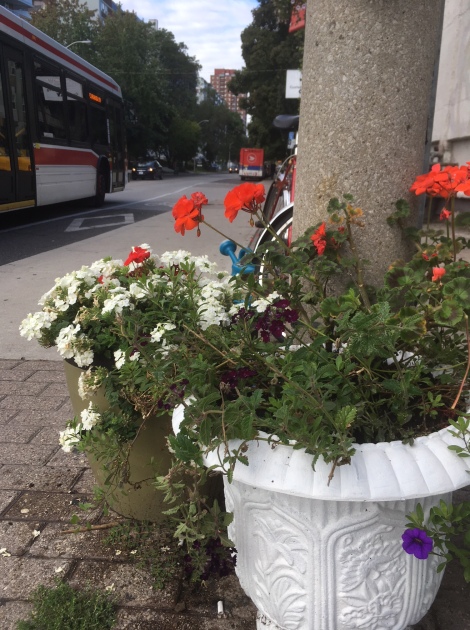
First, I hauled a bucket of soil and the new pot over to the corner of Pape and Cosburn. I had placed some bricks in the bottom of the white pot for drainage — and to deter tiny-garden thieves who might find the new garden a wee bit heavy to make off with.

Next I ran back for some orange geraniums and my trusty blue plastic watering can. I decanted half the soil into the white pot, then put in the geraniums, followed by a top dressing of soil. The new pot, and its older companion tiny garden in a green pot, got a good soaking of water.

The next day I wobbled over on my red beater bike to check progress. The gardens were looking healthy with cooler weather and some sunshine.

Two thumbs up from Leo

Leo stopped to say hello. He comes by his name honestly. He is the lion-hearted crossing guard at Pape and Cosburn, helping hundreds of citizens cross safely each day at the start and end of school, and the lunch hour.

Leo had dubbed me “the mystery guy with the flowers” earlier this spring. He had been off during the summer so I introduced myself again:

“I decided to dress up the corner with some flowers,” I told him. “I live nearby.”

“Well it definitely needs it,” Leo replied. A bustling dry-cleaning business had closed down four years ago. “The guy who bought the business is doing some work on it, but it’s been awhile,” Leo added. Citizens still took shelter from bad weather under the former shop’s rough entranceway and steps at the corner.

Leo had a burning question for me: “Did you need any permits or anything to put the flowers here?”

“No, I guess it’s a guerilla garden,” I said.

Starting a trend

Leo had to go — he was brandishing his stop sign for the next wave of pedestrians: “Well it’s nice,” he said — “I hope you are starting a trend.”

I came by a few days later to water the garden but it looked like someone had done that favour for me — perhaps another good samaritan.  I picked off a few geranium bloom deadheads and removed a black and yellow Mike’s Hard Lemonade Can that had been placed next to the flowers.

The lemonade can boasted an alcohol content of 8%. It was empty. I hoped its owner, like Leo, had gotten a kick out of my tiny garden double-double.


Alchemy! Work your composter to perform magic in the garden

On a cold March day I was trying to get the jump on spring at my community garden plot in Thorncliffe Park.  The thaw had come out of the ground, mostly. So I was wrestling it into shape with my old spade, using a technique called the double-dig. This would save me time later during the spring planting season.

The wind whipped through the hydro towers, while the first wave of migrating birds alighted for a feed at my friend Linda’s bird sanctuary. I was all alone at the community garden, on hydro land north of the Swiss Chalet.

IMG_3917 composter

Or thought I was. Mid-grunt, with my head down, I heard a friendly greeting: “Could you use some nice vegetable scraps?”

I turned around to find an older man proffering a grey bag. “It’s stuff from my kitchen.” He had a slightly guilty smile.

“Oh, hey,” I said, lifting my head. At 56, I had lived my whole life without ever having had someone offer me squash rinds, carrot clippings and coffee grounds. “Sure!”

“I live in an apartment and don’t like to see it go to waste,” the man said.

“Rick, by the way, he added. “We don’t have a composting program at my building so it just goes into the garbage. I see you have a composter,” pointing to my black bin.

“Hi Rick, Ian” — we shook on it.

Rick, in fact, had made an earlier delivery after he spoke to Linda while she was feeding the birds.  Linda had left me a voicemail about the this offer of vegetable scraps, and I had given the green light.

My compost benefactor

So here was my benefactor in person, with his second delivery.

“This is great timing,” I told him. “I just kick-started my composter for the 2018 season.”

Rick admitted he didn’t know how composting works, and I explained what I had learned through trial and error over the years. “Composting is like a chemical reaction,” I told him.

Indeed, composting is a form of alchemy that can reward the gardener with rich — did I mention, free? — fertilizer for the soil. It requires some key inputs such as:

  • carbon, from dried leaves, straw or newspaper for example
  • nitrogen, from veggie scraps for example
  • bacteria, easily obtained from soil
  • and finally: oxygen and moisture.

You gotta work the pile!

Just like a high-strung sports car, your compost pile needs regular maintenance.

You can’t just toss in the green scraps. They will sit inert until you are collecting Old Age Security.

No, you gotta work the pile. Start with the right inputs. With each deposit of green scraps from the kitchen, add some soil and some newspaper or dried leaves.

Take time to aerate your pile from above every few weeks. A broom stick works, or a long piece of rebar has a nice heft and will do the trick to poke holes and get the pile moving. Add some water occasionally, especially if the pile seems dry.

Alchemy!

With some regular maintenance your high-strung composter will run nicely and produce some rich dark compost year round. There’s nothing like seeing your composter steaming away magically in mid winter while Don Cherry is blathering away on Hockey Night in Canada.

Most composters have a small opening at the bottom from which to dig out the finished product. Removing the good stuff then kick-starts the process again as you poke the pile from above and get it moving and aerated. You can even accelerate the next batch by tossing a bit of finished compost on top to keep the bacteria working from both ends.

Use some finished compost as a top dressing fertilizer or dig some in for new plants. Properly composted material will be free of weed seeds. It will feed your soil with nutrients while also retaining moisture.

The wind was brisk but the spring solstice sun was warming the ground. I thanked Rick as he headed off.

“I’m happy for more donations,” I told him. “My vegetables and flowers will thank you.”


Garden visions

DSC_0556 sweet pea

In the dead of winter, we conjure garden visions…

It was a cool but sunny day in April, and an older couple had agreed to meet me to accept their new plot at Thorncliffe Park Garden Club.

Even though I had given my standard note of caution to them, my heart sank a bit as I assessed the plot in advance. The small fence was bent and broken in places. Gaps had opened in the chicken wire intended to keep out critters. A chaotic collection of weeds sprouted from the soil. A few discarded Tim Horton’s cups blew about the 12×20-foot rectangular plot. Clearly, the previous gardener had made a good start the previous year but had been unable to sustain the momentum.

Assigning vacant plots in the spring was often one of the happier tasks I had as president of one of Toronto’s oldest community gardens. Each year, perhaps 10 of the 100 individual plots would come available to new gardeners on our waiting list.

I would speak to each new gardener by phone first, using a standard line — blending caution and optimism — for these occasions: “Each plot is different. Some of them need a little work. Some have some hidden treasures — like a raspberry bush that’s been left behind. Be prepared to roll up your sleeves and spend some time to get your plot in shape.”

On this spring day, I spotted the new gardener couple ambling arm in arm down our garden lane. They were ready to claim their little piece of paradise. I put on my game face and welcomed them: “Hi folks!”

Elena and Frank were long-time residents of the Thorncliffe Park neighborhood. They lived in an apartment with a small balcony but longed for a small garden to grow tomatoes, beans, leeks, onions and other nutritious vegetables. They had been on the waiting list for several years. (The story is true; their names and some details are changed).

Together we walked along a path between some neat and nicely-tilled plots to arrive at their future garden. By comparison to the plots nearby, it looked like a disaster zone.

It’d be an understatement to say that Elena and Frank were processing the sight of their new plot in very different ways. Frank’s face tightened and he inhaled sharply. “Oh no, it’s terrible,” he muttered. His wife Elena, by contrast, had tears of joy in her eyes and a smile on her face. “We can clean it up, Frank,” she gushed.

“So many weeds,” said Frank.

A glass half-full

“It’s going to be beautiful,” countered Elena, whose glass, as the saying goes, was definitely more than half full.

True to Elena’s word, the garden was tilled, the weeds discarded and the fence repaired nicely within a couple of weeks. Frank and Elena visited their plot most days, met some new friends, and brought home produce to their extended family.

Almost out of necessity, and especially with our long winters in Canada, many of my gardening friends are visionaries, just like Elena.

We gardeners dream of spring

In the dead of winter, we dream about the garden in spring. It’s a great time to conjure garden visions:

  • One friend, Robert, imagined the colourful blooms of the many hundreds of tulip bulbs he had carefully planted the previous fall around the perimeter of his Thorncliffe apartment building. His tulip garden would be a gorgeous gift to his fellow residents as well as many people walking or driving through the nearby shopping mall.
  • Ann, a retired teacher, puts pencil to paper in winter to map out next year’s garden — drawing changes to her mix of vegetables and flowers, or occasionally drafting a completely new garden layout. For her, it’s a time to get out the weeds and see the big picture, to take an artistic touch to garden planning.
  • Like Frank, I am a bit pessimistic by nature, so I order a seed catalogue each year to kick-start my garden visioning. With January’s extreme cold weather setting in, I can peruse my colour catalogue from William Dam Seeds in Dundas, Ontario. It lets me garden vicariously through its colourful images of traditional vegetable varieties and new hybrids, berries, as well as annual and perennial flowers.
  • Claus, my father-in-law, would start some seeds indoors in trays. This gave a jump on the growing season to plants such as the sweet pea pictured in the photo above. On a cold winter’s day in Toronto, the seeds sprouted. He could already imagine them winding their way up his stone chimney and along the rough wood siding of his cottage garage near Minden in summer.

Sometimes our garden visions are a single image — like the picture Elena had in her mind of a beautiful and well-ordered garden.

But the reality can be even richer. Our gardens will soon begin to grow and evolve throughout spring and summer — starting in late March, as soon as the ground can be worked.


Making babies: propagating plants for your garden and others

Fall and spring are good times to think about making babies.  And we’re talking about propagating plants for your own garden or to re-gift to friends and family.

Propagation is such a technical and intimidating term. Sometimes, it’s appropriate for the machinations of creating new plants. One example is the technique of “layering” stems of a living plant; the stems later put down roots and can be separated from the parent plant to become a new baby from the garden. Not too complex really, but some memory and delayed gratification is required. Another example recalls the story of a friend who used an electric toothbrush to stimulate reproduction of his squash. Similarly, a bit complicated, if not slightly provocative.

No, today we will keep it simple. Here are just a few examples of making babies in the garden:

IMG_2370 hydrangia

Hydrangea:

This low-maintenance perennial shrub puts up gorgeous globe-like blooms the size of Tilley Hats. It enjoys sunshine but can tolerate some shade too. We have some white-blooming and a couple of pink-blooming varieties. The blooms create a nice counterpoint to the shrub’s huge green leaves, and can be brought inside for a stunning bouquet, fresh or dried. Making Hydrangea babies: The Hydrangea roots spread vigorously.  I’ve found they benefit from a mulch of large rocks, twisting and turning around the rocks to see moisture and provide a solid base for the shrub.  In fall or spring, dig up some roots, with stems attached, on the side of the shrub’s root ball. Trim most of the leaves off the stems and place in a pot, well watered, until you have decided on a new site to transplant. Use some compost for a nutritional head-start when you replant.

Image result for red bergamot

Red Bergamot (Bee’s Balm):

Like Hydrangea, this perennial flower spreads vigorously by roots. My parents-in-law Ann and Claus acquired some on a walk around Horseshoe Lake. They were dazzled by the red blooms and complimented the gardener, an older gent with a massive garden on Reynolds Road. He promptly offered them some. Now the gift has been given again, as Ann encouraged me to take a couple of plants from Claus’s veggie garden this summer. They had provided chaotic colour at one end of the garden, north of Claus’s orderly rows of beans, kohlrabi, peas and other veggies. Bergamot also has herbal/medicinal qualities. Making Bergamot babies: Dig up some root with stems and leaves in fall or spring, place in a pot and keep well watered until you find a new spot to plant. The leaves may die back a bit, but the plant will put out new leaves once it recovers. Once planted, stick a plastic marker next to the new plant to remember the location. With some TLC, your baby Bergamot will put on a nice scarlet and aromatic show next year.

IMG_2900 Concorde Grape

Concord Grape:

I found a stem of this plant growing as a volunteer in my Thorncliffe Park Community Garden plot, but I have also propagated it by digging up part of a vine from its root. A native Ontario species, it produces sweet small purple grapes in fall.  These were key to Ontario’s wine industry before fancier varieties came along. You can also eat the leaves, steamed or baked, I believe, as we have had visitors making off with bags full of grape leaves. Making Concord Grape babies: Keep an eye for a baby plant or dig up part of the root of an existing vine. Keep it well watered until you find a new location to plant the baby. In future, enjoy a sweet late summer grape-snack or make grape juice or jelly!


The snacking garden

After all that weeding, watering and waiting, it’s harvest time — but in your haste to share your bounty with family of friends, take a moment to reward yourself first.

Depending on the season, a variety of instant snacks await the industrious gardener:

Let’s say it’s a warm late August day and you are stopping by your garden to pick the first of the carrot crop, along with some luscious-looking dark green-and-purple kale, and beefsteak tomatoes. These fresh organic vegetables will be gobbled up this Labour Day weekend by family who have gathered at your inlaws’ cottage.

But a bountiful harvest requires a well-fuelled gardener. So while you start to pick the big tomatoes, you can’t help but binge on some sweet Tiny Tims. These cherry tomatoes have grown as “volunteer” plants from compost you applied to the soil this spring. In fact, this year’s volunteer tomato plants are actually the prize winners — they ripened when the sun finally started to shine consistently late this summer after a wet spring. What’s more, these Tiny Tims are much better for you than that 12-pack of Tim Bits you had your eye on while in line for coffee at Timmies.

Nearby, your perennial spinach is delivering a second crop as fall sets in.  The flowers have died back and a new set of lush green leaves has sprouted.  You learned about this plant — also known as perpetual spinach — from your garden neighbor Pat.  She came by one day and asked to take home a few leaves.  You were puzzled by the perennial as it had been planted by the previous gardener of your allotment plot.  You were accustomed to annual spinach planted from seed each spring.

But Pat set you straight — perpetual spinach is a vigorous producer of spinach-like leaves that pack a spicy punch.  It’s a low maintenance and nutritious snack.  So you follow up your Tiny Tim binge with a chaser of several snacking leaves of perpetual spinach.

And as you admire your first crop of Kale, which will be steamed for dinner on the weekend, you cannot help but notice the first scarlet runner beans that are ripening on your crude bamboo trellis. Your nephew Ben planted the seeds this spring.  You pick a few to snack on — they are tasty and crunchy. And on a more sensible note, they are sure to give the snacking gardener his or her daily fibre requirement.

Now give yourself a pat on the back.  You are taking home some fresh vegetables to share with others. But as the Wealthy Barber once said when he shared his retirement planning secrets…

…you paid yourself first.


Warming up to my gooseberry bush

It’s taken 15 years but I think I am warming up to my gooseberry bush.

I inherited it from the previous gardener at my Thorncliffe Park Community  Garden plot. It was a sprawling, spikey green thing about three feet tall and wide. I gave it sideways glances while I planted more important crops, like tomatoes and beans.

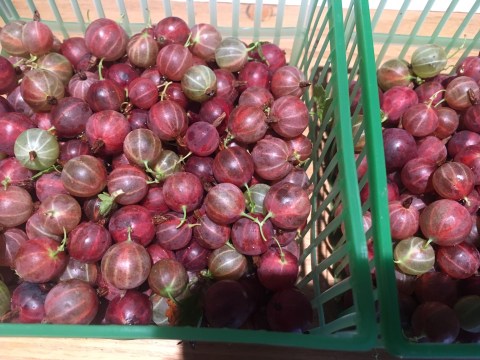
But in July, the gooseberry bush could not be denied. It bore loads of berries, pin-striped, like plump little new suits from Tip Top Tailors. They ripened from green to a deep purple in the full sunshine and long days of summer.

IMG_2393

I got scratched picking hundreds of them. My crop was donated to my father-in-law, Claus, who made gooseberry jam for the family at the cottage.

Through trial and error, I learned how to pick the berries while avoiding the nasty spikes, I would hold the top of one branch in my fingertips, pulling it up and away from the others, and carefully strip it berry by berry with the other hand. The spikes actually drive away birds and other critters — including humans — meaning you keep more berries for yourself.

Counting berries while you pick doesn’t hurt — you can give yourself a goal of 100 or 200 to see past the pain of your sore back and joints while you slowly circle the bush on bended knee. Folks in the corporate world have told you to lean in for success. The same principle applies for gooseberry picking.

I also learned how to propagate my gooseberry bush — this is a fancy gardening term for making babies.  To make a baby bush, grab a low-lying branch in spring, push it into the soil and bury part of the branch a couple of inches down. Leave some leaf exposed to the sunshine at the tip of the branch.

Over the fall and winter, this “layered” branch will put down roots. In spring, you can snip it from the mother bush and plant it elsewhere.  I took one to the cottage, where I now have a second nice mature gooseberry bush. I have given a few baby bushes away to gardening friends.  It`s the gift that keeps on giving.

If you are the foraging type, you can spot wild gooseberries along Ontario roadsides — they even sport spikes on the berries themselves. I`ve heard tell you can somehow defang them and use them for pies and jams. Or maybe just jelly, leaving the fangs in the screen before you boil up a batch. You`d have to google it.

IMG_2392.JPG

This week, Mehtab helped me pick a couple of pints of gooseberries at Thorncliffe Park. Claus passed away this summer and Ann has tried her hand at the jam making, with delicious results. Both Nadine and I have picked gooseberries in Toronto and Minden for Claus and Ann. So this next bunch will go to Ann in the hopes of jam batch number two.

I am sure there are more gooseberry dishes out there for the making. Rather than check Google, I consulted the Joy of Cooking 1997 edition and discovered that Gooseberry Fool was a popular dish in 17th Century England, blending custard and stewed gooseberries. The modern version involves pureed gooseberries and whipped cream.

Call me a gooseberry fool — but I think I am warming up to my gooseberry bush after all these years.


The secret to immortality: multiplier onions

When I started growing vegetables at Thorncliffe Park Community Garden a few years ago, my father-in-law Claus gifted me a few “multipliers.”

These were multiplying onions, and they are the gift that keeps giving.

In fact, because they never stop giving, and because you must keep planting and eating them going forward, they will guarantee your own immortality — much more so than cryogenic freezing, or belief in reincarnation, for example.

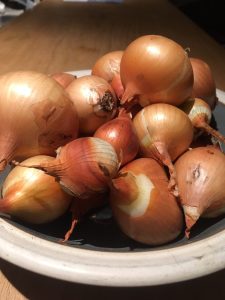
img_0418-onionsPlanting: First, let’s talk planting. A single dried multiplier onion bulb planted in spring will give you two bulbs harvested in fall. Eat one, and keep the next for next year. Or leave your second bulb in the ground and it will overwinter and multiply next year.

Harvesting bulbs: Onions are also time travelers. You can harvest in the fall, dirt and all, leave them in a cool dry place, like your basement, and forget about them. Once the excitement of the holiday season is done, you can have a eureka moment when you remember where you left the onions. Then you can process your onions for a mid-winter harvest.

Processing simply involves shaking off any dried dirt, peeling off a few gnarly layers of onion skin, and finding a new container to keep them handy for cooking in your kitchen. The  lazy Susan works well. You can complete your processing on the dining room table while your better half prepares dinner. Careful to tidy up after! Identify multipliers as the ones that are not perfectly round — like the one near the bottom of this photo — it has a flatter side that used to press up against its multiplier twin.

Surprise! So enjoy this surprise winter harvest! To use your onions in some tasty winter dishes, such as crockpots, start with the larger ones first. Any little ones left over in early spring can be replanted. They may even start putting out some green shoots in your kitchen, which shows they are eager.

In spring time, any onions you missed in the fall harvest become volunteers for this season. They will declare themselves in due course when they push up green shoots from the dirt.

Harvesting greens: To get fresh greens close at hand, put a bunch of onion bulbs in a pot to keep handy outside your kitchen door in spring. Keep it watered and exposed to sun. Soon you’ll be out there with scissors picking off some of the fresh greens to put on top of pasta.

Savoring the harvest: Small onions go nicely in a crockpot in a dish such as lamb stew. When will simmered, they give a burst of rich flavor to complement the meat and other vegetable goodies and spices.

Here’s to your hereafter! So much going on with multiplier onions. They start as the gift that keeps on giving, and they end up guaranteeing your immortality.

Gardening gratification with Ben and Sally-Anne

Gardening gratification comes in two forms: delayed or instant. A recent fall trip to the community garden with my nephew Ben and his support worker Sally-Anne proves the point.

Delayed gratification: Tulip planting. There is no bigger leap of faith than digging in tulips for spring. We are talking a six-month return on investment before tulips put on their spring colour show, following daffodils and even earlier birds such as snowdrops and crocuses. That is if the squirrels don’t get to the bulbs first as a fall snack.

It’s a late afternoon in October and we are headed to Thorncliffe Park Community Garden, located on the hydro corridor just north of Overlea Drive. It’s a little oasis off the beaten track of one of Toronto’s densest urban neighborhoods.

So far, the weather is not co-operating. The minivan wipers are set on intermittent, which means we still have a chance for our late-season gardening session. In fall and spring, our minivan has been dubbed “the shed” by Nadine, as it tends to house a collection of gardening tools, pots, mulch and other stuff in the hatch. Here’s to stow-and-go seating!

As we pull into the community garden and drive up to my 12×20-foot piece of paradise, the rain turns to mist. I’ve brought umbrellas just in case. However Ben assures me, with Sally-Anne interpreting his sign language, that he likes rain, so we are good to go in any case.

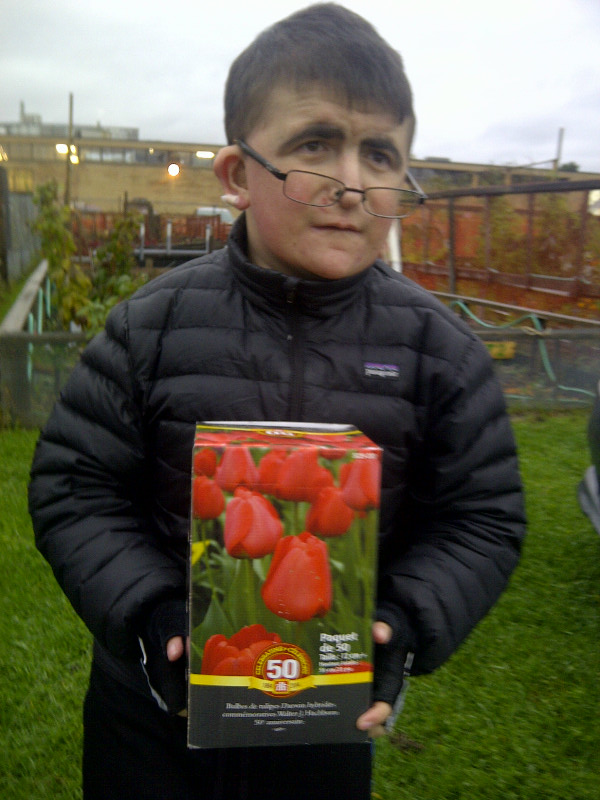
We pull out a box of 50 tulip bulbs. Woven among some perennial flowers and herbs, they will create a bright red border along the west side of the garden in spring.

IMG-20141021-02231

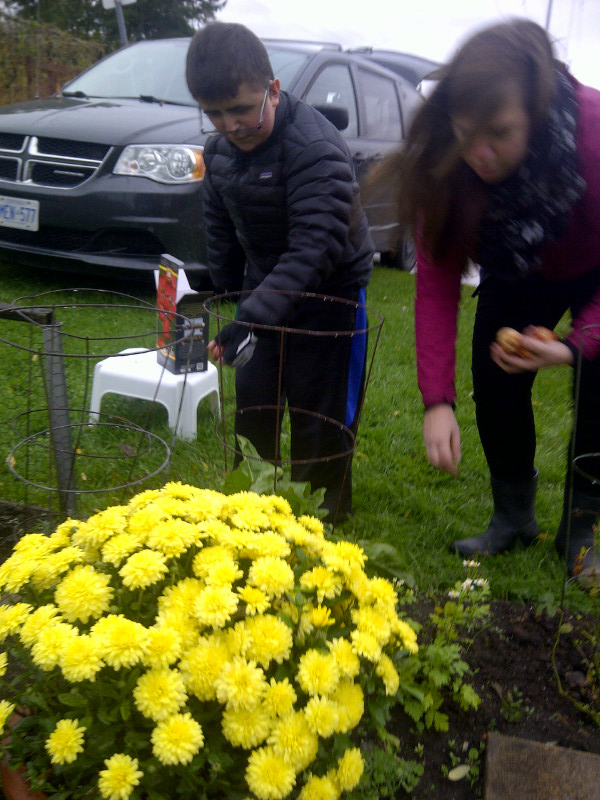
The planting exercise involves an assembly line of sorts. I dig the holes using an old piece of lumber to poke spaces in the soil, about six inches deep. Following me is Ben, who leans on the fence to carefully aim and drop bulbs one by one into each hole. Sally-Anne rounds out our line by making sure each bulb is upright (roots down), and uses a trowel to cover them up with soil. We get in about 40 bulbs, which means there are some left-overs for Ben and Sally-Anne to bring home to plant.


Over the long Canadian winter, the bulbs will set down some roots. They will wait patiently until the time is right to signal spring with their scarlet blooms.

Toronto-20141021-02234


Instant gratification: Sweet September raspberries. When I inherited this plot from a former gardening friend, she left some dwarf raspberry canes in the north-east corner. I can’t say I’ve done much with them except to enjoy the harvest — they put up fruit twice a year. My father-in-law Claus calls the fall crop “Sweet Septembers.” My canes have produced some sweet Octobers this year, so I pick a dozen of the last purple-red ripe raspberries and the three of us split them up for an instant treat. It’s almost suppertime, so the raspberry snack will buy us some time for the next gardening task.

Delayed gratification: the 2014 carrot crop. It’s been six months of weeding, watering and waiting. Now the carrots are ready to harvest. A few of the bigger ones have presented themselves — the orange tops now visible above the soil. I loosen the big ones and Ben hauls them up by their greens.

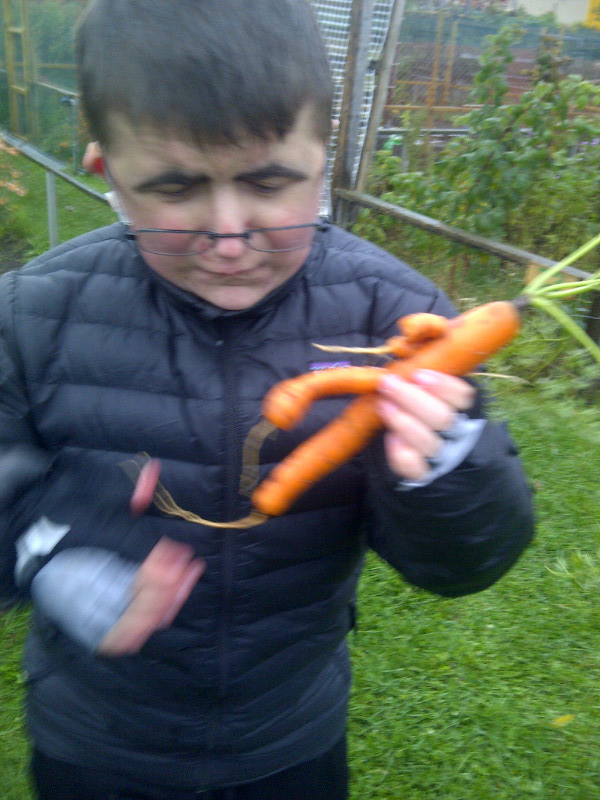
We head to the water tap to wash off the dirt, revealing a couple dozen healthy but gnarly looking carrots. Healthy, because they seem to have resisted the bugs that sometimes eat into the crop underground. Gnarly, because some of them are looking like something out of a sci-fi movie — the carrot that ate Don Mills.

Toronto-20141021-02238

Folks, you will never see carrots like these on store shelves. But they are tasty. We nibble on a couple of the little ones — sweet!

Ben and Sally-Anne each take home a basket, and I will be back for another couple of dozen before the soil freezes. Even after freeze up, if you miss a few carrots, they will generally sit tight over winter and provide a spring windfall when the soil thaws.

Instant gratification: Swiss Chalet. It’s getting dark and Ben agrees that we are done gardening for the day. We wash our hands under the nearest water tap. We’re getting a bit hungry and the raspberries and carrots have only bought us so much time.

As luck would have it, there is a Swiss Chalet located a stone’s throw from the community garden. We are seated by the hostess at a cozy booth, and gaze through the colourful options on the menu.

Ben is a pasta guy but likes his meal plain. When the waitress arrives, she asks Ben for his order. Ben signs and Sally-Anne translates. He has his own sign for pasta, using his index fingers and thumbs to indicate a pulling motion, like stretching a piece of spaghetti. He would like the fettucini, with some butter and salt. The menu shows a fettucini dish loaded with chicken and veggies, and I am reminded of the Jack Nicholson scene where he just wants toast, but has to order a chicken sandwich, hold the chicken, hold the mayo, etc. But Swiss Chalet is stepping up to the plate on Ben’s custom dinner order. The waitress asks Ben if he wants anything else on the pasta and he signs the letter “p” for Parmesan. Ben smiles and gasps when his pasta arrives, and I tuck into my quarter-chicken dinner.

Sally-Anne, who is one of Ben’s support workers, is studying for her sign-language interpretation diploma at George Brown, balancing school with work and being a mom to her five-year-old daughter. She’s heading to Montreal tomorrow for a couple of days for a break and some fun with friends.

Ben is a man who starts what he finishes. HIs pasta plate is clean as a whistle, and he’s making his way through his diet pepsi and chocolate cake while I savour my apple pie a la mode.  Ben is interested in the folks in the restaurant, including some retired couples and families. From his booth seat, he has a wide view of the place and is keeping an eye on the goings on.

We finish up and head home — soon I’ll put the garden to bed for the winter. We will all enjoy our carrot crop, and we’ll be back next spring to check out the tulips.

Growing greens close to home — the whisky barrel method

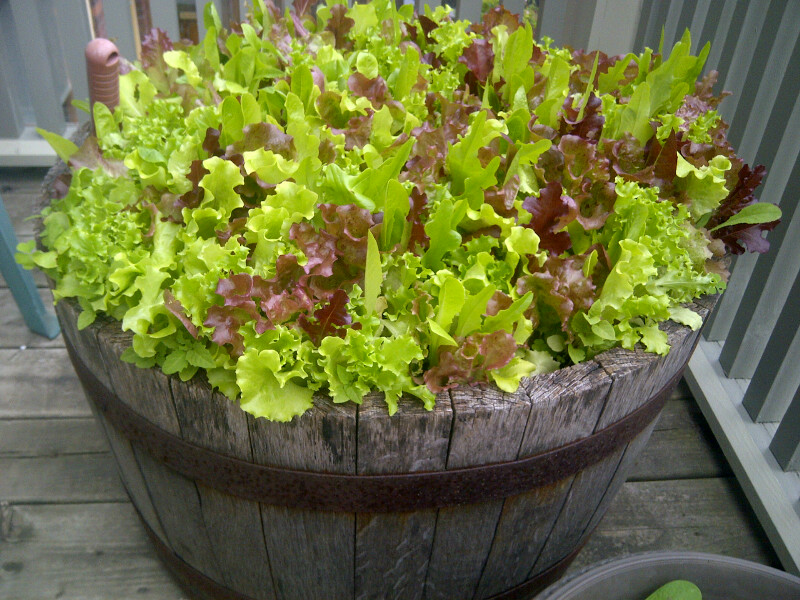
IMG-20130612-01184When it comes to tender salad greens, you need to be able to seize the moment. To harvest at a moment’s notice, it’s best to keep them close to home. So you use the circular elevated oaken growing medium system — also known as the whisky barrel method.

A few years back you were headed home in the minivan when you spotted a discarded whisky half-barrel, sturdily made of fitted oak strips bound by metal hoops. It had fallen out of fashion with your neighbor and had been placed hopefully on the boulevard. You knew the barrels sold for $29 at Home Depot so in a flash the whisky barrel was into the hatch of your Windstar.

You heaved and grunted the barrel into place on your balcony and dreamed of spring. Late at night while you were still wired from winter pickup hockey, you cruised the William Dam Seed catalogue looking for the perfect salad mix. You settled on a $1.95 packet of Healthkick Salad Blend, a special mix apparently high in phytonutrients. You didn’t know what that meant but, as an omnivore, you knew it was better than the single classic combo at Wendy’s.

When the ice melted on your balcony, you drilled a few holes in the base of the barrel, placed a few rocks and broken clay pots into the bottom for drainage, and started hauling soil to fill it. You mixed in some peat to retain moisture, and added a token earthworm to aerate and fertilize the soil. You sowed the pack of seeds, then watered, weeded and waited.

A month later the whisky barrel was stuffed with greens. You began to harvest for salads, picking a leaf or two from each plant so that the plants continued to grow.

For the next month, your barrel grew like a Chia Pet, putting at least a dozen good-sized salads on the table. The fresh-picked lettuce with augmented with chives and onion greens grown in smaller pots.

The whisky barrel method offered several advantages — as a raised bed, it allowed easy weeding. Its size meant it could hold water for four or five days at a stretch, even in hot weather, reducing the chance of a wilted crop from a smaller pot. Its proximity to the kitchen made it easy to harvest and to whip up a salad with dinner on the go.

You got so excited by the success of the whisky barrel method that you took time-lapse photos of your crop every week or so, and tried to show them to your wife and kids. They were not amused by the pics, but kept eating your salads.

Over the years you experimented with other whisky barrel crops — early Arugula, lush Bloomsdale Dark Green Spinach, a Mesclun mix of unknown exotic greens, and the herbal quartet of Parsley, Sage, Rosemary and Thyme.

Your collection of whisky barrels grew as you spotted other barrels discarded by neighbors and allowed yourself the luxury of forking over $29 for a new barrel from Home Depot.

In late summer, you replanted the barrels and continued to harvest well into the fall. The ultimate crop was a vigorous Bok Choi that lasted on your balcony into late November. Before frost set in, you added home-made compost to pay forward next year’s crops.

As you hit middle age, you looked back wistfully on the time you had manhandled the heavy barrels up the stairs to your balcony. You took pride in your environmentally friendly growing system — and began to think that if you ever sold the house, you’d probably leave your gi-normous whisky barrels on the balcony — as a gift to the next owner.

Garden muse — Interview with Mike Murakami

What led a retired industrial designer to request a small plot in the community garden near his Thorncliffe highrise?

For Mike Murakami, there are many garden inspirations — but his original garden muse is his grandfather Shinjiro.

Born prematurely, Shinjiro’s 5-foot stature disqualified him from military service in brewing Russian/Japanese hostilities. He took his skills as a fisherman east across the Pacific, landing in Canada in the late 19th century and settling in the “Japantown” of Richmond, B.C.

“With the anti-Asian sentiment, the Japanese immigrants found employment mostly in lumber, farming and fishing,” Mike says. The salmon industry was huge and a cannery in Richmond provided high quality products and job opportunities. Japanese Canadians also established farms and fruit and berry operations in the Fraser Valley.

Shinjiro and his wife Kinu, who followed him from Japan via an arranged marriage, later settled in Victoria, B.C. “Most of the Japanese lived in the Chinatown area there – in fact both my grandparents picked up some Chinese language there.” Shinjiro and his sons prospered in the fishing industry.

Shinjiro in Victoria, 1936

Shinjiro in Victoria, 1936

Aiko in Victoria, 1938

Aiko in Victoria, 1938

Fast forward to the Second World War. Following the attack by Japan on Pearl Harbour, the majority of B.C.’s Japanese-origin Canadians had been uprooted and moved to inland internment camps by the Canadian government.

“I was born in ’43 in the Kaslo, B.C. internment camp,” says Mike. “When I was one year old we moved to the New Denver internment camp in the Slocan Valley. David Suzuki (the Canadian broadcaster and environmentalist) was in the nearby Slocan camp; he’s about six years older than me. My mom Aiko was principal of the New Denver camp school. My dad Dave drove a truck for the camp administration and learned watch and jewelry repair on the side, through a correspondence course. My grandparents raised me in the camp from ’43 to ’47.”

There are few first-hand memories of the camp as Mike was so young. But he’s inspired by the stories of the ingenuity and persistence of his extended family to survive and thrive after having lost their homes, livelihoods and financial assets.

Mike recalls: “The joke went something like: ‘What’s for supper? Cabbage and Pork. What’s for lunch? Pork and cabbage.”

To augment a bland internment camp diet, camp residents “used their knowledge as farmers to set up gardens,” Mike says. “My grandpa and others would also sneak out of camp to nearby lakes to get fresh fish for their families.”

After the war, Mike’s family came to Toronto via Hamilton. His school-principal mom Aiko found work as a housekeeper and the family lived in the basement of her employer’s house at first. She later worked in a small Jewish business. “We felt the Jews understood and sympathized with our situation.” His father Dave eventually found work in his trade as a watchmaker, repairing the large clocks carried by night watchmen.

As the family’s economic situation improved, Mike’s mom came across a fixer-upper in Toronto’s Cabbagetown neighborhood. “My mom was quite brash and struck up a conversation with the old Scottish lady who lived at 83 Metcalfe Street.”

Aiko then set to work to scrounge the down payment for the house by writing to all of her brothers, sisters and extended family. Her relatives provided what they could, the down payment was made and the deal was done.

Mike describes the home in the Parliament/Wellesley area as “a toe-hold for Japanese Canadians in Cabbagetown. Within about a year and a half, most of our extended family ended up in Toronto. We had up to 21 people in that house – it was kind of like an underground railway.”

Mike recalls his grandfather Shinjiro, then well into retirement, growing corn, carrots and other vegetables on a tiny but productive garden in their Cabbagetown yard. “In the early ‘50s there were still horse-drawn milk wagons. I remember my grandfather going out with a shovel to get horse manure to fertilize his garden.”

Mike returned west in adulthood, founding an industrial design firm in Edmonton.

“As Alberta was very resource-based I felt I needed to support diversification and creative mindsets in my profession there.” As a result in addition to his business practice, he also taught and advised on curriculum development at the University of Alberta, Grant McEwan University and Northern Alberta Institute of Technology. Mike also became a community activist and advisor in the area of “hate-bias” crimes prevention, a topic near and dear to his family’s heart.

As he approached retirement, Mike owned a nice home in a “trendy” section of Edmonton. In a bold move, rather than sell the house before his planned move back to Toronto, he rented it to a family of eight Burmese refugees. “The Mennonite Centre for Newcomers in Edmonton was hard-pressed to find accommodation for the large refugee family and they reached out to me. The Burmese family had been subsistence farmers before the army destroyed their village and crops. We thought our house and large garden would help keep them together as a family unit and help supplement their food needs.

“By year 2 they had turned the garden into intensive production and began gifting veggies to all my neighbours! Most of my neighbours had never known a refugee before. The Burmese family now thrives in their own home, the parents work full time and the kids are doing great at school.”

Mike's greens

Mike’s greens

Now retired and back in Toronto, Mike is looking forward to his third year as a member of one of Toronto’s oldest community gardens at Thorncliffe Park. He’s planning to grow some new varieties of vegetables and herbs, plus his standard crops of tomato, lettuce, garlic beets, carrots and Asian greens.

Most of all, he will continue getting to know his fellow gardeners. “The community garden is really a level playing field,” says Mike. Each person has a small plot. You are there to grow food and enjoy the beauty of the garden in the spirit of community.”

With the neighborhood’s diversity, “the garden is a great metaphor for the collective intersection of culture. We can find a common ground to work together in a shared space.”

With a continued focus on healing the wounds of hate and bias in our society, he has reached out to a local cultural centre to explore options to celebrate the plurality of cultures and religions both within the garden and community.

Mike and Aiko at Thorncliffe Park gardens

Mike and Aiko at Thorncliffe Park gardens

Mike is also going back to his roots to write an online account of Japanese Canadians in Cabbagetown. As it turns out, a well-known historian and archivist now lives at… 83 Metcalfe Street – and Mike and his mom Aiko, now in her 90s, have been by to share notes on their history projects.

It’s been more than 120 years since Mike’s grandfather — and muse — Shinjiro arrived in B.C.  Memories of gardens in New Denver, Cabbagetown and Edmonton hold stories and meaning that inspire Mike’s effort in his new garden at Thorncliffe Park.

“We’re continuing to learn from our past,” Mike says, “and paying it forward.”