Your garden grows: February Figs

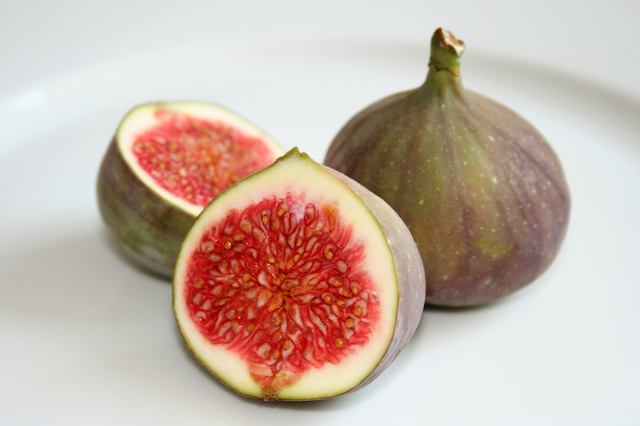
Sweetly ripened figs

Talk about delayed gratification.

Fourteen years ago you mailed a cheque and order form to the bluntly yet precisely-named Ernie Grimo’s Nut Nursery, located in Ontario’s Niagara Region. You imagined a small fig orchard on your deck, adding a Mediterranean ambience to your Toronto home. You also envisioned ripe figs, plucked on a summer’s day and eaten fresh as a healthy dessert.

Your fig trees arrived promptly via Canada Post. They were dormant, with bare roots bundled up and still moist. You were out of town when the special delivery arrived and your sister-in-law Karen kindly planted the young trees in large clay pots and put them in a sunny spot on your balcony.
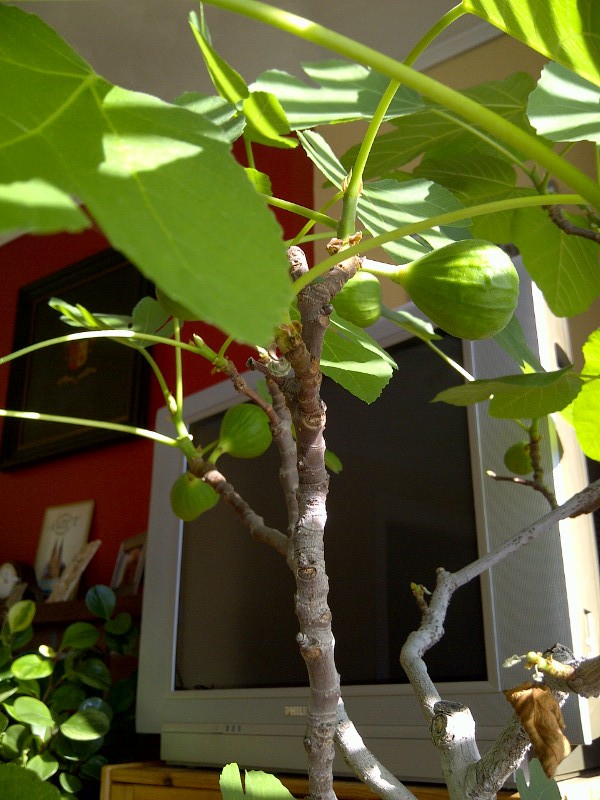
February figs in your TV room

The trees matured and set out fine green broad-leafed canopies each summer. You dutifully hauled the pots inside for the winter to prevent the sensitive young trees from freezing.

The seasons came and went.

The world wide web became quite popular. You got an e-mail account at work. Governments were voted in and voted out. The garbage and blue box went to the curb every Tuesday. And your two little girls became beautiful young women.

But nary a fig in sight.

Meanwhile, you had learned how to propagate the plants, carefully separating new shoots and roots when the trees were dormant, and offering the baby fig trees up for adoption. Eager recipients included a colleague’s father, who had grown figs as a young man in Italy, and your father-in-law Claus, a veteran gardener who immediately started into fig-nurturing competition with you.

Nary a fig in sight — until the winter of 2010. You had left the trees outside unusually late; their leaves had fallen and the top inch of the soil in their pots had been touched by frost. You brought them indoors feeling appropriately guilty, and checked them for signs of life on a weekly basis. The buds kept a hint of green, so you kept the faith, and watered lightly.

In January 2011, the buds became vigorous green leaf clusters.

And by February, the two trees were laden with several dozen swelling green figs.
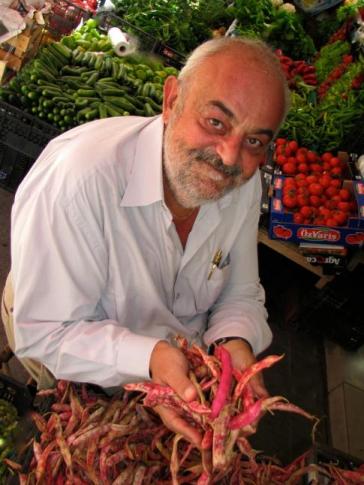
Byrons shops for fresh ingredients

For Mediterranean ambience inspiration, you turned to Byron Ayanoglu’s fine cookbook: Simply Mediterranean Cooking.  His recipe for Potato and Chickpea Stew with Spicy Sausage called for two figs cut into small cubes. “During the long winter months, this is the kind of hearty, legume-based stew with which Southern Europeans bring the sunshine back into their homes,” noted Byron.

You bounded up the stairs and harvested fresh figs from your TV room and surprised your family with a hearty supper. As a post-mortem, you penned a short note in the margin of Byron’s recipe: “Home-grown figs – nice!”

Meanwhile, your colleague Carm had dropped by at work with her blackberry to show you a photo of her father’s fig tree, the one you had donated to him in its infancy. “Tell your friend, thanks for the figs,” he had said. The photo showed a gargantuan fig tree, loaded with fruit in summer. In contrast to your offseason approach, Carm’s dad had planted his trees outside and kept them in the Canadian soil year-round. To keep the frost at bay in winter, he had constructed a sturdy frame around the tree, which was wrapped with insulation.

Meanwhile, too, in the fig-nurturing contest, your father-in-law Claus is winning. But you are too proud to ask him to reveal his fig-growing secrets.

This year, your fig trees are at it again. They seem to have permanently reversed the gardening season to give your family another indoor, off-season crop.

Instead of a fresh fig on a summer’s day, your figs have become a nutritional counterpoint to the winter-time Guinness-Advil-and-Pizza diet that has become a ritual after your Thursday night pick-up hockey game.

Figs ripen one by one or two by two, rather than in one big-bang crop, so you can savour them over several weeks at the tail end of the Canadian winter (while you put in your seed order for your summer garden plot at Thorncliffe Park). Byron’s Mediterranean recipes beckon.

In the case of a sweetly-ripened fig, there’s something to be said for delayed gratification.

Dreaming of spring — Interview with Robert Rayner

Dreaming of spring

A veteran urban gardener meets for a winter coffee at a Thorncliffe Park food court and dreams of spring.

Robert Rayner imagines the blue hyacinths and yellow daffodils emerging from the cool soil of his community plot garden. Meanwhile the garlic cloves he also planted the previous fall are setting down roots. He knows they will shoot up vigorous green stalks as the spring bulb display fades.

“I love growing garlic,” he says. “You must clip the curved flower of the garlic plant to give more strength to the bulb. Some people will chop up the garlic flower for salads although I find it a bit crunchy. In summer you harvest the garlic bulbs as the stalks die down.”

Robert and his wife Carmen use their home-grown garlic for “beef and fish stews and curry dishes. We also share our garlic crop with our children, friends and neighbors.” A recent experience with a garlic thief caused Robert to plant his cloves deeper, so that the stalk will be more apt to break off when it is harvested in haste, leaving the bulb intact.

Robert’s gardening philosophy spans beauty and sustenance – think of the left brain and right brain of gardening. “I grow a mixed garden, which is more pleasing to the eye,” he says. In addition to the cascade of spring bulbs, Robert practices companion planting, mixing Marigolds with his tomato plants to add colour and control pests.

Asparagus plants also bridge the artistic and culinary sidesof gardening. “Asparagus is a beautiful perennial. You have to nurture the young plant for several years before you can harvest it. Once the plant is strong, you can start to harvest the stalks in spring.” A few stalks must be left to grow to give strength to each plant, and these become lush ferns bearing red berries. “My plot neighbor Pearl will take a few asparagus ferns for the cut flowers she brings to church.” The red berries seed new asparagus plants that can be shared with fellow gardeners.

Robert got his start in gardening as a young engineer with the Ceylon Government Railway. “I was responsible for installing and maintaining the tracks as part of Essential Services.” That meant he was “on call” to troubleshoot and repair tracks, often in a tight timeframe — before the next train came along. The team’s mantra: “If you don’t lay the line right, the train goes wrong.”

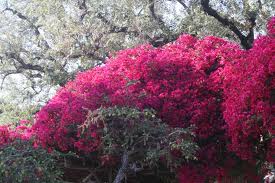
Robert grew Bougainvillea as a young man in Ceylon.

Railway workers were itinerant and were given living “quarters” by the railway company in different parts of Ceylon (now Sri Lanka). In his time off, Robert started a small garden on the grounds of his quarters in the Erayur area. “This was a hot part of southwest Ceylon where you could grow beautiful tropical plants.” A local worker gave him gardening ideas and he learned to grow Bougainvillea, Anthurium and other flowering plants. He was hooked when friends noticed the flowering fruits of his labour and asked him to provide flowers for a wedding.

Robert continued the gardening tradition in Canada. His children had begun to emigrate to Canada, and Robert and Carmen followed suit when Robert retired from his second engineering job with a tire manufacturer. In the backyard of their daughter’s Toronto home, they nourished a mixed garden while taking care of a growing crop of grandchildren. After working the odd midnight shift at the produce section of a Miracle Mart in Scarborough, Robert could be found putting in a morning shift at the garden. “The Halloween pumpkins and peach trees were a hit.”

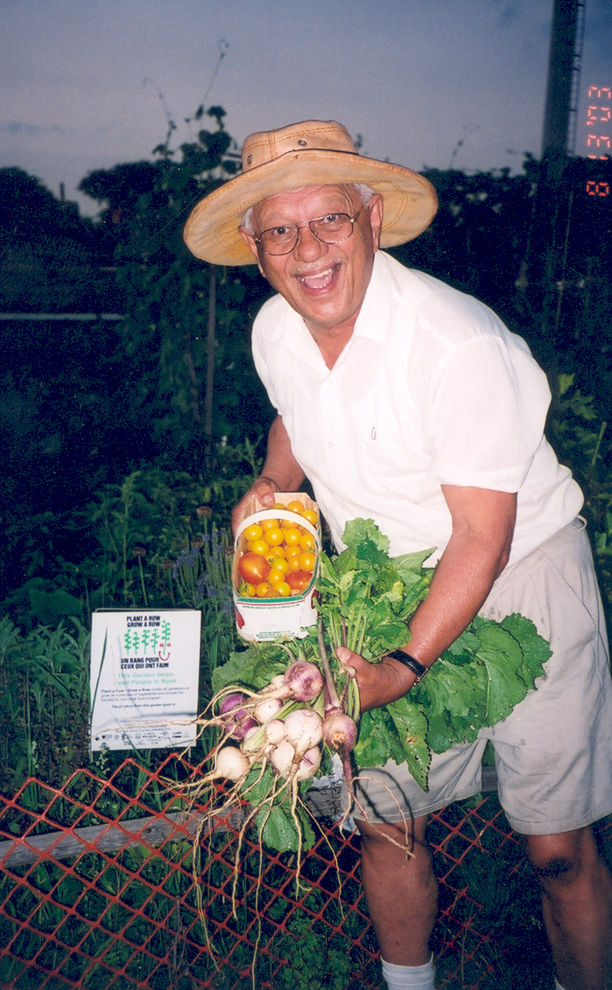
Spring veggies — Robert has donated part of his crop to Toronto’s Scott Mission

In the 1990s, Robert and Carmen settled in an apartment in Toronto’s Thorncliffe Park neighborhood. It is home to one of Toronto’s oldest community gardens, located on hydro land north of Overlea Blvd.  Approximately 100 plots are available to local residents on a non-profit basis, and Robert was quick to get on to the waiting list for the Thorncliffe Park Garden Club. He later used his community organizing skills as President of the volunteer committee that operates the club.

Today he maintains a 12 x 20 foot mixed garden, growing flowers as well as vegetables including squash, tomatoes and, if the thief will stay at bay, some garlic. Around the perimeter of his apartment building, he has planted hundreds of bulbs that will put on a spring show for his neighbors. His philosophy is to “live and let live – be sensitive to others.”

In the winter, Robert fashions meticulous and expressive carvings from basswood and stays busy with the social club in his apartment building. He and Carmen enjoy their extended family, and the community at Thorncliffe, a thriving urban neighborhood north east of the city core.

But on this bleak January day — a veteran gardener is dreaming of spring.