Bike stories: Top 10 bike path hazards

While the finishing touches are put on the vintage CCM, we welcome bike stories from readers. To date we have received three. Nancy Gwin wrote about bike envy and ecstasy as a kid in New Toronto. Dwayne Stevenson shared a bike story of beauty and brutality from his home town of Saskatoon. Now Jane Connor steps forward with some analysis and tips for navigating bike paths, based on her experience as a cycle commuter in Toronto.

By Jane Connor

There has been much talk and media coverage about the relationship between bicycles and cars or, more precisely, the relationship between cyclists and drivers. The angst that exists between these two groups of travelers is generated by a desire to get somewhere as efficiently as possible using the same route. Meanwhile, the person using the other form of transportation appears to obstruct the realization of the goal of the other traveler. This root cause is not unique to the relationship between cyclists and drivers. Interestingly, once the cyclist moves off the roadway and onto a bike path, the angst is quickly re-directed toward other occupants and travelers on this type of route.

To underline the point, the following list is the top ten hazards facing a cyclist traveling by bike paths:

10. The unexplained ball that rolls, unexpectedly across the path. It will force a swerve either off the trail or into oncoming traffic. In the former case, the cyclist may quickly become a botanist and in the latter, a linguist.

9. The photographers and videographers of wedding parties and community college media courses who determine that the middle of the path is where the perfect shot and the perfect light for the shot may be found. Inexplicably, they always find the most acute bend in the path and set up just on the blind side of the curve. Again, the cyclist will become either a botanist or a linguist.

8. The clumps of Sunday walkers that actually materialize on any day of the week and appear to have no set common direction but believe in ‘safety in numbers’ as they manage to occupy the entire width of the path. Here, the cyclist attempts to play a game of “Operation” as the most delicate route through the clump is navigated so that no contact is made.

7. The small unattended children that appear to prefer running in unpredictable, unstable and indecisive lines on the cold, hard trail instead of the soft, warm grass. The cyclist has to slow down and make no sudden movements that may contribute to the child’s decision making in order to pass safely.

6. The slightly older children who have recently mastered the two wheel bike, but use the trail to gain wobbly confidence. Again, no sudden movements are required for safe passage.

5. The roller bladders, oh, the roller bladders. There are those that are just learning. They can’t turn and can’t stop and can’t control their direction. There are those that apparently can only blade if they charge down the middle of the path; forcing all other travellers off to the sides, either in their wake or in anticipation of their impending whoosh. Here, the cyclist may select from botanist, linguist or no sudden movements!

4. The upright, self-righteous, occasional cyclist who believes the bell is a musical instrument and a helmet is an accessory to make them look environmentally conscious. So infrequent is their journey onto the pathways that they have no cycling etiquette what-so-ever. No sudden movement is the recommended approach.

3. The lovers. Yes, they do venture out! It’s not enough to simply walk hand-in-hand to take up as much of the path as possible. These “only-have-eyes-for-you” missing links have to hold hands whilst blading, jogging and even cycling. Circumnavigating them is near impossible. Eventually, the “sweet-talk” threatens to permanently wound the psyche and shear revulsion spurs on the cyclist on to pass.

2. The dog-walkers with the “extend-a-leash”. This is deadly for a cyclist. Up ahead is a dog-walker, a leash in one hand and a plastic bag in the other. The cyclist has assessed the situation and has positioned themselves to pass safely. Suddenly, the dog spies a cat, a bird, or a really good stick and shoots off across the path. A trip wire is instantly formed between the dog-walker and the dog. A screech of tires, some colourful blue language – a linguist solution – and the dog-walker has the audacity to look indignant about it all.

And the number one hazard for cyclists navigating bike paths is…. (drum roll, please)…

1. The Canada Geese. This is generally an early morning phenomenon. They appear to be quite organized, streperous and cunning. They actually gather in large groups on one side of the path and watch for an unwitting cyclist whirring along, head down. At precisely the right moment the first goose steps onto the path, followed by another and another and another. They actually cross the path single file, hissing and honking as they go. The cyclist pulls up fast and waits for a big enough gap to squeeze through whilst pondering whether the geese have actually been talking with the chickens.

Conclusion:

The hazards of the bike path demonstrate that different forms of transport sharing the same route contribute to angst between travelers. Drivers and cyclists on city roads are but one example.

The root cause of this angst, regardless of transportation method, is the ego-centrism of human beings. It is due to perception. It is how the rest of the world looks from the perspective of the “wronged”. Transportation angst will never be resolved. It will always exist. It is the fundamental right of the individual traveling from point ‘A’ to point ‘B’ to perceive and to be aggrieved. In most cases they live to tell the tale.

Shades of blue — fresh paint for the CCM

You’re standing in the automotive paint aisle at Canadian Tire clutching the front fork of a 1964 CCM Ladies one-speed. The fork tube retains a priceless piece of the bike’s DNA — the only intact strip of true blue original paint.

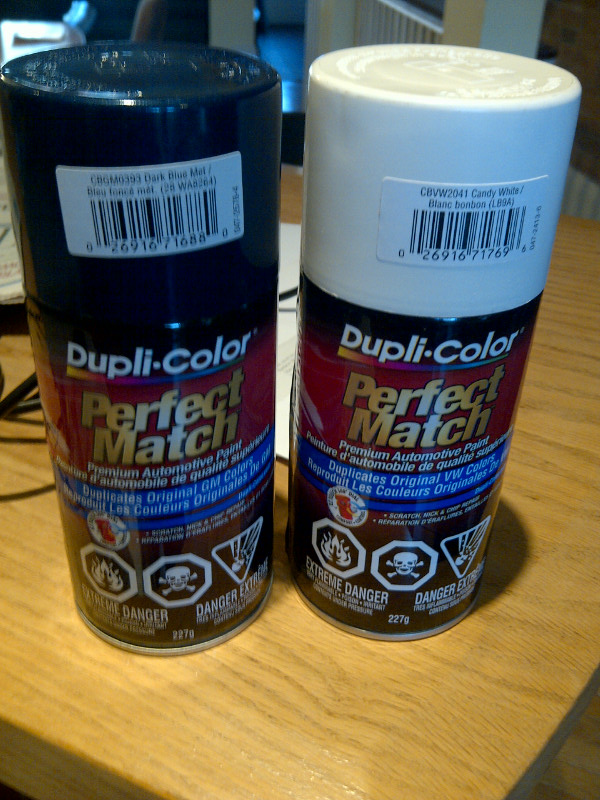
Your mission is to find a close match to bring the bike back to its original dark blue tone. The store shelves present a wall of perhaps 100 colours in no particular order, including about a dozen scattered blue options. You scan the lids of the spray cans and pinpoint a Dark Blue Metallic. There are two cans of the stuff, but you want to be sure of the paint match. There’s a Royal Blue that’s good, but not metallic. An Indigo Blue is bold, but too bright.

Meanwhile, a father and son combination have joined you in the automotive paint aisle. Like you, they are scanning the paint colours, and starting to finger some of the… yes… blue paint bombs. Feigning nonchalance, but with your heart rate accelerating, you return to stand in front of the last two remaining cans of Dark Metallic Blue. You hover for a moment, then pounce to grab both cans. You glance sideways and catch a fleeting glimpse of the son, who just might be giving you the evil eye. But you have your blue paint and you are sticking to it.

For the bike’s white fenders, you select Candy White, which seems to be of little interest to your father/son competitors. Grabbing a can of primer and clear coat as well, you head for the cash. You initiate small talk with the Canadian Tire cashier, asking how she’s doing. “Super tired,” she replies. “I was up late watching a Disney show with my brother.” You tell her you were up not so late watching Downton Abbey with your wife. “My mom is obsessed with that show,” the cashier replies, and suddenly you feel your age.

Toronto-20140506-01903

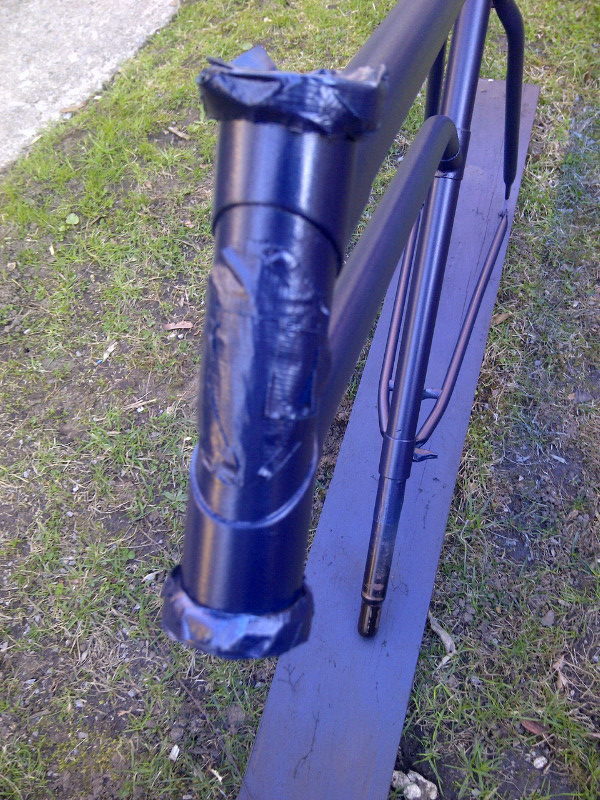
Back in the kinrosscordless workshop, it’s a bit stuffy for spray-painting inside, and you don’t want your better half inhaling fumes through the forced air system. It’s been a crappy winter but the weather is brightening, so you set up your paint shop in the backyard. A piece of 1×6 from your neighbor’s old fence serves as a good painting stand for the frame, which can be balanced in three different positions for maximum paint coverage. Your Dogwood tree has yet to bud, and a crook in one of the branches is a great place to hang the bike fork.

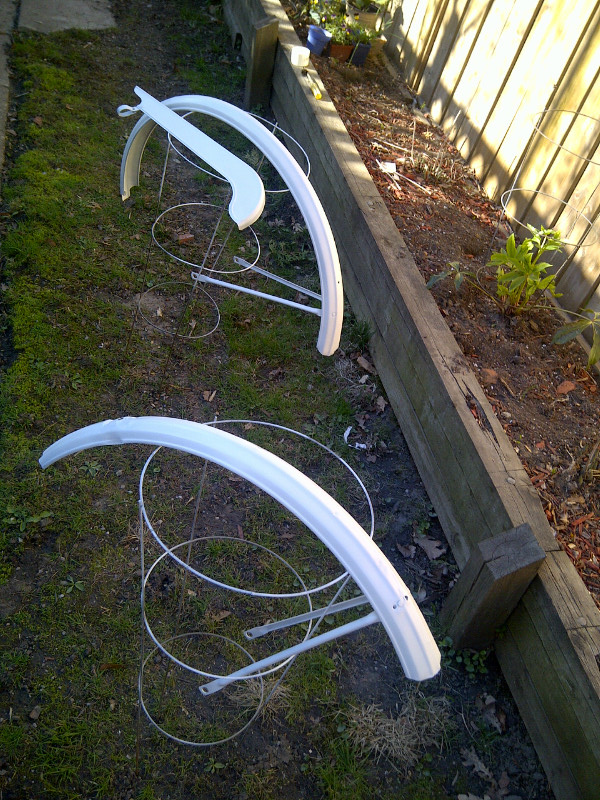
You catch some luck on the weather as the temperature hits 15C — okay for painting. Duct tape comes in handy to tape off the parts that don’t want paint — such as the original CCM headset badge, and the housing for the pedal bearings. Finally, you patent a cost-efficient method for painting the bike fenders and chain guard — tomato cages. The cages are stuck firmly in the ground and let you balance and flip around the fenders as required for painting.

Toronto-20140506-01901

The frame and forks have been stripped then sanded with 400 and 800-grit. You apply a coat of primer to get started and to smooth out some of the bike’s war wounds that remained after sanding. The spray bombs are a bit finicky but you start to lay on a series of light coats to build the base.

The fenders took more than elbow grease to get to the painting stage — you had some professional help from a young guy at Mayfair Plating on Carlaw. For the price of a few Starbucks lattes, he sandblasted away several caked-on coats of paint and accumulated rust.

The Dark Blue Metallic and Candy White go on in multiple coats, with a minimum of 10 minutes to dry before recoating.

Toronto-20140506-01898

Painting a bike is a mix of ballet and hot yoga, at a much better price. You’re getting close to the final step — applying a protective clear coat. But first, you’ll need to read instructions from a gent in Truro, Nova Scotia. He has sent a couple of period CCM decals in the mail. You will need to absorb the steps to apply the “water-slide” decals before the clear coat goes on.

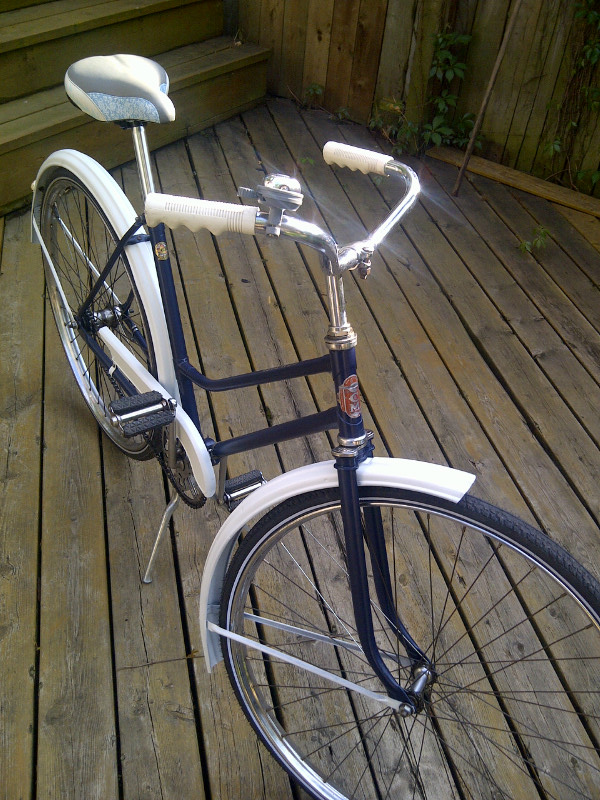
Meanwhile, the 1964 Vintage CCM has returned to its original true blue.

Bike in a box

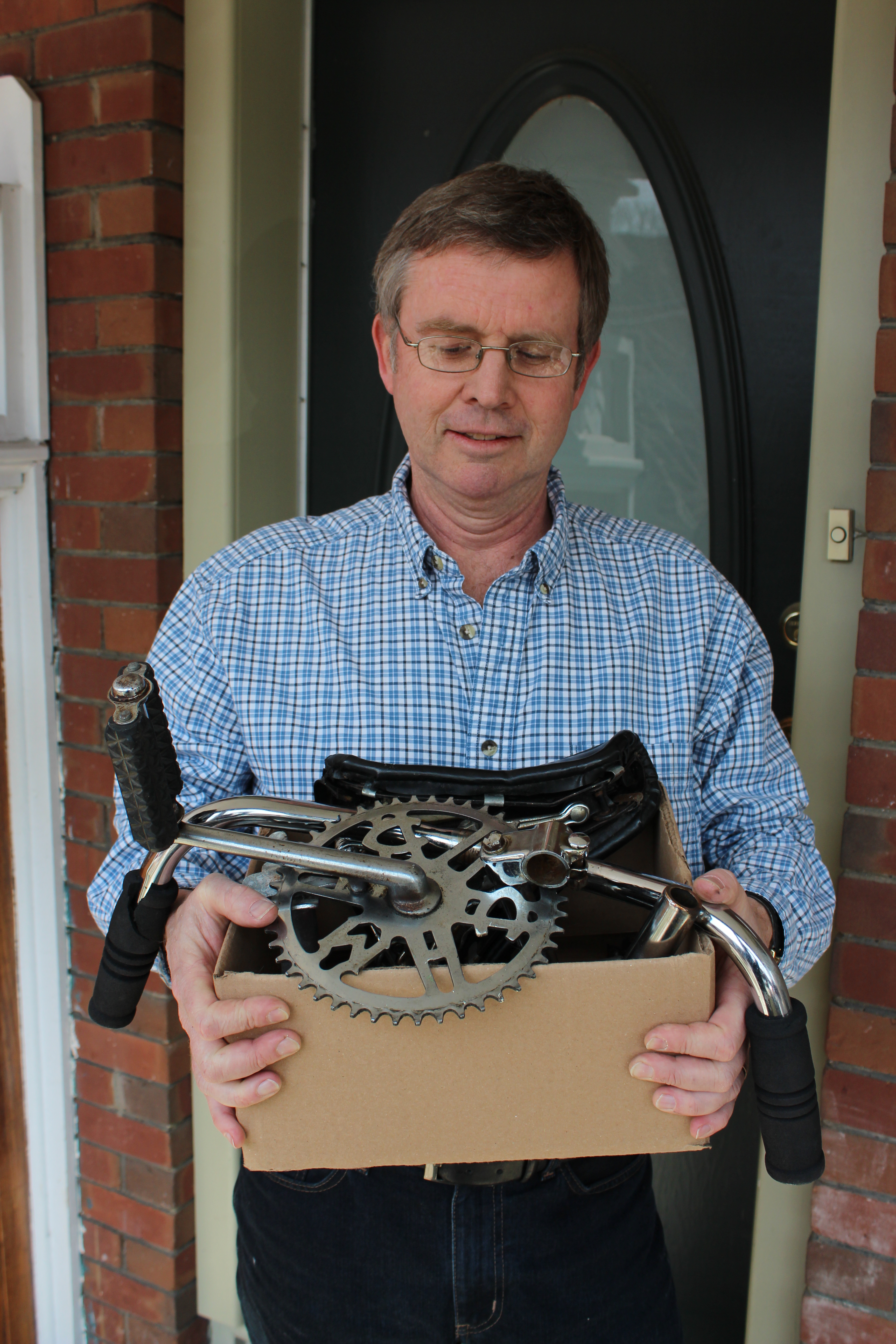
With the frame almost ready for primer and paint, and the steel wheels sporting new rubber, most of the remaining parts of the 1964 CCM cruiser are packed temporarily into a cardboard box.

The clock is ticking on the restoration, as Quinton is arriving back in Canada in May after an exchange in France. Let’s break down the contents of the bike-in-a-box with the hopes that these parts will make it back onto the frame in time — and in the right places. The box includes:

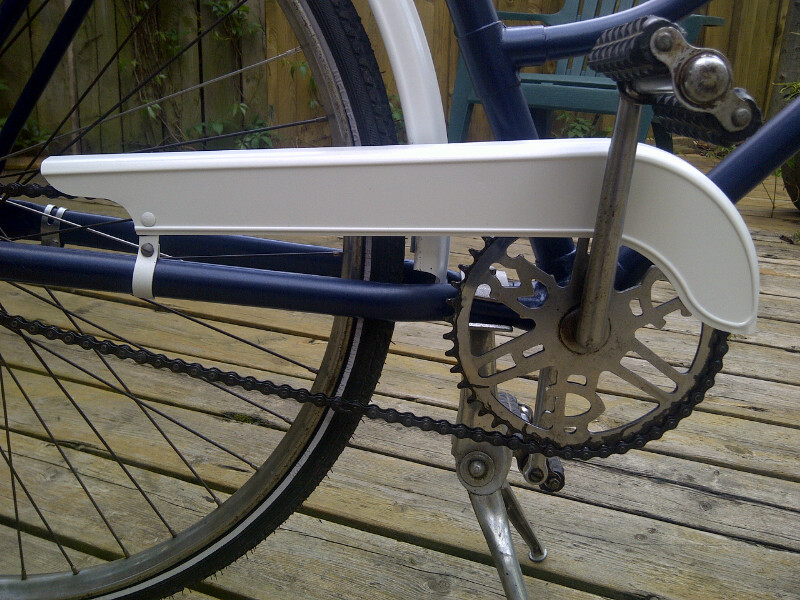
— a sturdy one-piece pedal crank and arms. The ingenious engineers at CCM created this integrated design, which fits nicely into the pedal bracket on the bottom of the frame. The design requires just one pedal to come off to remove the whole unit. No pesky cotter pins are required for the pedal arms, and therefore there is no risk of a pedal arm getting loose on the bike. The bearings are cleaned and ready to be repacked for a smooth drivetrain action.

— a short chrome seat tube. We will need to replace this with a slightly longer tube so the rider’s knees can straighten out while pedalling. Adults may have been shorter on average when the bike was built in 1964. The dude at Cyclemania on Danforth will have a longer chrome seat post, or I may have one kicking around in my drawer of bike treasures in the kinrosscordless workshop

— the black made-in-Japan seat is not original; we’ll find a modern seat that provides comfort and blends in with the bike’s retro character.

— the handlebar post was removed from the fork with the help of some primal screaming and my father-in-law’s vice; it has about an inch to spare to make the handlebars higher so we’ll use the original post

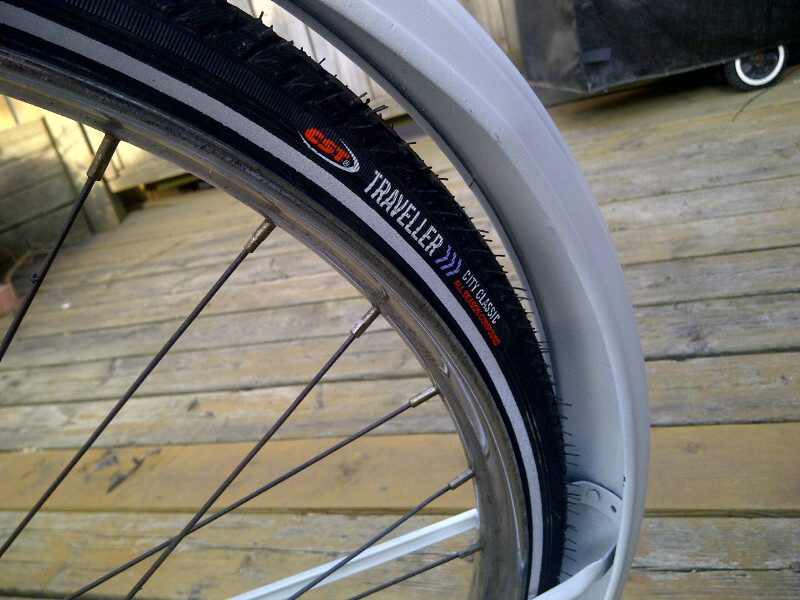
— the handlebars look original but the handgrips are aftermarket black foam and a bit ratty. The folks at the VintageCCM web site have told me that the bike had original white handgrips so we will scout for a new pair of white grips. They will nicely complement the bike’s white fenders, and counterpoint the frame’s true blue metallic tone.

— the original rear reflector on the rear fender is a bit banged up but will add character. The fenders are being stripped of paint, including a bad brushed-on paint job from a few years back, and will look sharp.

— the pedals are both original and in good condition and will get some lubrication before they are back on the bike. Some great videos on YouTube show the proper procedure for pedal removal — the thread pattern on the pedals are opposite to each other, so you can damage the pedal if you are wrenching it the wrong way with your adjustable. When the bike mechanic was younger he knew the principle behind the opposite thread pattern; now it’s easier and more entertaining to look it up on YouTube.

— the two-pronged kickstand is non-original but highly functional and non-intrusive so will get bolted back onto the bike once the paint is done

— some period CCM decals have been ordered from a gentleman in Truro, Nova Scotia, a fellow participant on the VintageCCM web site. Wayne has created sharp replicas of post-war CCM decals, and has dropped a couple into the mail. They will go on the seat tube and down tube to complement the original CCM metal badge on the front tube.

— the chain is soaking in varsol in an empty cat-litter pail. It’s caked in grime and will need a couple of varsol baths and lubrication before it goes back on the bike.

As George Michael sang, You gotta have faith…

The bike-in-the box parts will soon be installed on the CCM frame, with some fidgeting, finessing, praying and cussing.

Stay tuned.

IMG_5000

Bike stories — On a Saskatoon summer evening

Dwayne Stevenson grew up in Saskatoon and lives in Toronto. He’s a communicator, actor, hockey player, philosopher and cyclist, among many talents. Dwayne saw the blog on the 1964 CCM restoration and got in touch: “I like the bike that’s been described. I think I had one something like it when I was eight or nine.” He went on to share the following bike story, which has both beautiful and brutal elements.
The story I’ve related most about a bicycle took place when I was ten. The story is awful, but the bicycle was a quite beautiful, metallic-red, three-speed with a click grip-shifter that one rotated with one’s wrist. My father had traded a fading black ’49 Dodge for it. That was the most unique car we owned, I think, and is a story in itself. But the bike was a beaut with chrome fenders, a kick-stand, and add-ons my Dad thought were snazzy — red, green and blue plastic tassels that hung from the grips, and a high, looping sissy bar that was connected to a purple, metal flake banana seat. The add-ons were popular on bikes at the time, and they transformed what had been a relatively lovely, but otherwise sedate commuter bike. I thought it was terrific.
Although it was “given” to me, my father made a point of telling me that “no one else” was to ride it. But as I say, the bike was a beaut. And a good friend of mine liked it and asked if he could ride it. I said “sure”. Unfortunately my friend took a turn too hard — we were in the dirt parking lot behind the old Saskatoon arena — and he wiped out, bending the front wheel, which would no longer rotate all the way through the front fork. Of course my father’s words rang in my ears.
For whatever reason, the course of action decided was for my friend and I to walk back to my place and tell my father what had happened. My sister, who was with us at the time, said she’d drag the bike home. With that, my friend and I walked down 19th Street on a lovely June evening, made our way down the alley to our place and found my father in his garage. He’d been working in the backyard underneath a car for most of the afternoon and was dressed in dark, dusty, greasy clothes, as well as a black beret he’d taken to wearing to keep dirt out of his hair.
When I told him what had happened, he said “Didn’t I tell you to not let anyone ride your bicycle?” This made my friend a bit anxious and he said “I’ll pay for it to get fixed, Mr. Stevenson.” I’m not sure if my father said anything to Mel, my friend, but I remember my father asking where the bike was now. I said Colleen was dragging it home down 19th Street. He grabbed a sledgehammer and said “Let’s go.”
At the end of the alley we could see my sister coming down the street. “Bring that over here,” my father said to her. She dragged the bike over to us with the front wheel vertical. He told her to put it down and then he asked me: “Didn’t I tell you to not let anyone ride your bike?”
I don’t remember what I said, if anything. I could see my mother had joined us and was standing nearby. I don’t know if she said anything. He began pounding the bicycle with the sledgehammer, great overhead strokes — hitting the frame, handlebars, wheels and spokes — crumpling the thing. I think my mother may have said something then. I remember that a man in a car who’d stopped at the stop sign was looking at the scene.
It was an awful end to a beautiful bike.

Working on your core

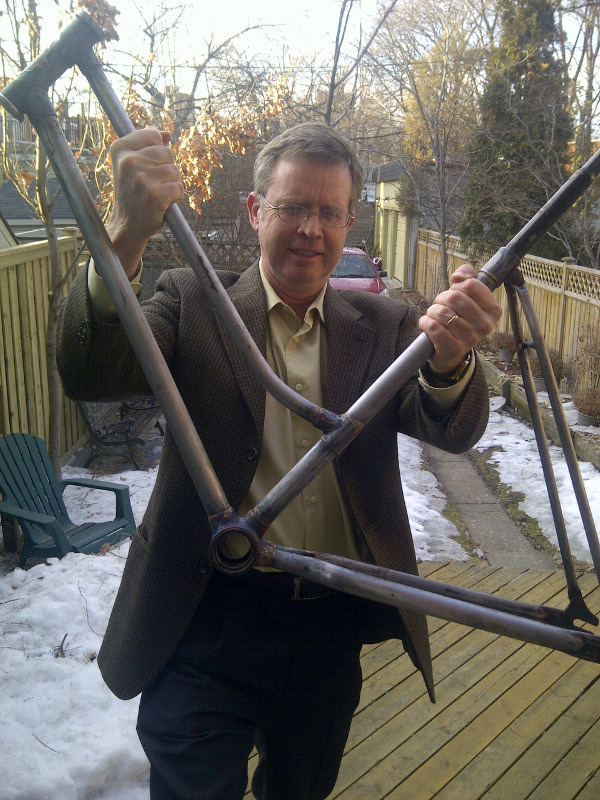
Prepping the bike for paint means working on your core – the steel frame manufactured 50 years ago at CCM’s Weston plant.

After all the bike’s parts have been removed, and scattered about the kinrosscordless workshop in various stages of repair, you arrive at a 7.2-pound frame.

Toronto-20140324-01858

You determine the weight the same way you weighed your cat before a trip to the veterinarian – by stepping on the bathroom scale with and without the object to be weighed.

In the case of the CCM frame, the math works out as follows:

The bike mechanic, fully clothed and clutching the bike frame, at 192.6 pounds

LESS  The bike mechanic alone (and still fully clothed) at 185.4 pounds

= a net weight of 7.2 pounds for the frame.

Your British dad would have described that as “half a stone.”

The bike’s core is a thing of beauty. Most of the paint has been removed. You used a combination of paint stripper, putty knives, 300-grit sandpaper, a dust mask, and elbow grease. Some of the bike’s war wounds take extra effort to sand down, and some, especially on the forks, are beyond remediation so will remain as part of the bike’s DNA.

The non-original red paint is gone, and the gold-coloured hand-welds of the tube joins have emerged.

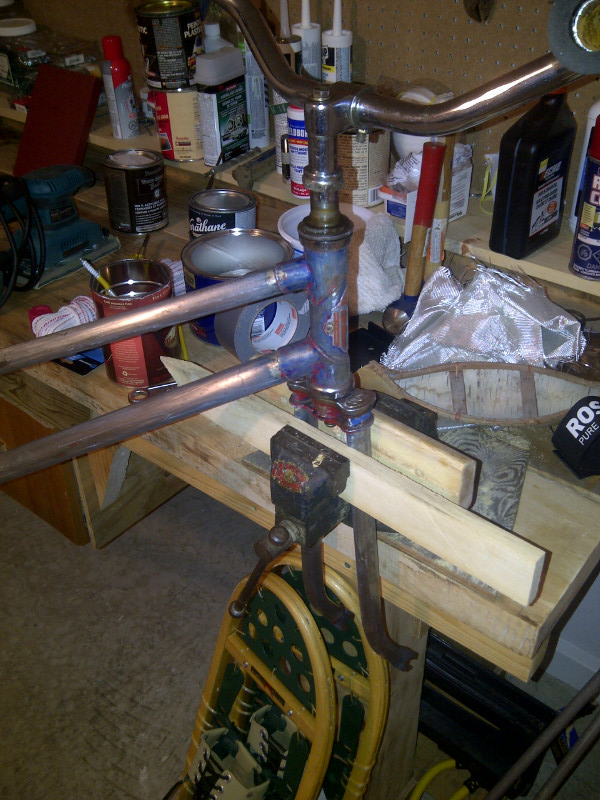
You needed extreme measures to remove the front fork, with assistance from your father-in-law’s vice, some WD-40 and occasional primal screams.

IMG-20140301-01810

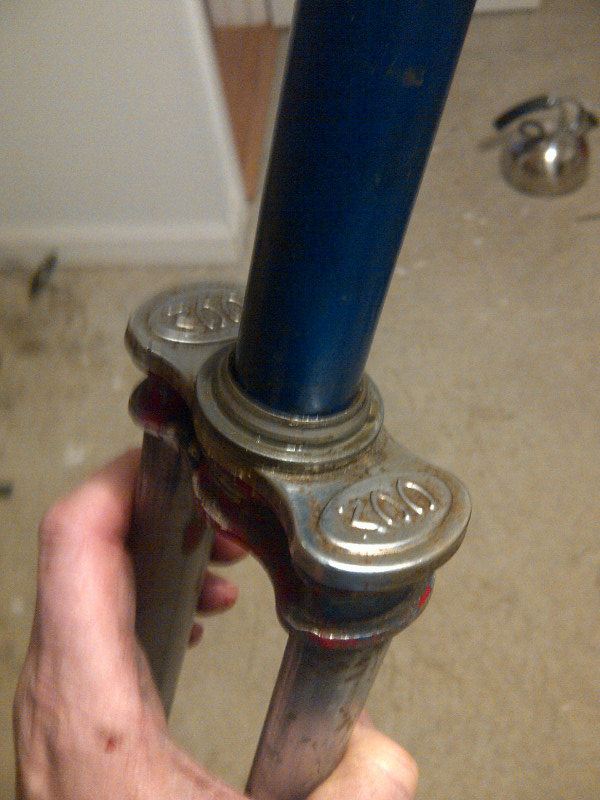
But once the fork was off, a pristine strip of the bike’s original true-blue paint was revealed. This can be matched later to restore the bike to its original paint colour.

IMG-20140301-01829


You took an Earl Grey tea break to watch some YouTube videos of the pros painting bikes. One features an almost ballet-like sequence of the painter twirling the bike as it is suspended from the seat tube by rope. He patiently puts on light coats of paint from a spray bomb. Another series on YouTube called Locked-In offers great primers (no pun intended) on bike painting and all aspects of bike repair.

You are refreshed and have your inspiration, but working on your core will require on final step before paint – sanding the vintage CCM with 800-grit paper for a smooth finish. You are planning to watch a rerun of Downton Abbey’s season 1, episode 5, as there is no Leafs’ game on this evening, but the night is young.


Getting your bearings

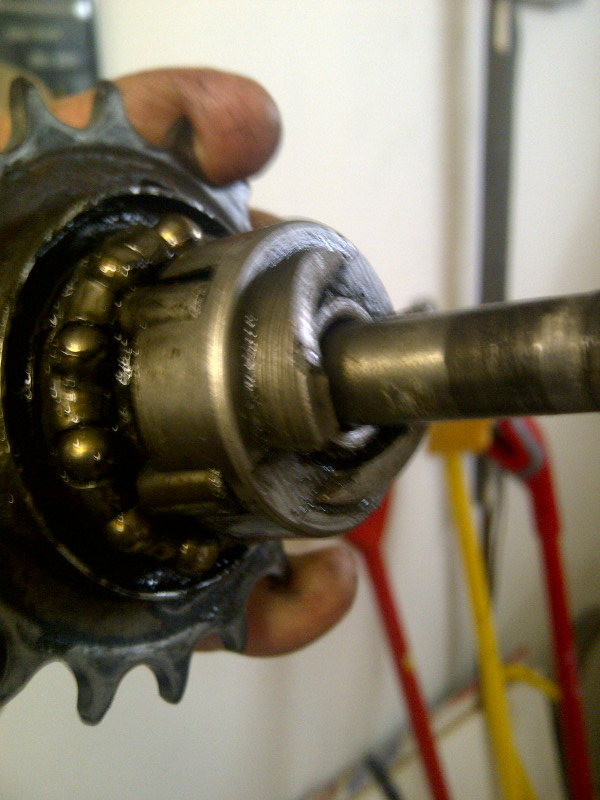
Every 50 years or so, the wheel bearings and hubs on the Blue-Bradshaw CCM get a Varsol bath, whether they need it or not.

Photo: Every 55 years or so, the wheel bearings in the Blue-Bradshaw CCM cruiser should get a bath, whether they need it or not.

The front wheel on this 1964 bike is original CCM and a straightforward job. Once the lock washer is off you pull out the bearings. They come in a clip for easy removal and installation. That’s a luxury compared to some wheels equipped with loose bearings, one of which usually falls out in your haste to extract them. This can lead to an all-fours scavenger hunt on your basement floor.

You fish around in your blue bin for a suitable plastic container that will become the bathtub for your bearings. The bearings are immersed in Varsol and gently jiggled with a screwdriver to loosen the gunk, then rolled on clean paper towel until clean.

Photo: Bearings are ready for a Varsol bath. Mind you don't splash the white dress shirt you're still wearing from your day job.

You apply a liberal coating of Teflon Super Lube to the bearings, repack the hub and adjust the lock washer so the wheel runs smooth but tight.

Photo: Some Teflon superlube is an upgrade from regular grease

The next bath is scheduled for 2064, when this bike mechanic will be 103 years old. Is it possible to book that in your Microsoft Outlook Calendar?

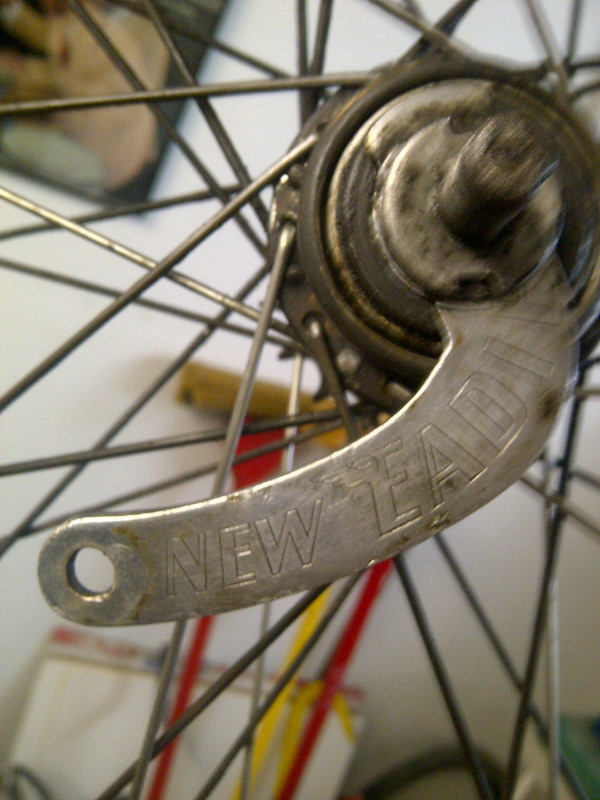
The rear wheel is more complex and compelling. It is a UK-built Dunlop, likely added at some point to keep the bike going when the original CCM wheel, with Hercules hub, was damaged. The Dunlop wheel sports a New Eadie rear hub and coaster brake, a make associated with the UK BSA company, famous for motorcycle building.

Toronto-20140127-01734

The hub is a work of art and engineering. Its bearings float the bike on the wheel, and inside the cylinder resides an ingenious coaster brake mechanism. When the rider backpedals, the mechanism engages a drum that presses into the inside of the hub, braking the bike.

Toronto-20140124-01729

The coaster brake reminds you of your first bike, a red one-speed beauty. You remember the sudden realization that your Dad had let go and you were pedalling solo down Shadwell Place. You took the turn around the cul de sac island too fast, hit the curb, wiped out and chipped your tooth.

But you were right back in the saddle and exploring the winding roads and ravine trails of Don Mills with your buddies. After a while you developed a special talent for braking the bike while riding with no hands, a trick exercised with a certain air of nonchalance.

You are not religious, but reassembling the New Eadie coaster brake is an act of faith. Following the standard Varsol bath and coat of Super Lube, everything clicks into place. The hub adjustment is a bit finicky and will need to be checked again when the bike is road tested.

But for now, you have got your bearings. The wheels on this vintage bike are true with spokes adjusted or replaced, and ready for some new rubber.

CCM stories — A bike for my birthday

As the 1964 CCM Ladies one-speed gets rebuilt, we would love to hear your bike stories.

Here is one from Nancy Gwin. Nancy grew up in New Toronto (now Etobicoke) where her parents ran a variety store on Lakeshore Road. She recalls the powerful and mixed emotions of getting her first bike as a present for her 8th birthday.

***************************

Oh man, I wanted a bike.

All my friends had bikes. I was almost 8 years old and ‘But dad, everyone has a bike’ was getting me nowhere.

My dad told me I could have a bike when I could ride one. ‘Hmmmmm,’ I thought. ‘But first I would need a bike to learn to ride one. Now what?’

My friend Joanne had a bike, a beauty, a blue CCM with a front basket and a bell and streamers from the handlebars and I lusted after it. It seemed everyone’s bike was a CCM.

Joanne lived on 21st Street, a block away from the variety store my parents ran at Lakeshore and 22nd. This was a true variety store. We sold penny candy, comics, magazines and newspapers, cigarettes, milk and bread. We also had a milkshake stand and a gift section. Out front there was a bike rack with an advertising sign on it. Our family lived above the store and the kids helped out in the store.

Joanne and I went to 20th Street School together. We were friends, so she let me learn on her bike. We went a few houses down from her place to ride up and down on Mr. Fisher’s driveway. His driveway was paved asphalt and made for a smooth ride.

Well, I practiced, fell, coasted, practiced, pedaled and learned how to ride a bike. Now… How to get my dad on board? I told him I could ride now, and please could he get me a bike. He was thinking about it and I knew enough not to ask again.

Finally, it was my 8th birthday. I came home from school for lunch and there was a bike outside the store in the bike rack. There were no customers in the store so I thought this might be for me, except… it couldn’t be. It wasn’t a CCM, it didn’t have a basket or a bell or streamers. It was some other bike from somewhere with a crest and strange initials I didn’t recognize.

I thought, ‘That can’t be for me because it’s not what I asked for.’ I had asked for a CCM with a basket and a bell and streamers from the handlebars. ‘Whose bike is outside?’ I wanted to know.

My parents were watching me as I slowly realized that this was my birthday present. They had parked it outside the store to surprise me. A beautiful dark blue girl’s bike, a one-speed – or “no speeds” as we would say – with a coaster brake. Not exactly what I wanted, not exactly what I asked for, but oh boy, I had a bike. And I knew I had to learn to love it.

Joanne and I and our neighborhood friends would ride our bikes up 21st Street, across Birmingham, and around behind the Lion’s Arena. We would ride to the train tracks and back, and along Lakeshore Road to the Library. Eventually, I got streamers, a basket and a bell for my new blue bike.

In high school, I would get up on a Sunday, grab some food from the fridge, and go for long rides. I rode all along Lakeshore Road to the ferry docks at Yonge Street and back.

I had that bike until I was in my early 20s – when Peter and I moved to Nova Scotia. We drove out, so we didn’t bring much along and I gave my bike away before I left – the one that wasn’t a CCM but that I had learned to love.

Steel wheels

Today’s bike repair challenge: The sturdy 28-inch steel and chrome wheels on Quinton’s classic CCM cannot be trued because many spokes are seized.

Solution: Your first step is to pull the tire using methods handed down by your Don Mills neighbor Mr. Harmer, who rebuilt old bikes pillaged from the garbage in the ’60s and ’70s.

Photo: Challenge: the sturdy UK-built front wheel on Quinton's 50s CCM cruiser cannot be trued because many spokes are rusted solid.

He gave bike repair clinics to you and your friend Craig Harmer (his son). The first was how to wield screwdrivers to pull a tire and repair a puncture — pronounced “poonctcha” in Mr. Harmer’s Yorkshire accent.

The screwdriver method can cause some interesting self-inflicted injuries during puncture repairs, so as a boy you purchased CCM tire tools from Norwegian Ski Shop at Don Mills Plaza. The tire tools had better leverage and less sharp edges. You still have them handy in the flotsam and jetsam of bike repair stuff in your toolbox.

Photo: You must pull the tire using methods handed down by your Don Mills neighbor Mr. Harmer, who rebuilt old bikes pillaged from the garbage.

Once the tire and tube are pulled, the problem spoke threads on the 1964 CCM get treated with WD-40 plus some Superlube Teflon grease you bought at the Don Mills Canadian Tire — the gift that keeps on giving.

For the half dozen spokes that absolutely will not give, you pay a visit to the gent who owns the Cyclemania bike shop on the Danforth. He produces matching spokes at 50 cents a pop. Some people are scared of this guy’s gruff manner and Eastern European accent. The fact is he is a top-tier bike mechanic and a keener for all things bike-related.

Back at home, you clip out the old spokes with wire cutters and weave the new ones into the wheel’s spoke pattern. Listening to CBC radio gives you the right Karma to wrestle the new spokes into place one by one.

The wheels are now ready to be trued — which will iron out wobbles and make this vintage bike run straight. A cheap true key on the 15 mm setting will do the trick.

To find the major wobbles in the tire you can spin it on the bike fork and use a thumbnail to diagnose the problem areas. This is a cheaper option than a professional truing stand used by bike repair shops.

Then loosen and tighten alternating spokes appropriately to coax the rim back into true.

Photo: Once the tire and tube are pulled, the problem spokes get treated with WD-40 plus some superlube grease you bought at the Don Mills Canadian Tire in the 70s -- the gift that keeps on giving. The rim can now be trued.

But it’s getting late and you have a day job. Say a quick thank you to your bicycle repair muse Mr. Harmer, and set your alarm clock.

The next bike repair challenge in our CCM restoration will be an overhaul of the front and rear hubs.

Photo: But you have a day job. The hub overhaul awaits.

In the meantime, here is…

More on the art and science of bicycle wheel spokes:

Some fascinating background on spokes comes from writer David Fiedler in the Bicycling section of About.com. He describes the beauty and complex functionality of the spoke, including its role to provide integrity to the wheel and to transfer power from the rider to the rubber that hits the road. Even Shakespeare with his rhyming couplets and iambic pentameter could not have paid a better tribute to the bicycle spoke:

The spokes on your bike’s wheels are like the busboys at the restaurant. They’re quiet and out of the way, and it’s pretty much a thankless job. No one ever notices when everything is working well, but without proper set up and operation, all sorts of trouble will break loose.

What Spokes Do

The spokes on your bike may look like little more than metal toothpicks that fill space between the axle and wheel but really, these mighty little dudes have an important job.  They do a couple of things:

  • Add strength to your rim
  • Transfer your leg power from the hub to the wheel
  • Support your weight on the wheel

How Spokes Work

How the spokes accomplish these terrific and heroic feats? First, spokes don’t push outward, holding the rim at bay, like it might seem. Rather, the rim is evenly pulled inward by spokes that are laced through the hub, the center part of the wheel that rotates around the axle, which makes it extraordinarily strong. These spokes coming from the hub then radiate outward to the rim, where they attach to nipples, which are almost like little nuts resting in the rim. The nipples can be screwed down onto threaded tips of the spokes, which increases tension on the rim, and also pulls it slightly to the left or right.

Another important job of spokes? Playing a key role in the transferring the power from your legs to the rim to make the bike go. Enormous force gets applied to the hub of a rear wheel by the chain and gearing when you pedal down hard, and together the spokes carry the power that has gone from your legs to the chain then out to the wheel.  That force driving the bike forward gets distributed among many spokes in a properly aligned wheel, which people usually describe as being “in true.”  When you look at weight distribution, too, even under a very heavy load many spokes help spread out the weight so that it is more evenly carried and doesn’t put too much stress on any single spoke.

Deconstructing the CCM Cruiser

Heather has told the back story of the CCM cruiser she purchased from a Kingston antique dealer — and now the bike itself has arrived at kinrosscordless headquarters, ready for restoration.

Each bike has a million stories to tell. A quick mechanical assessment will coax some more clues related to this CCM’s origin and use. Some expert advice from CCM enthusiasts will fill in the blanks and solve some mysteries.  And the bike’s next rider, Quinton, will help us plan the road ahead for the restoration by sharing some of her preferences for this classic’s new lease on life.

We’ll start with the curb appeal. Then we’ll assess some specific areas such as the drive train before moving to the big reveal: carbon-dating the bike.

The curb appeal

At first blush, Quinton’s CCM Cruiser is a solid-state city bike with two-tone red frame and white fenders.

Red CCM 1

The wide fenders are funky and functional – you can ride the bike in the rain without getting the proverbial stripe up the back. They’ve been repainted once in their original white.

Several scratches on the frame reveal the original dark blue metallic tone underneath a more recent coat of red paint.

The bike is equipped with a one-speed coaster hub. Unlike the fixed gear one-speeds that have become popular again recently, the CCM hub lets the bike coast freely while the rider stops pedalling, and contains an internal brake that’s applied by back-pedalling. The related absence of hand brakes, a shifter, gears and cables gives the bike a clean and simple look.

The seat post is a bit short – just like more adults were back in the day when this bike was made.

The top tube on the frame has a u-shaped curve and is set lower, indicating a women’s (ladies’) model. This design maintains the integrity of the frame and allows a lady rider to seat herself on the bike with decorum and efficiency – unlike men’s bikes with their straight and high top tubes requiring an ungainly leg-over to get seated.

The bike will be great for city trips – it’s not going to compete on the steep hills of the Alpe d’Huez , but will be a comfortable and classic ride to school, work or around the neighborhood.

The drive train

The CCM logo is an integral part of the chain ring, blending physics and fashion. It’s cool that the company logo is actually transferring power from the pedals to the back wheel.  Perhaps the CCM marketers took the engineers for coffee? Each letter has parallel vertical bars that give extra integrity — and look a bit like dollar signs, evoking an era when CCM was King of the bike business in Canada.

Toronto-20131230-01663

The chain is gunked up with oil and dirt and moves stiffly. Likewise for the wheel bearings that allow the bike to float on its axles – you can hear and feel some crusty crunching while spinning the wheels.

Wiping away grime on the rear hub arm reveals a New Eadie logo, and the hub is attached to a rear Dunlop wheel. Both of these are UK-made.

The bike has heavy-duty 28” wheels on a straight frame. The wheels are tall and wide, allowing big wide tires that enhance the bike’s suspension. Many spokes are seized and the result is the wheels are slightly out of true.

The rubber tires and tubes are functional but mismatched and showing some cracks in the sidewalls.

The pedals look to be original and spin nicely on their bearings.

Despite some aches and pains, the bike had been well-used and maintained, and was still roadworthy many years after it rolled off the CCM assembly line.

The fine details

The stylized CCM logo appears in chrome detail on the fork caps, and as a badge on the headset.

ccm badge

The seat and handgrips are more recent additions – a sturdy made-in-Japan black seat, and some soft black handgrips.

The rear fender sports a small red reflector light for safety.

Scratches on the headset reveal the bike used to have a front basket.

Carbon dating the bike

The bike reminds me of some of those owned by “the adults” in my Don Mills neighbourhood growing up, so my first guesstimate of the model year is late 1950s.

The headset badge shows the bike was made at the CCM plant in Weston, Ontario (in Toronto’s west end), at the huge CCM plant that operated from the late 19th century to the early 1980s.

Heather has found a vintage CCM website, so I sign on to the discussion forum and post a picture of the bike and some of its components.

Within a couple of hours I am joined by several CCM enthusiasts who are keen to provide information and help pinpoint the date of manufacture.

A discussion-forum participant named Wayne notes that the bike is likely early to mid-1960s: “the CCM-marked cap on the forks was only used for a couple of years: ’62 to ‘64 I think.”

I’ve tied myself into knots trying to find the serial number on the usual spots on the bottom bracket or seat tube, to no avail. Wayne sets me straight: “Look on the rear dropouts,” he advises. Sure enough, a clear serial number starting with the letter D is revealed when I wipe away grease on the left rear dropout (the part of the frame that holds the rear axle). I eagerly update my discussion post with the serial number.

Toronto-20131230-01668

A gent with the handle ccmusclebikes weighs in: “D sounds like a 1964 bike to me.”

Soon another enthusiast named Carl posts a picture of the serial number and dropout on his 1965 Ladies CCM. The 1965 models start with the letter “E” and his photo is a dead ringer for the 1964 dropout that’s hanging in front of me. The only difference is the coaster brake and arm – Quinton’s bike should have a Hercules coaster hub but instead it is equipped with a New Eadie model – a UK make linked to the famed BSA company.

A final post comes from William who hypothesizes that “your New Eadie brake and back wheel may have been replacements to keep the bike going.”

The road ahead

Heather and Quinton, along with Heather’s sister Susan, drop by to have a look at the bike during the check-up.

Getting ready for deconstruction.

Getting ready for deconstruction.

Together we write the checklist for the upcoming restoration:

  • Return the paint on the frame to its original dark blue tone.
  • Find some matching accessories including a seat and handgrips that will enhance the bike’s original look.
  • Tune up some of the mechanics including bearings and straighten the wheels for a truer ride.
  • Install some new rubber to get the best suspension out of the bike’s big, wide wheels.
  • Replace the seat post and adjust the handlebars for today’s taller adult – namely Quinton Bradshaw
  • And finally…  add a basket that will carry Quinton’s textbooks. (Okay, that sounds way too studious, but this bike mechanic once carried textbooks in his bike basket).

The CCM 1964 Ladies one-speed has shared a few stories. The kinrosscordless workshop is stocked with bike tools and some strange potions including chrome polish.

Let the restoration begin!

CCM Cruiser – The Antique Market Discovery

First in a series chronicling the discovery and rebuild of a classic CCM cruiser bike. Posts are co-authored by Heather Blue and Ian Kinross. In this first post, Heather discovers the bike…

It was a perfect afternoon in early September; the sun was bright and warm, the sky a brilliant blue and a soft autumn breeze filtered through Kingston’s Old Market Square.  The Sunday Antique Market was unusually busy, with tourists, university students and locals wandering about. There was good energy in the air as everyone seemed to be savouring this idyllic day, taking pleasure in the waning days of summer’s splendour.  Shoppers of all ages perused the well-worn items, forgotten treasures, junk and gems.  The regular antique vendors were there, casually engaging with the browsers who lingered a little longer over their tables.

Red CCM

Our vintage CCM cruiser – needing a little work to bring back to form. The original colour was blue but along the way it was painted red.

My daughter Quinton and I had made an impromptu decision to come downtown.  We weren’t really looking for anything in particular but as we always do when we stop by a garage sale or flea market, our eyes scanned for something interesting, quirky or special.  Something from another time and place that was well used or cherished, that we could adopt, take home and give new life.  We shuffled through the busy marketplace, checking out the old jewelry, albums and furniture and then, we saw it.

There it was, leaning up against a table of old books; a vintage red women’s CCM one speed cruiser.  It spoke to us, drawing us over by its fashion sense, practicality and simplicity.  We hustled over, wanting to get our hands on this classic before someone else scooped it.  As we approach the bike, I got excited.  It really WAS in good shape, not much rust, the chrome actually shiny in spots and the tires had been updated.  I wasted no time in hopping on.

We had recently talked about trying to find an old bike just like this and, low and behold, here it was.  As I passed the bike over to Quinton to try it on for size, the antique dealer slid over to my side.  He said it fit her perfectly and invited her to take it for a spin.  She reluctantly wondered if that was okay given how busy the market was and since we were “just looking.”  With a little encouragement, she took off around the block, testing its brakes and handlebars.  These old bikes have an interesting way of adjusting our expectations of steering manoeuvrability and comfort.  There’s a fun awkwardness about them in their uprightness, but the key word here is fun. Quinton came back unscathed and with a smile on her face.  Our bike had passed the drive test.Red CCM 4

Of course the next step was to agree on a price.  I seem to recall the sticker said $60.  My emotions were telling me that this was a fair price especially for such a fine bike that my daughter would love and use as her ride to school.  My practical, sensible side told me that I should never pay the sticker price, that I should talk him down, at least a little bit.  We settled on 50 bucks cash.  In the world of antique hawking, cash is king, you know — no cheques or credit cards accepted.  It was at that moment I remembered we had not stopped by the bank on our way downtown and if I was lucky, I had at most $20 in my purse.  Our deal was in jeopardy!  I asked him if he would hold it for us on a minimal deposit so that we could run to the bank.  “No problem,” he said, assuring us that he would keep it for us and not sell it to anyone else.

After we returned with the balance and completed the transaction, he gave us the sales pitch.  His timing seemed a bit odd given that we had just paid, but we listened enthusiastically.  He told us that this had been his mother’s bike and she had enjoyed riding it for many years.  He had been storing it in his garage for a while but it was now time to let it go, to become part of someone else’s family.  His mom, Margaret, had won this bike in a contest back in the 50s.  Apparently there had been a matching pair of bikes to be won, a women’s CCM and a men’s CCM.  When the contest was over, the prize winners met.  The young man who won the other bike took a fancy to Margaret and, long story short, they fell in love and got married!  What a great story.  Was it true or was he just trying to make us feel good about over-paying for an old bike needing some TLC?  This antique dealer was either a darned good salesman or, as we prefer to believe, a romantic with a wonderful story to share of how his parents had met.  For Quinton and me, it was the icing on the cake for finding a great bike on a beautiful day.  This bike was now ours and we were taking it home.Red CCM 2

Heather — December 16, 2013

This blog is co-authored by Heather Blue and Ian Kinross