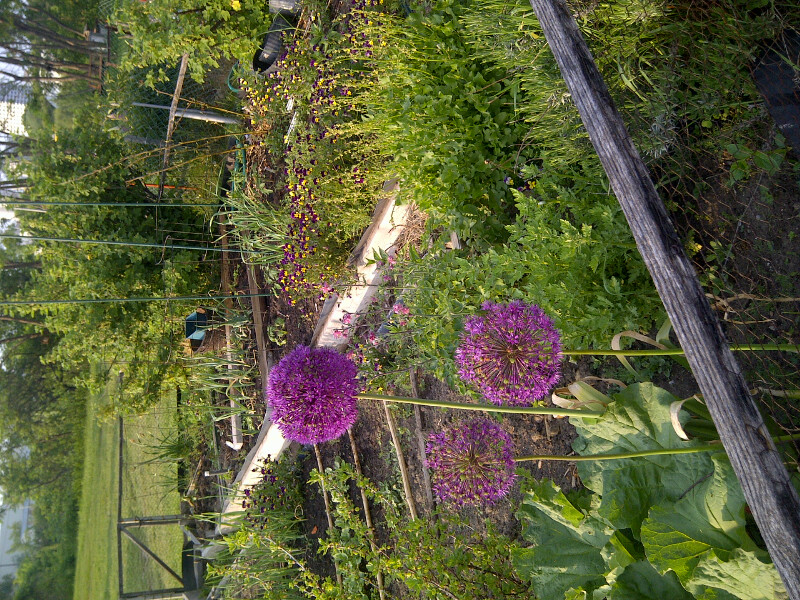
Miracles and disasters in the urban garden

About this time of year you’ll start to hear the hype about the miracle garden:

Grow 800 pounds of organic produce on a postage-stamp-sized plot – in just minutes a week! Garden yourself to victory in the coming food security apocalypse — without even getting your hands dirty!

But if you’re planning to roll up your sleeves to grow food in the city, don’t plan on the miracles unless you’re prepared to sweat some major disasters.

Or to put a more positive spin on life in an urban garden — every garden disaster makes each garden miracle that much sweeter.

That’s one of the lessons you’ve learned from Joe, Athena, Robert, Carmen, Andy and your many gardening comrades in ten years at one of Toronto’s oldest allotment gardens. Not to mention the escapades of the mysterious red currant thief.

Disaster: the squash devil

One year you planted several varieties of squash in a raised bed fortified with much well-rotted manure. Using your limited carpentry skills honed from childhood tree-fort building in Don Mills, you constructed a kind of folk-art trellis upon which you imagined your squash plants would rocket their way skyward.

You kept the bed well watered and the plants burst from the soil — the rocketing had begun. Yet while the green foliage showed the desired vigour, one by one, every single delicate yellow bloom withered on the squash vine.

One day your allotment neighbor, Joe, identified the culprit – a small black-and-yellow bug that feasted on squash blossoms. “He’s a devil,” said Joe, showing you the bug before squishing him between his thumb and forefinger.

Joe and Athena

You trusted Joe. He and his wife Athena, retired from the restaurant trade, grew an orderly Greek-themed garden filled with tomatoes, beans, onions and tasty greens. They enjoyed the long summer evenings in late June on lawn chairs outside their plot. Joe ferried fresh produce daily back to his nearby apartment on a rickety blue bicycle. Joe’s secret to gardening was soil preparation, and he spent days carefully hand-tilling his plot each fall, to be ready for the next growing season.

And Joe knew his pests.“You gotta pick off every bug and kill ‘em,” Joe said, proceeding to smear the bug on your garden fence, possibly as a warning to the devil’s comrades.

This minutes-a-week-to-gardening-victory thing just wasn’t working. You figured if you quit your desk job you could keep up with the devil-squishing. But you needed to pay the mortgage.

So your plants continued to rocket skyward that summer without producing a single squash. It was a garden disaster.

Miracle: the onion volunteers

But think back a little further and you will recall a garden miracle.

You had been two years on the waiting list for a plot at the Thorncliffe Park Garden Club, when you got the call. The club president, an elegant retired railway engineer named Robert, phoned to welcome you to the club. You had your piece of paradise – a 12×20-foot garden in full sunlight in a hydro corridor near Toronto’s Thorncliffe neighborhood.

Robert — who with his wife Carmen nourished a gorgeous mixed garden of vegetables and flowers — accepted your $20 fee, and showed you your plot number 6. It didn’t look like much on a cold April day: just a patch of dirt surrounded by a 2-foot wooden fence in reasonable repair.

But poking through the ground were green “volunteers” – several varieties of onion, and a multitude of garlic shoots.

You carefully dug up the volunteers, prepared a patch of soil, and arranged them in neat rows. Robert dropped by in his broad-brimmed hat and khakis to offer encouragement. “I have some elephant garlic bulbs for you, my dear,” he added. (In addition to his generosity in sharing plants and produce, he punctuated some sentences with this gender-neutral term of endearment, perhaps a turn of phrase from his native Ceylon).

Spring greens at Thorncliffe

You reciprocated by lending him some muscle to move a mountain of earthworm-laced soil to his plot – a special delivery from a farm outside the city. You and Robert were both out of breath following the shoveling workout, and rewarded yourselves with a shared thermos of coffee and a few minutes of peace in the community garden.

Later that summer, you pulled up the plants and took home your onion bounty, placing it in the basement to dry.

The onions and garlic from that summer fortified your home-made soups for many months that winter. The capper was when your daughter Colleen wolfed down a bowl of the house special and asked “Are there seconds?”It was a garden miracle.

Disaster: the red currant thief

But then, there was the case of the red currant thief.

You’re not talking about a guy who sneaks into the garden at night and steals the little red currant berries that dangle in delicate clusters from the currant foliage.

This guy took the whole bush.

The previous summer, you had proudly guided your spouse Nadine, daughters Alison and Colleen, and step-brother Stefan to your red currant patch, where they had picked bags full of berries. That weekend you spent a night at the stove at your inlaws’ cottage, boiling the berries into little pots of clear currant jam. Your father-in-law Claus stopped by to offer free advice during the critical gelling stage.

Your gardeners’ pride was compounded by the fact that you had successfully propagated the plants by taking cuttings in the fall. You had planted the cuttings and then carefully tended the new bushes over several years as the berry production slowly increased.

It was an unusually warm day in late March the next spring, and you had come back to the garden to admire your pruning job on my three red currant bushes.

But where your middle currant bush once stood now gaped… a crater. The thief hadn’t even bothered to backfill the hole from which he had wrenched your bush, roots and all.

When it comes to crime, you can’t go much lower than stealing an honest man’s shrub.

Miracle: best boy special delivery

But you forgive the shrub thief by remembering the miracle of the Best Boy special delivery.

It was a scorching summer in T.O., a summer for heat-lovers. And you’re talking tomatoes.

Another garden plot neighbor, Andy, had taken to giving you regular advice in a very direct manner, and booming voice, on many gardening subjects. Andy was the Thorncliffe Park Garden Club’s number 1 “fixer.” When he wasn’t working his own plot, Andy could be found sawing and hammering away doing odd jobs on neighbors’ plot fences, and going for coffee runs in his aging but immaculate silver Volvo.

Your first inclination was to play dumb, or to avoid this nosy gardening neighbor — until Marina set you straight.

“Listen to the old man,” said Marina, who grew bitter-melon and other exotic (to you) vegetables. “He knows what he’s talking about.”

Andy decreed that the best tomato seedlings could be found at small garden shop on Pape Avenue. You parked illegally across the road and jay-ran over to spot the shop’s last flat of tomato seedlings. The price was a steep but the seedlings had thick sturdy cores and healthy leaves, and an intriguing brand name: Best Boy.

Andy took pity on your initial attempt to plant the seedling plants, brushing you aside to show you how to dig them a little deeper and to pick off the lower stems, helping the Best Boys set down a good root system.

In the heat of that summer you had a bumper crop. You convinced your older daughter Alison to join you for the harvest.

You picked baskets of deep red unblemished tomatoes, and set them in the trunk of your red Echo. You two put aside a good quantity for home use, and proceeded to play a pair of tomato Robin Hoods, driving through Toronto’s Riverdale streets to bestow a surprise gift of Best Boys upon friends and neighbors.

It was a miracle of miracles in the urban garden.

Family garden set to bloom in Thorncliffe — Interview with Amy Sutherland


In a dusty rectangle in one of Toronto’s most dense urban neighborhoods, community volunteer Amy Sutherland reveals the space where a new community garden will bloom. The Thorncliffe Family Garden is the latest in a series of enhancements to a previously neglected park at the heart of the Thorncliffe Park community.

R.V. Burgess Park is undergoing a renaissance ignited by the imagination and energy of Amy and fellow members of the Thorncliffe Park Women’s Committee.

Amy Sutherland

“The park is really like a village square,” she says. “It connects the school, the library, community centre, apartment buildings, and the shops.”

The community is no small village – its high rise apartments are home to about 30,000 people. The local elementary school is Canada’s largest, with close to 2,000 students, she notes. Named one of the world’s major “arrival cities” by Globe and Mail journalist Doug Saunders, Thorncliffe Park is a destination for new Canadians from around the world.

Largely hidden from view from the surrounding roads, the neighborhood’s central park – R.V. Burgess — had fallen on tough times. A popular wooden playground had been dismantled due to insurance concerns and not replaced. Dirt paths cut through the grass, revealing the park’s place as a pedestrian crossroads, but proving slippery and muddy when wet.  A children’s summer splash pad had deteriorated and its water feature malfunctioned. The few older park benches were in poor shape and the park maintenance shed and other features had been vandalized.

Amy and five other local moms felt the neighborhood deserved better; they got together as a committee to start the change process and “get things done.”

“It was a matter of drawing attention to these issues, and making the right connections with community partners,” she says.The group approached the Toronto Parks, Forestry and Recreation Department to address infrastructure issues and also applied successfully to the Trillium Foundation for funds to support park improvements. Thorncliffe Neighborhood Office provided meeting and office space.  Local residents volunteered their support.  Foodshare provided information and connections, and a community group at Toronto’s Dufferin Grove Park provided inspiration.

Today, the park’s infrastructure is dramatically improved and its village-square potential is a reality. Kids swing from upgraded playground equipment, footpaths are paved, and the splashpad and water fountain are good to go.

On a warm summer’s Friday night, residents can sample Samosas, Biryani, Shawarma and other world foods, and purchase clothing and jewellery from more than a dozen mostly-female vendors.

“The Friday night Bazaar is a way for moms to operate a home business – these are women who may not speak English fluently or have the immediate skills for employment,” says Amy.

A temporary bake oven has been stoked for community bread-making, and a permanent Tandoor-style oven is in now the works.

And the new family garden? It is set to bloom starting this year. On a sunny morning in March, Amy points to areas of the rectangular fenced space that will provide:

— children’s garden programs

— a raised planter for seniors and/or people with mobility issues

— several family gardens

— and a garden shed, tools and composting centre.

“We wanted a community garden with a public feeling where people can share knowledge, and generations can come together,” she says. Toronto’s Parks department is getting ready to turn the sod and install a water system.

Amy and her husband Dave had previously grown their own tomatoes, lettuce, rhubarb, mint, Zinnias, Rudbekias and more as members of the original neighborhood garden —

Thorncliffe Park Garden Club — on hydro land just north of Overlead Boulevard. There, 100 allotment gardens offer fresh air and fresh produce to residents and their families.

“It was fun learning from our gardening neighbours. We knew there were long waiting lists for the existing gardens and also many people who wanted to try out gardening without necessarily having the full time responsibility for managing their own plot,” says Amy. The family-garden concept in R.V. Burgess Park was born, and promises a great fit with the park’s village-square vibe.

So how did a woman from Toronto’s established Yonge and Lawrence neighborhood end up as part of a community action group in Thorncliffe Park’s arrival city?

“Dave was in university and doing some soul-searching about his career,” Amy recalls. “To clear his mind one day he took a long walk up the Don Valley and ended up in Thorncliffe Park. He had never been there before. The school bell rang and a thousand kids ran outside to play in the school yard.”

The diversity and energy of the neighborhood made Dave think this would be a great place to raise kids, and Amy agreed. They rented a Thorncliffe apartment and started a family. Dave teaches high school while Amy devotes her time to their three young children and her community volunteer work.

And now, budding with the efforts and imagination of the Thorncliffe Park Women’s Committee, a family garden is set to bloom in the village square.

More information on the committee: http://tpwomenscomm.ca/wiki/wiki.php

Your garden grows: February Figs

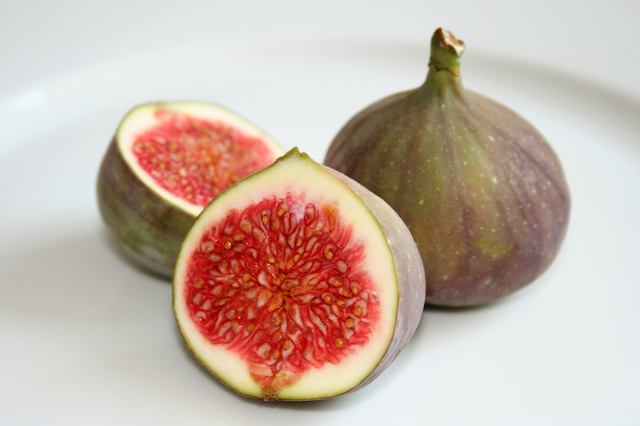
Sweetly ripened figs

Talk about delayed gratification.

Fourteen years ago you mailed a cheque and order form to the bluntly yet precisely-named Ernie Grimo’s Nut Nursery, located in Ontario’s Niagara Region. You imagined a small fig orchard on your deck, adding a Mediterranean ambience to your Toronto home. You also envisioned ripe figs, plucked on a summer’s day and eaten fresh as a healthy dessert.

Your fig trees arrived promptly via Canada Post. They were dormant, with bare roots bundled up and still moist. You were out of town when the special delivery arrived and your sister-in-law Karen kindly planted the young trees in large clay pots and put them in a sunny spot on your balcony.

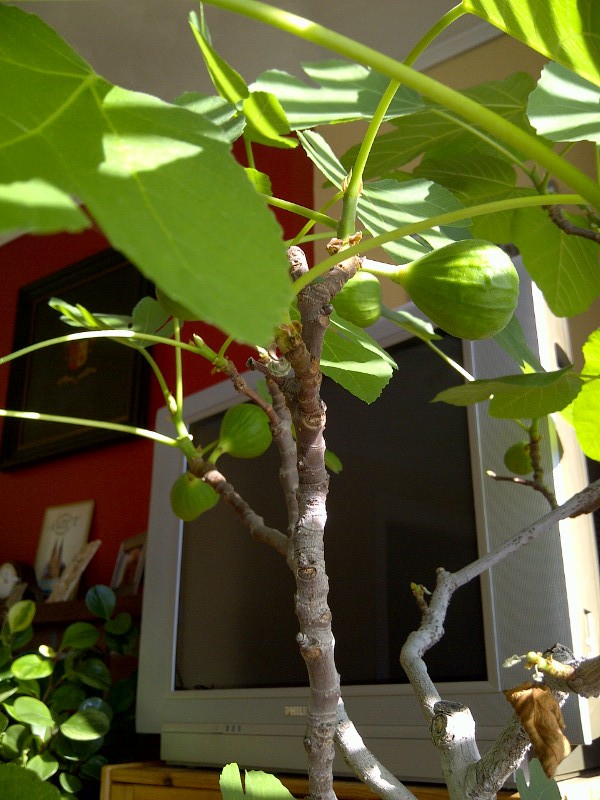
February figs in your TV room

The trees matured and set out fine green broad-leafed canopies each summer. You dutifully hauled the pots inside for the winter to prevent the sensitive young trees from freezing.

The seasons came and went.

The world wide web became quite popular. You got an e-mail account at work. Governments were voted in and voted out. The garbage and blue box went to the curb every Tuesday. And your two little girls became beautiful young women.

But nary a fig in sight.

Meanwhile, you had learned how to propagate the plants, carefully separating new shoots and roots when the trees were dormant, and offering the baby fig trees up for adoption. Eager recipients included a colleague’s father, who had grown figs as a young man in Italy, and your father-in-law Claus, a veteran gardener who immediately started into fig-nurturing competition with you.

Nary a fig in sight — until the winter of 2010. You had left the trees outside unusually late; their leaves had fallen and the top inch of the soil in their pots had been touched by frost. You brought them indoors feeling appropriately guilty, and checked them for signs of life on a weekly basis. The buds kept a hint of green, so you kept the faith, and watered lightly.

In January 2011, the buds became vigorous green leaf clusters.

And by February, the two trees were laden with several dozen swelling green figs.

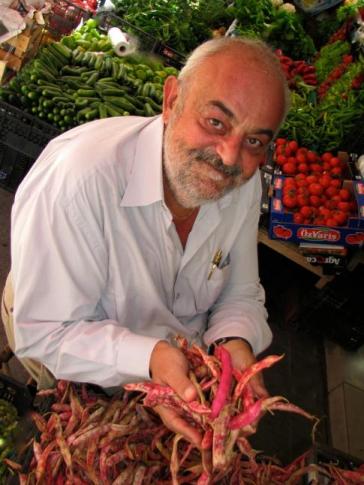
Byrons shops for fresh ingredients

For Mediterranean ambience inspiration, you turned to Byron Ayanoglu’s fine cookbook: Simply Mediterranean Cooking.  His recipe for Potato and Chickpea Stew with Spicy Sausage called for two figs cut into small cubes. “During the long winter months, this is the kind of hearty, legume-based stew with which Southern Europeans bring the sunshine back into their homes,” noted Byron.

You bounded up the stairs and harvested fresh figs from your TV room and surprised your family with a hearty supper. As a post-mortem, you penned a short note in the margin of Byron’s recipe: “Home-grown figs – nice!”

Meanwhile, your colleague Carm had dropped by at work with her blackberry to show you a photo of her father’s fig tree, the one you had donated to him in its infancy. “Tell your friend, thanks for the figs,” he had said. The photo showed a gargantuan fig tree, loaded with fruit in summer. In contrast to your offseason approach, Carm’s dad had planted his trees outside and kept them in the Canadian soil year-round. To keep the frost at bay in winter, he had constructed a sturdy frame around the tree, which was wrapped with insulation.

Meanwhile, too, in the fig-nurturing contest, your father-in-law Claus is winning. But you are too proud to ask him to reveal his fig-growing secrets.

This year, your fig trees are at it again. They seem to have permanently reversed the gardening season to give your family another indoor, off-season crop.

Instead of a fresh fig on a summer’s day, your figs have become a nutritional counterpoint to the winter-time Guinness-Advil-and-Pizza diet that has become a ritual after your Thursday night pick-up hockey game.

Figs ripen one by one or two by two, rather than in one big-bang crop, so you can savour them over several weeks at the tail end of the Canadian winter (while you put in your seed order for your summer garden plot at Thorncliffe Park). Byron’s Mediterranean recipes beckon.

In the case of a sweetly-ripened fig, there’s something to be said for delayed gratification.

Dreaming of spring — Interview with Robert Rayner

Dreaming of spring

A veteran urban gardener meets for a winter coffee at a Thorncliffe Park food court and dreams of spring.

Robert Rayner imagines the blue hyacinths and yellow daffodils emerging from the cool soil of his community plot garden. Meanwhile the garlic cloves he also planted the previous fall are setting down roots. He knows they will shoot up vigorous green stalks as the spring bulb display fades.

“I love growing garlic,” he says. “You must clip the curved flower of the garlic plant to give more strength to the bulb. Some people will chop up the garlic flower for salads although I find it a bit crunchy. In summer you harvest the garlic bulbs as the stalks die down.”

Robert and his wife Carmen use their home-grown garlic for “beef and fish stews and curry dishes. We also share our garlic crop with our children, friends and neighbors.” A recent experience with a garlic thief caused Robert to plant his cloves deeper, so that the stalk will be more apt to break off when it is harvested in haste, leaving the bulb intact.

Robert’s gardening philosophy spans beauty and sustenance – think of the left brain and right brain of gardening. “I grow a mixed garden, which is more pleasing to the eye,” he says. In addition to the cascade of spring bulbs, Robert practices companion planting, mixing Marigolds with his tomato plants to add colour and control pests.

Asparagus plants also bridge the artistic and culinary sidesof gardening. “Asparagus is a beautiful perennial. You have to nurture the young plant for several years before you can harvest it. Once the plant is strong, you can start to harvest the stalks in spring.” A few stalks must be left to grow to give strength to each plant, and these become lush ferns bearing red berries. “My plot neighbor Pearl will take a few asparagus ferns for the cut flowers she brings to church.” The red berries seed new asparagus plants that can be shared with fellow gardeners.

Robert got his start in gardening as a young engineer with the Ceylon Government Railway. “I was responsible for installing and maintaining the tracks as part of Essential Services.” That meant he was “on call” to troubleshoot and repair tracks, often in a tight timeframe — before the next train came along. The team’s mantra: “If you don’t lay the line right, the train goes wrong.”

Robert grew Bougainvillea as a young man in Ceylon.

Railway workers were itinerant and were given living “quarters” by the railway company in different parts of Ceylon (now Sri Lanka). In his time off, Robert started a small garden on the grounds of his quarters in the Erayur area. “This was a hot part of southwest Ceylon where you could grow beautiful tropical plants.” A local worker gave him gardening ideas and he learned to grow Bougainvillea, Anthurium and other flowering plants. He was hooked when friends noticed the flowering fruits of his labour and asked him to provide flowers for a wedding.

Robert continued the gardening tradition in Canada. His children had begun to emigrate to Canada, and Robert and Carmen followed suit when Robert retired from his second engineering job with a tire manufacturer. In the backyard of their daughter’s Toronto home, they nourished a mixed garden while taking care of a growing crop of grandchildren. After working the odd midnight shift at the produce section of a Miracle Mart in Scarborough, Robert could be found putting in a morning shift at the garden. “The Halloween pumpkins and peach trees were a hit.”

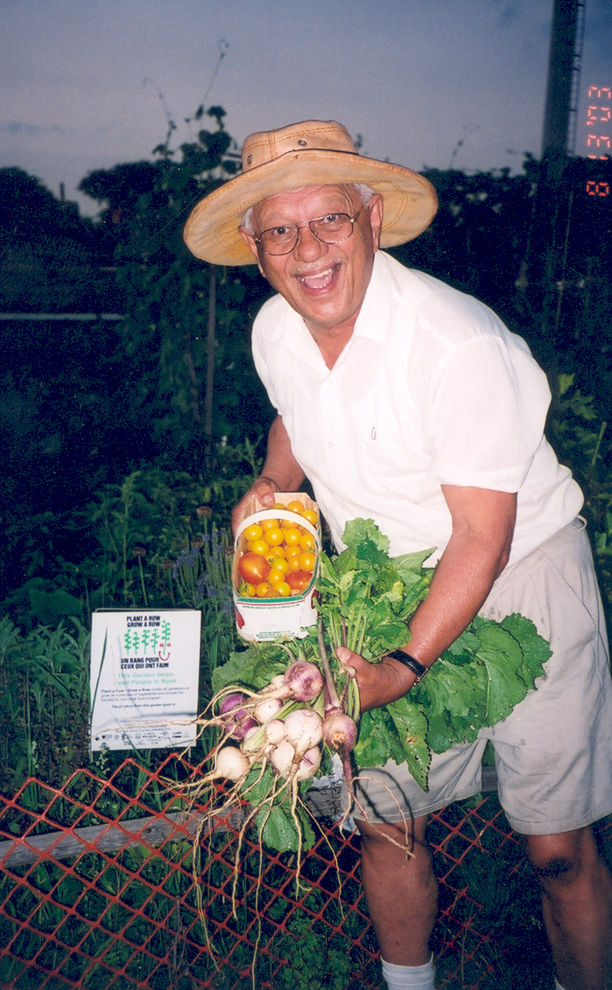
Spring veggies — Robert has donated part of his crop to Toronto’s Scott Mission

In the 1990s, Robert and Carmen settled in an apartment in Toronto’s Thorncliffe Park neighborhood. It is home to one of Toronto’s oldest community gardens, located on hydro land north of Overlea Blvd.  Approximately 100 plots are available to local residents on a non-profit basis, and Robert was quick to get on to the waiting list for the Thorncliffe Park Garden Club. He later used his community organizing skills as President of the volunteer committee that operates the club.

Today he maintains a 12 x 20 foot mixed garden, growing flowers as well as vegetables including squash, tomatoes and, if the thief will stay at bay, some garlic. Around the perimeter of his apartment building, he has planted hundreds of bulbs that will put on a spring show for his neighbors. His philosophy is to “live and let live – be sensitive to others.”

In the winter, Robert fashions meticulous and expressive carvings from basswood and stays busy with the social club in his apartment building. He and Carmen enjoy their extended family, and the community at Thorncliffe, a thriving urban neighborhood north east of the city core.

But on this bleak January day — a veteran gardener is dreaming of spring.