Stone terrace inspiration

manarola

Over centuries on the rugged Italian Riviera coast, stone craftsmanship turned steep slopes into sturdy terraces. In turn, the terraces supported a string of colourful seaside villages and vineyards: Cinque Terre.

Italian for “paradise,” in my opinion.

Nadine and I were headed to Italy to attend my cousin’s wedding anniversary near Lucca.

Before our trip, our friend David showed us pictures of the coast he had visited at Cinque Terre, noting that “the stone terracing is pretty stunning.” Looking back, I know I didn’t fully appreciate his comment. Perhaps, I had mused, David was a little too obsessed with stone. Certainly, I had not yet developed my own stone-building obsession.

Taking the mule trail

After a wonderful family event in an elegant villa near Lucca, Nadine and I travelled to the tiny, pretty coastal town of Volastra. it is perched high on the hills overlooking Cinque Terre. Our hotel owner, knowing our Italian vocabulary totalled perhaps 15 words, pulled out a map. She proceeded to give us walking directions in enthusiastic English to the nearest coastal Cinque Terre village, Manarola. “You can take the path here!” she added — pointing to the spot.

We started off on a small road, then caught an ancient set of wide stone steps heading down to the ocean. The steps themselves were tightly constructed of dry stone, originally built to withstand daily mule-trains up and down the hill. After centuries of use, the steps were flattened and polished.

Rounding a corner on the mule trail, we saw the full scope of the stonework that was the foundation for life in Cinque Terre — sweeping curved terraces tracking the coast like elevation lines on a topographical map.

Orchards and gardens occupied the terraces, as well as vineyards that used a small monorail-like system to move the grape harvest up and down the steep hills. Below, the colourful homes and buildings of Manarola clung to the steep coast next to the ocean, also buttressed by stone terracing.

How steep was it? We continued down to the main street and small port of Manarola, where fishers still plied their trade in small ocean-going boats. It was so steep that each boat had to be stored on its trailer on main street, then lifted by a small crane and winched down into the rocky but well-protected harbour.  At the end of a fishing day, the boat and catch would be winched back up. Visitors hiked into the rocky harbour for a dip, then relaxed in trattorias in the small town square, enjoying local specialities of pesto, fish and wine.

sailboat

A fishing boat is lowered by winch into the harbour at Manarola

Interconnections

The five towns of Cinque Terre, and larger hub of La Spezia to the south, are connected to each other by rail, road, boat and walking trails. Knowing we could return by train or boat, Nadine and I set off on hikes each day to explore the interconnected villages. Paradise can be crowded in summer, so we avoided some of the visitor traffic in the towns by hiking through the country.

As the area’s commerce now favoured tourism, some of its original vineyards had gone fallow, and pine trees were putting down roots on the ancient stone terraces.  In other areas, farmers continued to nourish grape vines, fruit trees such as lemon, olive and apple and lush vegetable gardens.

town on cliff

Cinque Terre clings to the cliff. In foreground: a fruit tree is harvested

Here and there, we came across masons repairing areas of terracing that were occasionally damaged by flash floods on the steep coast.  They used wheelbarrows to transport their tools and stone. There was very little room here for motorized construction machines, so much of the work was by hand. They used a dry stone construction method — carefully stacking the larger stones one-over-two and two-over one, and sloping back into the hill. Behind the face stones, they packed in smaller stones to give the wall integrity. On the wall’s face, they tapped in little wedge stones to keep it tight. On top, they placed heavy stones to keep the wall in place.

stone terrace closeup

A stone terrace gets its close-up.

Solid as a rock

Along its coasts and in its mountains, Italy is said to have 100,000 miles of dry stone walls.  Because they are permeable, they retain soil and some moisture while allowing heavier precipitation to wash through. Many have lasted untouched for centuries — works of art and engineering, without mortar — solid as rock. A New York Times article described how citizens of Cinque Terra are reigniting stone building traditions to monitor and repair ancient terraces — to prevent them from washing into the sea. (See NY Times photo of Manarola, included at top of this post).

The road less travelled

We took a bad fork in the trail and ended up clinging to the side of a cliff on a path that was getting narrower by the second.  A young Swedish couple hailed us, and gestured for us to turn back — they directed us back to the main trail. We thanked them, and during a brief chat, learned that they were on their honeymoon in Italy.

At the end of a gorgeous hike, we arrived hot and tired in the town of Vernazza. We  made a beeline for seats in a breezy patio in the town square. Cooling off with a glass of local white wine, we ordered some pasta to reward our hiking efforts. At the other side of the restaurant, we spotted the young Swedish couple just sitting down, also red-faced from the hike. We paid our waiter to send some wine their way as a surprise.

They caught our eye and smiled at us, and we raised a toast to them. “Cheers! Well done! And thanks again for setting us straight!”

Cooling off

Back in our small hotel in Volastra that night, we wandered over to the town’s only restaurant. Most of the staff were still having a pre-shift chat and smoke, sitting just outside. So we continued through the old part of the town, where a narrow promenade and high stone buildings afforded a cool walk on a warm day.

It was mid-summer and days were above 30 Celsius. The use of stone’s thermal properties to moderate heat are even more important in the heat spikes of the Italian summer, when temperatures can approach 40 Celsius in some spots.

After circling back through the courtyard of the town’s old stone church, we sat down to a local speciality of small whole fish and pasta — and more local wine to wash it down. There we plotted our next set of hikes — including an ambitious one with some steep stretches connecting to the last village of Monterosso al Mare — the only one of the five villages boasting a beach. And we could not miss Riomaggiore, where couple declare their love by placing padlocks on gates along the seaside stroll.

locks

Lovers’ locks on the Oceanside promenade at Rimaggiore


A little piece of Cinque Terre…

Trying to take in all the beauty and expanse of the Italian coast, I thought about the lakeside place we had purchased near Minden, Ontario, north of Toronto, with its steep slopes towards the lake. Not exactly gravity-defying slopes like those in Cinque Terre, but in sore need of some stone garden terracing. Nadine and I had already rolled up our sleeves and built a little stone patio by the lake.

Perhaps I could bring back a little piece of Cinque Terra to our new place in Minden, Ontario?

flowers and terraces

A purple Hydrangea blooms and thrives on a stone terrace garden in Cinque Terra



Tiny garden twilight

It was Halloween day and the tiny garden was dressed for the occasion.

I had stopped into a dollar store nearby for some festive black spiders and orange paper pumpkins to adorn the two pots of now-droopy geraniums at Pape and Cosburn. From a fruit shop, I acquired some gnarly green-and-orange gourds, and a little pot of cyclamen flowers to give the garden its last blast of colour before the long Canadian winter set in. People hurried to and fro to pick up candy to shell out, or find last-minute costumes for Oct. 31st.

A radio journalist had dropped by to interview me about the tiny garden. Quinton is a family friend studying at Ryerson University. For a radio feature, she wanted to learn more about guerilla gardening and so had booked time to visit.  It was a nice way to bring closure to this year’s garden season, and to think about the meaning of guerilla gardening.

IMG_5303 pumpkin

An act of faith

Quinton started with the specific — “What’s going on today? Describe you garden? — and moved to the universal — “How do you define guerilla gardening? What are the benefits?” I recalled my nervous SWAT mission to install the garden that spring. Gardening in a public space had been an act of faith. It had some trials but the tribulations had been worth it. The garden had put a smile on the faces of many passersby at an urban intersection that felt down on its luck.

As a journalist myself, I found inspiration in the next generation — here was Quinton visiting the scene with her tape recorder, questions and insights, to uncover garden moments and meaning. Quinton also asked if she could speak with my guerilla gardening mentor — my mom Sheila, who had carefully tended a small garden in a park near Rosedale subway station this summer.

Fleeting blooms

A few weeks later, when I was chatting with mom, she mentioned Quinton had visited, and they had walked over together to her “steps” garden. As early November weather set in, some hardy pink Mums provided final blooms as the two talked about the little garden that caught the eye of so many downtown residents and passersby.

Later in November, I dropped by Pape and Cosburn Avenue to take away my two large pots and their fading flowers.  They were heavy, so I parked my minivan illegally and hustled to drag them over and put them inside.

“You had a good run”

Leo the crossing guard came by. “Putting the garden to bed, eh?” he said. “You had a good run.” I asked Leo about his winter schedule — he is there several times each day to ensure the safety of hundreds of residents who cross the busy intersection. “My only vacation is in the summer when school’s out,” he added.

With the garden season in twilight, I wished Leo well. I told him I hoped to bring back the tiny garden next spring.


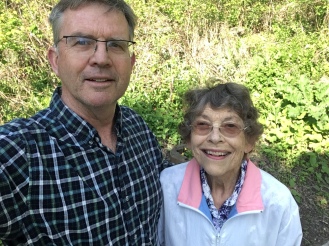
IMG_4458 me and mom

Guerilla gardeners


Trouble in the tiny garden

IMG_5190 October white zinnia

My mom and I had beat the heat, helping our tiny gardens survive a steamy summer. But if guerilla gardening is an act of faith, our faith was to be tested a few more times in 2018.

At the urban intersection of Pape and Cosburn Avenues, my little collection of geraniums got some kudos for brightening up a dismal corner. Still, they needed regular stewardship against occasional unkindness — with every visit, I continued to remove a motley collection of objects deposited in the flower pots:

— a McDonald’s coffee cup

— a TTC transfer

— cigarette butts

— a cigarette lighter (broken)

— and perhaps most intriguing: an empty can of Mike’s Hard Lemonade, alcohol content 8%.

Luckily a nearby city bin accepted waste and recyclables, so I regularly deposited these and other items that had been so casually tossed into the tiny garden.

One day, I noticed my Tiny Garden #3 sign had gone missing. The flowers were fine, but their signage and branding had walked away. Somewhere out there, I thought, someone has carefully conserved my rustic attempt at a garden sign. It had been fashioned on a small piece of plywood, with capital letters written in black marker, fixed to a 1×1″ stick. I am sure it is now someone’s private shrine. At least, that is my hope.

Dire news — garden thievery

Over at my mom’s little guerilla garden near Toronto’s Rosedale Subway station, the news was more dire.  My mom had headed out one day with her watering can and trowel, when a resident in her building gave her the warning: “Sheila, it looks like somebody has damaged your garden unfortunately.”

As my mom got closer to her beloved tiny garden, she spotted gaping holes left by a thief who had made off with geraniums and zinnias — roots, leaves, flowers and all.

As a long time community gardener, I am accustomed to having things walk away from my plot — the worst theft ever was of my entire red currant bush. On a recent visit to my plot at Thorncliffe community garden, my neighbor Boris showed me how thieves had jumped his fence to make off with bags full of cherry tomatoes.

To catch a thief

I sympathized with my mom.  At the same time I tried to give her some context: “Mom, remember that hundreds of people have enjoyed your garden. It’s just one person that has damaged it.” That may be true but the idea can feel a bit trite to a gardener who has carefully nourished plants over months, only to see them disappear in an instant. She considered the thievery to be a beastly act, and I agreed.

I was reminded of a newspaper clipping my uncle Ray had once sent me in the mail from the UK. He knew my interest in community gardening, and he had heard about my stolen red currant bush.  “ALLOTMENT GARDENER GIVES BOTH BARRELS TO VEGETABLE THIEF,” the headline screamed. The story went on to describe how the gardener had laid in wait overnight with his shotgun. He was now facing a manslaughter charge. I empathized with the man’s stolen veggies, but thought his method was a bit extreme.

Abandoning the tiny garden

What can you do? We tried replacing a few of mom’s plants with some new ones, only to see them disappear from her plot. She was heart-broken. Twice bitten, thrice shy. She decided to give up her tiny garden.  She started taking another route on her daily walks. Friends in her building commiserated with her plight.

I held out hope, though. On a recent visit with mom I asked her if she had been by to visit her tiny garden at all. She admitted she had recently taken some scissors to trim back the weeds next to the path, and a trowel to dig over the soil a bit.  Some geraniums had made a comeback in the fall, pushing out red blooms, she added. And the original mums we had planted behind a hollow log in the spring had started to bud up.

Holding out hope

“They are late bloomers mom, they will put on a pink show for you in about a month.”

Mom said she would keep an eye on things and hope for the best.

IMG_5189 October mums

Late bloomers and theft survivors: Mom’s mums in October 2018. At top, a remaining pretty white Zinnia in mom’s tiny garden, October 2018.


Tiny garden double-double

IMG tiny garden double double

A network of good Samaritans had helped my tiny garden survive the summer heat wave in T.O.

One of them, my friend Reshmi, donated an unused planter to the tiny garden cause.

Fall days were shorter and cooler and kids headed back to school, sporting their colourful backpacks. As the population of citizens at the gritty north-west corner of Pape and Cosburn swelled, I delivered the tiny garden double-double.

On a mission

It was another gardening SWAT team mission of sorts.  With my minivan illegally parked on the north side of Cosburn to avoid a 2-buck parking fee, I executed my sortie with maximum efficiency.

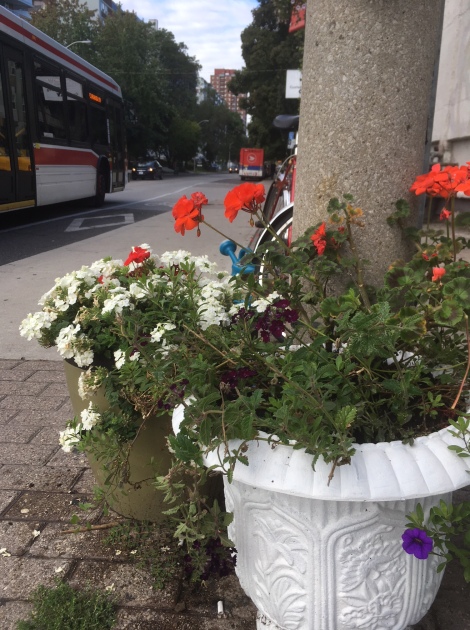
First, I hauled a bucket of soil and the new pot over to the corner of Pape and Cosburn. I had placed some bricks in the bottom of the white pot for drainage — and to deter tiny-garden thieves who might find the new garden a wee bit heavy to make off with.

Next I ran back for some orange geraniums and my trusty blue plastic watering can. I decanted half the soil into the white pot, then put in the geraniums, followed by a top dressing of soil. The new pot, and its older companion tiny garden in a green pot, got a good soaking of water.

The next day I wobbled over on my red beater bike to check progress. The gardens were looking healthy with cooler weather and some sunshine.

Two thumbs up from Leo

Leo stopped to say hello. He comes by his name honestly. He is the lion-hearted crossing guard at Pape and Cosburn, helping hundreds of citizens cross safely each day at the start and end of school, and the lunch hour.

Leo had dubbed me “the mystery guy with the flowers” earlier this spring. He had been off during the summer so I introduced myself again:

“I decided to dress up the corner with some flowers,” I told him. “I live nearby.”

“Well it definitely needs it,” Leo replied. A bustling dry-cleaning business had closed down four years ago. “The guy who bought the business is doing some work on it, but it’s been awhile,” Leo added. Citizens still took shelter from bad weather under the former shop’s rough entranceway and steps at the corner.

Leo had a burning question for me: “Did you need any permits or anything to put the flowers here?”

“No, I guess it’s a guerilla garden,” I said.

Starting a trend

Leo had to go — he was brandishing his stop sign for the next wave of pedestrians: “Well it’s nice,” he said — “I hope you are starting a trend.”

I came by a few days later to water the garden but it looked like someone had done that favour for me — perhaps another good samaritan.  I picked off a few geranium bloom deadheads and removed a black and yellow Mike’s Hard Lemonade Can that had been placed next to the flowers.

The lemonade can boasted an alcohol content of 8%. It was empty. I hoped its owner, like Leo, had gotten a kick out of my tiny garden double-double.


Tiny gardens: beating the heat

tiny garden August Sheila

How hot was it?

It was so hot in Toronto in summer 2018 that this blogger once had to seek urgent cooling shelter in Fairview Mall, a place full of fashion shops in which I was too scared to set foot. But I did find a little variety store that sold me a diet coke.

Over at my mom’s tiny guerilla garden near Rosedale Subway, the multi-coloured zinnias, sturdy geraniums, red-blooming creepers and other plants added by a good Samaritan were coming into rich colour and profusion. My mom’s original batch of pansies in and around the hollow cedar log were still going strong, as she continued to pick off old blooms each day and keep them well watered.

Her garden blooms were peaking but the sun was beating down in “the Six,” with daily highs hitting 35 degrees. Extreme climactic events were in the news around the world. Shade was a precious commodity.

Praying for rain

To keep the tiny garden watered, my mom sometimes made three trips daily with her little apple juice containers filled with water. She prayed daily for rain.

Over at Pape and Cosburn, I was making furtive early morning trips on my red beater bike, wobbling along with a full watering can in the old basket, to keep my tiny garden hydrated — and to get home before I broke into a full-body sweat.

While I was out of town, many good-Samaritan friends volunteered to come by to water the little mixed planter of red and white geraniums.

Delivering hydration and TLC

My friend Reshmi texted to advise that the tiny garden got a bit droopy in the intense heat but was hanging in there. Her son came by to water it. My sister Louise dispatched her husband D’Arcy to deliver additional hydration. My garden friend Ann parked nearby to check on the garden and give it some water and TLC.

My tiny garden survived. Slowly the evenings grew longer, with a heavier dew overnight. I trimmed off dry deadheads, and removed a McDonald’s coffee cup and broken cigarette lighter from the planter. The geranium buds began to re-appear.

Fall sometimes feels like the end of this year’s garden; in fact, it’s the start of a second gardening season following dormancy triggered by the superheated summer.

As September Labour Day approached, our buds were swelling. The plants were greening up.

It was a tiny garden renaissance.

The tiny garden — finding allies

As summer heated up, my Mom and I tended our tiny guerrilla gardens — and found allies along the way.

One day my mom descended the steps towards her little garden in a Rosedale Park.  As she approached, she noticed that a good Samaritan had put down some topsoil and added a few plants.

She was a bit shocked at first but we tried to reframe the experience.

“I think someone has been inspired by your little garden, Mom,” I told her.

Over the next few weeks, she diligently watered the expanded garden. She noted that as her spring pansies started to fade, a new generation of geraniums and zinnias — planted by the good Samaritan — were coming into their own. “They’re budding out very nicely,” Mom told me.

IMG_4783 tiny garden July Sheila

Toronto entered a heat wave with daily temperatures into the 30C range. Still, mom set off each morning from her apartment with a watering can, and often returned later that day, to keep her garden watered.

Fans and allies

Along the way she discovered she had some gardening fans — and allies. “Just a quick note,” she wrote, “to tell you that while I was watering our pansies, a lady stopped and mentioned to me that she has already met and chatted with you when you were digging in the garden! Her name is Mary and she has kindly offered to do some watering for us once in awhile.”

Mom also said she had been visited by the good Samaritan who had placed the soil and extra plants around the little log garden. She couldn’t recall the woman’s name but had thanked her. Meanwhile, she noted that many people “had stopped with complimentary comments about our mini garden. I like to think it is appreciated by most of those who use the steps, up or down.”

“So you’re the mystery guy”

Over at the gritty northwest corner of Pape and Cosburn, I was quietly watering my Tiny Garden #3 one morning when the crossing guard approached me: “So you’re the mystery guy with the flowers,” he said.

“Yeah I live down the road and I thought the corner needed sprucing up,” I replied.

“Well people appreciate it and were wondering who put them there,” he said, stepping out into the intersection with his stop sign.

“Thanks for keeping everyone safe,” I told him.

IMG_4780 tiny garden July ian

My tiny garden now had some other allies:

While I was out of town one week, my Thorncliffe garden friend Debi and her husband dropped by to water it.  The couple are guerilla gardeners in their own right. They have planted two beautiful trees at one entrance to a major grocery store on Broadview Avenue.  The trees — a silver maple and locust — are flourishing with some occasional TLC by Debi and her husband.  They seem to have been adopted by the grocery store grounds crew as well, who keep the grass well cut around them

Hope and inspiration

Another gardening friend, Mike M., who was awaiting some major surgery, wrote to me: “I’m sure the fun,  colour and HOPE of the transformation of that grey space will put people right at the core of natural beauty, and may inspire them to spread the beautiful concept.”

On that note, my friend Reshmi, a former colleague in health care communications, gave me a large flower pot to expand the tiny garden, and offered her help with the expansion. And Mike R., who rides his bike through the intersection daily, said he would keep an eye on it during his commute to work. Friends and fellow citizens were coming out of the woodwork to support Tiny Garden #3.

Did I mention the cashier at the Wine Rack across the street? She told me: “Oh I love those flowers, I wondered where they came from.”

So much goodwill for the little guerilla gardens — the gardeners are feeling blessed!


Tiny garden #3 — on a mission

IMG_4697 tiny garden 3

While my mom adopted and lovingly tended her new guerilla garden in a park near Rosedale Subway, I found a location for my next tiny garden.

Pape Avenue north of Danforth is a bustling community featuring small shops, schools and a community centre where our kids used to swim. Homes are a mix of high-rise rentals and post-war houses. It’s grittier and perhaps more vibrant than the popular Danforth Avenue nearby.

But the busy intersection at Pape and Cosburn had fallen on tough times after the closure of Crow Cleaners, a dry-cleaning and laundry shop where workers once starched and steamed shirts on big machines in the window facing Cosburn. Situated on the northwest corner of the intersection, the once-thriving shop was now boarded up, its paint peeling, a target for graffiti.

Despite its forlorn state, many people continued to congregate on its broad steps to catch some shade, await a bus or meet a friend. Each day nearby, a crossing guard with his orange vest, whistle and stop sign would ensure safe passage of hundreds of school kids and citizens at rush hour times.

So I decided to brighten up this neglected corner — with Tiny Garden #3.

Planning the mission

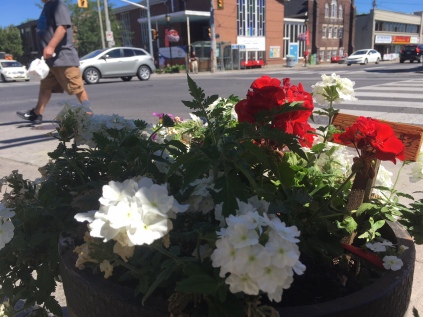
Tiny garden #3 started with a large green pot discarded by my neighbor earlier this year. The pot seemed sturdy enough. It was reasonably light and had a big hole for drainage. Next was a nice arrangement of sun-loving red and white geraniums for this south-facing garden. I came across a basket arrangement on sale for 15 bucks at a garden centre and pounced. Finally, I prepared some home-made triple mix consisting of earth from my garden, well-rotted compost from our kitchen veggie scraps, and some peat moss.

On an early May morning I parked on Cosburn Ave. and walked my materials over to the corner. My heart rate spiked a bit as I approached the site — not from the exertion of hauling a heavy load, but because of the nature of my guerilla gardening mission itself.

I was about to install a tiny garden in the concrete jungle, with no permissions and likely contravening at least one important municipal bylaw. Not to mention I had cheaped out by not putting money in the parking metre.

I felt like that guy in the movie Platoon, who was on what could be his last military mission. “I got a bad feeling about this one,” I told myself. But I carried on, as my late Dad would say.

I got organized, set up the garden quickly and emptied a watering can on it.

A ray of sunshine

The spring sun was shining, school kids were babbling as they crossed the intersection on the way to school. The red and white geraniums in my pot were in full bloom. I had high hopes for Tiny Garden #3.

As every gardener knows, planting is the easy part. It’s the ongoing TLC that can be tough. But for today, Tiny Garden #3 had landed.

Mission accomplished.

img_4702-tiny-garden-3-too.jpg


Adopting the little log garden

Three days had passed since my clandestine mission to install a little guerilla garden near my mom Sheila’s apartment building downtown.

I’d been back once to water the five pansies I had planted in and around an old cedar log in a ravine park near Rosedale subway station.

But still no word from Mom, although I knew one of her walking routes took her right by the little garden. I decided to send her an email and get right to the point:

May 2, 9:22 a.m.: “Hi Mom, by chance have you come across a little garden like this on the steps up to Rosedale subway? It looks a bit like your log garden in Don Mills.”

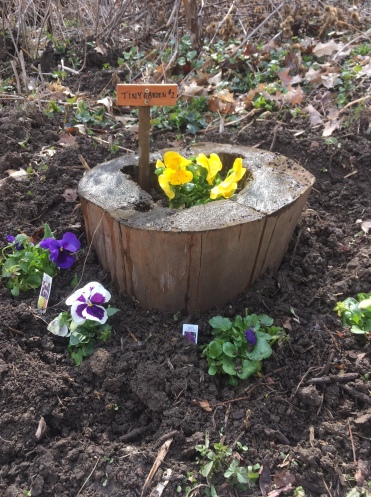
IMG_4453 the log

The suspense was killing me. But she got back to me later that day.

May 2, 5:05 p.m.: “Hi Ian.  Yes… I have just walked past this colourful pansy display… halfway down the steps, and can show it to you tomorrow. A nice reminder of my earlier Don Mills log garden.”

I decided to spill the beans.

May 2, 6:50 p.m.: “Glad you like it. I put it there for you! When the pansies fade we can put in a few geraniums.”

We had planned a walk the next day but the weather didn’t cooperate, so we rebooked for Sunday evening.

In the meantime, Mom reported back:

May 4, 4:29 p.m.: “Just a quick note to say that I’ve just enjoyed another steps walk and I’m pleased to see that all your blooms, yellow and purple, are still brightly coloured and healthy.”

The good news? She was intrigued by the little garden. The bad news — her use of the second-person “your” signalled, perhaps, that she was not taking ownership of it quite yet. It was still my guerilla garden.

One day later…

May 5, 4:25 p.m.: “Hi Ian, just another quick note… to let you know that I have just watered our special flowers by the steps! And I’ll continue to do this daily, if there’s no rain.”

Mom was now using the first-person plural — “our” flowers! I sensed she was on her way to adopting the little log garden.

Gentle rain

That Sunday in May we took a walk in the rain to see the pansies. After a long Canadian winter, Mom said it felt like a spring evening in England — a gentle rain was greening up the grass and gardens. Robins sang and pecked for worms.

Mom was surprised by how large the pansy blooms were. Her parents grew pansies in England and these ones were multicoloured and much larger.  I replied that I thought the pansy growers had bred bigger flowers over many generations. This would also make them sell faster at five for ten bucks at Sobey’s, I thought.

I had brought a long a small hand trowel and a mixture of home-made compost, peat moss and garden soil. Mom pointed out a few weeds that had sprouted around the pansies and I plucked them out while edging the little garden bed with the trowel.

An older man down on his luck shuffled past down the steps, then made a 90-degree turn into the woods to find some solitude. Meanwhile, two young women walking a black Labrador dog came past us going in the other direction. The dog wanted to sniff the pansies but my Mom kept him at bay. The dog’s owner smiled at us as she reined in her dog, checked her cell phone, and passed by.

Garden friends

Mom told me that an older couple had stopped to chat while she was watering the flowers the previous day and had complimented her on the garden. “My son planted it,” she told them, going for the sympathy vote. They told her they enjoyed seeing it every day and it seemed to be flourishing.

I emptied the compost mix beside the garden bed and mom gave instructions about where to spread it. “The pansy inside the log needs some too.”

On the way back to her seniors apartment building that evening we passed bold blue Hyacinth blooms and yellow daffodils planted the previous fall by the Parks Department in a park next to Yonge Street. The city was greening up and people had emerged to stroll with a spring in their step. The next week, we would return on a sunnier day — two guerilla gardeners in the heart of the city:

IMG_4458 me and mom

As we said goodbye I presented mom with the garden trowel, wrapped in a plastic bag, and she accepted it.

From failing hands I had passed the trowel — be hers to hold it high this gardening season.

My mom had officially adopted the little log garden.


The little log garden that could

Near Toronto’s Rosedale subway station, a non-descript walkway and set of  concrete steps lead to a secret ravine that is a green oasis for local residents. The ravine is a regular walking route for my mom Sheila, who lives nearby in seniors apartments on Yonge Street.

Lately, Mom lamented the loss of her gardens in Don Mills.  She had lovingly tended three guerilla gardens there in a public park near Norman Ingram school — two around trees dedicated to here parents, and one in an old hollow log closer to her condo.

So as my entry into guerilla gardening, I decided to give Mom her own little garden in the ravine.

IMG_4341 the log

I had obtained a piece of hollow cedar log from  my inlaws’ cottage — it would recreate Mom’s favourite “log” garden in Don Mills and act as a centrepoint for the new garden.  I hauled the piece of cedar, along with a spade, a hand trowel, a plastic milk jug full of water, and some spring pansies — five for ten bucks at Sobeys — over to the new site.

A gardening SWAT mission

I found a nice spot on the landing of the ravine steps, with good sun exposure. And like a good guerilla gardener on a horticultural SWAT mission, I started digging vigorously, hoping to get the job done before having to explain myself to anyone.

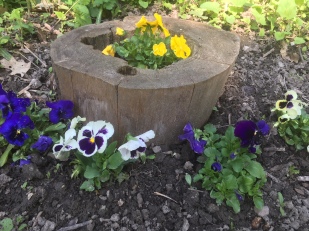
I dug down a circle wider than the log diameter, then placed the cedar log inside, nestled into the soil. Using the hand trowel, I added soil to the log’s hollow area, and planted a yellow pansy there. As I moved on to work the soil in front of the log, I had my first visitor.

“Oh that is nice,” exclaimed an older woman coming down the steps. “We need more flowers here.”

“It’s for my Mom,” I replied, going for the sympathy vote. I realized that I was working up quite a sweat down my back between my vigorous digging and undercurrent of guilt at my illegal gardening activity. “This is one of her favourite walks.”

“Well thanks for brightening up the space,” the woman said, continuing on her way.

I got down to the final step of planting — by alternating purple and white pansies in front of the log. With the hand trowel, I dug spaces for each pansy and worked the soil around and on top of them.

So pretty

I was hustling to complete my entry into guerilla gardening when a second visitor came by. “Oh that is pretty,” said an older woman in a trim purple sports jacket. When I say older, I mean a few years older than me. She had her white hair tied back neatly and was smiling as she caught some afternoon sunshine while descending the steps.

“Thanks, it’s for my Mom,” I replied, figuring this line had already won over my first visitor. “She lost her garden when she moved downtown.”

“I can sympathize with that,” my visitor replied.  “I live in an apartment too. There’s a man who maintains a garden in a vacant spot next to our building. I tried to help him out but he is a bit of a control freak.  So I just leave him some plants from time to time and he fits them in.”

“Maybe you could find another spot,” I suggested.

She told me she wanted to grow some herbs near her building, to have a fresh source close at hand for cooking. She had seen some herbs for sale outside a local variety store, and would have a closer look.

Tiny Garden #2

I wished her well and took the final step of branding this tiny log garden. I inserted a stick with a small sign indicating this was “Tiny Garden #2.”  As Tiny Garden #1 existed only in my imagination, I thought my sign would indicate that this idea was trending.

I pushed the sign into the soft earth to complete the picture. I hoped this tiny garden would survive — and that my Mom would notice it next time she walked by!


Alchemy! Work your composter to perform magic in the garden

On a cold March day I was trying to get the jump on spring at my community garden plot in Thorncliffe Park.  The thaw had come out of the ground, mostly. So I was wrestling it into shape with my old spade, using a technique called the double-dig. This would save me time later during the spring planting season.

The wind whipped through the hydro towers, while the first wave of migrating birds alighted for a feed at my friend Linda’s bird sanctuary. I was all alone at the community garden, on hydro land north of the Swiss Chalet.

IMG_3917 composter

Or thought I was. Mid-grunt, with my head down, I heard a friendly greeting: “Could you use some nice vegetable scraps?”

I turned around to find an older man proffering a grey bag. “It’s stuff from my kitchen.” He had a slightly guilty smile.

“Oh, hey,” I said, lifting my head. At 56, I had lived my whole life without ever having had someone offer me squash rinds, carrot clippings and coffee grounds. “Sure!”

“I live in an apartment and don’t like to see it go to waste,” the man said.

“Rick, by the way, he added. “We don’t have a composting program at my building so it just goes into the garbage. I see you have a composter,” pointing to my black bin.

“Hi Rick, Ian” — we shook on it.

Rick, in fact, had made an earlier delivery after he spoke to Linda while she was feeding the birds.  Linda had left me a voicemail about the this offer of vegetable scraps, and I had given the green light.

My compost benefactor

So here was my benefactor in person, with his second delivery.

“This is great timing,” I told him. “I just kick-started my composter for the 2018 season.”

Rick admitted he didn’t know how composting works, and I explained what I had learned through trial and error over the years. “Composting is like a chemical reaction,” I told him.

Indeed, composting is a form of alchemy that can reward the gardener with rich — did I mention, free? — fertilizer for the soil. It requires some key inputs such as:

  • carbon, from dried leaves, straw or newspaper for example
  • nitrogen, from veggie scraps for example
  • bacteria, easily obtained from soil
  • and finally: oxygen and moisture.

You gotta work the pile!

Just like a high-strung sports car, your compost pile needs regular maintenance.

You can’t just toss in the green scraps. They will sit inert until you are collecting Old Age Security.

No, you gotta work the pile. Start with the right inputs. With each deposit of green scraps from the kitchen, add some soil and some newspaper or dried leaves.

Take time to aerate your pile from above every few weeks. A broom stick works, or a long piece of rebar has a nice heft and will do the trick to poke holes and get the pile moving. Add some water occasionally, especially if the pile seems dry.

Alchemy!

With some regular maintenance your high-strung composter will run nicely and produce some rich dark compost year round. There’s nothing like seeing your composter steaming away magically in mid winter while Don Cherry is blathering away on Hockey Night in Canada.

Most composters have a small opening at the bottom from which to dig out the finished product. Removing the good stuff then kick-starts the process again as you poke the pile from above and get it moving and aerated. You can even accelerate the next batch by tossing a bit of finished compost on top to keep the bacteria working from both ends.

Use some finished compost as a top dressing fertilizer or dig some in for new plants. Properly composted material will be free of weed seeds. It will feed your soil with nutrients while also retaining moisture.

The wind was brisk but the spring solstice sun was warming the ground. I thanked Rick as he headed off.

“I’m happy for more donations,” I told him. “My vegetables and flowers will thank you.”