Alchemy! Work your composter to perform magic in the garden

On a cold March day I was trying to get the jump on spring at my community garden plot in Thorncliffe Park.  The thaw had come out of the ground, mostly. So I was wrestling it into shape with my old spade, using a technique called the double-dig. This would save me time later during the spring planting season.

The wind whipped through the hydro towers, while the first wave of migrating birds alighted for a feed at my friend Linda’s bird sanctuary. I was all alone at the community garden, on hydro land north of the Swiss Chalet.

IMG_3917 composter

Or thought I was. Mid-grunt, with my head down, I heard a friendly greeting: “Could you use some nice vegetable scraps?”

I turned around to find an older man proffering a grey bag. “It’s stuff from my kitchen.” He had a slightly guilty smile.

“Oh, hey,” I said, lifting my head. At 56, I had lived my whole life without ever having had someone offer me squash rinds, carrot clippings and coffee grounds. “Sure!”

“I live in an apartment and don’t like to see it go to waste,” the man said.

“Rick, by the way, he added. “We don’t have a composting program at my building so it just goes into the garbage. I see you have a composter,” pointing to my black bin.

“Hi Rick, Ian” — we shook on it.

Rick, in fact, had made an earlier delivery after he spoke to Linda while she was feeding the birds.  Linda had left me a voicemail about the this offer of vegetable scraps, and I had given the green light.

My compost benefactor

So here was my benefactor in person, with his second delivery.

“This is great timing,” I told him. “I just kick-started my composter for the 2018 season.”

Rick admitted he didn’t know how composting works, and I explained what I had learned through trial and error over the years. “Composting is like a chemical reaction,” I told him.

Indeed, composting is a form of alchemy that can reward the gardener with rich — did I mention, free? — fertilizer for the soil. It requires some key inputs such as:

  • carbon, from dried leaves, straw or newspaper for example
  • nitrogen, from veggie scraps for example
  • bacteria, easily obtained from soil
  • and finally: oxygen and moisture.

You gotta work the pile!

Just like a high-strung sports car, your compost pile needs regular maintenance.

You can’t just toss in the green scraps. They will sit inert until you are collecting Old Age Security.

No, you gotta work the pile. Start with the right inputs. With each deposit of green scraps from the kitchen, add some soil and some newspaper or dried leaves.

Take time to aerate your pile from above every few weeks. A broom stick works, or a long piece of rebar has a nice heft and will do the trick to poke holes and get the pile moving. Add some water occasionally, especially if the pile seems dry.

Alchemy!

With some regular maintenance your high-strung composter will run nicely and produce some rich dark compost year round. There’s nothing like seeing your composter steaming away magically in mid winter while Don Cherry is blathering away on Hockey Night in Canada.

Most composters have a small opening at the bottom from which to dig out the finished product. Removing the good stuff then kick-starts the process again as you poke the pile from above and get it moving and aerated. You can even accelerate the next batch by tossing a bit of finished compost on top to keep the bacteria working from both ends.

Use some finished compost as a top dressing fertilizer or dig some in for new plants. Properly composted material will be free of weed seeds. It will feed your soil with nutrients while also retaining moisture.

The wind was brisk but the spring solstice sun was warming the ground. I thanked Rick as he headed off.

“I’m happy for more donations,” I told him. “My vegetables and flowers will thank you.”


The secret to immortality: multiplier onions

When I started growing vegetables at Thorncliffe Park Community Garden a few years ago, my father-in-law Claus gifted me a few “multipliers.”

These were multiplying onions, and they are the gift that keeps giving.

In fact, because they never stop giving, and because you must keep planting and eating them going forward, they will guarantee your own immortality — much more so than cryogenic freezing, or belief in reincarnation, for example.

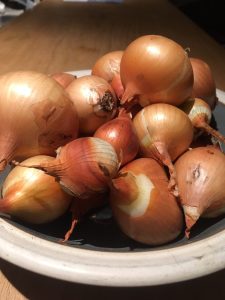
img_0418-onionsPlanting: First, let’s talk planting. A single dried multiplier onion bulb planted in spring will give you two bulbs harvested in fall. Eat one, and keep the next for next year. Or leave your second bulb in the ground and it will overwinter and multiply next year.

Harvesting bulbs: Onions are also time travelers. You can harvest in the fall, dirt and all, leave them in a cool dry place, like your basement, and forget about them. Once the excitement of the holiday season is done, you can have a eureka moment when you remember where you left the onions. Then you can process your onions for a mid-winter harvest.

Processing simply involves shaking off any dried dirt, peeling off a few gnarly layers of onion skin, and finding a new container to keep them handy for cooking in your kitchen. The  lazy Susan works well. You can complete your processing on the dining room table while your better half prepares dinner. Careful to tidy up after! Identify multipliers as the ones that are not perfectly round — like the one near the bottom of this photo — it has a flatter side that used to press up against its multiplier twin.

Surprise! So enjoy this surprise winter harvest! To use your onions in some tasty winter dishes, such as crockpots, start with the larger ones first. Any little ones left over in early spring can be replanted. They may even start putting out some green shoots in your kitchen, which shows they are eager.

In spring time, any onions you missed in the fall harvest become volunteers for this season. They will declare themselves in due course when they push up green shoots from the dirt.

Harvesting greens: To get fresh greens close at hand, put a bunch of onion bulbs in a pot to keep handy outside your kitchen door in spring. Keep it watered and exposed to sun. Soon you’ll be out there with scissors picking off some of the fresh greens to put on top of pasta.

Savoring the harvest: Small onions go nicely in a crockpot in a dish such as lamb stew. When will simmered, they give a burst of rich flavor to complement the meat and other vegetable goodies and spices.

Here’s to your hereafter! So much going on with multiplier onions. They start as the gift that keeps on giving, and they end up guaranteeing your immortality.

Gardening gratification with Ben and Sally-Anne

Gardening gratification comes in two forms: delayed or instant. A recent fall trip to the community garden with my nephew Ben and his support worker Sally-Anne proves the point.

Delayed gratification: Tulip planting. There is no bigger leap of faith than digging in tulips for spring. We are talking a six-month return on investment before tulips put on their spring colour show, following daffodils and even earlier birds such as snowdrops and crocuses. That is if the squirrels don’t get to the bulbs first as a fall snack.

It’s a late afternoon in October and we are headed to Thorncliffe Park Community Garden, located on the hydro corridor just north of Overlea Drive. It’s a little oasis off the beaten track of one of Toronto’s densest urban neighborhoods.

So far, the weather is not co-operating. The minivan wipers are set on intermittent, which means we still have a chance for our late-season gardening session. In fall and spring, our minivan has been dubbed “the shed” by Nadine, as it tends to house a collection of gardening tools, pots, mulch and other stuff in the hatch. Here’s to stow-and-go seating!

As we pull into the community garden and drive up to my 12×20-foot piece of paradise, the rain turns to mist. I’ve brought umbrellas just in case. However Ben assures me, with Sally-Anne interpreting his sign language, that he likes rain, so we are good to go in any case.

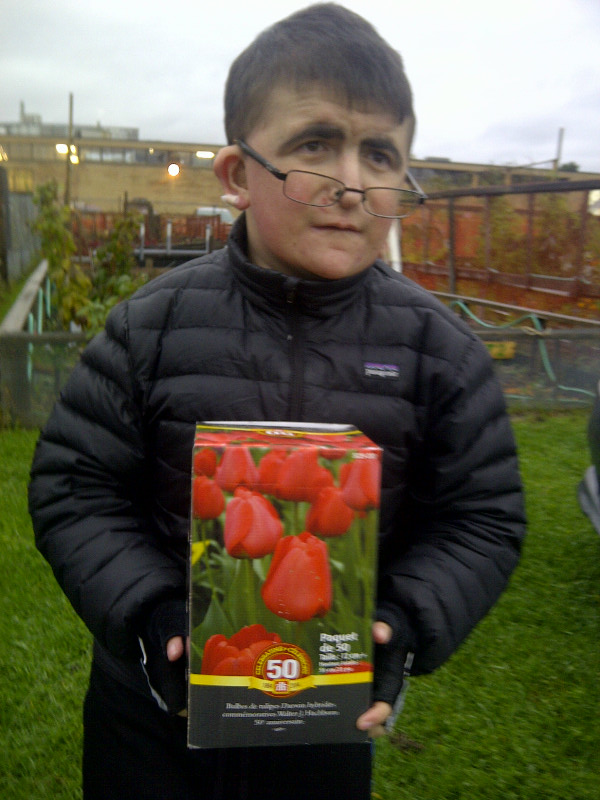
We pull out a box of 50 tulip bulbs. Woven among some perennial flowers and herbs, they will create a bright red border along the west side of the garden in spring.

IMG-20141021-02231

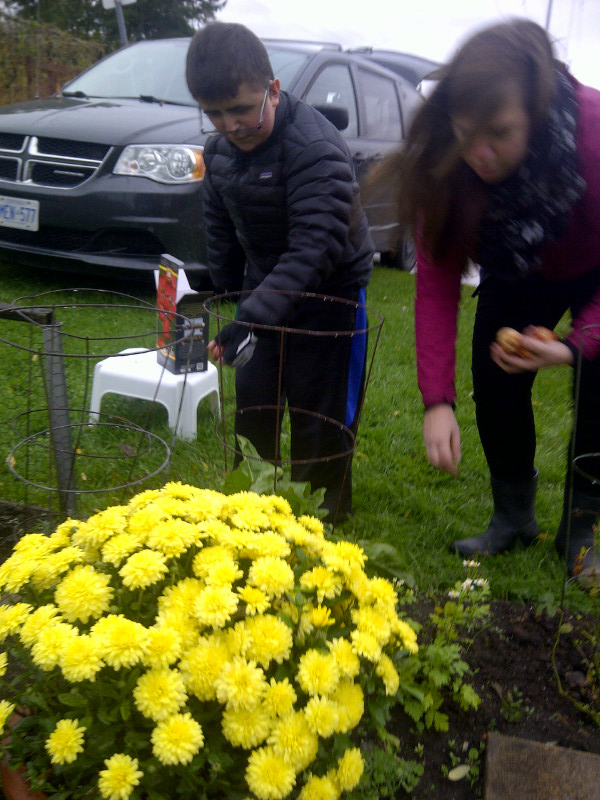
The planting exercise involves an assembly line of sorts. I dig the holes using an old piece of lumber to poke spaces in the soil, about six inches deep. Following me is Ben, who leans on the fence to carefully aim and drop bulbs one by one into each hole. Sally-Anne rounds out our line by making sure each bulb is upright (roots down), and uses a trowel to cover them up with soil. We get in about 40 bulbs, which means there are some left-overs for Ben and Sally-Anne to bring home to plant.


Over the long Canadian winter, the bulbs will set down some roots. They will wait patiently until the time is right to signal spring with their scarlet blooms.

Toronto-20141021-02234


Instant gratification: Sweet September raspberries. When I inherited this plot from a former gardening friend, she left some dwarf raspberry canes in the north-east corner. I can’t say I’ve done much with them except to enjoy the harvest — they put up fruit twice a year. My father-in-law Claus calls the fall crop “Sweet Septembers.” My canes have produced some sweet Octobers this year, so I pick a dozen of the last purple-red ripe raspberries and the three of us split them up for an instant treat. It’s almost suppertime, so the raspberry snack will buy us some time for the next gardening task.

Delayed gratification: the 2014 carrot crop. It’s been six months of weeding, watering and waiting. Now the carrots are ready to harvest. A few of the bigger ones have presented themselves — the orange tops now visible above the soil. I loosen the big ones and Ben hauls them up by their greens.

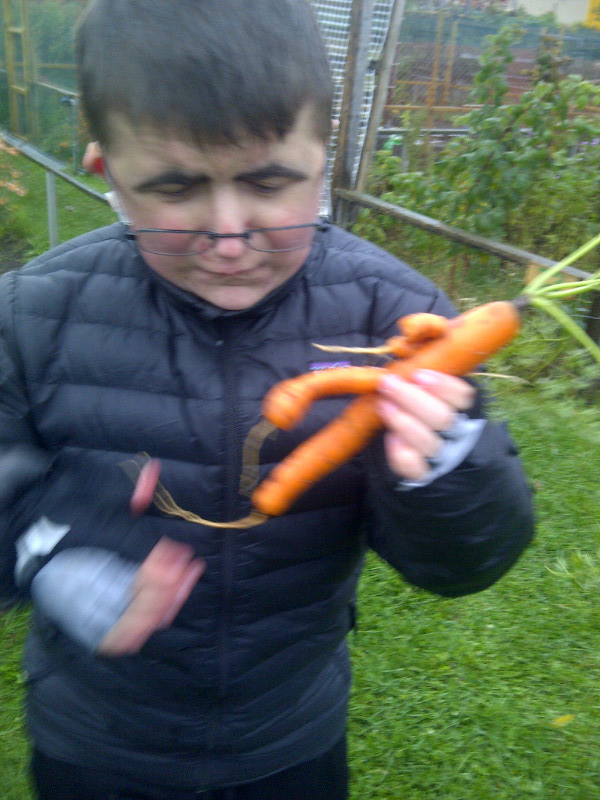
We head to the water tap to wash off the dirt, revealing a couple dozen healthy but gnarly looking carrots. Healthy, because they seem to have resisted the bugs that sometimes eat into the crop underground. Gnarly, because some of them are looking like something out of a sci-fi movie — the carrot that ate Don Mills.

Toronto-20141021-02238

Folks, you will never see carrots like these on store shelves. But they are tasty. We nibble on a couple of the little ones — sweet!

Ben and Sally-Anne each take home a basket, and I will be back for another couple of dozen before the soil freezes. Even after freeze up, if you miss a few carrots, they will generally sit tight over winter and provide a spring windfall when the soil thaws.

Instant gratification: Swiss Chalet. It’s getting dark and Ben agrees that we are done gardening for the day. We wash our hands under the nearest water tap. We’re getting a bit hungry and the raspberries and carrots have only bought us so much time.

As luck would have it, there is a Swiss Chalet located a stone’s throw from the community garden. We are seated by the hostess at a cozy booth, and gaze through the colourful options on the menu.

Ben is a pasta guy but likes his meal plain. When the waitress arrives, she asks Ben for his order. Ben signs and Sally-Anne translates. He has his own sign for pasta, using his index fingers and thumbs to indicate a pulling motion, like stretching a piece of spaghetti. He would like the fettucini, with some butter and salt. The menu shows a fettucini dish loaded with chicken and veggies, and I am reminded of the Jack Nicholson scene where he just wants toast, but has to order a chicken sandwich, hold the chicken, hold the mayo, etc. But Swiss Chalet is stepping up to the plate on Ben’s custom dinner order. The waitress asks Ben if he wants anything else on the pasta and he signs the letter “p” for Parmesan. Ben smiles and gasps when his pasta arrives, and I tuck into my quarter-chicken dinner.

Sally-Anne, who is one of Ben’s support workers, is studying for her sign-language interpretation diploma at George Brown, balancing school with work and being a mom to her five-year-old daughter. She’s heading to Montreal tomorrow for a couple of days for a break and some fun with friends.

Ben is a man who starts what he finishes. HIs pasta plate is clean as a whistle, and he’s making his way through his diet pepsi and chocolate cake while I savour my apple pie a la mode.  Ben is interested in the folks in the restaurant, including some retired couples and families. From his booth seat, he has a wide view of the place and is keeping an eye on the goings on.

We finish up and head home — soon I’ll put the garden to bed for the winter. We will all enjoy our carrot crop, and we’ll be back next spring to check out the tulips.