
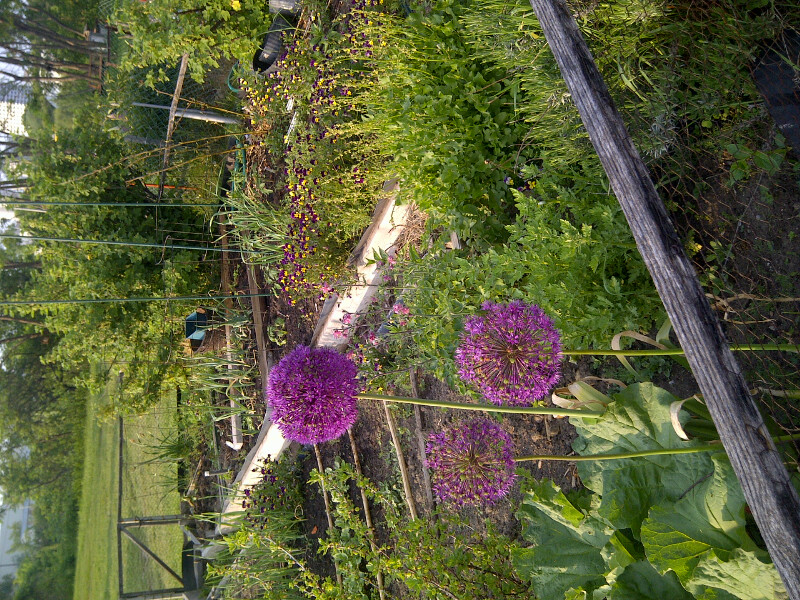
Garden gifts


Perennials declare themselves in spring, like a photographic image emerging in a darkroom tray.

And, in the end, the love you take… is equal to the love you make.

Lennon and McCartney were likely thinking of gift-giving in the garden when they penned this musical footnote to the Beatles’ classic Abbey Road album.

Garden gifts are living keepsakes – with the memory and meaning of the giver permanently attached to the perennial plant now growing in the receiver’s garden.

All in the family

When my parents started a family in their almost-new Don Mills bungalow in the early 1960s, they dug in several Forsythia shrubs to line the front of their home.

My mom Sheila took cuttings from the shrubs when the snow was still on the ground. Placed in a vase of water, the Forsythia cuttings bloomed indoors to hasten the arrival of spring.

During my parents’ move years later from the family home to a condo, my mom gifted me with a final Forsythia cutting. I discovered that the cuttings root easily outdoors with some TLWWW – tender-loving watering, weeding and waiting.

My mom’s cutting found a good spot in our front garden in Riverdale. Today, 8 years later, my propagated Forsythia shows off its bold yellow bloom in spring, and optimistic greenery throughout the growing season.

I have returned the favour over the years with small perennial gifts for Sheila’s garden. Some recent examples include Trillium bulbs, Lily of the Valley with their tender white bell blooms, and strawberry plants. The strawberries are spreading a second generation across my mom’s new guerilla garden, located in the public park near her condo.

The gifted perennials surround a small circular garden she has dug around an old hollow log stump. Inside the stump bloom red geraniums, which she tends daily.  Passersby in the park often stop by to comment on this small jewel of a garden in a public park near Norman Ingram elementary school.

 “Gifts” from the abandoned garden

Our cottage neighbors Harry and Christine haven’t been seen in three years. Word is they moved to the west coast. Their Minden cottage lot, in the Haliburton region, is sprouting volunteer poplar and sand-cherry trees. Several Minden phonebooks wrapped in plastic linger on the steps. But the rhubarb patch Harry and Christine planted years ago has taken nicely in the sunny south side of a small hill.

On a May weekend, the rhubarb is mighty tempting and will surely go to waste. Plus the act of harvesting will stimulate the plant, I tell myself. With a promise of dessert for dinner at the in-laws, I pay a clandestine visit to Harry and Christine’s rhubarb patch.

To pick rhubarb, you need to investigate each cluster, zero in on the older, outer stalks, and preserve the young stalks at the heart of the cluster. To harvest, the thumb slides down to the deep red base of the stalk, and pushes hard before snapping the stalk up. The large floppy leaves may be used as a mulch around tomato seedlings that are just going in with the first heat wave of the season.

This act of rhubarb piracy turns into a fair trade when I spark up the gas mower, cut the grass on Harry and Christine’s property, and plant a mixed flower basket gift in the planter near the front door — to give the place a lived-in look. And possibly ward off cottage burglars.

Thank you, Harry and Christine, for the rhubarb. It was stewed by my wife Nadine with sugar and strawberries and served as a compote atop some Kawartha Dairy vanilla ice cream.

The inherited garden

Over at Thorncliffe Community Garden, on hydro land just north of Toronto’s “arrival city” of Thorncliffe Park highrises, my new garden declares itself. I’ve decided to change plots to a more open area of the garden, with fewer fences, and closer to the wildlife at the edge of the ravine. A new garden in spring is like a photograph emerging in the chemical tray of a darkroom, before the digital age. It’s an act of wonder and patience on the part of the photographer, as the image emerges.

This spring, peonies, rhubarb, chives, and raspberry canes have sprouted in my new garden, and a grand-daddy red currant bush sets a promising crop of berries. The plants are all gifts from the plot’s previous owner, Stacey, who has recently moved.  She came by to pick up a favourite gooseberry bush, and gifted me several dozen perennial flowers and herbs that border her garden plot, leaving them be. I will honor the gift by keeping the plants, and fill in the gaps with some tomatoes, peas, potatoes, beans and carrots. How can I repay this gift? I’ve offered to divide the Peony in fall for its original owner, I’ve left some plants in my old plot which I hope the owner can use, and have made recent green donations to fellow gardeners.

In fact, Linda has dropped by on her way to feed the birds. She is the steward of the community garden’s burgeoning wildlife population, the topic for a future blog. “Do you need any gladiola bulbs?” I ask. Linda knows I’m likely flush on gladiolas in the same way she was once flush on Irises.

She takes a handful of bulbs for her garden, possibly to humour me — a footnote that will be the prequel to future garden gifting.

Miracles and disasters in the urban garden

About this time of year you’ll start to hear the hype about the miracle garden:

Grow 800 pounds of organic produce on a postage-stamp-sized plot – in just minutes a week! Garden yourself to victory in the coming food security apocalypse — without even getting your hands dirty!

But if you’re planning to roll up your sleeves to grow food in the city, don’t plan on the miracles unless you’re prepared to sweat some major disasters.

Or to put a more positive spin on life in an urban garden — every garden disaster makes each garden miracle that much sweeter.

That’s one of the lessons you’ve learned from Joe, Athena, Robert, Carmen, Andy and your many gardening comrades in ten years at one of Toronto’s oldest allotment gardens. Not to mention the escapades of the mysterious red currant thief.

Disaster: the squash devil

One year you planted several varieties of squash in a raised bed fortified with much well-rotted manure. Using your limited carpentry skills honed from childhood tree-fort building in Don Mills, you constructed a kind of folk-art trellis upon which you imagined your squash plants would rocket their way skyward.

You kept the bed well watered and the plants burst from the soil — the rocketing had begun. Yet while the green foliage showed the desired vigour, one by one, every single delicate yellow bloom withered on the squash vine.

One day your allotment neighbor, Joe, identified the culprit – a small black-and-yellow bug that feasted on squash blossoms. “He’s a devil,” said Joe, showing you the bug before squishing him between his thumb and forefinger.

Joe and Athena

You trusted Joe. He and his wife Athena, retired from the restaurant trade, grew an orderly Greek-themed garden filled with tomatoes, beans, onions and tasty greens. They enjoyed the long summer evenings in late June on lawn chairs outside their plot. Joe ferried fresh produce daily back to his nearby apartment on a rickety blue bicycle. Joe’s secret to gardening was soil preparation, and he spent days carefully hand-tilling his plot each fall, to be ready for the next growing season.

And Joe knew his pests.“You gotta pick off every bug and kill ‘em,” Joe said, proceeding to smear the bug on your garden fence, possibly as a warning to the devil’s comrades.

This minutes-a-week-to-gardening-victory thing just wasn’t working. You figured if you quit your desk job you could keep up with the devil-squishing. But you needed to pay the mortgage.

So your plants continued to rocket skyward that summer without producing a single squash. It was a garden disaster.

Miracle: the onion volunteers

But think back a little further and you will recall a garden miracle.

You had been two years on the waiting list for a plot at the Thorncliffe Park Garden Club, when you got the call. The club president, an elegant retired railway engineer named Robert, phoned to welcome you to the club. You had your piece of paradise – a 12×20-foot garden in full sunlight in a hydro corridor near Toronto’s Thorncliffe neighborhood.

Robert — who with his wife Carmen nourished a gorgeous mixed garden of vegetables and flowers — accepted your $20 fee, and showed you your plot number 6. It didn’t look like much on a cold April day: just a patch of dirt surrounded by a 2-foot wooden fence in reasonable repair.

But poking through the ground were green “volunteers” – several varieties of onion, and a multitude of garlic shoots.

You carefully dug up the volunteers, prepared a patch of soil, and arranged them in neat rows. Robert dropped by in his broad-brimmed hat and khakis to offer encouragement. “I have some elephant garlic bulbs for you, my dear,” he added. (In addition to his generosity in sharing plants and produce, he punctuated some sentences with this gender-neutral term of endearment, perhaps a turn of phrase from his native Ceylon).

Spring greens at Thorncliffe

You reciprocated by lending him some muscle to move a mountain of earthworm-laced soil to his plot – a special delivery from a farm outside the city. You and Robert were both out of breath following the shoveling workout, and rewarded yourselves with a shared thermos of coffee and a few minutes of peace in the community garden.

Later that summer, you pulled up the plants and took home your onion bounty, placing it in the basement to dry.

The onions and garlic from that summer fortified your home-made soups for many months that winter. The capper was when your daughter Colleen wolfed down a bowl of the house special and asked “Are there seconds?”It was a garden miracle.

Disaster: the red currant thief

But then, there was the case of the red currant thief.

You’re not talking about a guy who sneaks into the garden at night and steals the little red currant berries that dangle in delicate clusters from the currant foliage.

This guy took the whole bush.

The previous summer, you had proudly guided your spouse Nadine, daughters Alison and Colleen, and step-brother Stefan to your red currant patch, where they had picked bags full of berries. That weekend you spent a night at the stove at your inlaws’ cottage, boiling the berries into little pots of clear currant jam. Your father-in-law Claus stopped by to offer free advice during the critical gelling stage.

Your gardeners’ pride was compounded by the fact that you had successfully propagated the plants by taking cuttings in the fall. You had planted the cuttings and then carefully tended the new bushes over several years as the berry production slowly increased.

It was an unusually warm day in late March the next spring, and you had come back to the garden to admire your pruning job on my three red currant bushes.

But where your middle currant bush once stood now gaped… a crater. The thief hadn’t even bothered to backfill the hole from which he had wrenched your bush, roots and all.

When it comes to crime, you can’t go much lower than stealing an honest man’s shrub.

Miracle: best boy special delivery

But you forgive the shrub thief by remembering the miracle of the Best Boy special delivery.

It was a scorching summer in T.O., a summer for heat-lovers. And you’re talking tomatoes.

Another garden plot neighbor, Andy, had taken to giving you regular advice in a very direct manner, and booming voice, on many gardening subjects. Andy was the Thorncliffe Park Garden Club’s number 1 “fixer.” When he wasn’t working his own plot, Andy could be found sawing and hammering away doing odd jobs on neighbors’ plot fences, and going for coffee runs in his aging but immaculate silver Volvo.

Your first inclination was to play dumb, or to avoid this nosy gardening neighbor — until Marina set you straight.

“Listen to the old man,” said Marina, who grew bitter-melon and other exotic (to you) vegetables. “He knows what he’s talking about.”

Andy decreed that the best tomato seedlings could be found at small garden shop on Pape Avenue. You parked illegally across the road and jay-ran over to spot the shop’s last flat of tomato seedlings. The price was a steep but the seedlings had thick sturdy cores and healthy leaves, and an intriguing brand name: Best Boy.

Andy took pity on your initial attempt to plant the seedling plants, brushing you aside to show you how to dig them a little deeper and to pick off the lower stems, helping the Best Boys set down a good root system.

In the heat of that summer you had a bumper crop. You convinced your older daughter Alison to join you for the harvest.

You picked baskets of deep red unblemished tomatoes, and set them in the trunk of your red Echo. You two put aside a good quantity for home use, and proceeded to play a pair of tomato Robin Hoods, driving through Toronto’s Riverdale streets to bestow a surprise gift of Best Boys upon friends and neighbors.

It was a miracle of miracles in the urban garden.