Five tons of stone

If you had two hundred bucks in a sock, would you use it to buy:

a) 25 latte ventis at Starbucks?

b) a nice car wash and detailing for your old minivan?

c) or five tons of Haliburton stone?

If you were a dry-stone waller, the correct answer goes without saying.

I had scrounged stone from a number of sources at our cottage on Minden Lake, but the cupboard was bare, so to speak.  To be ready for the garden terrace project this summer, I needed a fresh supply. So I put in a call to a guy who knows stone.

Brent Coltman provides excavation services in the Minden-Haliburton area.  He comes by the profession honestly — his Dad, Wayne, still works in the “aggregates” business into his 80s — quarrying stone, sand and gravel and other materials for construction in the area.

Stone riches

The Minden-Haliburton area is rich in Canadian shield stone, including granite with its rich reddish-grey hues, and older sedimentary stone.  The area is crisscrossed by a fault line that has pushed ancient stone into view. A trip north on highway 35 features some stunning granite rock cuts — such as the one near Miner’s Bay.

Brent has a gravel pit on 100 acres of bush, where he processes material from excavations. Sand, for example, is screened in a giant mechanized machine. The final product is used as a clean and porous bed for new septic systems.

I visited Brent at the pit and we agreed on a nice pile of small and mid-size stone, as well as the price —  $200 dollars. The next morning, as I watched a pair of bluebirds build their nest in a box near our cottage, I heard Brent’s large dump-truck chugging down our small cottage lane.

The eagle had landed

Despite a tight space, Brent backed up expertly to the delivery site, and tipped five tons of stone onto our cottage lawn. He also gave me the contact information for his dad, as I needed some special stone for stairs and capstones. I would get that later.

five tons of stone.png

The eagle had landed. On this multiple choice question, I had selected option c).

Nesting instinct

With a good supply of stone, it was time to start excavating the site for the stone terrace garden.  The stonework would create a kind of nest for the pretty little log cabin that Nadine’s dad built years ago.  The cabin, situated on a sloping hill in the woods, would get a stone terrace in front. A few shade-loving plants would green up and beautify the area in front of the porch. The log cabin would also be shored up in the back with a dry-stone retaining wall, to create some breathing room and better drainage against the slope behind it.

hosta.png

Nadine and I scoped out the stone terrace area.  With a tape measure, I marked two spots for a line parallel with the cabin’s front. Using a standard round-edged garden spade, I started excavating the area for the first terrace, one shovelful of sand at a time.

Once I got the excavation area roughed in, I put in two posts and tied a string in between. This would guide the building of a straight and level wall.

I continued excavating the site to allow a wall roughly seven feet long by 2 1/2 feet wide at the base.  The terrace would rise to about three feet high, to create the little green space level with the cabin front porch.

excavation 1.png

For a porous and flexible base for the dry stone wall, I put down a couple inches of gravel and tamped it down using an 8×8-inch hand tamper, all the while checking that the site stayed level.

Curating stone

Next up was stone selection. Using a small but sturdy hand-dolly, I started to load up the bigger stones and deliver them to the site. These would comprise the terrace foundation. To save my sore back, I tried to use gravity and leverage to my advantage, and trundle the material carefully down the hill on the dolly. Stones of similar heft and shape were grouped together near the site. Most of these foundation stones weighed 30 to 50 pounds and would provide a integral footprint for the terrace.

As the bigger stones were pulled from the pile, I also looked for mid-sized building stones to be used later, as well as the small “heart-stones” that would pack the centre of the structure.  These were all delivered to the job site by dolly or wheelbarrow.

To get a sense of the utility of each stone, you can flip it around. Ideally it has two straighter opposing sides, and a front that will give a gentle angle, or “batter” for the face of the wall. Each stone has its own beauty, heft, colour, character and faults. After a while, the stones start to speak to you. A stone waller in the stone selection phase might even admit to dreaming about stone.


foundation stones.png

A moveable feast

As I concentrated on finding nice stones, the first wave of June blackflies feasted on my neck and a hot sun found its way through the trees. Curating stone can be a dreamy but prickly business.

As stones were sorted and delivered to the job site, my 5-ton, $200-dollar pile of stone was slowly starting to shrink.

excavation 2.png


Stone wall spring training

Like a ball player getting ready for the summer season, I went into spring training — in this case, to flex my dry-stone-walling chops. I needed to be in top shape to tackle a bigger project this summer — a pretty garden terrace to go around the little log cabin Nadine’s father built.

Log cabin in spring.png

Little cabin awaits its stone terrace. This cedar log cabin was built by my father-in-law Claus for his grandkids.  He and my mother-in-law Ann wanted to keep it in the family, so gifted the cabin to our Minden Lake cottage last year. 

At the edge of Minden Lake, our stone patio and terraces have been emerging over the past couple of years. Slowly, they’ve brought some order and easy access to a jumbled bit of land near the corner of our lot. We’ve even started to dress up the Italian-inspired terraces in summer with some cascading annuals like orange nasturtium and some lush perennial shrubs such as white hydrangea.

A little piece of Italy…

To bring a little piece of Italy to Minden, Ontario, we had overwintered two fig trees in pots in our cottage basement, ready to put out in the warmer weather. After going into hibernation in the winter months, the fig stems had started to bud out with the warmer March sun through the cottage windows. As well, we had found some hardy Ontario grape vines that might add a Tuscan feel to our Canadian terraces. These had been planted — somewhat optimistically — the previous fall.

Some lemon and fig trees would complete the Italian picture, I thought, but that might be pushing it.

My spring training goal this year was to finish up a little terrace I had started the previous year. Nadine, who was eager to plant gladiolus and dahlias in that area, had flagged this little terrace as a priority. Check!

Foraging for stone

Half the battle in dry stone walling is staging the site — getting the right stone materials in place, close at hand. It had been a tough winter and I began to scrounge for stone on our property.  Some was still stuck in ice, but each time I found a nice stone, I flung it towards the spring-training site, and organized it there in rough piles on the snow. For bigger pieces, I carted them in a wheelbarrow across the hard snow-pack.

I foraged for heavier foundation stones, and laid them out side by side to get a sense of how they would fit together.  Smaller building stones, and the flat cap stones, were organized in piles. Tiny heart-stones sat in buckets nearby, to be packed in the core of the wall later.

While the Toronto Blue Jays players were playing catch in Florida, Mallard Ducks were perched on the edge of large ice flows on Minden Lake.  Deer came out of the woods hungry for spring greens. Canada Geese in honking “V” formation were flying northward.

hungry deer.png

Deer in early spring on Horseshoe Lake Road, Minden.

After five months of deep freeze, the frost was coming out of the ground.

No spring-training jumping jacks for me, but I did get a workout excavating the stone terrace site with a shovel, and moving wheelbarrows full of sandy soil further up the hill. This would be used later to backfill the terrace.

Then I made some measurements to get the site straight, and used a mallet to pound marker posts into the ground. These would denote the outer border of the wall. A string between the posts gave me an exact level, as well as the terrace boundary.

A solid foundation

Next came the gravel foundation. While the Jays took batting practice, I was thumping down the gravel base of the terrace with a hand tamper — a heavy, square metal tamper attached to a straight wooden pole.

A groundhog nibbled nearby on the first grass exposed by the thaw, and bolted when he saw me. Cows from the neighboring farm ventured further into the valley next door; they too searched for spring grass and gave me puzzled looks through the fence.

cow.png

Slowly, the little spring-training terrace wall took shape.

spring training wall.png

I wasn’t feeling much like an athlete.  In fact, my back and hips were stiffening up.  Besides the stone walling, my recreational ice hockey season was in its home stretch and, in my mid/late-50s, I sometimes felt like a bag of bones after a game.

I took a few stretch breaks to loosen up.  A couple of cups of coffee didn’t hurt. Deep breaths of the cold spring air felt like fuel to keep at it. My Dad, Douglas, taught me that trick when I was a kid, well before mindfulness caught on. Stop, close your eyes, take a deep, cool breath through your nose.

And I reminded myself that moving around stone is often more of a mental than physical exercise. Wherever possible, I used leverage and gravity, and tried to go easy on my back.

Blending Zen and elbow grease

Stone-walling itself is the ultimate mindfulness practice — a nice blend of Zen, jig-saw puzzle patience, and some elbow grease. For a small terrace wall like this one, you might go through a tone of stone — and each one has its unique characteristics, colour, heft and purpose.

I was getting there. Nadine dropped by to do some garden cleanup of the area next to the lake.  I took a breather, sitting on the unfinished wall as I got ready to put on the final courses of stone.


Ian spring training.png

I was still short a couple of heavy capstones.  While driving into town, I spotted some jumbled stone that had been dumped in a “clean-fill” construction waste site next to the road.  Eureka!  I stopped and completed a lightning-fast SWAT mission to load a couple of fine flat pieces of discarded granite into my minivan.

With the caps in place, my stone-wall spring training was complete.

spring terrace lake view

Now we could sit back for a moment, and visualize the bigger project on tap this summer — a pretty stone garden terrace for the little log cabin that Claus built.


Stone terrace inspiration

manarola

Over centuries on the rugged Italian Riviera coast, stone craftsmanship turned steep slopes into sturdy terraces. In turn, the terraces supported a string of colourful seaside villages and vineyards: Cinque Terre.

Italian for “paradise,” in my opinion.

Nadine and I were headed to Italy to attend my cousin’s wedding anniversary near Lucca.

Before our trip, our friend David showed us pictures of the coast he had visited at Cinque Terre, noting that “the stone terracing is pretty stunning.” Looking back, I know I didn’t fully appreciate his comment. Perhaps, I had mused, David was a little too obsessed with stone. Certainly, I had not yet developed my own stone-building obsession.

Taking the mule trail

After a wonderful family event in an elegant villa near Lucca, Nadine and I travelled to the tiny, pretty coastal town of Volastra. it is perched high on the hills overlooking Cinque Terre. Our hotel owner, knowing our Italian vocabulary totalled perhaps 15 words, pulled out a map. She proceeded to give us walking directions in enthusiastic English to the nearest coastal Cinque Terre village, Manarola. “You can take the path here!” she added — pointing to the spot.

We started off on a small road, then caught an ancient set of wide stone steps heading down to the ocean. The steps themselves were tightly constructed of dry stone, originally built to withstand daily mule-trains up and down the hill. After centuries of use, the steps were flattened and polished.

Rounding a corner on the mule trail, we saw the full scope of the stonework that was the foundation for life in Cinque Terre — sweeping curved terraces tracking the coast like elevation lines on a topographical map.

Orchards and gardens occupied the terraces, as well as vineyards that used a small monorail-like system to move the grape harvest up and down the steep hills. Below, the colourful homes and buildings of Manarola clung to the steep coast next to the ocean, also buttressed by stone terracing.

How steep was it? We continued down to the main street and small port of Manarola, where fishers still plied their trade in small ocean-going boats. It was so steep that each boat had to be stored on its trailer on main street, then lifted by a small crane and winched down into the rocky but well-protected harbour.  At the end of a fishing day, the boat and catch would be winched back up. Visitors hiked into the rocky harbour for a dip, then relaxed in trattorias in the small town square, enjoying local specialities of pesto, fish and wine.

sailboat

A fishing boat is lowered by winch into the harbour at Manarola

Interconnections

The five towns of Cinque Terre, and larger hub of La Spezia to the south, are connected to each other by rail, road, boat and walking trails. Knowing we could return by train or boat, Nadine and I set off on hikes each day to explore the interconnected villages. Paradise can be crowded in summer, so we avoided some of the visitor traffic in the towns by hiking through the country.

As the area’s commerce now favoured tourism, some of its original vineyards had gone fallow, and pine trees were putting down roots on the ancient stone terraces.  In other areas, farmers continued to nourish grape vines, fruit trees such as lemon, olive and apple and lush vegetable gardens.

town on cliff

Cinque Terre clings to the cliff. In foreground: a fruit tree is harvested

Here and there, we came across masons repairing areas of terracing that were occasionally damaged by flash floods on the steep coast.  They used wheelbarrows to transport their tools and stone. There was very little room here for motorized construction machines, so much of the work was by hand. They used a dry stone construction method — carefully stacking the larger stones one-over-two and two-over one, and sloping back into the hill. Behind the face stones, they packed in smaller stones to give the wall integrity. On the wall’s face, they tapped in little wedge stones to keep it tight. On top, they placed heavy stones to keep the wall in place.

stone terrace closeup

A stone terrace gets its close-up.

Solid as a rock

Along its coasts and in its mountains, Italy is said to have 100,000 miles of dry stone walls.  Because they are permeable, they retain soil and some moisture while allowing heavier precipitation to wash through. Many have lasted untouched for centuries — works of art and engineering, without mortar — solid as rock. A New York Times article described how citizens of Cinque Terra are reigniting stone building traditions to monitor and repair ancient terraces — to prevent them from washing into the sea. (See NY Times photo of Manarola, included at top of this post).

The road less travelled

We took a bad fork in the trail and ended up clinging to the side of a cliff on a path that was getting narrower by the second.  A young Swedish couple hailed us, and gestured for us to turn back — they directed us back to the main trail. We thanked them, and during a brief chat, learned that they were on their honeymoon in Italy.

At the end of a gorgeous hike, we arrived hot and tired in the town of Vernazza. We  made a beeline for seats in a breezy patio in the town square. Cooling off with a glass of local white wine, we ordered some pasta to reward our hiking efforts. At the other side of the restaurant, we spotted the young Swedish couple just sitting down, also red-faced from the hike. We paid our waiter to send some wine their way as a surprise.

They caught our eye and smiled at us, and we raised a toast to them. “Cheers! Well done! And thanks again for setting us straight!”

Cooling off

Back in our small hotel in Volastra that night, we wandered over to the town’s only restaurant. Most of the staff were still having a pre-shift chat and smoke, sitting just outside. So we continued through the old part of the town, where a narrow promenade and high stone buildings afforded a cool walk on a warm day.

It was mid-summer and days were above 30 Celsius. The use of stone’s thermal properties to moderate heat are even more important in the heat spikes of the Italian summer, when temperatures can approach 40 Celsius in some spots.

After circling back through the courtyard of the town’s old stone church, we sat down to a local speciality of small whole fish and pasta — and more local wine to wash it down. There we plotted our next set of hikes — including an ambitious one with some steep stretches connecting to the last village of Monterosso al Mare — the only one of the five villages boasting a beach. And we could not miss Riomaggiore, where couple declare their love by placing padlocks on gates along the seaside stroll.

locks

Lovers’ locks on the Oceanside promenade at Rimaggiore


A little piece of Cinque Terre…

Trying to take in all the beauty and expanse of the Italian coast, I thought about the lakeside place we had purchased near Minden, Ontario, north of Toronto, with its steep slopes towards the lake. Not exactly gravity-defying slopes like those in Cinque Terre, but in sore need of some stone garden terracing. Nadine and I had already rolled up our sleeves and built a little stone patio by the lake.

Perhaps I could bring back a little piece of Cinque Terra to our new place in Minden, Ontario?

flowers and terraces

A purple Hydrangea blooms and thrives on a stone terrace garden in Cinque Terra


Stone walling ’til the cows come home

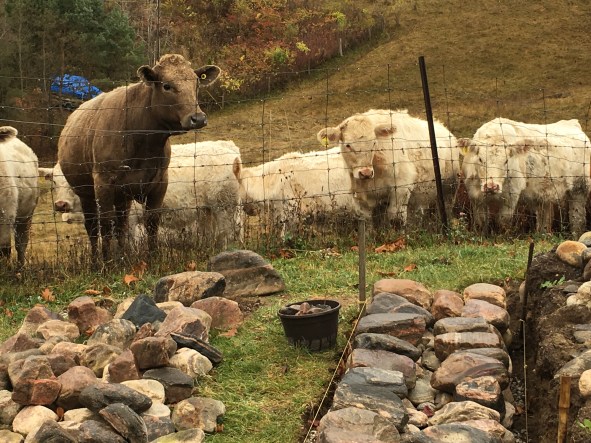
The cows next door to our place at Minden Lake caught me in the act of building a small dry stone retaining wall for our garden this fall. They are a curious bunch. They gathered quietly, just the other side of our fence, and gazed at the little stone wall under construction. It occurred to me that they might have thought it was a salt lick, and come busting through the flimsy wire fence to get at it.

IMG_3210 stone wall with cows

But I’d prefer to think they had some questions about how and why this little wall was rising at the top of the hill. Time was short for some of them — the yearlings would be sold at auction in Woodville in a few weeks. And the clock was ticking for me to get this job done. Soon the snow would fly, shutting down this year’s stone-walling season.

But today, time stood still. I communed, briefly, with the cows. I imagined the questions they were asking me, and tried to answer them patiently. All the while, I kept my eye on a quick escape route to follow if they decided to storm the fence.

Why are you building this wall?

The main reason is to level the playing field for the onions and all of the other vegetables and flowers in the little garden outside our screened porch.

IMG_3248 onions

This year’s crop included tomatoes, beans, peas, carrots, cucumber, kohlrabi, lettuce and beautiful flowers from bulbs including dahlia and gladiola. We also have gooseberries and currants. Some of these were gifts from my father-in-law Claus, a master gardener who mixed the beauty of flowers with the nutrition of tasty, fresh vegetables.

The wall will shore up the slope on the south side of the garden, creating a more level playing field and retaining moisture in the soil for those veggies and flowers. Once completed, it will also be a nice place to sit, plant, weed and even take a load off with a cup of coffee.

It replaces a rather crude previous attempt by yours truly. A couple of years ago, without the right knowledge or skill, I had thrown down some stones in a ramshackle pattern in an attempt to retain the soil. Very quickly, the wall started to move, leak and crumble.

Now, I wanted to rebuild the retaining wall to last. To get started, I pulled apart the previous wall, sorted the stone, set in some posts and string to keep straight and level, and put down a base of tamped gravel.

But quick, the frost is coming! It’s lighting up the fall colours — like the red leaves on this cute baby oak tree next to the garden. So pretty.

IMG_3205 oak with frost

You don’t use mortar? Why don’t all the stones just tumble down?

Because I am following an ancient and proven tradition, built on a few sound scientific principles. Dry stone walling dates back thousands of years and you can find examples of its durability and beauty in places like the UK, Italy and Peru.

After being inspired by the dry stone terraces in the pretty sea-side towns of Cinque Terra, Italy, I took a course with 20 other students at Haliburton’s School for the Arts. Our instructor was John Shaw-Rimmington, a master mason and dry stone waller. John’s work blends art, engineering and sensitivity to landscape. A stunning recent example is the dry stone footbridge he and his class created last year over a small brook near the town of Haliburton. The arch in the footbridge is solid as a rock — possibly more solid than a mortared arch because gravity and friction will keep the arch stones tight, whereas mortar can crack and heave the structure.

From John, who is president of Dry Stone Walling Across Canada, we learned the importance of principles that include:

stone selection — curating the stone into a dozen or more categories and knowing the role of each stone size and type.

gravity — using gravity to our advantage to create integrity in the structure. Typically, the heavier stones on the outsides of the wall tilt inward and are tied together on top with heavy, thick and wide capstones.

friction and placement — learning how to knit stones together in a pattern that creates multiple touch points and integrity for each stone and for the entire structure. This includes the use of smaller “hearting” stones in the core of the structure.

In addition to the science, we learned some human qualities that support this effort: patience, flow, intuition, teamwork, and the importance of stepping back to get context on progress. Finally, there is the joy of each moment and celebrating a job well done.

IMG_3257 stone wall facing cottage

In the photo above, you can see the first three course of stone are placed, with smaller heart stones placed inside for each course. These include small wedge stones used to adjust the tilt and lie of the bigger stones. I raise and level my guide string as I go, using it as a reference for stone placement. My guideposts and string also ensure a slight “batter” or slope to the wall — perhaps an 8 to 1 ratio — to help it retain weight from the garden soil it will hold. You can see the soil at the left of the photo. If the wall was to be taller, I would build forms at each end to ensure an exact batter ratio.

It’s particularly important to get integrity at each end of the wall. One trick is to use some of your best stones in the prime spots including the ends. A standard rule of wall building is to place one stone goes over two, and vice versa, to avoid “running joints” that might compromise the structure.

Where do you get all the rocks?

It’s good to have multiple sources. These may include some existing stone on your property. In Minden Hills more than a century ago, the first farmers pulled stones as they cleared land and left the stones in long piles. Some of this farm land has reverted to forest but the stones have not budged. Using a wheelbarrow, I mined some nice stones from behind my in-laws’ cottage garage, an area where stone used to divide farm fields.

A local “clean fill” municipal site often features a few nice pieces of stone that have been dumped along with wood and concrete waste. Finally, a gent named Brent on Horseshoe Lake Road specializes in excavation and aggregates. He has kindly delivered local stone right to our cottage at a reasonable price — a ton of delivered stone can be had for a cost equal to about 25 tall bold coffees at Starbucks.

It must be tough on the back

If you take care, stone building makes you sore but strong. Our stone sensei John taught us several techniques to make the job easier:

  • Leverage with a shovel, sometimes combined with an old two by four, can help move heavy stones with less effort and risk. There are more specialized tools but the principles are the same.
  • A handcart and wheelbarrow make it easier to move stones around.
  • A long piece of 2×10 wood can be used to slide a heavy capstone into place without direct lifting.
  • Lifting with your legs and working methodically reduces the chance of injury.

Oh, oh — the snow is flying. Will this wall get done?

Thanks for asking, my bovine friends.  And thanks again for keeping to your side of the fence. In fact, this little retaining wall is 90 per cent complete. Four courses of stone are built and the hearting is packed in. A row of slim stones will be the penultimate step before the heavy capstones go on — to lock everything together.

But as the snow flies in Minden, my fingers are getting a little numb. The wall will have to wait for early spring. I’ll temporarily cover it with plywood and the capstones to keep out the elements. Then we’ll complete the finishing touches in 2018. Thanks for your interest, and best of the season to you!

IMG_3296 stone wall winter 2017