SIRCH Repair Cafe — A Day in the Life

When it comes to sustainability, talented volunteers at the SIRCH Repair Cafe live the principles of reduce, reuse, repurpose and recycle every month — at events running April to October. The final cafe runs Sunday October 5th from 10 a.m. to 2 p.m. at the SIRCH Bistro in Haliburton. Feel free to drop by with items needing repair, have a coffee and snack, and speak with our fixers! This article gives a glimpse of a day in the life of the SIRCH Repair Cafe.

Caleigh arrives at the SIRCH Repair Cafe holding two broken radios. She’s reluctant to toss them out — especially the one that belonged to her grandmother.

Caleigh, who runs a gardening business in the area, checks in at the reception desk and completes a form for each radio. On a sunny Sunday morning, it’s quiet so far. After a short wait, Caleigh is escorted to meet two volunteer fixers.

Gary has a look at her smaller radio — it’s a retro-vintage model Caleigh picked up at a yard sale a few years ago. With his background in computers and electronics, Gary tests the radio and quickly determines that a dusty tuner knob is generating static. He takes apart the knob, cleans and lubricates it. Then he powers up the radio again and finds a nice, clear signal on a local FM channel — a DJ is introducing the next song.
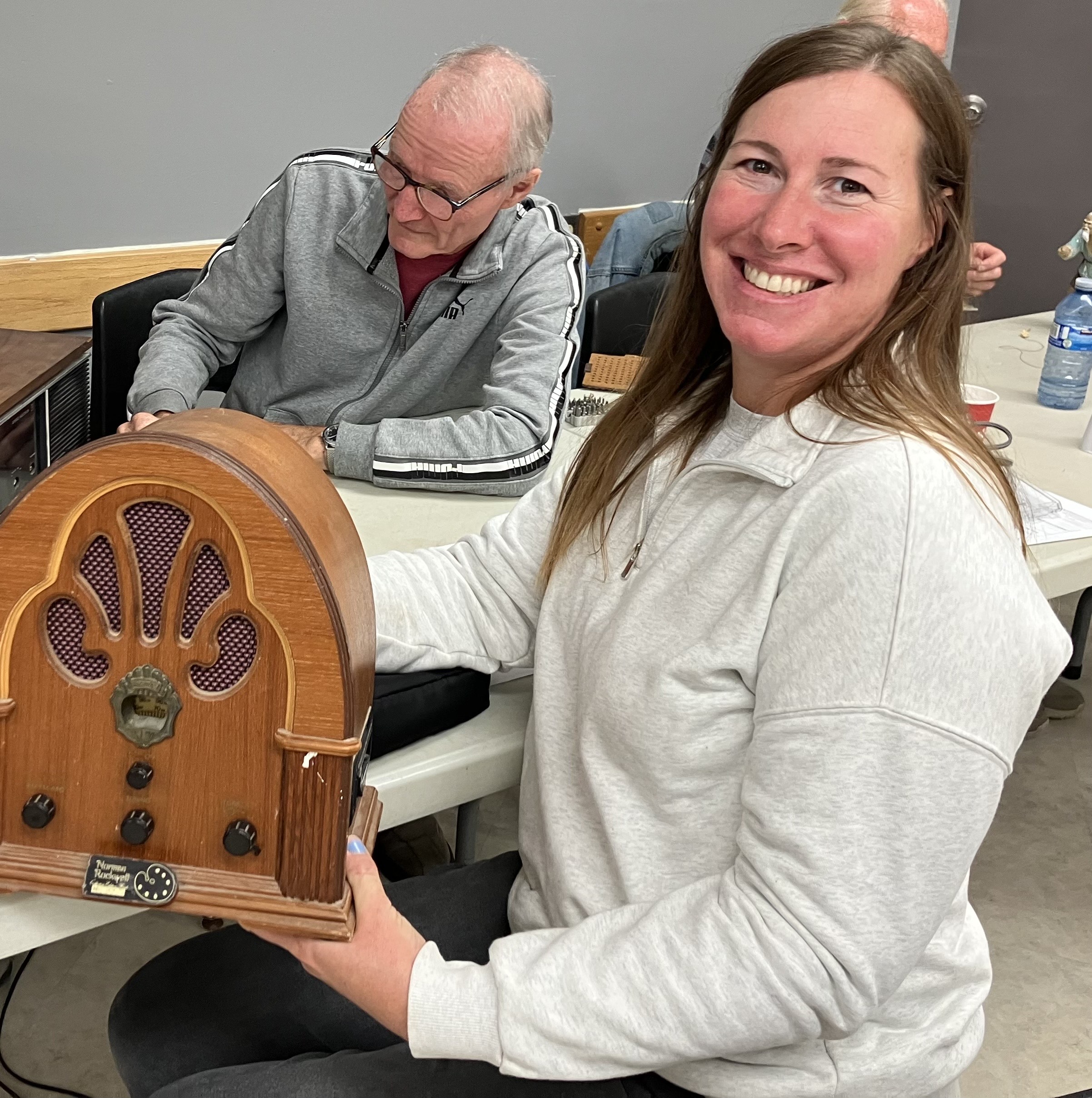
Fixed!

But the next repair is trickier — volunteer fixer Jurgen has been looking at the larger radio. It’s an old AM/FM model with stereo sound. Jurgen and Gary open up the unit, conduct several tests, and confirm that one of the two speakers needs to be replaced.
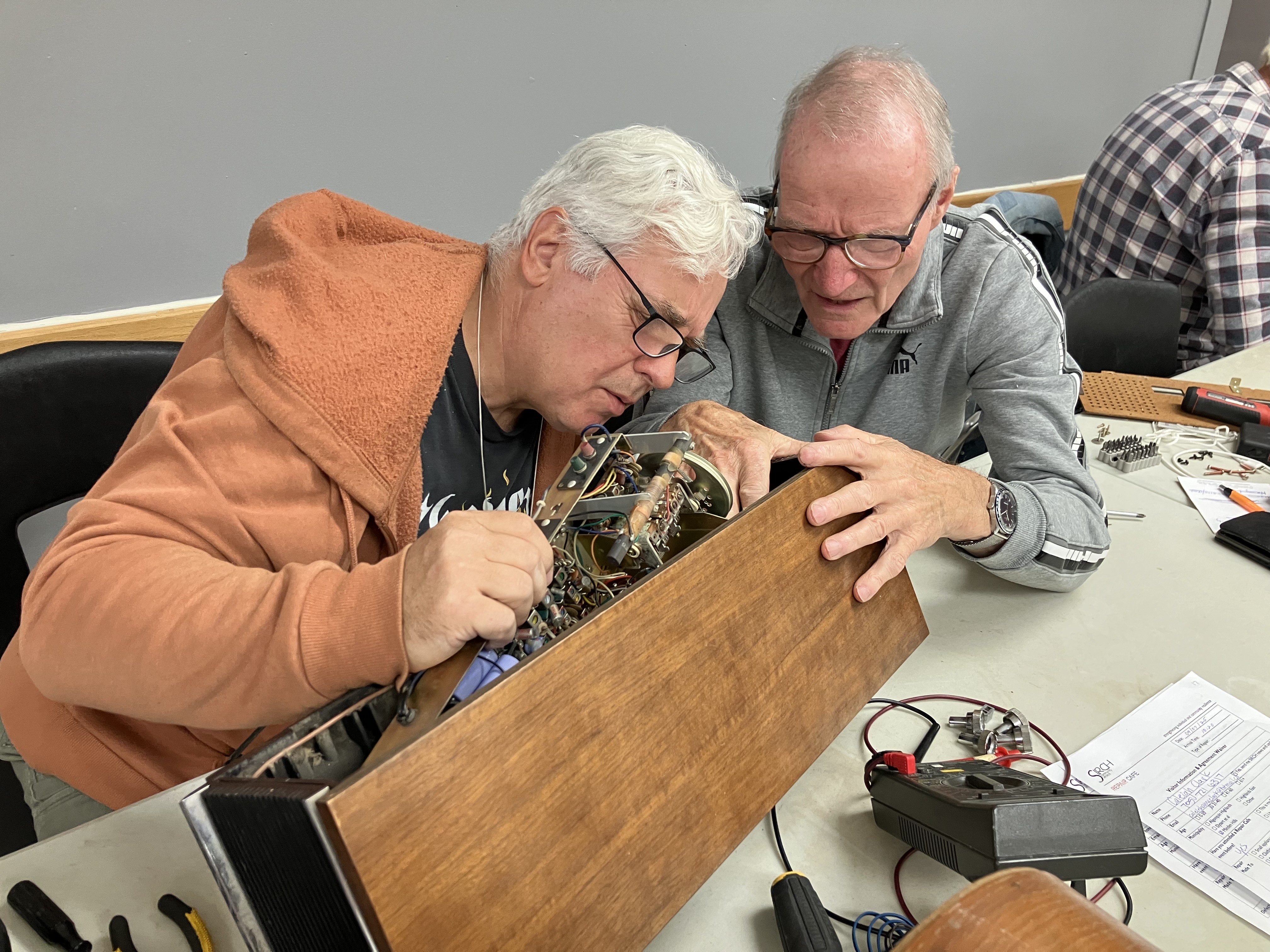
The radio — a keepsake from Caleigh’s Grandma — can still be repaired, but Caleigh has some homework. She will look for a new speaker and aim to visit the next repair cafe to have it installed. Jurgen and Gary provide the specifications for the speaker including the required OHMs (electrical resistance units).

It’s another day in the life of the SIRCH Repair Cafe…

With its sustainability mandate and skilled volunteers — fixing everything from small appliances to electronics to jewelry — the SIRCH Repair Cafe is running seven events in 2025. Five of them are held at the SIRCH Bistro in Haliburton, and two here at the community centre in neighbouring Minden.

After a quiet first half-hour, there’s a buzz in the air now as more guests arrive with items to be fixed. Volunteer fixer Dave has unpacked his bicycle tools and is testing the “true” of a bike wheel. He’s removed it from the bike and connected it to his truing stand to check the side-to-side and vertical movement. Gary, a local musician, obtained the Raleigh bike from a friend. He enjoys riding it but noticed a thumping in the back wheel.

Dave makes some adjustments to the wheel’s spokes to make it straighter, and also re-seats the tire and tube. He reinstalls the wheel on Gary’s bike.
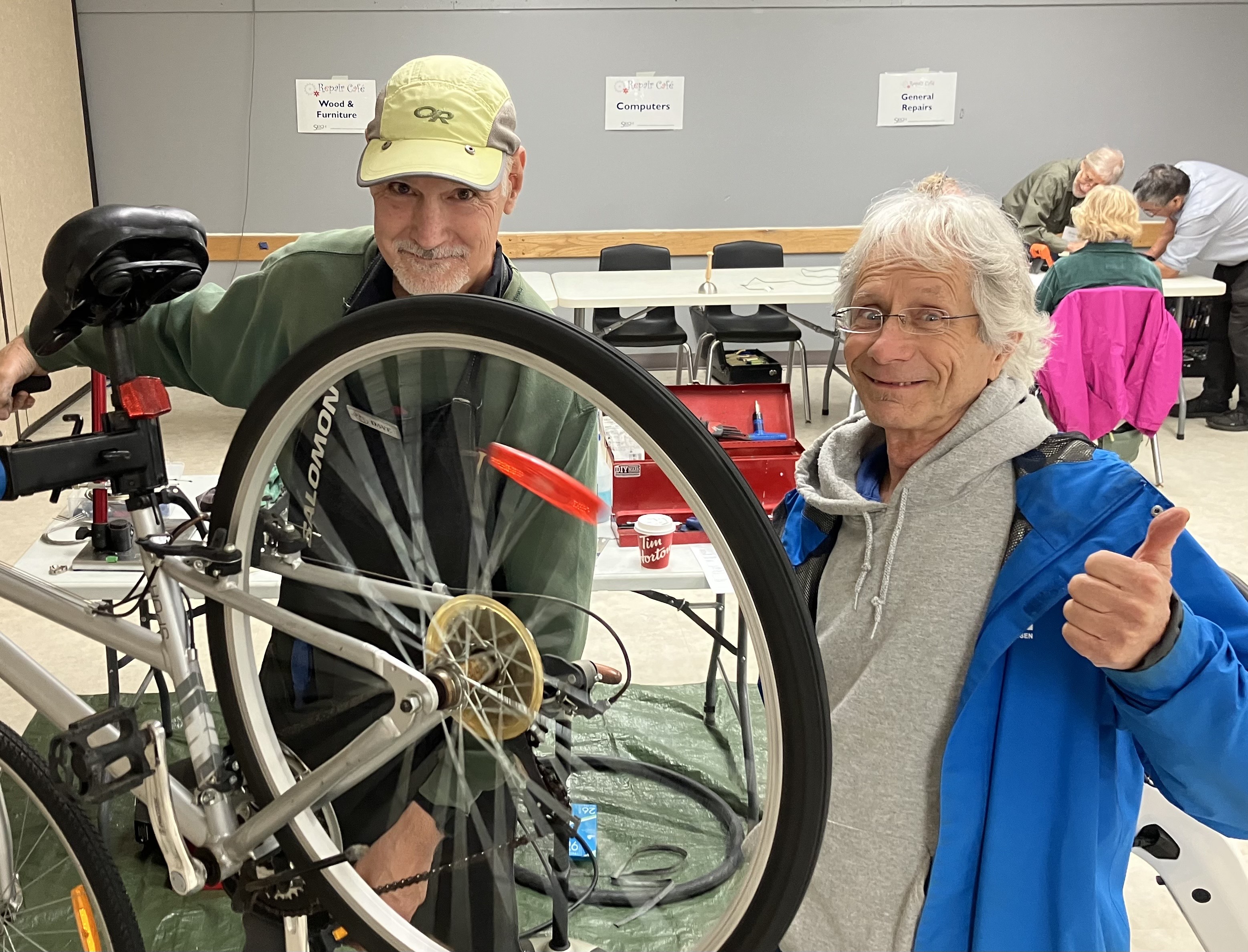
Back in business! A SIRCH volunteer rings a bell to celebrate another successful repair.

Across the room, fixer Rick tackles an unusual repair — a broken fishing rod belonging to a ceramic Japanese fisherman. The fisherman’s owner, Elisabeth, obtained the whimsical piece from the SIRCH Thrift Warehouse in Haliburton. She realized it would go perfectly with her collection of Bonsai collection.

Rick uses some fast-acting glue to repair the rod, and carefully rethreads the tiny fishing line and lure.

Hook, line and sinker — it’s fixed!
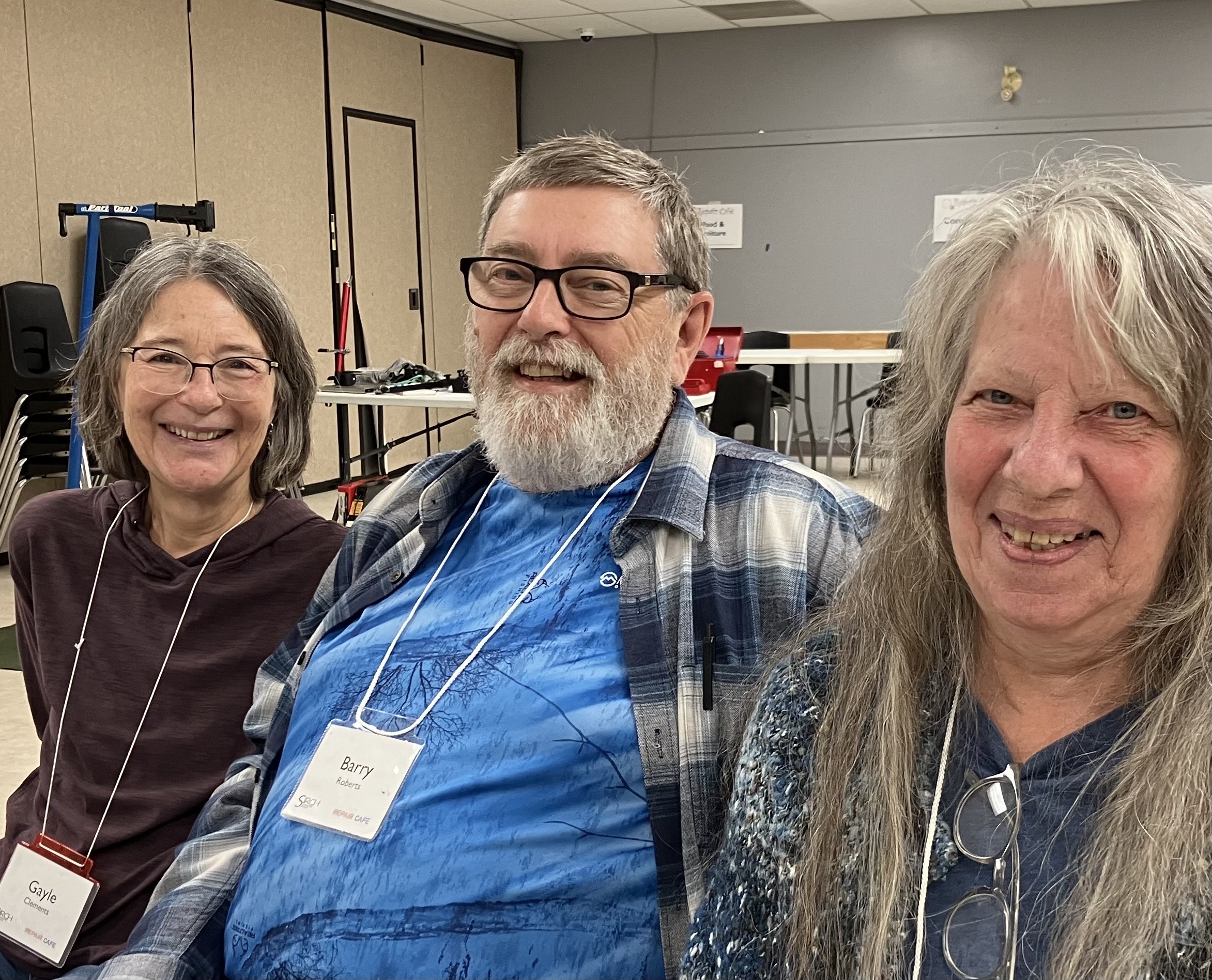
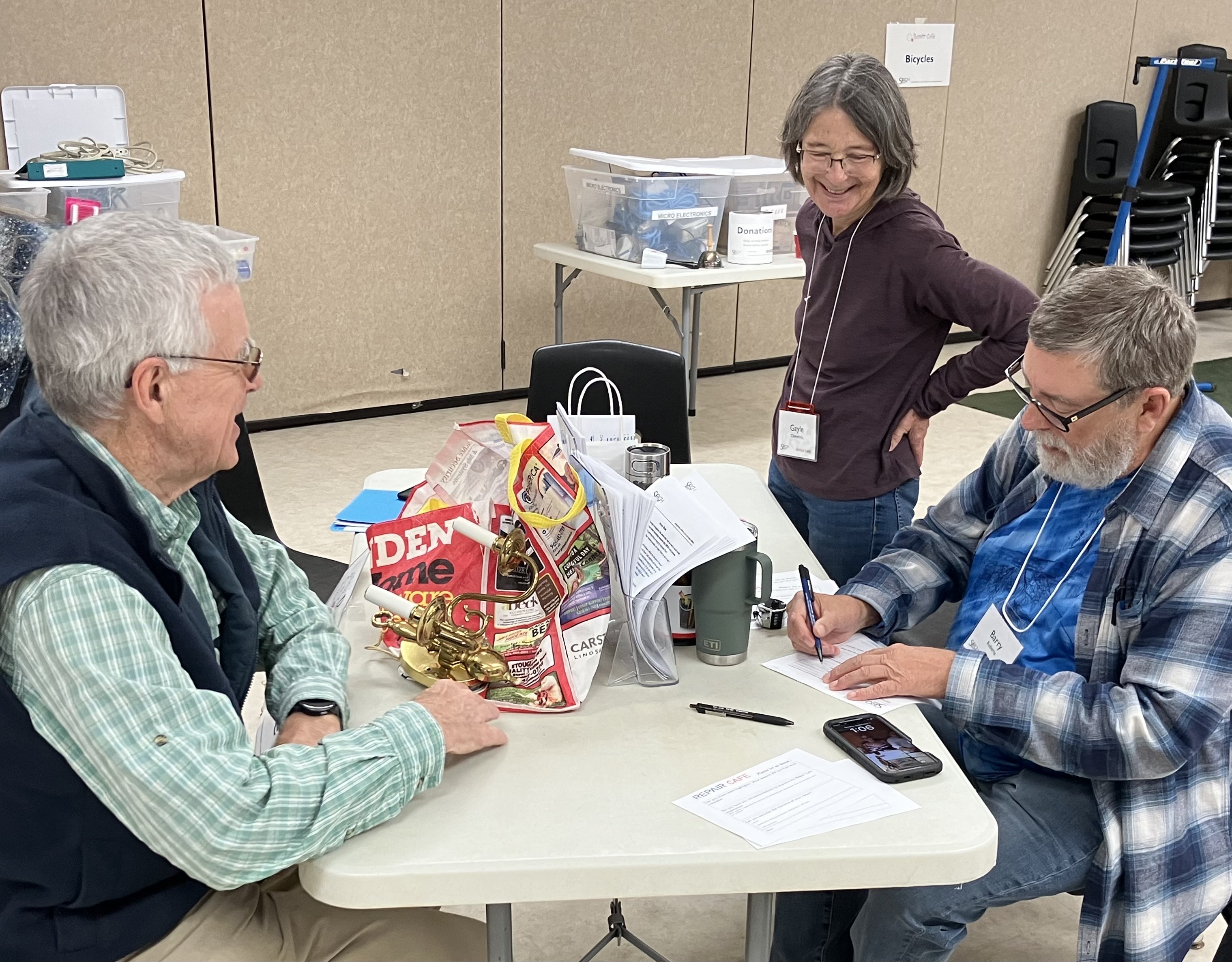
During a pause for lunch, we sit down with volunteer Barry, who’s working the reception desk with his fellow volunteers Gayle (left) and Laurie (right). Barry tallies up the day’s repair forms and reports that 30 guests have brought in 37 items so far.

A former auto mechanic and StatsCan field interviewer and supervisor, Barry doesn’t carry out repairs himself but uses his people skills to welcome and register guests at the Repair Cafe. He wants to establish trust and a comfort level with each guest, and to help triage the items that come in. (Most items, but not all, can be fixed). His day here actually started yesterday, with some prep work to bring materials and signage over to the Minden location.

Barry says the sustainability message — keeping things out of the landfill — resonates with most guests. But that message is further enriched by each guest’s role in the repair of their item. “We want the guest to be part of the repair, to meet the fixer, give some background, sit with them, learn about their item and any parts that might be required.” In a throw-away culture, “it’s important for all of us to know that most things can be repaired.” says Barry.
“So far this year we’ve repaired 170 items,” says Program Coordinator Dianne Woodcock. “Our success at keeping items out of the landfill hovers around 82% of all items brought in.”

Since the program restarted after the pandemic, it is closing in on 700 successful repairs, she notes. Guests have the option of donating to support the good works of SIRCH Community Services.

Did you know? Waste Reduction Week in Canada takes place during the third week of October. “We’re proud to be living the principles of Waste Reduction Week — reduce, reuse, repurpose and recycle — at every single Repair Cafe,” says Dianne.
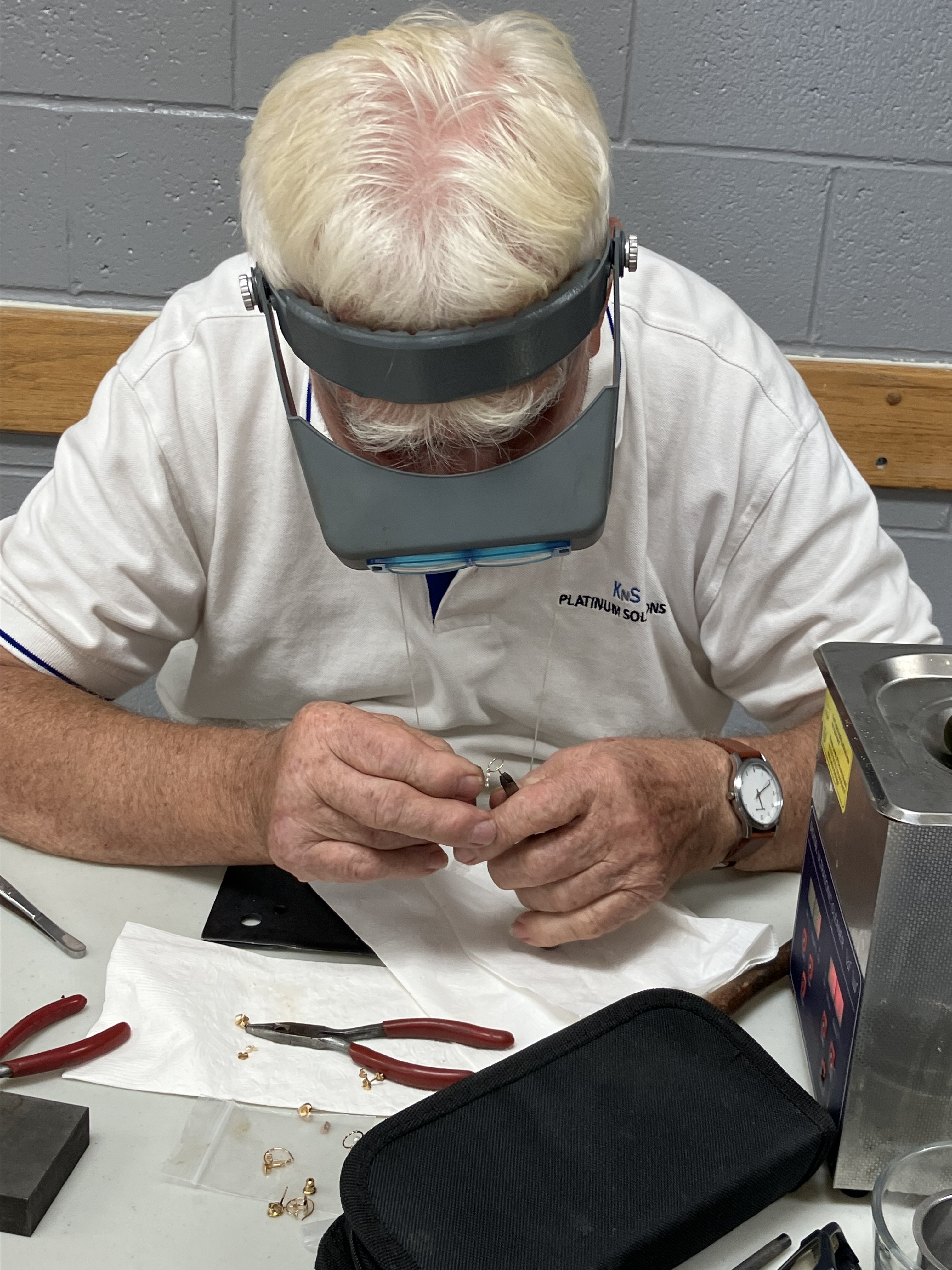
Another loyal Repair Cafe fixer is Henry. A master jeweler and goldsmith, he first apprenticed in his trade in the 1950s. He’s still at it today, repairing an assortment of rings, bracelets and other jewelry brought in by guests at the SIRCH Repair Cafe. Henry dons his jewelers glasses to get a close look at each item, and to make expert repairs.

At the table to his right, Sue has been tackling a hooked rug featuring the face of a lion. It’s a two-stage repair involving some handwork to remove loose material, then her sewing machine to repair the frame of the piece.
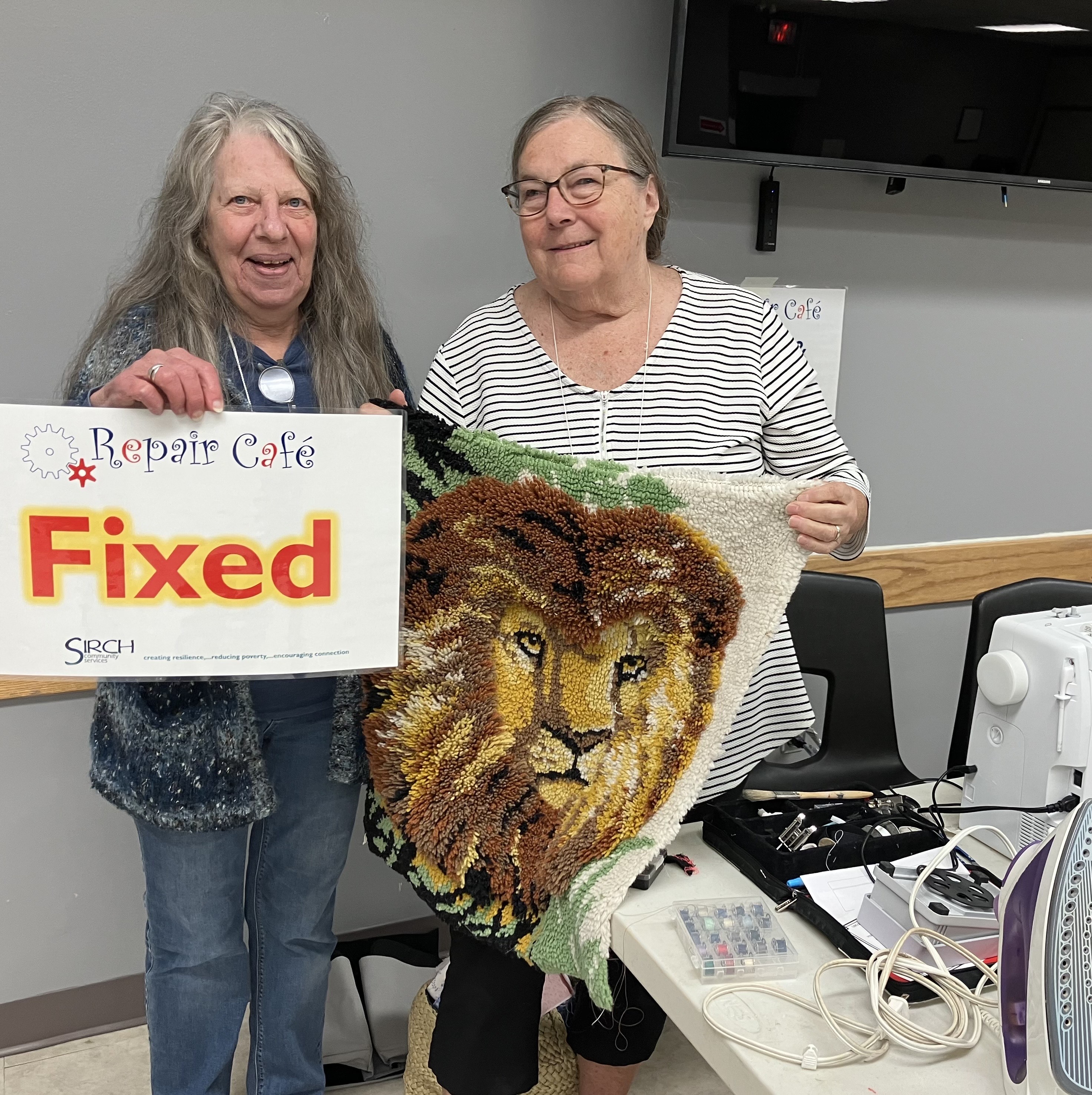
As the clock ticks towards the 2 p.m. closing time, the Repair Cafe’s volunteers start packing up.

Today, they’ve repaired an amazing variety of items ranging from an electric sander to stereo equipment, bikes to bracelets, jeans to ceramics. Not to mention a soda machine. Along the way they’ve helped guests hang on to items of functional and often sentimental value. They’ll be back on the first Sunday of October in Haliburton, at the SIRCH Bistro.

Toss it? No way!

For more information on SIRCH Community Services and its amazing Repair Cafe, please visit: sirch.on.ca

Journey of a master jeweler — Interview with SIRCH Repair Café fixer Henry Schoenke

Henry Schoenke’s passion for making fine jewelry has taken him from an apprentice’s workbench in Germany to the Arctic to his volunteer role today at the SIRCH Repair Café in Haliburton. We spoke to Henry as he was putting on his jeweler’s magnifying glasses to take a closer look at a bracelet, ring and other keepsakes brought in by guests.

How did you get your start as a jeweler?

I started as a teenager out of high school in Germany in 1952. Our school was run by monks, and the monastery had some beautifully made gold objects like cups. I thought I should be able to make beautiful things.

I was a guy who liked to use my hands. I took an apprenticeship with a jeweler for three and a half years, learning on the job on my workbench, repairing and crafting jewelry. To make new jewelry, my boss would give me a sample – like a broach, ring or pendant – and I would make it. Later, I obtained my master’s degree in gold and silver smithing.

What’s your assessment of the bracelet you examined at the Repair Café today?

The piece is not valuable, but it was a gift from the owner’s daughter and has a sentimental value. I will need to make a new pin and reassemble it.

What brought you from Germany to North America?

I founded and operated a jewelry store in Germany for many years, specializing in gold jewelry. At age 54, I wanted to go to the source of this precious metal – I became the part owner of a gold mine in Alaska, north of the Arctic Circle. I opened a jewelry studio in Anchorage, and also began to specialize in platinum. My passion was to design and hand-craft one-of-a-kind platinum jewelries.

Henry crafted his wedding ring of platinum, blue star sapphire and diamonds

I met my spouse Yasmin in Vancouver and we lived and worked in Anchorage. Yasmin handled sales, customer education and accounting for our business. When I retired, I could not stay in the US, so Yasmin sponsored me to live in Canada. We wanted a quieter place to live. We drove around rural Ontario and happened to stop at the Pinestone Inn near Haliburton. The manager’s husband was a realtor – he showed us some properties, and the rest is history. We made our permanent move to Canada in 2006.

What are the challenges and rewards of being a master jeweler in today’s world?

One challenge is that it can be hard to find parts and even tools to repair jewelry. I sometimes make my own tools – for example a small tweezer with curved pincers.

One of my biggest rewards is being asked to create special pieces – such as a custom pendant — for groups such as the hospital, police, Canadian Forces, tournaments and fundraising events in this area. In our world of mass-produced items, people still see the value in a custom-made piece. It’s rewarding to be able to craft a piece you know is one-of-a-kind and will be treasured for many years.

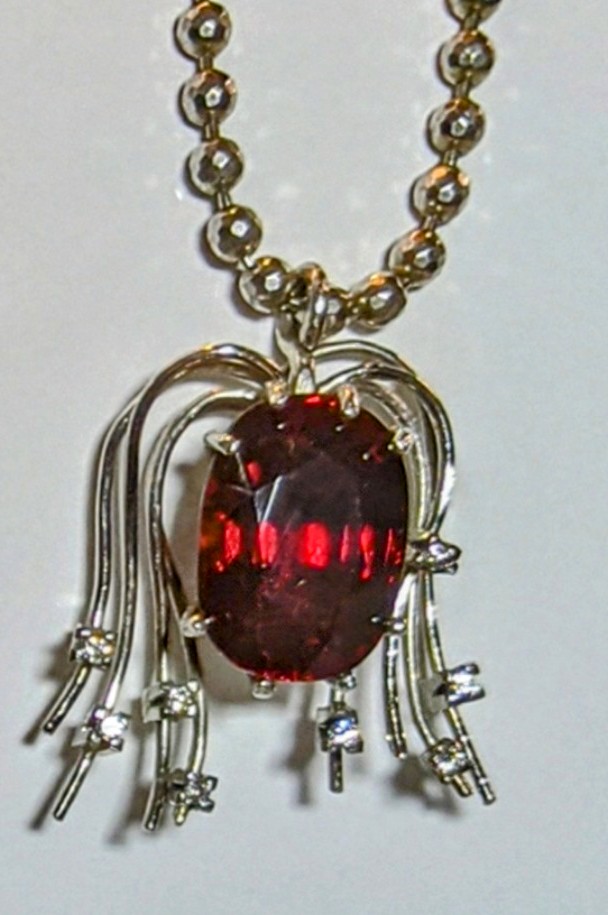
Above: Necklace of rubellite, platinum and diamonds handcrafted by Henry for Yasmin

I also love being able to repair jewelry here at SIRCH for people who may not be able to access or afford a good jeweler. To give a piece of jewelry a new life — that gives me joy.

Heinrich (Henry) and his wife Yasmin are partners in life as well as the jewelry business. Yasmin has also volunteered her time today to provide free henna tattoos for several guests. In the community, she volunteers at nursing homes and in palliative/hospice settings, bringing comfort through friendly visits and foot massages, and joy through sharing her Indian Dancing skills.

In all, Henry and his fellow fixers have repaired more than 50 items at today’s café, ranging from jewelry and ceramics to small appliances and electronics. Toss it? No way!

Or as Henry himself puts it: “SIRCH it? Yes way!”

For more information on SIRCH, please visit sirch.on.ca

“Putting it back together” — interview with Repair Café fixer Andrew Ablett

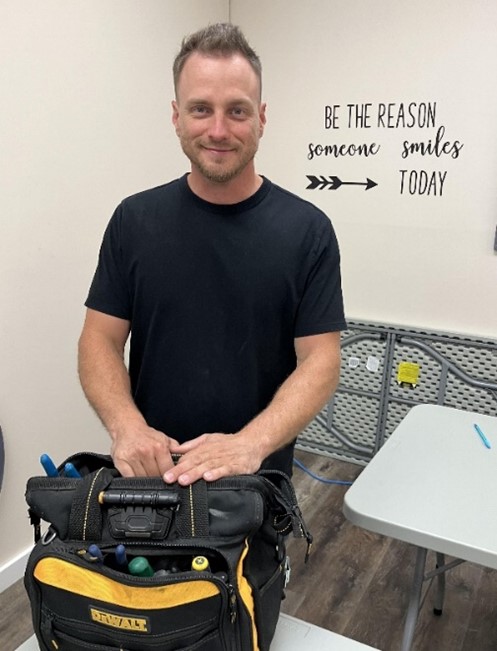
Whether it’s a broken bike, projector or even an iPad, SIRCH Repair Café volunteer Andrew Ablett believes he can find a way to fix it. A former auto mechanic, Andrew left the GTA a few years ago for a quieter life in the Haliburton area. He now runs his own property maintenance company while he and his wife raise a young family. We spoke with Andrew just after he finished repairing a broken printer.

Can you tell us about the repair you just completed?

One of our visitors brought in a printer that was jammed. I took it apart and discovered that the felt guide for the printer head had dislodged. I was able to get that piece back into place. We put the printer back together and tested it by printing off some pages. Now it works fine.

What is the approach that you take to fixing things?

The more difficult the challenge, the more I like it. I guess I am a bit obsessive that way — when I take something apart, I am focused on understanding how it works and putting it back together. I don’t have a photographic memory but when I disassemble something I can typically recall exactly where things go. Some of that skill comes from multi-tasking as an auto mechanic.

What are your biggest challenges as a fixer?

Some manufacturers make it hard or impossible to fix their products. They’d prefer you throw something out and buy a new one. Some products have a built-in shelf life – for example a cell phone with a limited life on its software and battery. I found the same thing as a mechanic. My work used to be more hands on, but the automakers now control the repair process more through computer systems. Some repairs are delayed for days waiting for a computer update.

How did you find out about the Repair Café?

From a friend in Haliburton. After moving here, I wanted to be part of the community, and to give back. Volunteering at SIRCH is a great way to do that.

In his first year as a volunteer at the SIRCH Repair Café, Andrew and his fellow fixers and other volunteers have completed more than 500 repairs to items such as electronics, furniture, jewelry, ceramics, clothing, small appliances and more. Sometimes it’s a cherished keepsake like a grandmother’s teacup. Or a functional device like a computer printer. Always, Andrew and the SIRCH team give a new lease on life to broken things, and help the environment by keeping them out of the landfill.

Toss it? No way!

****************************************************************************

Visitors to the Repair Cafe who have their items fixed are asked to make a donation to support SIRCH Community Services’ good works in the Haliburton area. For more information on SIRCH, please visit: http://www.sirch.on.ca

Meet the fixers

Haliburton SIRCH Repair Café volunteers save hundreds of items from landfill

(My article published in the Oct. 29/24 Haliburton Echo — I am proud to support the great work of the SIRCH Repair Cafe as a volunteer)

Toss it? No way?

So far this year, volunteer fixers have repaired more than 500 items at the Haliburton SIRCH Repair Café – from electronics and small appliances to clothing and jewelry, to ceramics, furniture, bikes and more.

“Sometimes it is a treasured keepsake like a piece of china, or a functional item like a toaster,” says Repair Café Project Coordinator Dianne Woodcock. “In every case, by repairing something instead of tossing it away, we are helping the community — and the environment.”

Donations towards repaired items support the good works of SIRCH Community Services in Haliburton.

The final monthly event of 2024 runs Sunday November 3rd from 10 a.m. to 2 p.m. at the SIRCH Bistro and Bakery at 49 Maple Ave. Have something broken that needs fixing? Come on over! After the November 3rd event, the Repair Café will start up again in April, 2025.

The Repair Café fixers and other volunteers are dedicated to helping Haliburton residents. They’re also pushing back against a disposable culture — and supporting the right to repair. Let’s meet a few of them.

“When something is broken, I feel its pain,” says fixer Neville Tebbit.  “I want to jump in there and make it feel good again. That makes me happy, especially when I can make a good repair without spending money. New parts to repair something can often exceed the cost of the entire item, so I often try to find a good used part that will do the job. That is the challenge and joy of it.”

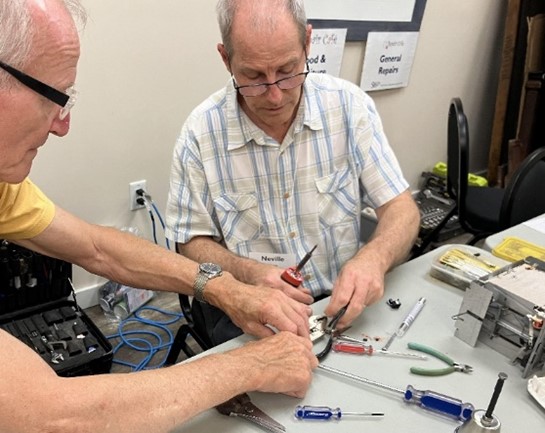
Neville (right) with fellow volunteer fixer Jurgen work to replace a toaster cord.

Neville grew up on a farm in Rhodesia and developed a fix-it mentality and skills from his father. In his professional life, he fixes specialized instruments used in mining and other sectors. As a volunteer at the SIRCH Repair Café, he recently fixed a toaster, CD player, bike and more.

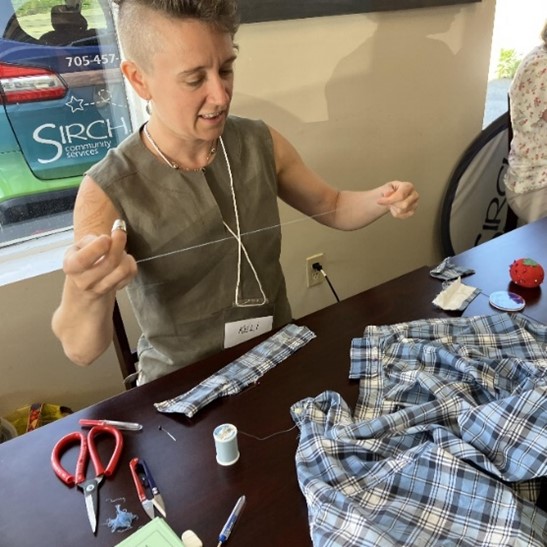
Keli Schmidt operates the Haliburton Clothing Co, drafting, cutting and sewing women’s and men’s fashions. She also brings her sewing talents to the SIRCH Repair Café, giving a new lease on life to garments that might otherwise be tossed away.

Keli repairs a shirt collar.

“The dominance of fast fashion presents many problems,” says Keli.  “Since most manufacturers are only concerned with price, it’s difficult to find good-quality fabrics. Clothing has been devalued, especially for younger people who have grown up with fast fashion.” Keli notes there are environmental and social benefits to repairing clothing. “We should all be looking at ways to reduce and re-use.  And of course you’re also saving money along the way.”

Whether it’s a broken bike, projector or even an iPad, SIRCH Repair Café volunteer Andrew Ablett believes he can find a way to fix it. A former auto mechanic, Andrew left the city a few years ago for a quieter life in the Haliburton area. He now runs his own property maintenance company while he and his wife raise a young family.

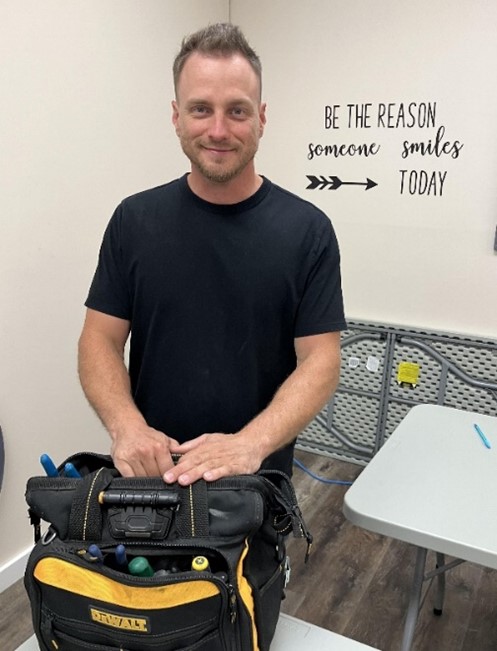
Andrew brings tools, knowledge and a can-do attitude

“The more difficult the challenge, the more I like it,” Andrew says.  “I guess I am a bit obsessive that way — when I take something apart, I am focused on understanding how it works and putting it back together. I don’t have a photographic memory but when I disassemble something I can typically recall exactly where things go. Some of that skill comes from multi-tasking as an auto mechanic.”

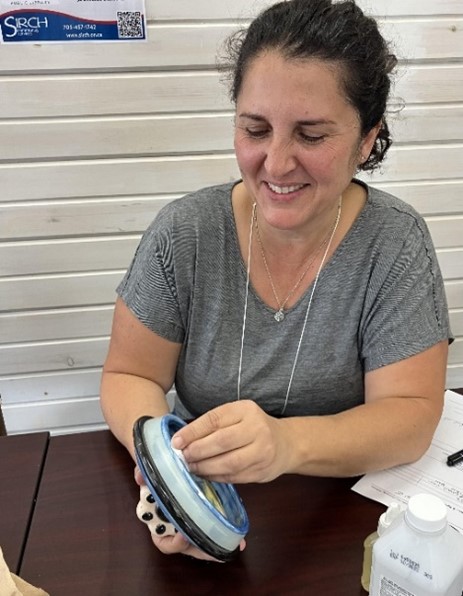
Michelle Anton is a high-school teacher by profession who has a passion for the craft of pottery. At the Repair Café, she fixes broken ceramics, giving a new lease on life to often-treasured items.

Michelle repairs a broken cookie jar lid. Her next challenge was the handle on a broken 1940s-era china gravy boat.

“Most important for me is taking a cooperative approach to pottery,” says Michelle. “To help the community, I organized an event called Empty Bowls. We had local potters make bowls, and 12 local restaurants make soup. Participants chose a bowl to sample the soups and then took it home as a reminder of world hunger. We were able to raise about $9,000 to support three community programs – the SIRCH Community Kitchen, the Haliburton 4Cs Food Bank and the Fuel for Warmth program.”

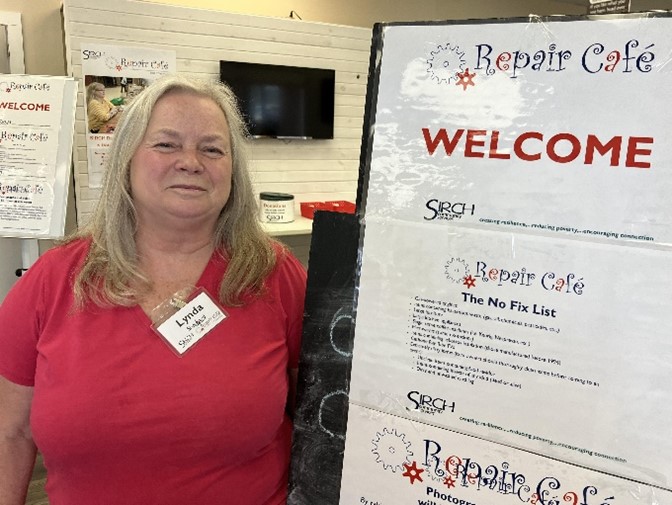
Lynda Shephard is busier than ever after retiring from a leadership development role with the province. She has taken on a few volunteer roles with SIRCH, supporting the work of the social services agency in the Haliburton community. She also chairs a local charitable organization, Brooksong, that provides community and a healing space for people living with cancer.

Lynda is a volunteer greeter at the SIRCH Repair Café.

“When people come in with their items to be repaired, I want to make them feel comfortable,” says Lynda. “I chat with them and let them know about the process. I show them to the registration table. I may speak with them when they are in the waiting area, to find out more. Sometimes there are bigger issues than the object they have brought in for repair. One senior shared with me that she was struggling at home with things like yard maintenance. I was able to provide a local contact to enable her to get some assistance.”

Besides the Repair Café, Lynda volunteers at the SIRCH Thrift Warehouse. “I am responsible for curating books, organizing them into categories like fiction, biography, gardening, decorating etc. – to make it easier for patrons to find the books they want. There is a nice connection with the Repair Café, because some items repaired by our fixers are sold at the thrift store, with proceeds to SIRCH.

*****************

In 2024, with repairs topping 500 and counting, Coordinator Dianne Woodcock also invited special guests to attend the monthly cafes, including a small engine specialist, bike mechanic and children’s toy expert.

The 2024 repair season is drawing to a close, but you’re invited to come out to the November 3rd, 2024 event at SIRCH, says Dianne.

“Bring a broken item, have a coffee – and meet our fixers!”

Article and photos by SIRCH volunteer Ian Kinross