Henry Schoenke’s passion for making fine jewelry has taken him from an apprentice’s workbench in Germany to the Arctic to his volunteer role today at the SIRCH Repair Café in Haliburton. We spoke to Henry as he was putting on his jeweler’s magnifying glasses to take a closer look at a bracelet, ring and other keepsakes brought in by guests.

How did you get your start as a jeweler?
I started as a teenager out of high school in Germany in 1952. Our school was run by monks, and the monastery had some beautifully made gold objects like cups. I thought I should be able to make beautiful things.
I was a guy who liked to use my hands. I took an apprenticeship with a jeweler for three and a half years, learning on the job on my workbench, repairing and crafting jewelry. To make new jewelry, my boss would give me a sample – like a broach, ring or pendant – and I would make it. Later, I obtained my master’s degree in gold and silver smithing.
What’s your assessment of the bracelet you examined at the Repair Café today?
The piece is not valuable, but it was a gift from the owner’s daughter and has a sentimental value. I will need to make a new pin and reassemble it.
What brought you from Germany to North America?
I founded and operated a jewelry store in Germany for many years, specializing in gold jewelry. At age 54, I wanted to go to the source of this precious metal – I became the part owner of a gold mine in Alaska, north of the Arctic Circle. I opened a jewelry studio in Anchorage, and also began to specialize in platinum. My passion was to design and hand-craft one-of-a-kind platinum jewelries.

Henry crafted his wedding ring of platinum, blue star sapphire and diamonds
I met my spouse Yasmin in Vancouver and we lived and worked in Anchorage. Yasmin handled sales, customer education and accounting for our business. When I retired, I could not stay in the US, so Yasmin sponsored me to live in Canada. We wanted a quieter place to live. We drove around rural Ontario and happened to stop at the Pinestone Inn near Haliburton. The manager’s husband was a realtor – he showed us some properties, and the rest is history. We made our permanent move to Canada in 2006.
What are the challenges and rewards of being a master jeweler in today’s world?
One challenge is that it can be hard to find parts and even tools to repair jewelry. I sometimes make my own tools – for example a small tweezer with curved pincers.
One of my biggest rewards is being asked to create special pieces – such as a custom pendant — for groups such as the hospital, police, Canadian Forces, tournaments and fundraising events in this area. In our world of mass-produced items, people still see the value in a custom-made piece. It’s rewarding to be able to craft a piece you know is one-of-a-kind and will be treasured for many years.
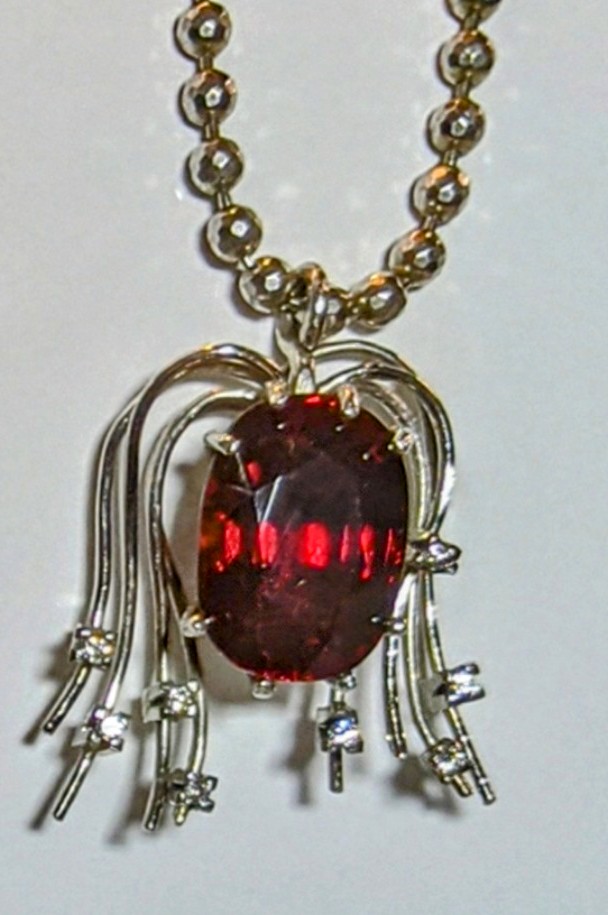
Above: Necklace of rubellite, platinum and diamonds handcrafted by Henry for Yasmin
I also love being able to repair jewelry here at SIRCH for people who may not be able to access or afford a good jeweler. To give a piece of jewelry a new life — that gives me joy.
Heinrich (Henry) and his wife Yasmin are partners in life as well as the jewelry business. Yasmin has also volunteered her time today to provide free henna tattoos for several guests. In the community, she volunteers at nursing homes and in palliative/hospice settings, bringing comfort through friendly visits and foot massages, and joy through sharing her Indian Dancing skills.

In all, Henry and his fellow fixers have repaired more than 50 items at today’s café, ranging from jewelry and ceramics to small appliances and electronics. Toss it? No way!
Or as Henry himself puts it: “SIRCH it? Yes way!”
For more information on SIRCH, please visit sirch.on.ca
 kinrosscordless