Haliburton SIRCH Repair Café volunteers save hundreds of items from landfill
(My article published in the Oct. 29/24 Haliburton Echo — I am proud to support the great work of the SIRCH Repair Cafe as a volunteer)
Toss it? No way?
So far this year, volunteer fixers have repaired more than 500 items at the Haliburton SIRCH Repair Café – from electronics and small appliances to clothing and jewelry, to ceramics, furniture, bikes and more.
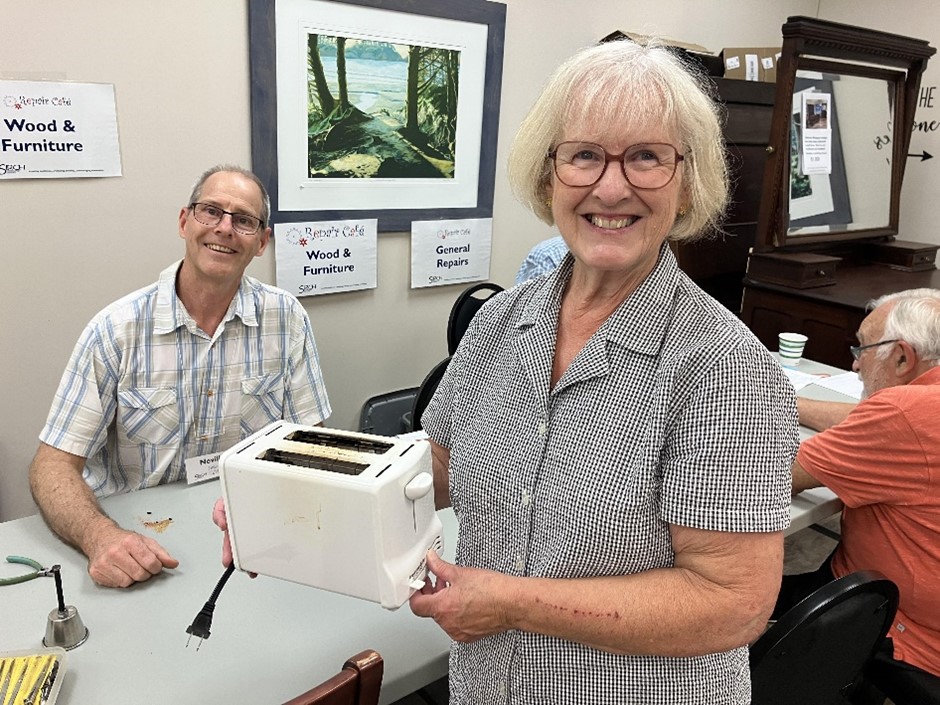
“Sometimes it is a treasured keepsake like a piece of china, or a functional item like a toaster,” says Repair Café Project Coordinator Dianne Woodcock. “In every case, by repairing something instead of tossing it away, we are helping the community — and the environment.”
Donations towards repaired items support the good works of SIRCH Community Services in Haliburton.
The final monthly event of 2024 runs Sunday November 3rd from 10 a.m. to 2 p.m. at the SIRCH Bistro and Bakery at 49 Maple Ave. Have something broken that needs fixing? Come on over! After the November 3rd event, the Repair Café will start up again in April, 2025.
The Repair Café fixers and other volunteers are dedicated to helping Haliburton residents. They’re also pushing back against a disposable culture — and supporting the right to repair. Let’s meet a few of them.
“When something is broken, I feel its pain,” says fixer Neville Tebbit. “I want to jump in there and make it feel good again. That makes me happy, especially when I can make a good repair without spending money. New parts to repair something can often exceed the cost of the entire item, so I often try to find a good used part that will do the job. That is the challenge and joy of it.”
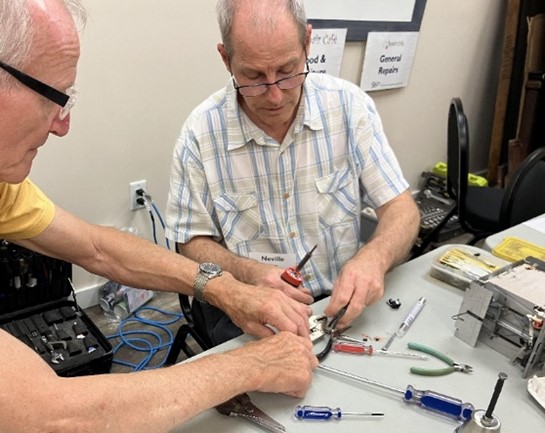
Neville (right) with fellow volunteer fixer Jurgen work to replace a toaster cord.
Neville grew up on a farm in Rhodesia and developed a fix-it mentality and skills from his father. In his professional life, he fixes specialized instruments used in mining and other sectors. As a volunteer at the SIRCH Repair Café, he recently fixed a toaster, CD player, bike and more.
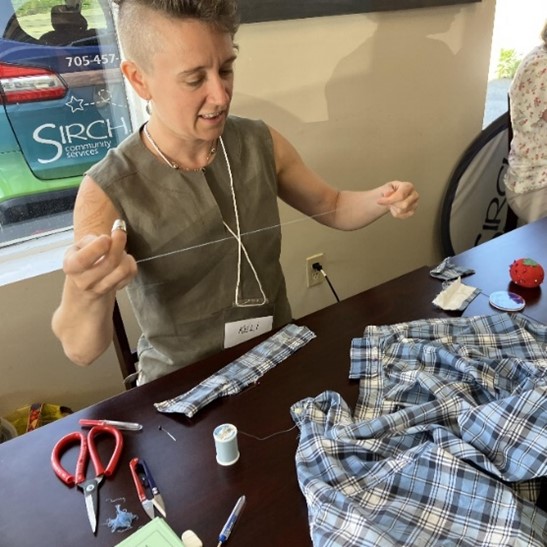
Keli Schmidt operates the Haliburton Clothing Co, drafting, cutting and sewing women’s and men’s fashions. She also brings her sewing talents to the SIRCH Repair Café, giving a new lease on life to garments that might otherwise be tossed away.
Keli repairs a shirt collar.
“The dominance of fast fashion presents many problems,” says Keli. “Since most manufacturers are only concerned with price, it’s difficult to find good-quality fabrics. Clothing has been devalued, especially for younger people who have grown up with fast fashion.” Keli notes there are environmental and social benefits to repairing clothing. “We should all be looking at ways to reduce and re-use. And of course you’re also saving money along the way.”
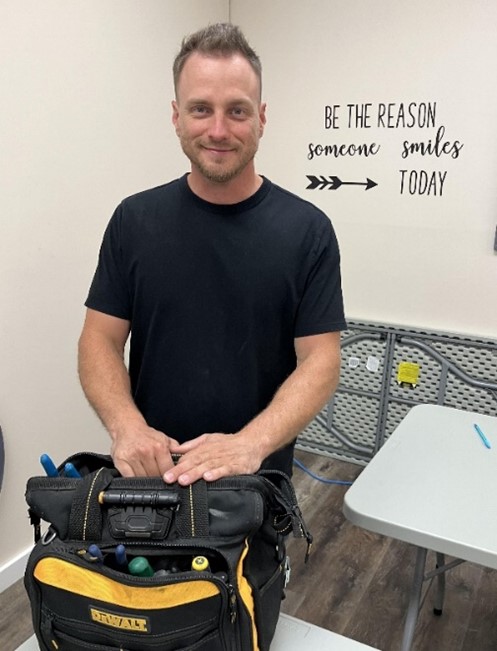
Whether it’s a broken bike, projector or even an iPad, SIRCH Repair Café volunteer Andrew Ablett believes he can find a way to fix it. A former auto mechanic, Andrew left the city a few years ago for a quieter life in the Haliburton area. He now runs his own property maintenance company while he and his wife raise a young family.
Andrew brings tools, knowledge and a can-do attitude
“The more difficult the challenge, the more I like it,” Andrew says. “I guess I am a bit obsessive that way — when I take something apart, I am focused on understanding how it works and putting it back together. I don’t have a photographic memory but when I disassemble something I can typically recall exactly where things go. Some of that skill comes from multi-tasking as an auto mechanic.”
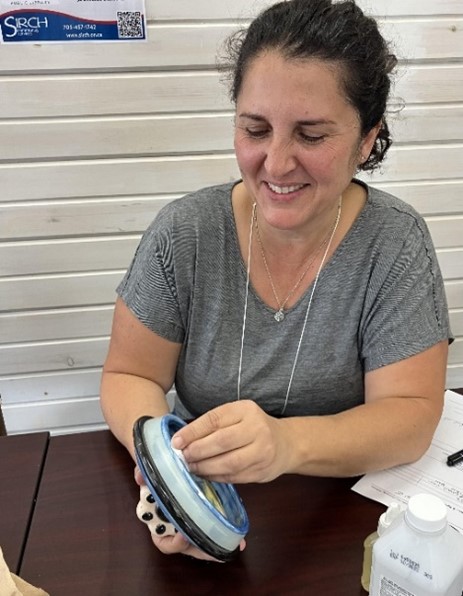
Michelle Anton is a high-school teacher by profession who has a passion for the craft of pottery. At the Repair Café, she fixes broken ceramics, giving a new lease on life to often-treasured items.
Michelle repairs a broken cookie jar lid. Her next challenge was the handle on a broken 1940s-era china gravy boat.
“Most important for me is taking a cooperative approach to pottery,” says Michelle. “To help the community, I organized an event called Empty Bowls. We had local potters make bowls, and 12 local restaurants make soup. Participants chose a bowl to sample the soups and then took it home as a reminder of world hunger. We were able to raise about $9,000 to support three community programs – the SIRCH Community Kitchen, the Haliburton 4Cs Food Bank and the Fuel for Warmth program.”
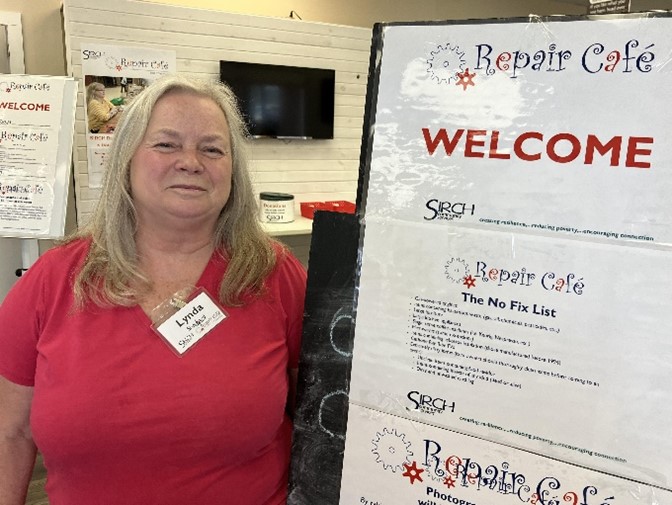
Lynda Shephard is busier than ever after retiring from a leadership development role with the province. She has taken on a few volunteer roles with SIRCH, supporting the work of the social services agency in the Haliburton community. She also chairs a local charitable organization, Brooksong, that provides community and a healing space for people living with cancer.
Lynda is a volunteer greeter at the SIRCH Repair Café.
“When people come in with their items to be repaired, I want to make them feel comfortable,” says Lynda. “I chat with them and let them know about the process. I show them to the registration table. I may speak with them when they are in the waiting area, to find out more. Sometimes there are bigger issues than the object they have brought in for repair. One senior shared with me that she was struggling at home with things like yard maintenance. I was able to provide a local contact to enable her to get some assistance.”
Besides the Repair Café, Lynda volunteers at the SIRCH Thrift Warehouse. “I am responsible for curating books, organizing them into categories like fiction, biography, gardening, decorating etc. – to make it easier for patrons to find the books they want. There is a nice connection with the Repair Café, because some items repaired by our fixers are sold at the thrift store, with proceeds to SIRCH.
*****************
In 2024, with repairs topping 500 and counting, Coordinator Dianne Woodcock also invited special guests to attend the monthly cafes, including a small engine specialist, bike mechanic and children’s toy expert.
The 2024 repair season is drawing to a close, but you’re invited to come out to the November 3rd, 2024 event at SIRCH, says Dianne.
“Bring a broken item, have a coffee – and meet our fixers!”
Article and photos by SIRCH volunteer Ian Kinross
 kinrosscordless