Let it ride — decoding the Zildjian ping cymbal

As I put together the old Rogers drum kit I had purchased off minivan dude at a Toronto storage locker facility, I had a close look at the ride cymbal and its stand.

My thoughts went back to the mid-70s, and the thrill of buying my first drum kit from the Long & McQuade music store.  It was a beat-up, but solid, used Sonor kit with dark green sparkle wrap. The Turkish Zildian ride cymbal that came with it had a huge crack in it, running straight out from near the bell, and then zigzagging a bit parallel with the cymbal’s circular lines.

My drum teacher, Glenn Price, showed me a small hole that had been drilled into the cymbal in an attempt to stop the crack from spreading further.  I couldn’t complain because I paid only $175 for a full kit of good quality, very well-used, drums and cymbals.

While the ride cymbal sounded fine, because of the crack I used it only for rhythm. But that is the raison d’etre of a ride cymbal — to let it ride with the rhythm.

In a rock song, for example, the drummer may beat a repetitive rhythm on the ride cymbal’s surface or bell — a key part of the rhythmic mix. So I stuck to the rhythm and was reluctant to crash the cymbal for fear of the crack spreading.

Pings, washes, crashes and moans

A ride cymbal is typically the widest and heaviest cymbal on the drum kit. Its sounds include the “ping” of the stick striking the cymbal, and the “wash” as the cymbal resonates with repeated strikes on its surface.  For a hard percussive effect, you can strike the cymbal’s bell.

There is also the option to hit the cymbal from the side with force for a crash effect. Or to build up a heavy wash in the cymbal by using a roll on its edges with sticks, or its surface with soft mallets.

So many permutations, techniques and tools. With some effort you can get other cool orchestral sounds out of a ride cymbal, like a moaning “ooh” or “oh” sound from resonating the cymbal with a violin bow.

IMG_2446 Ian with cymbal

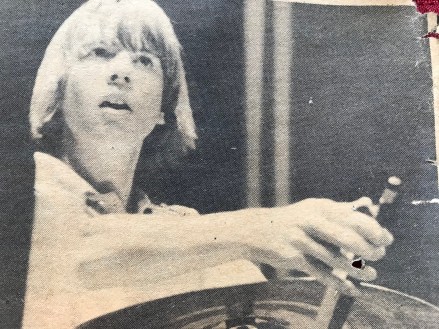
Using a violin bow to resonate the cymbal — from my days with the North York Percussion Ensemble.

The ride cymbal I got from minivan dude in a sketchy meeting at a storage locker is a 22-inch diameter “ping” ride made in the U.S. by the fabled Turkish-Armenian Avedis Zildjian cymbal company. It came with a solid Yamaha stand. I had a quick look online and found a few of these cymbals retailing used for several hundred bucks. Was my cymbal hot, or what?

A ping-style ride emphasizes the sound of the strike — this is especially important in loud volumes, like a rock concert. But the sound of this particular ride was a little too pingy for my liking.  I was using plastic-tipped sticks so that probably sharpened the ping sound even further.  I would try to dig out some wood-tipped sticks to see if that softened the ping a bit.

ping ride

And maybe the cochlear implant in my right ear was sharpening the ping sound. If I hit the cymbal hard, the force of the ping was very sharp. Maybe a low-tech solution like duct tape might dull it down a bit.  I would experiment.

Feuding cymbals

The Zildjian ping ride cymbal now to my right, and the Sabian high-hats operated by my left foot, represented dueling sides of a family feud. After being passed over for the Zildjian company’s leadership, one brother struck out for Canada and established his own cymbal manufacturing company in New Brunswick: Sabian.

Meanwhile, Zildjian had centralized manufacturing in its biggest market, the U.S.  With its special-recipe alchemy of copper, tin and other elements, Zildjian has manufactured fine cymbals for almost 400 years.  Its product got a boost when Beatles drummer Ringo Starr played a kit with Zildjian cymbals on the Ed Sullivan show.

I hoped that the feuding would settle down and that my cymbals would cooperate when I started kicking the tires on my Rogers drum kit.


Music and memory with Mom

I reminisced with Mom recently about the time she had been the accompanist for my post-secondary music program auditions.

“It was a classical piece for marimba, and you played the piano accompaniment,” I said. “Remember?”

After high school I had auditioned for music programs at York University, University of Toronto and Humber College.

“Did I?” my Mom, Sheila, replied. She was going through some health troubles complicated by the lockdown and her memory was not good.

“Yes, it was a lovely piece but I can’t remember the composer.  You waited patiently while I performed the other pieces. I played timpani, snare drum, vibraphone and then you joined me for the marimba piece.”

“Well it’s nice to be reminded about these things,” my Mom said.  “I am glad I could help.” I went on to recall how far she had pursued piano — up to Grade 10 Conservatory performance and then beyond with the Grade 10 theory and music history studies.

I remember Mom taking the same diligent approach to her music history studies as she did to a complicated piece on the piano.  She was well prepared, so could play a piece beautifully, and pass a tough exam.  We heard her play piano in church when we were kids, accompanying the hymn sings in the Sunday School.  When Nadine and I were married, Mom played a piece for us at our reception.

Mom had her hands full as the parent of three kids but still found time for her music. She taught me some piano basics when I was a little kid but also realized I had a passion for percussion. So when I was about 10 or 11 she found me a great teacher, Glenn Price, after spotting a classified ad in the weekly Don Mills paper. She encouraged me to take lessons.

Family unit

Our Dad, Douglas, was not a musician but had a strong tenor singing voice and sure vocal pitch from his school days in the UK. He quietly encouraged of all of our activities, including music, driving us to practices and coming to watch us play music or sports.

mom kids and piano

Looking back, I know I was a bit blasé, more likely sheepish, about my Mom joining me for my music auditions in my late teens. Now as a parent myself, I realize what it must have taken for her to do it. I was eager at that time to get into music school and she was on the line to help me. And she came through for me.

I was accepted by both York and Humber, and chose Humber for its focus on jazz and modern music. I did not stick with music as a study path or career but was proud to be accepted into, and briefly experience, a top music program.

I recall hearing my North York Percussion Ensemble friend Tony go into the audition before me and blow the doors off the drum kit, sending some sweat down my back as I listened in the hallway.  Among more than 100 drummer applicants, Tony and I got two of a handful (maybe 10?) drumming spots in that first-year class. Humber also knew that both of us had played the gamut of percussion instruments as members of the percussion ensemble.

Mom’s memories of those times are a bit foggy, but she feels better knowing these things when I fill in the gaps. One of the problems with memory loss is you may lose the knowledge of your own talents and accomplishments.

Mom was facing some major surgery at Toronto General Hospital recently. During the lockdown and her hospital stay before the surgery, we kept in touch with her by phone and were able to visit in person just once for a health consultation.

Music was a fond and familiar topic. I asked her a few questions about what music meant to her:

You had a piano teacher early on, nicknamed “Lemp” who was an inspiration for you. Can you tell me more about her and why she inspired you?

Miss Lempriere was the piano teacher at my boarding school, Claremont, in Esher, Surrey. She was always very well dressed and had a beautiful smile. She would have been in her late 20s. She gave me weekly lessons in the drawing room on a beautiful grand piano.

I had taken piano lessons before I went to Claremont, but Lemp and I had a good connection; we seemed to understand each other. She was not too demanding, but she would start the lesson by playing the piece I was learning.  I heard the piece the way it should be played. And so I would make sure to practice.  There were two smaller practice rooms there with upright pianos. When I played at my lesson, Lemp would tell me which sections to practice more for the next lesson.

While we were away from home at boarding school, our families would visit on occasion and the children were allowed to come out on the front steps, watch for their parents to come, and wave to greet them. I was at Claremont through high school into what was called Upper 5th, which had an exam and would allow me to qualify to apply for a job.

Your Mom, Ruth Henwood, was an excellent pianist and seemed to easily sight-read and play different forms of music. 

I can’t remember a piano in our home but she must have started me on lessons near our home. My mother also sang in choirs.

Who is your favourite composer and why?

Beethoven creates changing moods in his compositions. An example is the Sonata Pathetique, where a theme is developed through different movements. There are changes from major to minor keys, and changes of feeling.

I also enjoy Mozart’s music for its expression and sometimes light-heartedness.  You can listen to it and imagine running along a hillside in the summer.

Sonata pathetique pic

You played the Sonata Pathetique and some of your other favourites when you were at the Toronto Rehab Institute recently. [Your daughter] Louise brought your music there.

I still love playing. They had a piano in a kind of kitchen area there. I did have a few nice comments from people who listened from the hallway.

Sonata Pathetique score

After you came to Canada, you pursued the Royal Conservatory piano studies as an adult. You achieved Grade 10 in performance.

I am glad you can remind me of these things. I also enjoyed the music history.  Perhaps the history more than the theory, although both are important.

Thanks Mom for these music memories.


Maximum percussion

I was a teenaged kid clutching a pair of claves — two wooden sticks — on stage at an international music festival. There was nowhere to hide.

With four of my fellow North York Percussion Ensemble musicians, we got ready to perform “Pieces of Wood” at a packed concert hall at the University of Western Ontario.

The composition by Steve Reich introduces and develops a rhythmic theme, syncopated through five performers as each joins in. There is also interplay between the different tone and pitch of each pair of claves.

Usually, us drummers are holed up at the back of the band. We are part of the bedrock of a musical composition, holding and advancing the rhythm, but often hidden behind cymbals, massive copper tympani, music stands, or even tubular bells.

On this day, I felt a little more exposed. I recall my forearms tightening up with nerves before we went on stage. But we had practiced the piece and our program relentlessly.

A rhythmic river

The sound of each clave striking its pair is enriched by cupping the palm under the receiving clave — to create a small echo chamber. Reich’s composition unfolded beat by beat into a rhythmic river, echoing throughout the hall. Hypnotic for us performers, and for the audience.

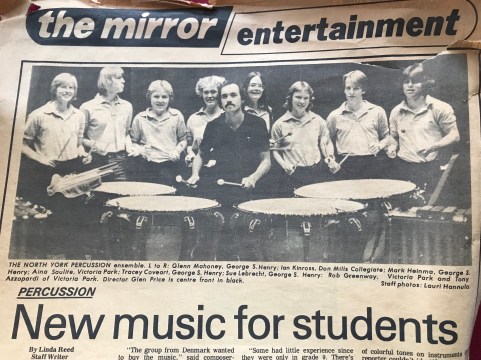
Our musical mentor and percussion guru was Glenn Price. Many of us had taken drum lessons with him. Then he raised the bar by establishing a percussion ensemble at his high school, Toronto’s Victoria Park Collegiate. While studying music at the University of Toronto, he expanded the group into regional collective, bringing together percussionists from many North York public schools. We performed across Toronto and at music festivals including the Kiwanis.

IMG_2450 Mirror photo

Glenn drove us to experience maximum percussion.  That meant going beyond traditional instruments such as a snare drum, to a medley of keyboard instruments such as the xylophone, and learning the music theory, chords, and melody techniques behind them.

Instruments in the percussion family create a palette of musical sounds and textures. “Bells ring, raindrops fall on water and deep chimes sound when these kids get  together,” wrote Mirror reporter Linda Reed in a feature article about the ensemble.

As we practised in advance of concerts, Glenn scrounged percussion instruments from several high schools and his own personal collection to loan to us so we could practice at home — I recall a checklist of vibraphones, marimbas, glockenspiels and other instruments in constant circulation with our group. Glenn and his girlfriend Debbie would ferry us to concerts, cramming musicians and various percussion instruments into old station wagons.

Musical fusion

Maximum percussion also meant bridging classical, latin, pop and other musical forms. It meant rehearsing and performing to achieve the synergy of an ensemble.

IMG_2446 Ian with cymbal

A violin bow resonates a Turkish cymbal

“We benefited from the discipline of practicing regularly as a group with a very organized and professional teacher,” recalls Ward Cornforth, a percussion compatriot and former member of the ensemble. “I think what I gained the most is the love of performing publicly — the excitement and feedback from the audiences,” said Ward. He also recalls a U.S. road trip with the ensemble, including participation in a drum clinic at the Eastman School of Music in Rochester, NY.

Ward went on to a lifetime of musical performance, most recently as the lead singer and guitarist in a Johnny Cash tribute show — We Walk the Line. Ward added that lessons learned from the ensemble have carried on to the next generation in new ways — his teenaged daughter is pursuing track and field. Her family ensures she has full support as a member of a high-level team.

Glenn certainly pushed us to find new musical opportunities — for me, that meant playing with the North York Concert Band, a gig with at the Canadian Opera company’s summer dinner theatre house band, and touring Ontario with our high school rock band, Bruce the Moose. After university, my percussion performing waned, but I picked up the guitar and piano for fun, and continued to appreciate percussion in any music I listened to.

The beat goes on

Through social media, many of my percussion ensemble musicians reconnected, and had glimpses of how music became a thread in our lives. Rob G. and Tracey recently formed a duo — Hush and Rust — putting new spins and moods on classic songs. Both continue to write and perform original music. Sue shared a video of an all-women band she had just joined as drummer. Ward was touring with his tribute band, channelling 1960s-era Johnny Cash. In the footsteps of two musician parents, Tony’s daughter had become a singer-songwriter. She had recently asked her Dad to play drums on two new tracks in the studio. Barry was subbing in as a blues drummer in the UK, while his son was drumming for a dynamite rock band in Europe. Rob P. was hosting and playing in jazz jam sessions at a coffee shop he owns. And Nick’s daughter sang gorgeous jazz vocals.

Meanwhile, our mentor Glenn had continued his career as a music educator and conductor internationally, inspiring many generations of musicians. He is now Conductor and Director of Performing and Visual Arts at California Institute of Technology (Caltech).

*******************************

On stage at the international music festival on that day in the late 1970s, my forearms had loosened up. The house was packed with musicians from 40 countries at that event, organized by the International Society of Music Education.

Our ensemble was in the zone, arms and hands flying. Reich’s “Pieces of Wood” built to a percussive climax, a wall of sound. Then it ended on a dime — to stark and serene silence.

The audience came out of its trance. A flood of applause. The forearms tingling.


IMG_2448 Poster

Vintage poster from a show we performed at Seneca College’s Minkler Auditorium