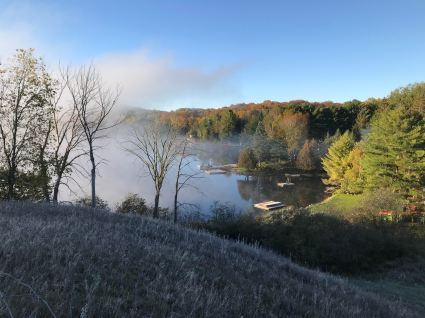
Stone terrace twilight

Our bluebird family had flown the coop for warmer climes and the Canada Geese were flying circular training runs in the farm field next to our cottage. Honking in their traditional V-formation, and weaving expertly through a set of hydro lines, they prepared for the journey south.

canada geese
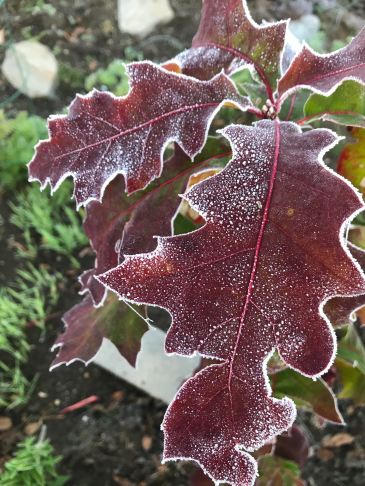
oak with frost

First frost shimmered on fall colours in Minden Hills, lighting up the leaves of the baby pin oak tree next to our garden.

Several tons of stone and a special order of granite that I had obtained from Brent Coltman and his father Wayne had been formed into new dry-stone terraces surrounding the little cabin in the forest.

The cabin, originally built by my father in law, Claus, and later moved to our place by truck and crane, now had some breathing room in front and back. It would stay higher and drier in the long winter, and it sported a new extended front porch area for future occupants.

For my stone work this year, I had channeled learnings from master stone waller John Shaw Rimmington and my classmates at Haliburton School of the Arts.  Working with sometimes gnarly and ancient stone once rolled by glaciers, I had come to appreciate its beauty and history. And yes, as I got into a rhythm, putting the pieces of the dry stone puzzle together, I occasionally dreamt of stone.

The morning frost sent a mist off the lake and up the hill.
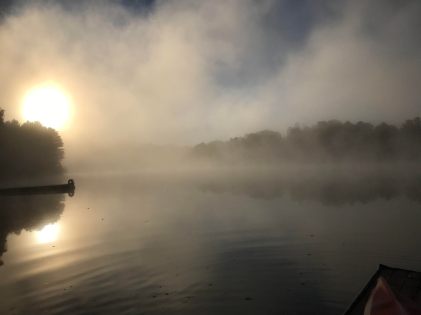
misty lake

fall lake view

Around the cabin site, new perennial hosta plantings blended with a grove of smooth-barked beech. Annual impatiens flashed their final colours of white and pink. Sturdy oak trees continued to rain down their motherlode of acorns for local critters.

By the lake, our stone terrace gardening efforts had yielded some new perennial plants that were now established and should survive the winter. Nadine’s gladiolas and hydrangeas continued to produce beautiful blooms for table arrangements. Annual orange nasturtiums cascaded and collapsed over the stone, touched by frost. The fig trees I had put out in pots for an Italian garden touch would need to be brought inside soon to hibernate during the long Canadian winter.

We were missing our two daughters Ali and Colleen, who were living and working far from home — in Scotland and the U.S..  For this Canadian Thanksgiving, we were joined in Minden by four young adults — two of our nieces, Rachel and Katie, and two family friends, Mehtab and Alva — and Nadine’s mom Ann. They checked out the log cabin in its new stone nest in the forest.
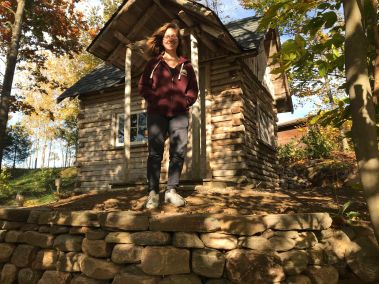
rachel at cabin

On tap that weekend were some board games, a tour of local artists, and some homework for the youth movement — they were studying engineering, political science, commerce and social work respectively. The highlight was a splendid turkey dinner prepared by Nadine and Ann.

Next to a roaring fire outside, we roasted marshmallows, then coaxed embers around a big beech stump that was slow to burn. Night fell and stars came out across Minden Lake. As the air chilled, we fed the fire and nudged our chairs closer to its warmth.


A sturdy foundation

The stones were speaking to me…

With the site excavated and gravel base in place, it was time to build the foundation for the stone terrace garden.

I had been “mining” my new five-ton stone pile for the biggest, squarest stone I could find. It wasn’t quite like finding a needle in a haystack, but I would smile whenever I dug out a nice foundation stone.

A palette of stone

As the stone migrated to the job site by wheelbarrow and hand-trolley, I grouped like-minded stone in clusters.  If stone-walling is like oil painting, I wanted a nice palette to choose from. I also wanted a surplus of stone close at hand, so I could keep on a roll. A few of the absolute best stones were earmarked for the corners — they would act as anchors for the foundation.

Our resident blue birds kept busy flying in and out of their bird box with nesting material. It had been a late spring and we hoped the female would settle down soon to lay her eggs.  Meanwhile, swallows had nested on our front porch and would make a racket and fly away whenever we opened the front door.

Next door, a few cows roamed the pasture at Cox Farm.  Rhubarb was sprouting in our garden, and lilac bloomed in our front yard. After a long winter, summer had truly arrived.

lilac.png

The gravel base for the terrace was a straight seven feet, with a freelance curlicue at the end for architectural interest. I dug in and started to rough in the bigger stones, and used a rubber mallet to tap them together as tightly as possible.

Keeping a tight fit

In a few cases, I chiselled off small edges for a tighter fit. The gravel base had some give, so when a foundation stone was slightly misshapen I could work the flaw into the base; that way, the upper side stayed as level as possible for the second course. Once in awhile, I took a break to back to spot and correct any serious flaws in level or placement.

The next task was hearting — carefully packing in smaller stones to create integrity inside the structure.  I worked my way on bended knee along the line of foundation stones, packing about six buckets of heartstones inside.

foundation from beside.png

I checked the wall from above.  A light rain brought out the variegated colours of the stone foundation, including its curlicue at the south end. The muted pinks, greys, blacks and blues of the stone stood out nicely against the green of the oaks, birch and ironwood trees nearby.

So pretty — but also a pattern that would be hidden forever once the terrace was fully built. Better get a photo for posterity!

foundation from above.png

The stone terrace garden now had a sturdy foundation.


Five tons of stone

If you had two hundred bucks in a sock, would you use it to buy:

a) 25 latte ventis at Starbucks?

b) a nice car wash and detailing for your old minivan?

c) or five tons of Haliburton stone?

If you were a dry-stone waller, the correct answer goes without saying.

I had scrounged stone from a number of sources at our cottage on Minden Lake, but the cupboard was bare, so to speak.  To be ready for the garden terrace project this summer, I needed a fresh supply. So I put in a call to a guy who knows stone.

Brent Coltman provides excavation services in the Minden-Haliburton area.  He comes by the profession honestly — his Dad, Wayne, still works in the “aggregates” business into his 80s — quarrying stone, sand and gravel and other materials for construction in the area.

Stone riches

The Minden-Haliburton area is rich in Canadian shield stone, including granite with its rich reddish-grey hues, and older sedimentary stone.  The area is crisscrossed by a fault line that has pushed ancient stone into view. A trip north on highway 35 features some stunning granite rock cuts — such as the one near Miner’s Bay.

Brent has a gravel pit on 100 acres of bush, where he processes material from excavations. Sand, for example, is screened in a giant mechanized machine. The final product is used as a clean and porous bed for new septic systems.

I visited Brent at the pit and we agreed on a nice pile of small and mid-size stone, as well as the price —  $200 dollars. The next morning, as I watched a pair of bluebirds build their nest in a box near our cottage, I heard Brent’s large dump-truck chugging down our small cottage lane.

The eagle had landed

Despite a tight space, Brent backed up expertly to the delivery site, and tipped five tons of stone onto our cottage lawn. He also gave me the contact information for his dad, as I needed some special stone for stairs and capstones. I would get that later.

five tons of stone.png

The eagle had landed. On this multiple choice question, I had selected option c).

Nesting instinct

With a good supply of stone, it was time to start excavating the site for the stone terrace garden.  The stonework would create a kind of nest for the pretty little log cabin that Nadine’s dad built years ago.  The cabin, situated on a sloping hill in the woods, would get a stone terrace in front. A few shade-loving plants would green up and beautify the area in front of the porch. The log cabin would also be shored up in the back with a dry-stone retaining wall, to create some breathing room and better drainage against the slope behind it.

hosta.png

Nadine and I scoped out the stone terrace area.  With a tape measure, I marked two spots for a line parallel with the cabin’s front. Using a standard round-edged garden spade, I started excavating the area for the first terrace, one shovelful of sand at a time.

Once I got the excavation area roughed in, I put in two posts and tied a string in between. This would guide the building of a straight and level wall.

I continued excavating the site to allow a wall roughly seven feet long by 2 1/2 feet wide at the base.  The terrace would rise to about three feet high, to create the little green space level with the cabin front porch.

excavation 1.png

For a porous and flexible base for the dry stone wall, I put down a couple inches of gravel and tamped it down using an 8×8-inch hand tamper, all the while checking that the site stayed level.

Curating stone

Next up was stone selection. Using a small but sturdy hand-dolly, I started to load up the bigger stones and deliver them to the site. These would comprise the terrace foundation. To save my sore back, I tried to use gravity and leverage to my advantage, and trundle the material carefully down the hill on the dolly. Stones of similar heft and shape were grouped together near the site. Most of these foundation stones weighed 30 to 50 pounds and would provide a integral footprint for the terrace.

As the bigger stones were pulled from the pile, I also looked for mid-sized building stones to be used later, as well as the small “heart-stones” that would pack the centre of the structure.  These were all delivered to the job site by dolly or wheelbarrow.

To get a sense of the utility of each stone, you can flip it around. Ideally it has two straighter opposing sides, and a front that will give a gentle angle, or “batter” for the face of the wall. Each stone has its own beauty, heft, colour, character and faults. After a while, the stones start to speak to you. A stone waller in the stone selection phase might even admit to dreaming about stone.


foundation stones.png

A moveable feast

As I concentrated on finding nice stones, the first wave of June blackflies feasted on my neck and a hot sun found its way through the trees. Curating stone can be a dreamy but prickly business.

As stones were sorted and delivered to the job site, my 5-ton, $200-dollar pile of stone was slowly starting to shrink.

excavation 2.png