What led a retired industrial designer to request a small plot in the community garden near his Thorncliffe highrise?
For Mike Murakami, there are many garden inspirations — but his original garden muse is his grandfather Shinjiro.
Born prematurely, Shinjiro’s 5-foot stature disqualified him from military service in brewing Russian/Japanese hostilities. He took his skills as a fisherman east across the Pacific, landing in Canada in the late 19th century and settling in the “Japantown” of Richmond, B.C.
“With the anti-Asian sentiment, the Japanese immigrants found employment mostly in lumber, farming and fishing,” Mike says. The salmon industry was huge and a cannery in Richmond provided high quality products and job opportunities. Japanese Canadians also established farms and fruit and berry operations in the Fraser Valley.
Shinjiro and his wife Kinu, who followed him from Japan via an arranged marriage, later settled in Victoria, B.C. “Most of the Japanese lived in the Chinatown area there – in fact both my grandparents picked up some Chinese language there.” Shinjiro and his sons prospered in the fishing industry.

Shinjiro in Victoria, 1936

Aiko in Victoria, 1938
Fast forward to the Second World War. Following the attack by Japan on Pearl Harbour, the majority of B.C.’s Japanese-origin Canadians had been uprooted and moved to inland internment camps by the Canadian government.
“I was born in ’43 in the Kaslo, B.C. internment camp,” says Mike. “When I was one year old we moved to the New Denver internment camp in the Slocan Valley. David Suzuki (the Canadian broadcaster and environmentalist) was in the nearby Slocan camp; he’s about six years older than me. My mom Aiko was principal of the New Denver camp school. My dad Dave drove a truck for the camp administration and learned watch and jewelry repair on the side, through a correspondence course. My grandparents raised me in the camp from ’43 to ’47.”
There are few first-hand memories of the camp as Mike was so young. But he’s inspired by the stories of the ingenuity and persistence of his extended family to survive and thrive after having lost their homes, livelihoods and financial assets.
Mike recalls: “The joke went something like: ‘What’s for supper? Cabbage and Pork. What’s for lunch? Pork and cabbage.”
To augment a bland internment camp diet, camp residents “used their knowledge as farmers to set up gardens,” Mike says. “My grandpa and others would also sneak out of camp to nearby lakes to get fresh fish for their families.”
After the war, Mike’s family came to Toronto via Hamilton. His school-principal mom Aiko found work as a housekeeper and the family lived in the basement of her employer’s house at first. She later worked in a small Jewish business. “We felt the Jews understood and sympathized with our situation.” His father Dave eventually found work in his trade as a watchmaker, repairing the large clocks carried by night watchmen.
As the family’s economic situation improved, Mike’s mom came across a fixer-upper in Toronto’s Cabbagetown neighborhood. “My mom was quite brash and struck up a conversation with the old Scottish lady who lived at 83 Metcalfe Street.”
Aiko then set to work to scrounge the down payment for the house by writing to all of her brothers, sisters and extended family. Her relatives provided what they could, the down payment was made and the deal was done.
Mike describes the home in the Parliament/Wellesley area as “a toe-hold for Japanese Canadians in Cabbagetown. Within about a year and a half, most of our extended family ended up in Toronto. We had up to 21 people in that house – it was kind of like an underground railway.”
Mike recalls his grandfather Shinjiro, then well into retirement, growing corn, carrots and other vegetables on a tiny but productive garden in their Cabbagetown yard. “In the early ‘50s there were still horse-drawn milk wagons. I remember my grandfather going out with a shovel to get horse manure to fertilize his garden.”
Mike returned west in adulthood, founding an industrial design firm in Edmonton.
“As Alberta was very resource-based I felt I needed to support diversification and creative mindsets in my profession there.” As a result in addition to his business practice, he also taught and advised on curriculum development at the University of Alberta, Grant McEwan University and Northern Alberta Institute of Technology. Mike also became a community activist and advisor in the area of “hate-bias” crimes prevention, a topic near and dear to his family’s heart.
As he approached retirement, Mike owned a nice home in a “trendy” section of Edmonton. In a bold move, rather than sell the house before his planned move back to Toronto, he rented it to a family of eight Burmese refugees. “The Mennonite Centre for Newcomers in Edmonton was hard-pressed to find accommodation for the large refugee family and they reached out to me. The Burmese family had been subsistence farmers before the army destroyed their village and crops. We thought our house and large garden would help keep them together as a family unit and help supplement their food needs.
“By year 2 they had turned the garden into intensive production and began gifting veggies to all my neighbours! Most of my neighbours had never known a refugee before. The Burmese family now thrives in their own home, the parents work full time and the kids are doing great at school.”

Mike’s greens
Now retired and back in Toronto, Mike is looking forward to his third year as a member of one of Toronto’s oldest community gardens at Thorncliffe Park. He’s planning to grow some new varieties of vegetables and herbs, plus his standard crops of tomato, lettuce, garlic beets, carrots and Asian greens.
Most of all, he will continue getting to know his fellow gardeners. “The community garden is really a level playing field,” says Mike. Each person has a small plot. You are there to grow food and enjoy the beauty of the garden in the spirit of community.”
With the neighborhood’s diversity, “the garden is a great metaphor for the collective intersection of culture. We can find a common ground to work together in a shared space.”
With a continued focus on healing the wounds of hate and bias in our society, he has reached out to a local cultural centre to explore options to celebrate the plurality of cultures and religions both within the garden and community.

Mike and Aiko at Thorncliffe Park gardens
Mike is also going back to his roots to write an online account of Japanese Canadians in Cabbagetown. As it turns out, a well-known historian and archivist now lives at… 83 Metcalfe Street – and Mike and his mom Aiko, now in her 90s, have been by to share notes on their history projects.
It’s been more than 120 years since Mike’s grandfather — and muse — Shinjiro arrived in B.C. Memories of gardens in New Denver, Cabbagetown and Edmonton hold stories and meaning that inspire Mike’s effort in his new garden at Thorncliffe Park.
“We’re continuing to learn from our past,” Mike says, “and paying it forward.”

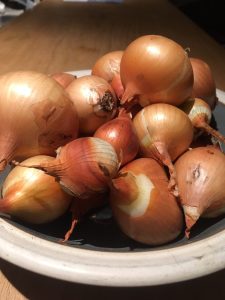 Planting: First, let’s talk planting. A single dried multiplier onion bulb planted in spring will give you two bulbs harvested in fall. Eat one, and keep the next for next year. Or leave your second bulb in the ground and it will overwinter and multiply next year.


 kinrosscordless