Unknown's avatar

About Ian Kinross

I am a Toronto-based writer and communicator. I volunteer at the Thorncliffe Park Community Garden and recently learned the skill of dry stone wall building. I've been known to mess around with bicycles. I would like to thank Karen Maraj and Nicky Borland for their inspiration and support to kickstart this blog. Also thanks to Hannah Materne for design of the kinrosscordless logo. I appreciate your comments.

“When something is broken, I feel its pain” — Interview with fixer Neville Tebbit

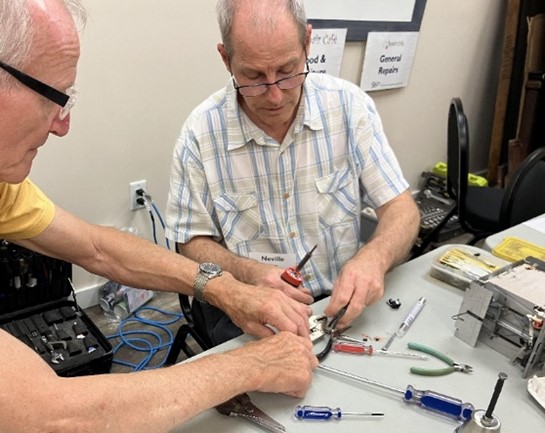
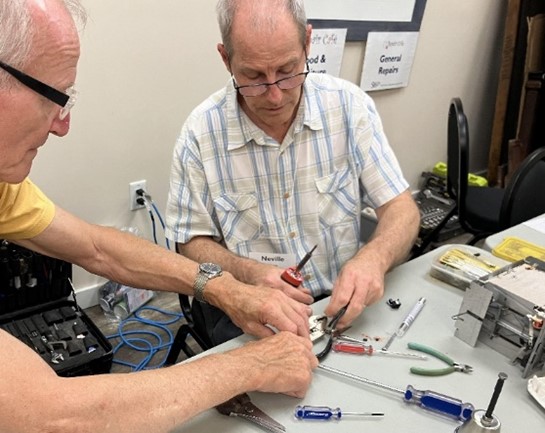
Growing up on a farm in Rhodesia, Neville Tebbit (pictured below at right, with fellow volunteer Jurgen), often helped his Dad fix things. “I would take things apart and wanted to know how they worked,” he recalls. As a teen, he completely rebuilt a “rust-bucket” 1966 Jaguar. These days, Neville, whose professional job involves servicing xray spectrometers used in mining and other sectors, is contributing his fix-it savvy to the SIRCH Repair Café in Haliburton, Ontario.

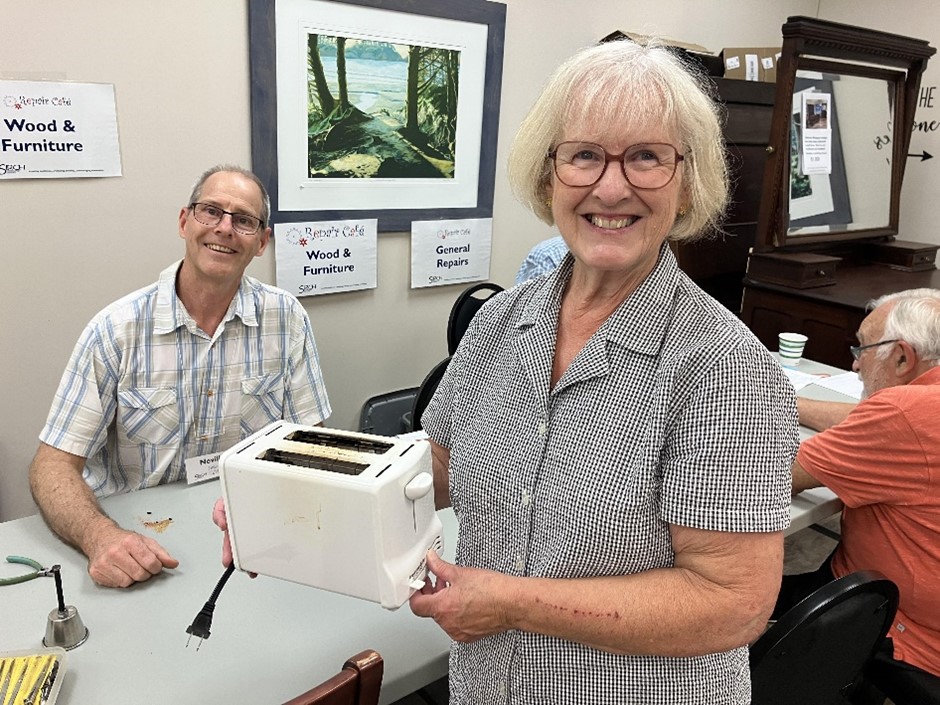
Neville, it looks like you have taken apart a toaster. Can you tell us how you are repairing it?

The problem is with the plug. We don’t have a new plug, but we are repurposing a good one from a non-repairable coffee maker. The connection needs to be soldered and then we can put the toaster back together and test it.

Do you have a philosophy about fixing broken things?

When something is broken, I feel its pain. I want to jump in there and make it feel good again. That makes me happy, especially when I can make a good repair without spending money. New parts to repair something can often exceed the cost of the entire item, so I often try to find a good used part that will do the job. That is the challenge and joy of it.

What do you enjoy most about your role at the Repair Café? How do you see the future of this concept?

The community feeling here is great. But also, our ability to change mindsets. Our society has reached a point where in many cases it is harder to fix things. For example, sometimes manufacturers may prevent us from fixing their products.

We have all heard of the concept of a disposable society. We have to push back against that thinking and promote the right to repair.

About 15 minutes later, Neville’s repair is almost complete. He carefully re-assembles the older Proctor-Silex toaster in its white casing and re-installs the knobs on the control switches. He tests it — and the repaired toaster works like a charm. Its owner (pictured above) is happy to have it back in working order, and SIRCH Community Services will receive a donation to support its work benefiting the Haliburton community.

Both Neville and his wife Zena are dedicated volunteers at the Repair Cafe. Zena was busy today registering guests and connecting them with the volunteer fixers. They made the drive north from the city early this morning to join a volunteer team fixing dozens of items ranging from small appliances, electronics, clothing, ceramics and more.

Toss it? No way!

**********************************************************************

The final 2024 SIRCH Repair Cafe was held in November — Neville, Zena and their fellow volunteers will be back when the event starts up again in spring 2025. For more on SIRCH Community Services and its Repair Cafe, please visit sirch.on.ca

Fighting fast fashion — interview with Keli Schmidt

As a young girl in Winnipeg, Keli Schmidt couldn’t keep still. Her mom, who nicknamed her daughter “Hurricane Keli”, enrolled Keli in a Kids Can Sew course. “I found that the skill of sewing slowed me down,” recalls Keli. “It was meditative.”

Thirty years later, she operates the Haliburton Clothing Co, drafting, cutting and sewing women’s and men’s fashions. She also brings her sewing talents to the Haliburton SIRCH Repair Café, giving a new lease on life to garments that might otherwise be tossed away. In 2024, Keli and other volunteer fixers at SIRCH repaired more than 500 items ranging from electronics to small appliances, clothing, jewelry and more.

Can you tell us what you are repairing today?

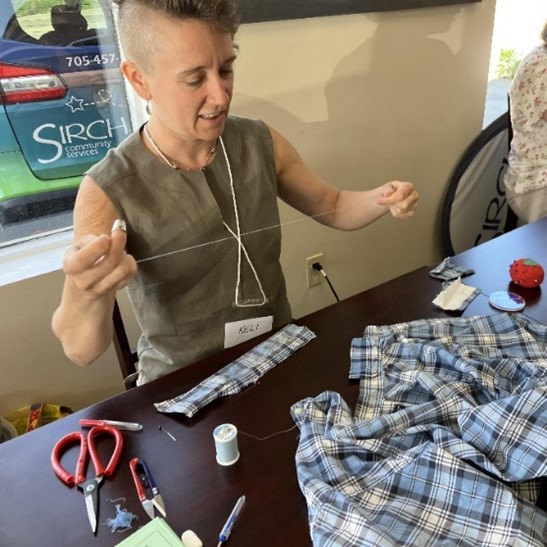
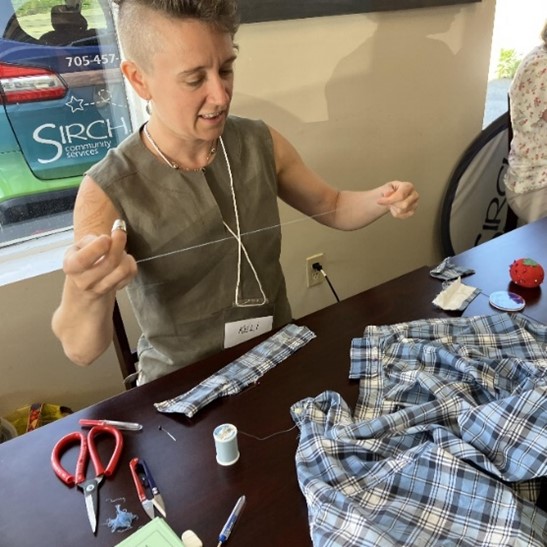
This is a men’s cotton short-sleeve shirt in good condition except for the collar, which is often the first thing to go. I am removing the top collar, and will use some pieces of it to reinforce the stand, which connects the neckline to the collar. This will turn it into a mandarin collar style.

How do you describe your craft?

I would say I am a sewer-fixer and enjoy repairing anything from shirts, pants, boots, jackets, zippers, snaps, you name it. The correct term is “sewer” rather than words like “seamstress” or “tailor”, which are gendered. I am also a compulsive maker: Bees have to make honey and I have to make clothes.

How did you learn about the Repair Café?

Actually, I previously brought my fabric cutting machine here to be fixed. I wanted to give back, so here I am. We want to find a way to extend the life of good garments, but in some cases to make them better. In the case of this shirt, the slimmer collar is better for hot summer weather.

What challenges do you face in your profession?

The dominance of fast fashion presents many problems. Since most manufacturers are only concerned with price, it’s difficult for me to find good-quality fabrics. Clothing has been devalued, especially for younger people who have grown up with fast fashion. This has resulted in the decline of fashion manufacturing in Canada, where minimum wages are higher than the foreign countries where most of our clothing is made these days.

I use my brand as a platform to talk about social justice in the context of manufacturing.

How does the Repair Café help?

There are environmental and social benefits to repairing clothing. We should all be looking at ways to reduce and re-use.  And of course you’re also saving money along the way.

Keli completes the shirt repair, using a needle, thread and thimble to hand-stitch the repurposed collar for another happy customer at the SIRCH Repair Cafe. It’s the same “ethical Canadian slow-fashion” approach she uses to making garments in Haliburton – a counterpoint to today’s fast-fashion trends.

For more information, you can visit her web site at haliburtonclothingco.com

For more information about SIRCH Community Services in Haliburton, and the SIRCH Repair Cafe, please visit: http://www.sirch.on.ca

Meet the fixers

Haliburton SIRCH Repair Café volunteers save hundreds of items from landfill

(My article published in the Oct. 29/24 Haliburton Echo — I am proud to support the great work of the SIRCH Repair Cafe as a volunteer)

Toss it? No way?

So far this year, volunteer fixers have repaired more than 500 items at the Haliburton SIRCH Repair Café – from electronics and small appliances to clothing and jewelry, to ceramics, furniture, bikes and more.

“Sometimes it is a treasured keepsake like a piece of china, or a functional item like a toaster,” says Repair Café Project Coordinator Dianne Woodcock. “In every case, by repairing something instead of tossing it away, we are helping the community — and the environment.”

Donations towards repaired items support the good works of SIRCH Community Services in Haliburton.

The final monthly event of 2024 runs Sunday November 3rd from 10 a.m. to 2 p.m. at the SIRCH Bistro and Bakery at 49 Maple Ave. Have something broken that needs fixing? Come on over! After the November 3rd event, the Repair Café will start up again in April, 2025.

The Repair Café fixers and other volunteers are dedicated to helping Haliburton residents. They’re also pushing back against a disposable culture — and supporting the right to repair. Let’s meet a few of them.

“When something is broken, I feel its pain,” says fixer Neville Tebbit.  “I want to jump in there and make it feel good again. That makes me happy, especially when I can make a good repair without spending money. New parts to repair something can often exceed the cost of the entire item, so I often try to find a good used part that will do the job. That is the challenge and joy of it.”

Neville (right) with fellow volunteer fixer Jurgen work to replace a toaster cord.

Neville grew up on a farm in Rhodesia and developed a fix-it mentality and skills from his father. In his professional life, he fixes specialized instruments used in mining and other sectors. As a volunteer at the SIRCH Repair Café, he recently fixed a toaster, CD player, bike and more.

Keli Schmidt operates the Haliburton Clothing Co, drafting, cutting and sewing women’s and men’s fashions. She also brings her sewing talents to the SIRCH Repair Café, giving a new lease on life to garments that might otherwise be tossed away.

Keli repairs a shirt collar.

“The dominance of fast fashion presents many problems,” says Keli.  “Since most manufacturers are only concerned with price, it’s difficult to find good-quality fabrics. Clothing has been devalued, especially for younger people who have grown up with fast fashion.” Keli notes there are environmental and social benefits to repairing clothing. “We should all be looking at ways to reduce and re-use.  And of course you’re also saving money along the way.”

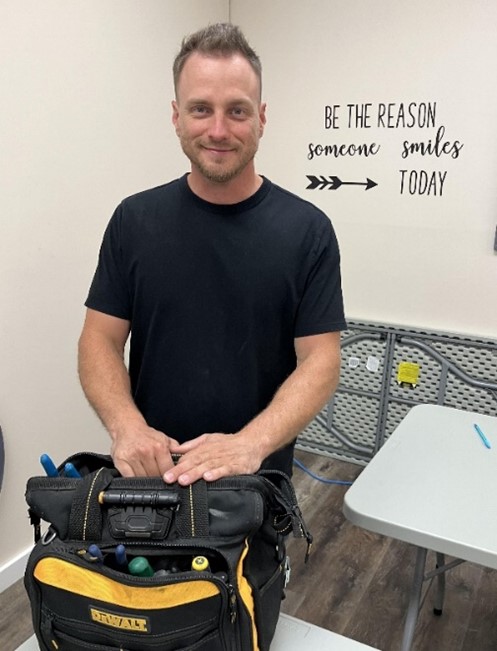
Whether it’s a broken bike, projector or even an iPad, SIRCH Repair Café volunteer Andrew Ablett believes he can find a way to fix it. A former auto mechanic, Andrew left the city a few years ago for a quieter life in the Haliburton area. He now runs his own property maintenance company while he and his wife raise a young family.

Andrew brings tools, knowledge and a can-do attitude

“The more difficult the challenge, the more I like it,” Andrew says.  “I guess I am a bit obsessive that way — when I take something apart, I am focused on understanding how it works and putting it back together. I don’t have a photographic memory but when I disassemble something I can typically recall exactly where things go. Some of that skill comes from multi-tasking as an auto mechanic.”

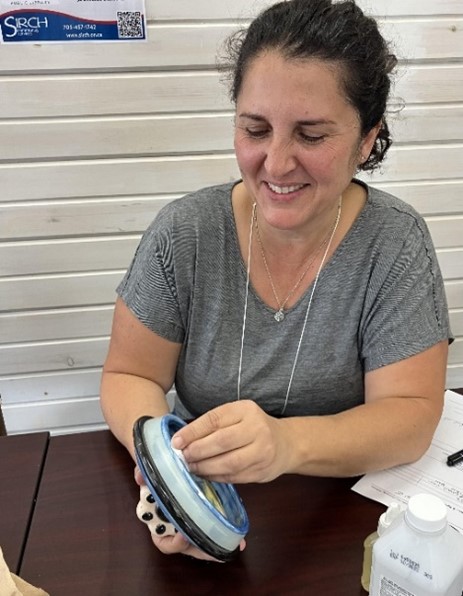
Michelle Anton is a high-school teacher by profession who has a passion for the craft of pottery. At the Repair Café, she fixes broken ceramics, giving a new lease on life to often-treasured items.

Michelle repairs a broken cookie jar lid. Her next challenge was the handle on a broken 1940s-era china gravy boat.

“Most important for me is taking a cooperative approach to pottery,” says Michelle. “To help the community, I organized an event called Empty Bowls. We had local potters make bowls, and 12 local restaurants make soup. Participants chose a bowl to sample the soups and then took it home as a reminder of world hunger. We were able to raise about $9,000 to support three community programs – the SIRCH Community Kitchen, the Haliburton 4Cs Food Bank and the Fuel for Warmth program.”

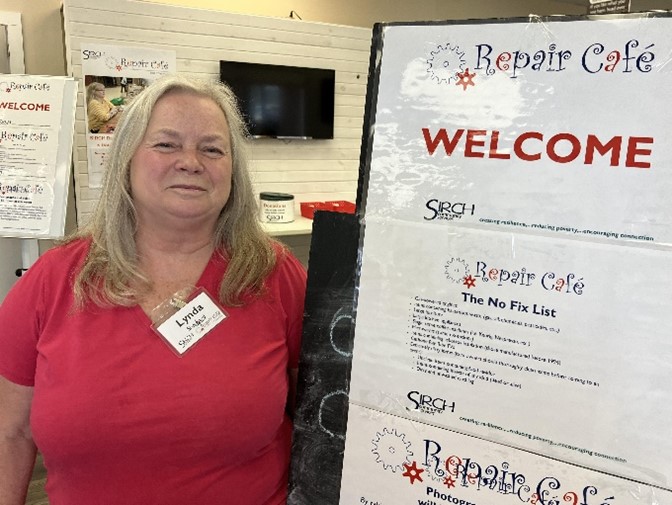
Lynda Shephard is busier than ever after retiring from a leadership development role with the province. She has taken on a few volunteer roles with SIRCH, supporting the work of the social services agency in the Haliburton community. She also chairs a local charitable organization, Brooksong, that provides community and a healing space for people living with cancer.

Lynda is a volunteer greeter at the SIRCH Repair Café.

“When people come in with their items to be repaired, I want to make them feel comfortable,” says Lynda. “I chat with them and let them know about the process. I show them to the registration table. I may speak with them when they are in the waiting area, to find out more. Sometimes there are bigger issues than the object they have brought in for repair. One senior shared with me that she was struggling at home with things like yard maintenance. I was able to provide a local contact to enable her to get some assistance.”

Besides the Repair Café, Lynda volunteers at the SIRCH Thrift Warehouse. “I am responsible for curating books, organizing them into categories like fiction, biography, gardening, decorating etc. – to make it easier for patrons to find the books they want. There is a nice connection with the Repair Café, because some items repaired by our fixers are sold at the thrift store, with proceeds to SIRCH.

*****************

In 2024, with repairs topping 500 and counting, Coordinator Dianne Woodcock also invited special guests to attend the monthly cafes, including a small engine specialist, bike mechanic and children’s toy expert.

The 2024 repair season is drawing to a close, but you’re invited to come out to the November 3rd, 2024 event at SIRCH, says Dianne.

“Bring a broken item, have a coffee – and meet our fixers!”

Article and photos by SIRCH volunteer Ian Kinross

Seeing nature with fresh eyes

As a hike leader in the Haliburton area, Rob Halupka gets a kick out of helping others experience nature. “My role is being a conduit to help them discover the great outdoors,” says the retired engineer, who’s worked in the mining and financial sectors. “One of my rewards is to see things fresh through their eyes.”

Above: Rob at left with hikers on a Ganaraska Hiking Trail event in May, 2024

I know first-hand Rob’s experience and skills in the wilderness. When our kids were young, we joined Rob, his wife Jacquie and their children Madde and Emma on some epic canoe trips to Ontario destinations like northwest Algonquin Park. With another family of four, our friends the Finleys, we 12 paddled, portaged, swam and cooked up some feasts over the campfire. I recall Rob venturing off into the woods with a small hatchet and knife, and returning to set up a wooden tripod for our stew, complete with a hook on an adjustable wire that could raise and lower the pot over the fire as required. He also helped us prepare with detailed checklists for the trip that always ended with these two items: unmentionables and a rubber chicken.

Fast forward 20-plus years and Rob is a certified hike leader and president of the Wilderness Club — one of nine trail sections of Ontario’s Ganaraska Hiking Trail Association. The rugged section of trails Rob heads up is definitely off-grid. It includes 72 kilometres of trails winding through rivers, lakes, Canadian Shield, woodland and wetland, most of it within Queen Elizabeth II Wildlands Provincial Park. The legendary “cross-over” hike typically takes three days — including two nights of overnight camping.

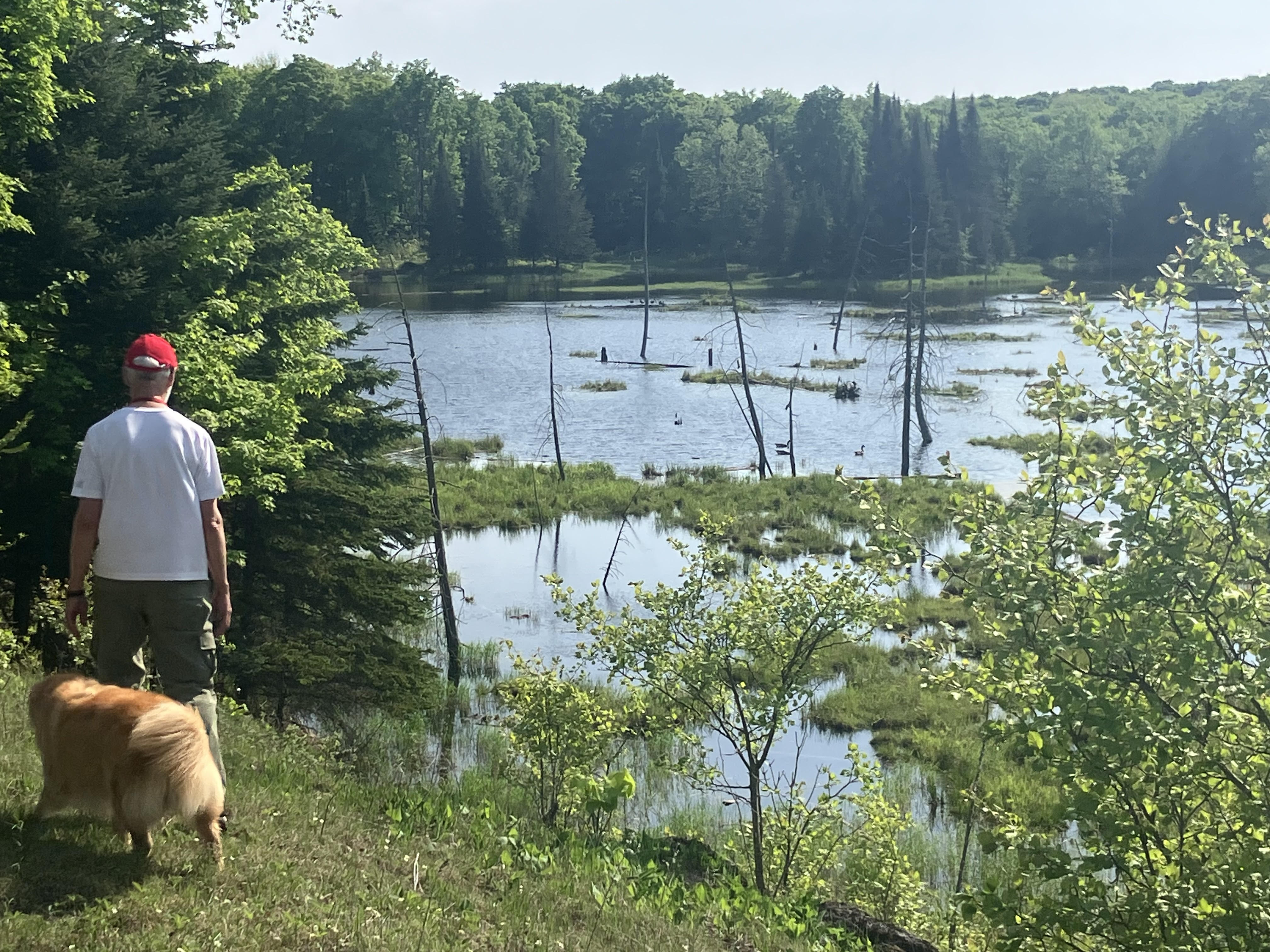
I invited Rob, Jacquie and their faithful hound Mungo to join me recently for a hike to one of my favourite spots, Kinross Creek, back in the bush about a 45-minute walk from our cottage. Rob showed me a neat app called Avenza that I used to track the hike. The four of us took a little rest near a tiny lake, then ventured back to Kinross Creek where four frogs scattered after Mungo hopped in the water to cool off.

Afterwards, I spoke more to Rob about hiking, the great outdoors, and his impressions of Kinross Creek. In future, I look forward to interviewing Jacquie for her take on interpreting the great outdoors through art.

You lead hiking groups that may include veteran hikers but also newbies. What do they get out of this experience?

Some of our new hikers are also new Canadians. They want to experience the beauty of the Canadian wilderness and wildlife but may not have the skills, knowledge or equipment to do it. They may have certain fears — like a fear of bears or snakes.

They may not know how to do it, but they know they want to do it!

Yesterday on a trail-clearing event we had hikers who had immigrated to Canada from Iran, United Arab Emirates, England, Russia, India and Vietnam. My role is being a conduit for them to experience the outdoors, and one of my rewards is to see things fresh through their eyes.

We also have some veteran hikers. One woman, in her 70s, has hiked the entire Appalachian Trail (more than 2,000 miles) in the U.S. She’s exceptionally fit and well prepared with ultralight gear and the right clothing. She is testing her stamina and knowledge, so it is a different kind of reward for her.

What responsibilities do you take on as a hike leader? How do you prepare?

Leading up to a hike, I ask a lot of questions. I want to know where each person is in terms of their experience. Also whether there are health issues I should know about. In some cases it is a reality check. If we are looking at a full day hike, or multi-day hike, through some areas that may not have cell phone service or road access, they need to know exactly what they are getting into. Each person also gets a checklist of equipment and supplies.

So there is individual preparation but we also look at preparation as a group — for example, to make sure that if one person has forgotten something, we can still function as a group. A simple example is ensuring we have a water filter and enough stoves for the group. We also look at weather conditions and limit the size of the group for safety.

The hike leaders have to be trained. I have my Certified Hike Leader — CHL — accreditation from Hike Ontario. The training involves fundamentals and simulated emergencies and how to deal with them. As well, I regularly update my first-aid training.

For longer hikes, we have a leader and a sweep — two experienced people responsible for the group. Between us, we want to keep the group safe and to avoid the slinky effect — we do not want the hike group to get stretched too far.

Can you describe a challenging situation on a hike and how you addressed it?

When you are into a multi-day hike, there is a point of no-return. You are all in.

On our cross-over hike from Devil’s Lake (south of Minden, Ontario) to Victoria Falls (north of Sebright, Ontario), we had a group of women who were veteran day hikers but had not done overnight trips. We carried 30-pound packs with food and gear. On our first day, my experienced partner Vlad was the guide, while I brought up the rear as sweep. Vlad became concerned that our group was too slow. Everyone was enjoying the hike, but Vlad quickly realized we were not going to reach our campsite in good time. He had to get serious and hustle the group and they were taken aback at first. I played more of the good cop, encouraging everyone. We were able to speed up and thankfully make camp that night.

They forgave Vlad later — they knew there was a good reason he was a bit brusque earlier in the day. We also realized not all hikers had good sleeping bags. During the day, the temperature was fine but overnight we were getting some frost. So as a group we were able to rustle up and share some gear so our hikers could stay warm.

Hiking can be a serious business but you also address the lighter side.

Our hikers want to have fun and experience wildlife and nature. This is not the marine corps!

There is an education component but I try to treat that in a fun way. I’ve been known to ask skill-testing questions along a hike. When a hiker gets it right, they get a little plastic model dinosaur as a prize. We take a break at a little enclave of rocks and moss. I explain that 66 million years ago, most dinosaurs were killed off in a mass extinction — except for this little spot on our hike. The hikers get a kick out of finding what I call Jurassic Parkette — a collection of little plastic dinosaurs in the wilderness. The prize-winners add their dinosaurs to the montage.

Hikers have a lot of questions about the natural world. On a recent hike we found some moose tracks and ended up having a great chat about animal poop and its different qualities — like the difference between small dry deer pellets and the messy poop of a bear who has feasted on berries. I was also able to explain the odd behaviour of a grouse that was apparently harassing our group, but was actually protecting her chicks.

On breaks, I’ve also been known to recite Robert Service poetry like the Cremation of Sam McGee — and tell bad jokes.

Jacquie and Rob near Kinross Creek

When we visited Kinross Creek, you showed me how to use the Avenza app to map out the hike. Is this a tool you use on your guided hikes?

Avenza is great to document a hike — the route, the distance, the time it takes, and points of interest along the way. It can also help to lay out and document the best trail. Of course, it is also important to use physical markers. I use coloured tape, and also am constantly snipping branches and removing obstacles. For example, we can document a main route using orange and yellow tape, and then mark some alternative routes with blue and yellow markers. So the combination of the digital app and the trail markings are important for navigation.

Near Kinross Creek we came across some massive stone piles and abandoned farm buildings.

We saw evidence of some of the history of the early farmers in that area. My first reaction was — somebody broke their back moving all those stones to try to establish a farm! They were likely given free land but had to work to develop it in a very challenging topography and climate. Some of them eked out a living for awhile but could not sustain it and had to abandon their farms, unfortunately.

Most people on my hikes are not from this area and have questions about history and the natural world here. So I have done some research on the Haliburton area. I also use an app called Merlin to track the bird life on our hikes. When we were at Kinross Creek, I heard a Rose-Breasted Grosbeak, and the app also identified an Indigo Bunting, which is a gorgeous blue bird returning here after migration. If you combine the app with a pair of binoculars, you can see many birds along the way.

Rob and Mungo, back in the bush

Over the past year, you have taken on many different hikes with groups including Hike Haliburton and of course the Ganaraska group. What is the reward for you?

I used to do a lot of hiking and canoeing either solo or with family, which is always fun. Leading group hikes now, with so many different participants, I can give them some guidance and a little boost.

Seeing nature through their eyes too — that is a big reward.

For more information, please visit the Ganaraska Hiking Trail Association — Wilderness Club Facebook page. Or you can visit the Ganaraska Hiking Trail Association website here: https://ganaraska-hiking-trail.org/

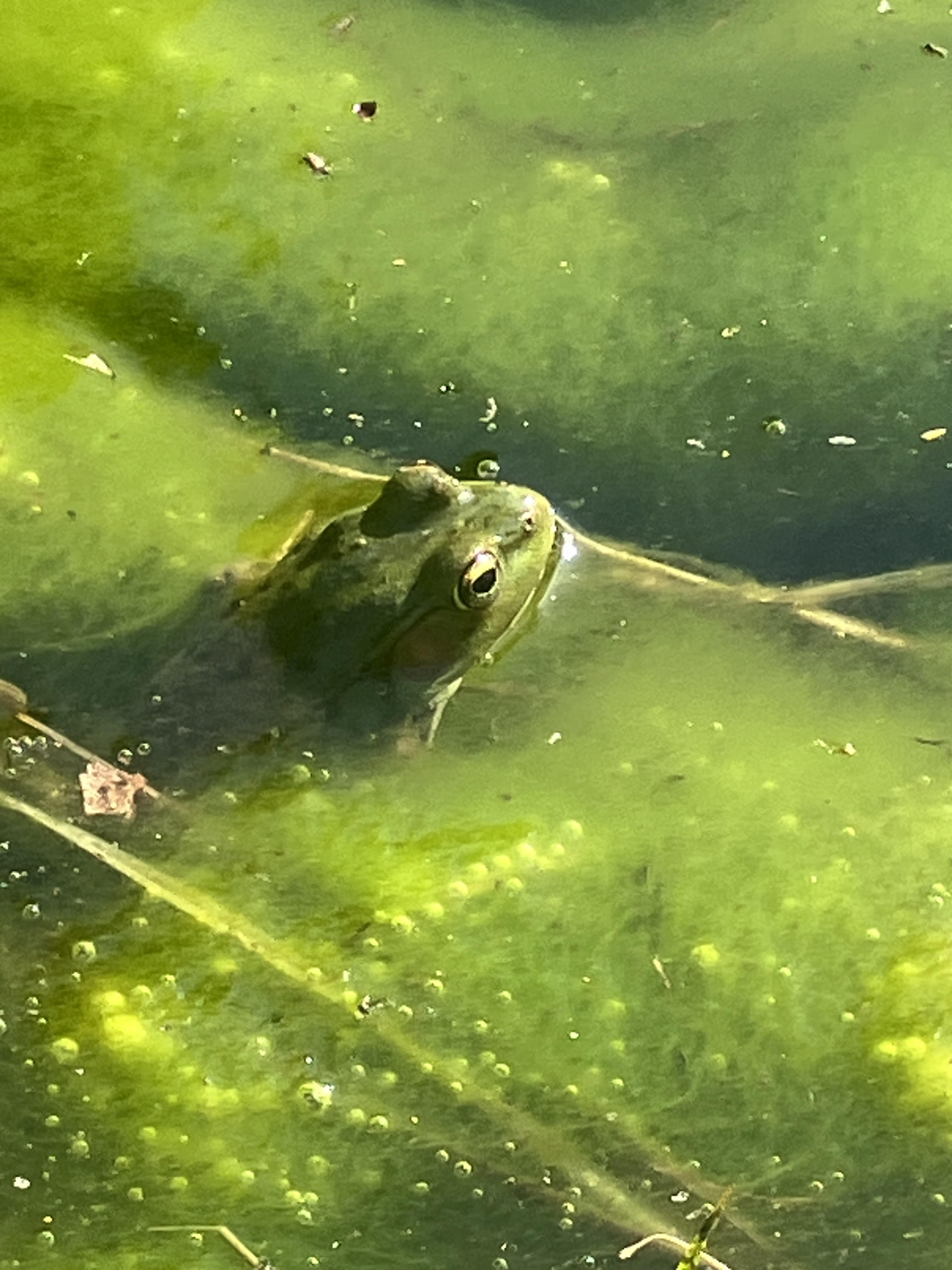
My first frog at Kinross Creek. Cutie!
A year in the life of Kinross Creek

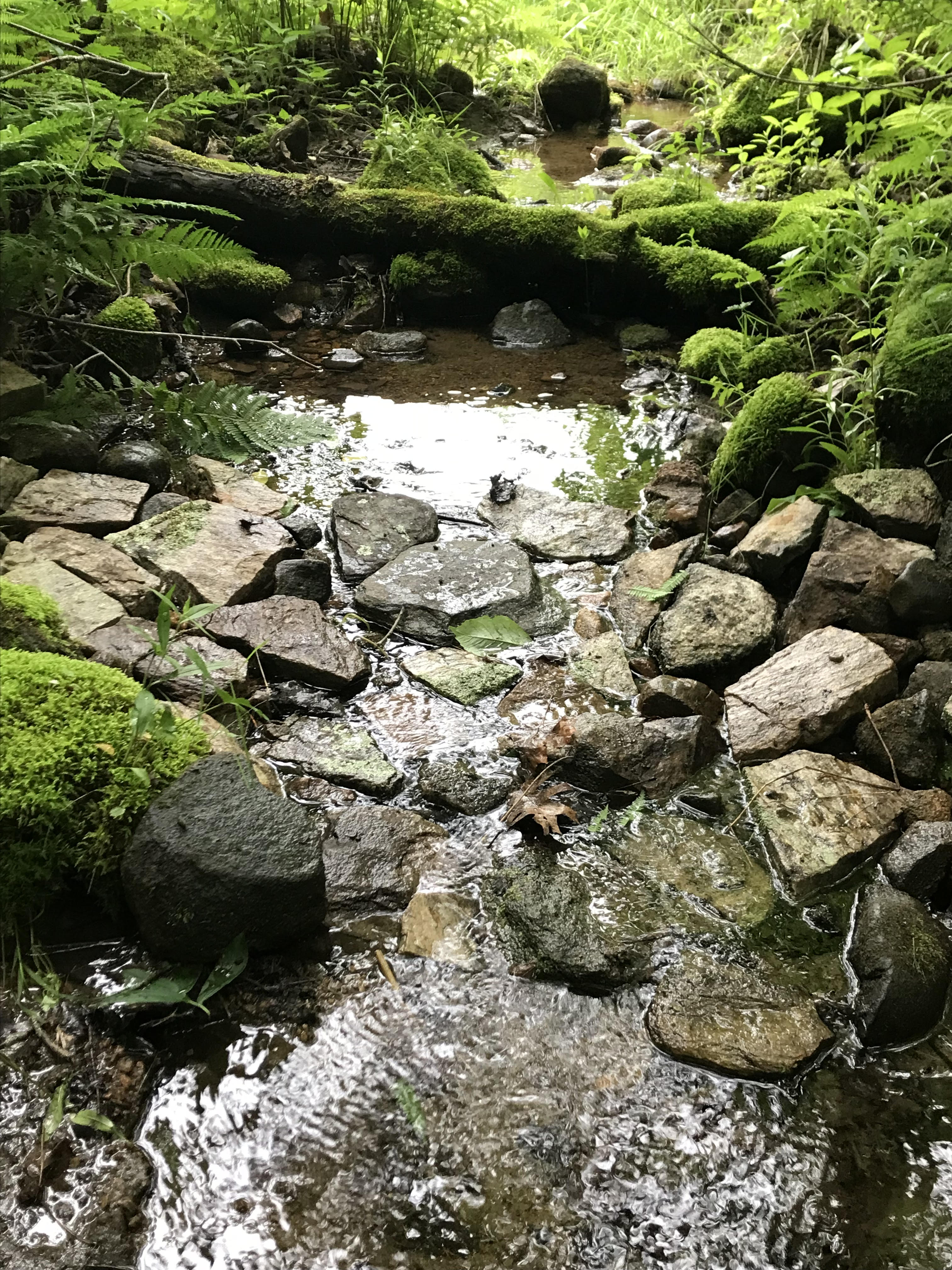
I discovered the little creek during a hike in the woods last year. It was running fast, carrying off the melting snow cover. It seemed to bubble up at a spring next to a massive granite formation on the hydro corridor. Meandering through the forest, it cascaded off a steep ridge and joined another creek feeding Minden Lake, where we have our cottage.

The creek reminded me of my childhood at Rippleton Road Elementary School in Don Mills, Ontario. During the spring run-off, a tiny creek formed in the ditch next to our school field. After school, we mucked about in the creek, making dams with stones. Here I am 55 years later and not much has changed!

I set a goal to visit Kinross Creek each month over the course of a year, to learn about the annual lifecycle of the creek, its watershed, and the natural world around it. And to write about it in this blog.

Birdsong and wild leeks

One of my favourite moments last year was the return of migratory birds to the Minden area in spring. After foraging for some stone for my little pond projects, I heard the chorus of diverse songbirds in the forest canopy above. With a little help from Merlin, a free app developed by Cornell University, I identified my companions by their bird song. These included the Great Crested Flycatcher, Ovenbird, Rose-breasted Grosbeak, Scarlet Tanager, American Redstart, and three different types of warblers: Black-and-White, Chestnut-sided and Nashville.

The same day, I found a patch of wild leeks and harvested a few that went nicely in pizza. The moss and ferns near the creek had turned a lush green.

The beauty of all seasons

Waiting for summer can be over-rated. Each season has its own and equal beauty.

Another favourite moment at the creek was on a minus-10 degree day in the dead of winter. The snowpack was hard and it was easy to get about. After huffing and puffing my way up the hill in the woods, I found a warm microclimate in the creek’s watershed. The sun penetrated the bare canopy of the forest and for a few minutes I could take off my coat. Downstream, I found the spot where deer cross the creek, and gazed at the tracks of their superhighway in the snow. I admired birds like chickadees, crows and Blue Jays, who were toughing it out through the winter.

Fall colours get the glory, and indeed they are splendid when hardwood trees in Minden blaze and fade. But the subtle colours of spring have their own beauty — like the fungi I found in shades of grey and subtle orange, sprouting from a rotting poplar tree. Their shapes reminded me of winter toques.

Forest therapy

The changing sights, sounds, textures and creatures of the forest sooth the soul. It felt like my blood pressure dropped a few figures each time I visited the creek. After some stonework to build out two little ponds, I would take a breather on the hill overlooking our cottage, maybe snack on an orange or a granola bar, catch sight of the horses nibbling grass on a farm field below. A feeling of peace.

And much cheaper than a visit to the spa.

Respecting the land and its people

Slowly, I got the lay of the land and wondered about who had travelled or lived here earlier. Nearby, I found outbuildings and fencing of a long-abandoned farm. There were also stones that the farmer had laboriously cleared from fields and piled on the perimeters.

Next to our cottage, we’re lucky to have the third and fourth generation of a farm family still raising cattle, planting and harvesting crops. Farmer Casey Cox told me about some of the neighbouring farms that used to be a going concern many years ago. We also talked about a ghost road to Minden nearby, where the current Horseshoe Lake Road used to join up with Scotchline. When you hike the ghost road, now used only as a snowmobile/ATV trail, you can spot an abandoned car, and former pasture fields now growing back into forest.

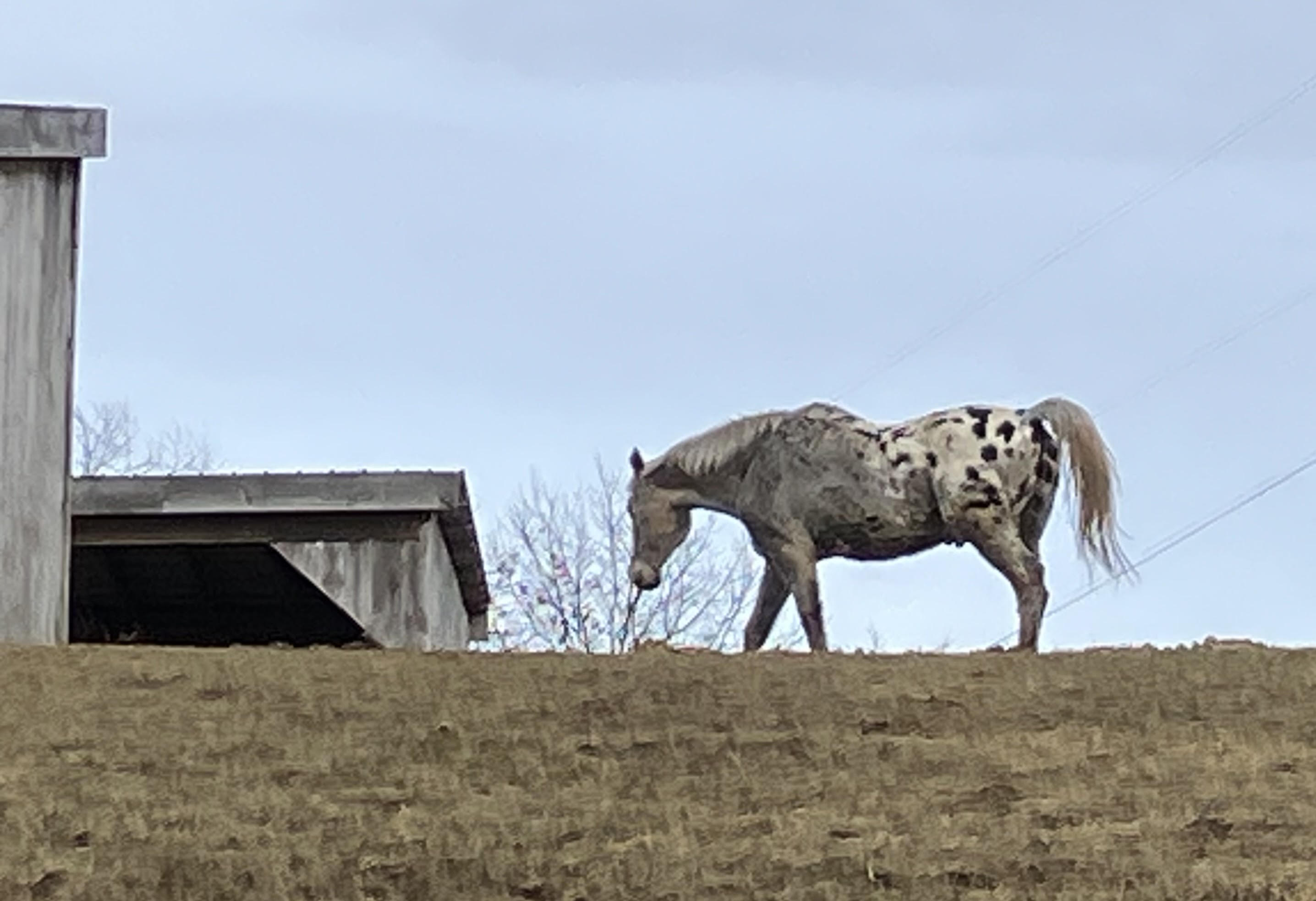
I’m especially fond of one of the Cox farm’s older horses, a sturdy and beautiful breed known as the Appaloosa. He’s still hanging in their at the ripe old age of 32. He gives me hope whenever I catch sight of him on my walks.

The farmers next door are also a rare breed, as many of the small local farms in this area were slowly abandoned over time. Mother nature is relentlessly reclaiming the rugged terrain into forest.

Before farmers, the Haliburton highlands area was the territory of indigenous peoples from the Anishinabaweki and Mississauga Nations. There was no Minden Lake until the 1930s, when a hydro dam was built along the Gull River.

Before that, a winding river and its rapids were a key connector between many lakes in the area. From the height of land at Kinross Creek, you can look down to the larger river valley of Minden Lake and imagine indigenous travel, habitation, ritual, hunting, fishing and trade.

I intend to learn and write more about indigenous life in this area.

Climate change and Permaculture

A year in the life of Kinross Creek demonstrated climate change we are encountering and its threats. I was surprised to find the creek never stopped running during the winter of 2023/24, one of the mildest on record. Typically any small watershed in this area will freeze solid with the deep cold of winter. A reduced snowpack also means less fresh water running into the larger rivers and lakes.

In spring, Minden now faces a greater fire risk. Fire captains in local regions implemented a complete fire ban last year during a dry spring, after battling several wildfires that were tough to control. Then in summer, smoke from uncontrolled wildfires in Quebec blanketed the Minden area, turning the sun and sky the colour of rust several times during summer. Individually, we’ll be forced to do more to protect ourselves from extreme weather including extreme heat and heavy rain. Collectively, we must continue to work to address the carbon threat.

I did some online research about permaculture and discovered how small-scale stone dams, known as “check dams”, can retain water in areas suffering drought. Countries like India, which experience drought as well as heavy rains and flood, use check dams to mitigate flooding and retain water.

Stonecraft and family

I decided to do a little permaculture test case at Kinross Creek. Using stone foraged near the creek, I constructed one small check dam. As well, I enlarged two existing ponds that had been created by tree deadfalls. These ponds do not interrupt the flow of the creek, as each has a central spout point directing the water downstream. During fall, the ponds filled up nicely, retaining more water in the little valley.

I named the two ponds after our daughters, Ali and Colleen. One day we’ll have a trek together to see them. Where Kinross Creek cascades off a ridge with the spring run-off, I found a waterfall feature and named it after our first grandson: Sebby Falls.

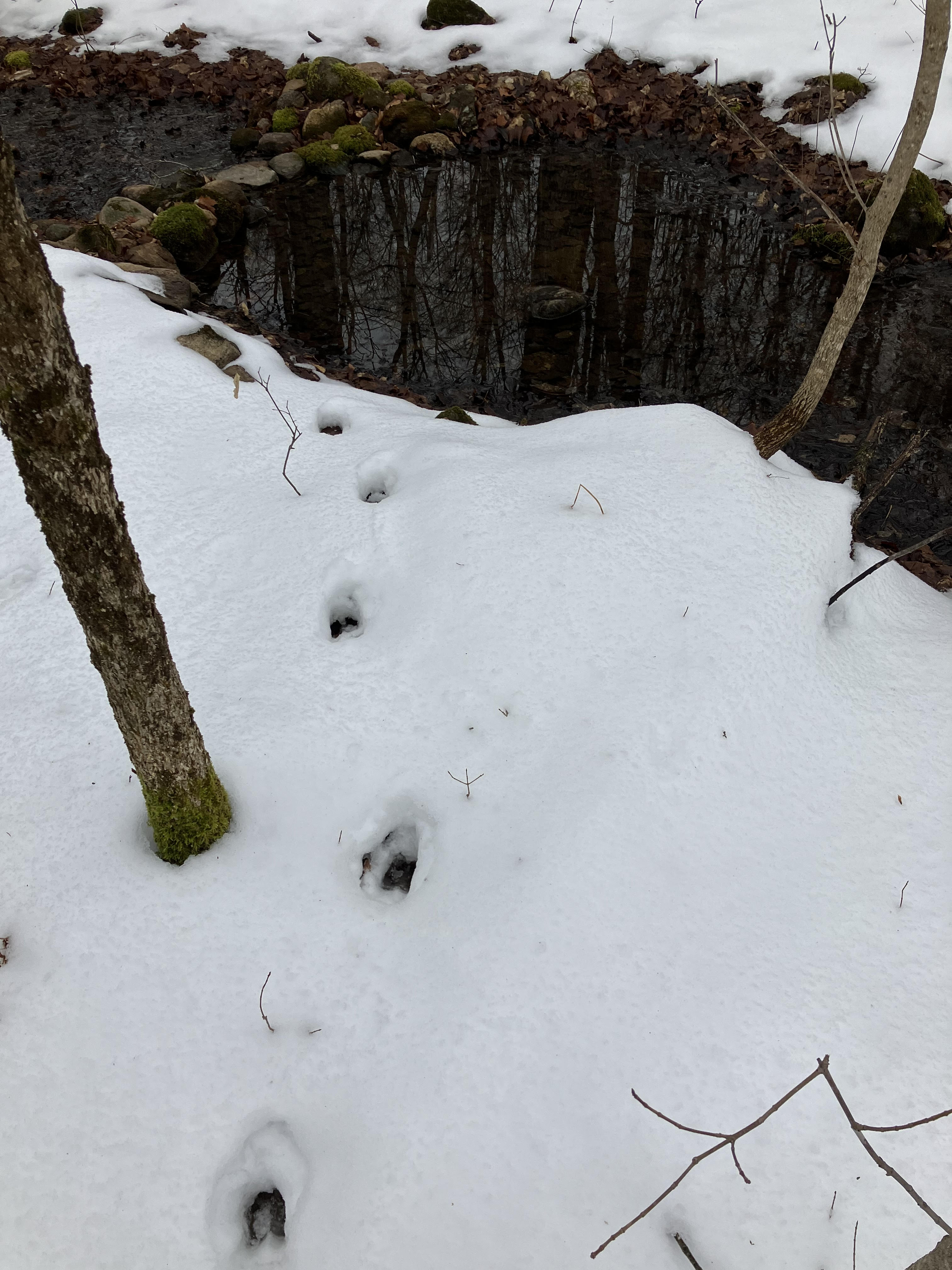
One of the first creatures to appreciate the new ponds was a deer. In winter, his tracks led directly to the water’s edge. Presumably, he had a nice drink and made his way back to the deer highway.

The road ahead

Now that I’ve witnessed the annual lifecycle of this little creek, I want to interpret it through other eyes. I’m hoping to go back there soon with our friends Rob, a hike leader and outdoorsman, and Jacquie, an artist.

I’d also like to get some expert opinions on the creek’s biodiversity and history.

Thanks to everyone who read, commented and supported me in telling the tale of Kinross Creek.

Signs of spring at Sebby Falls

March, it seems, is the new April. After a mild winter, signs of spring are everywhere: Canada Geese honk and flap northward; Mallard ducks float and paddle on Minden Lake, the old Appaloosa horse next door has shed his winter blanket…

At the point where Kinross Creek drops down a steep granite ridge, a tiny waterfalls is starting to trickle with the spring run-off. Let’s call it Sebby Falls, after our grandson.

My plan was to visit Kinross Creek each month for a year, to learn more about the lifecycle of this little watershed in the forest north of Minden, Ontario.

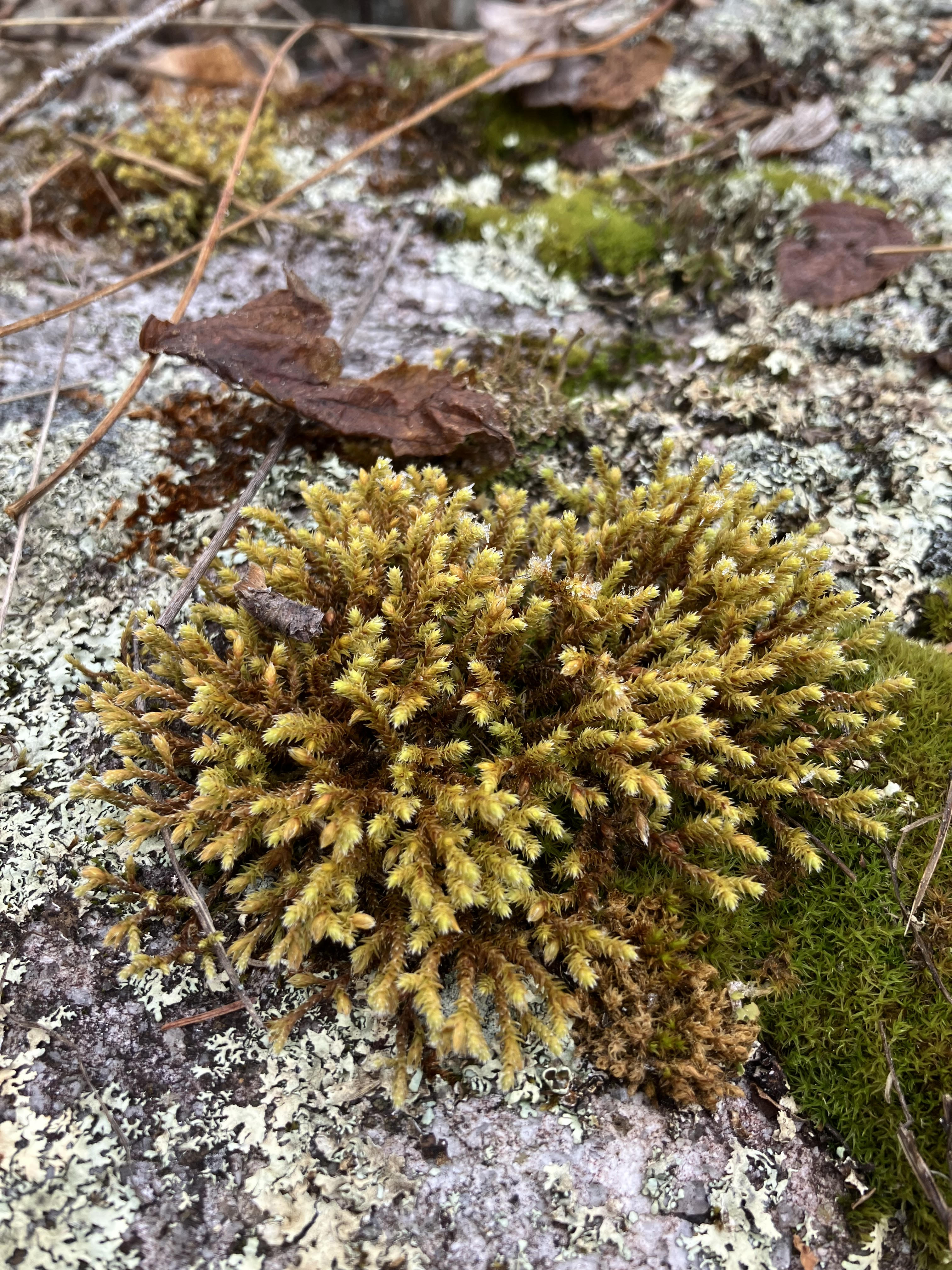
Today is the 12th month of this journey. Most of the snowpack has melted early. But because the temperature dropped to minus 5C last night, the ground is firm and easy to walk on. With my hiking stick, I navigate up the hill, stopping a few times to catch my breath and admire the muted colours of winter’s end — a carpet of reddish-brown leaves on the forest floor, frost glistening on old blackberry canes, the grey-green of lichen-covered stone.

With the last of the snow melting, Kinross Creek is running fast — probably approaching its peak flow. Ali’s pond is full, its water gushing through a central dip in the stone check dam. Some water has snuck around the west side, so I make a mental note to shore that up when the creek dries in summer.

Downriver, Colleen’s pond is filling and sending a strong current downriver. Typically the creek peters out past Colleen’s pond, but today it runs maybe 50 yards further, right to the edge of a granite shelf and into the valley below.

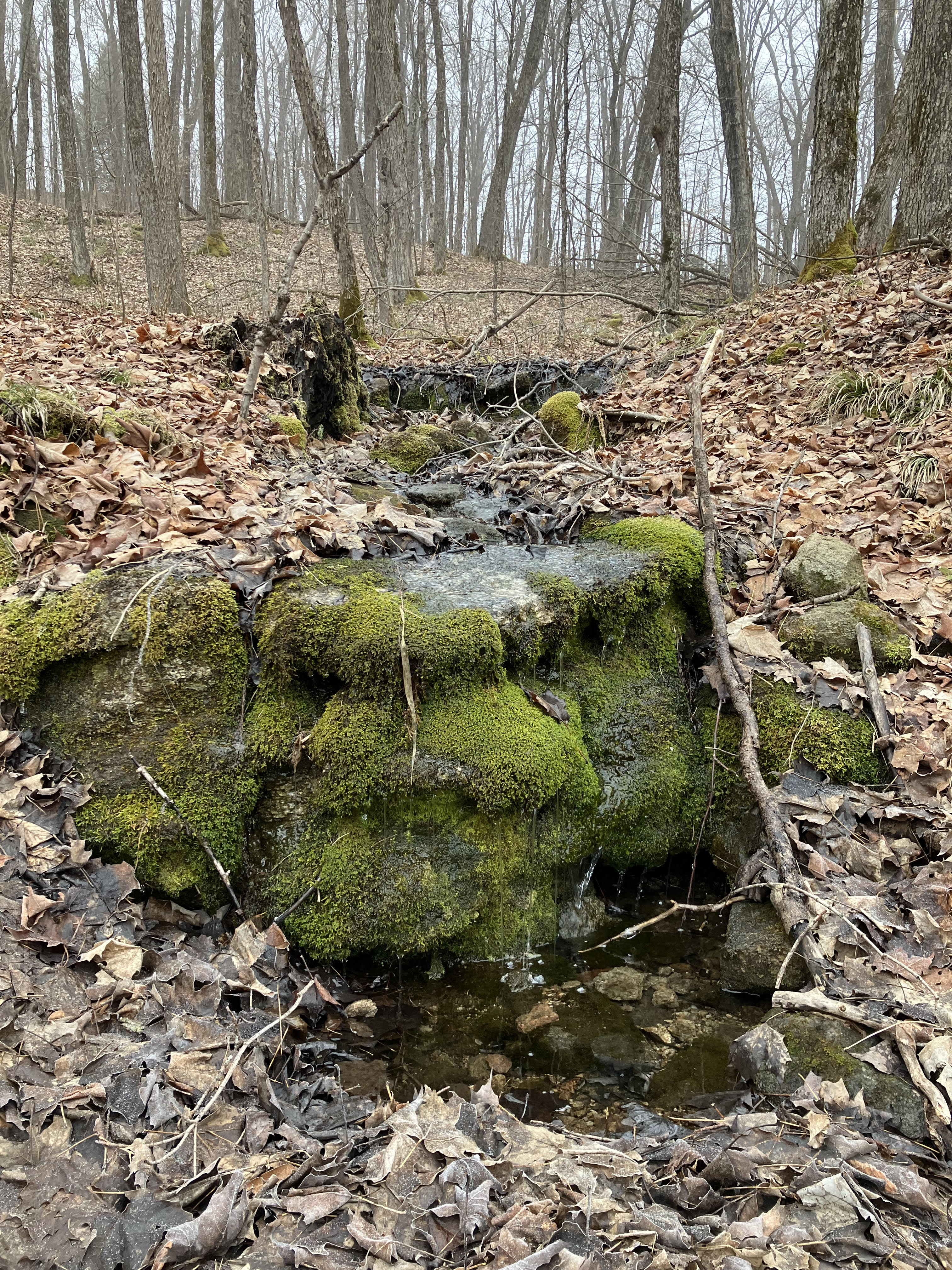
It’s not exactly Niagara Falls, but Sebby Falls is magical in its own way. The fresh, running water spills over a rock ledge, down moss-covered stone and into a tiny pond before it carries off down the hill. And eventually into Minden Lake.

Sebby (short for Sebastien) lives in Seattle, Washington with his parents, our younger daughter Colleen and her husband Tim. Sebby turns 2 in June. He’s a happy little dynamo. We grandfolk — Nadine and I in Canada, and Mathilde and Nicolas in France, are blessed.

I walk back upstream and snap a few pics of Ali and Colleen’s ponds. Next to the hydro tower, I take off my gloves and pause to snack on a granola bar. As I admire the scenery down the hill to the pastures below, the battery in my hearing device starts beeping. Nothing like a little reality check — and some humility — to interrupt a peaceful moment. And of course there is the reality check that our warmer winters, weather swings, and wildfire smoke are consequences of climate change. March may be the new April, but in many ways I wish it was just the old March.

With the tree canopy still months away, you spot different things in the forest. Some bizarre fungi are sprouting on a dead poplar. My boot hits a rock and I look down to see a striking, white quartz stone. I spot more quartz near the trail — a secret quarry? In the farm field near the road, the old Appaloosa has made it through the winter. Soon the songbirds will return from their migration.

Back at the cottage, we receive a zoom call from Sebby. He is eating porridge and reciting the first seven letters of his ABCs. He wants to show us his little wood train set and tracks. In the neighborhood enroute to Sebby’s favourite park, daffodils are swelling. To the east, the splendid Cherry trees at the University of Washington will soon be covered in pink blossoms — more signs of spring.

Woodland art at Kinross Creek

Fresh snowfall and chillier temperatures make it feel more like winter in Minden Hills after an unusually mild December and January.

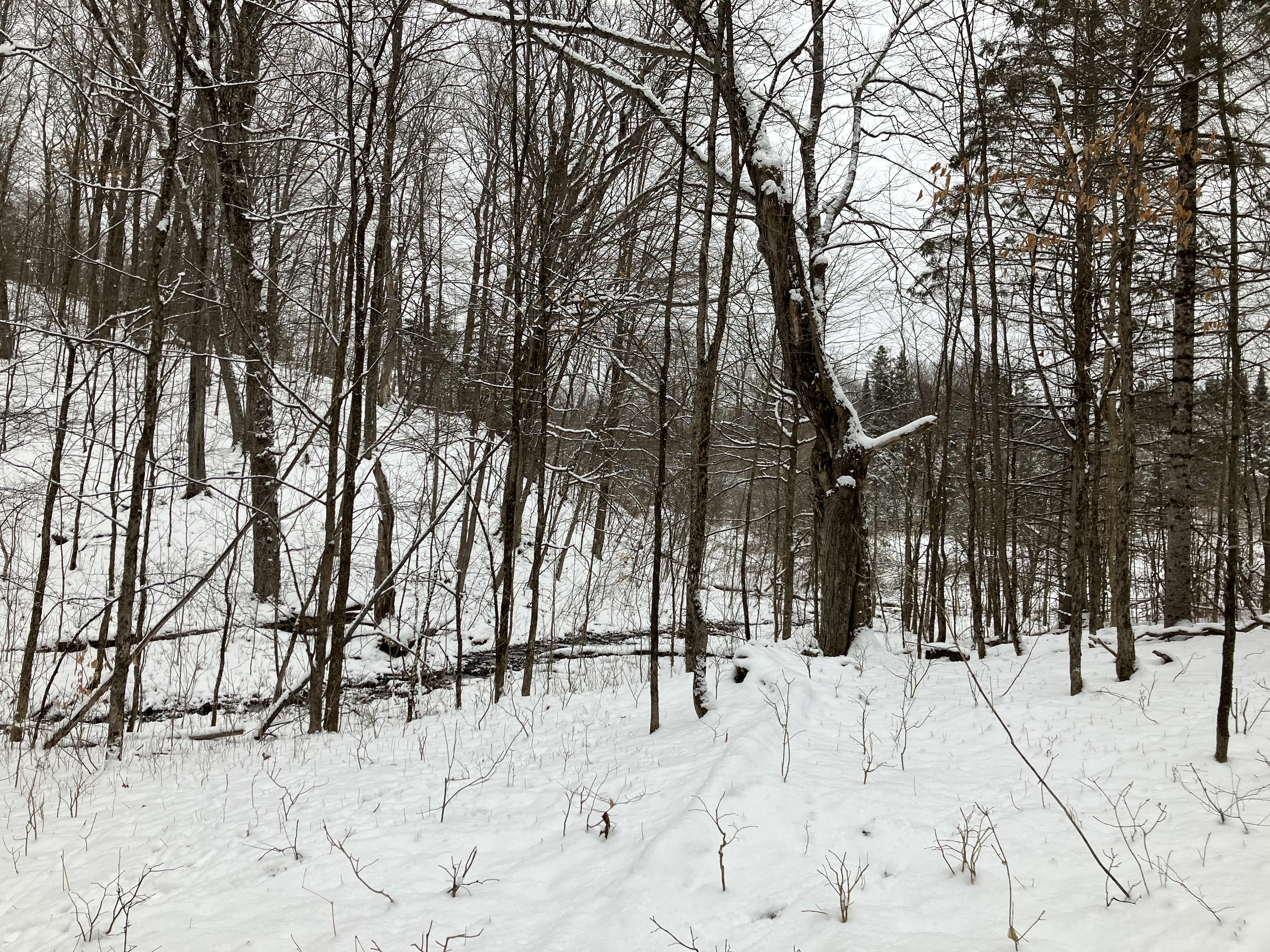
In the woods towards Kinross Creek, the sightlines are longer through the bare hardwood trees above a crisp, white forest floor. On my yard-sale snowshoes, I get up the hill and, as usual, find myself following deer tracks to my destination.

Crossing the creek, I notice an unusual pattern on a large tree stump maybe a hundred yards down the deer highway. From a distance, it looks like a Haida totem pole.

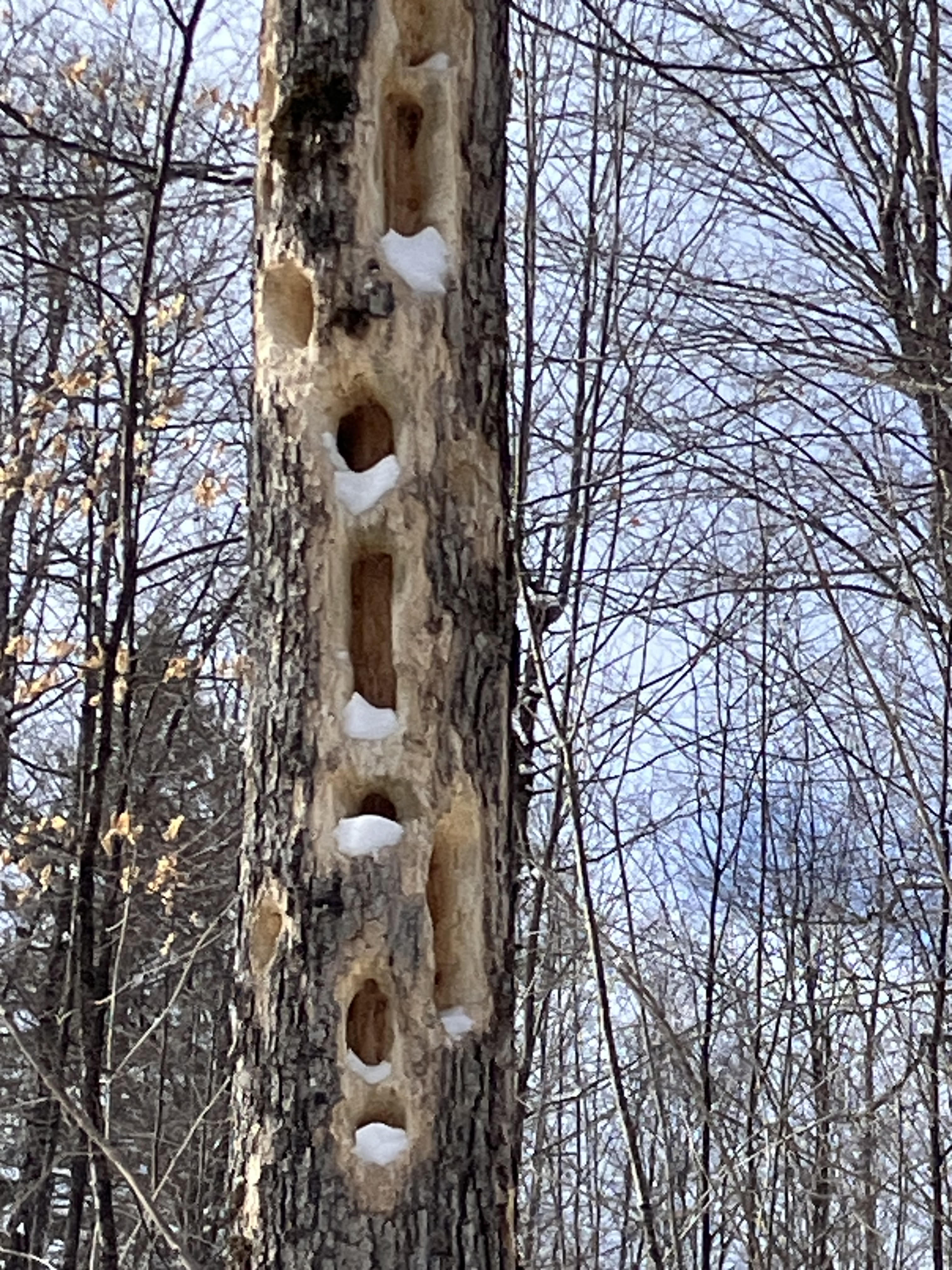
Up close, I can see that a woodpecker has been at this old maple stump, carving a series of holes to get at insects inside the decomposing wood. Some of these holes have caught and cupped the recent snowfall — creating a natural artwork in the forest.

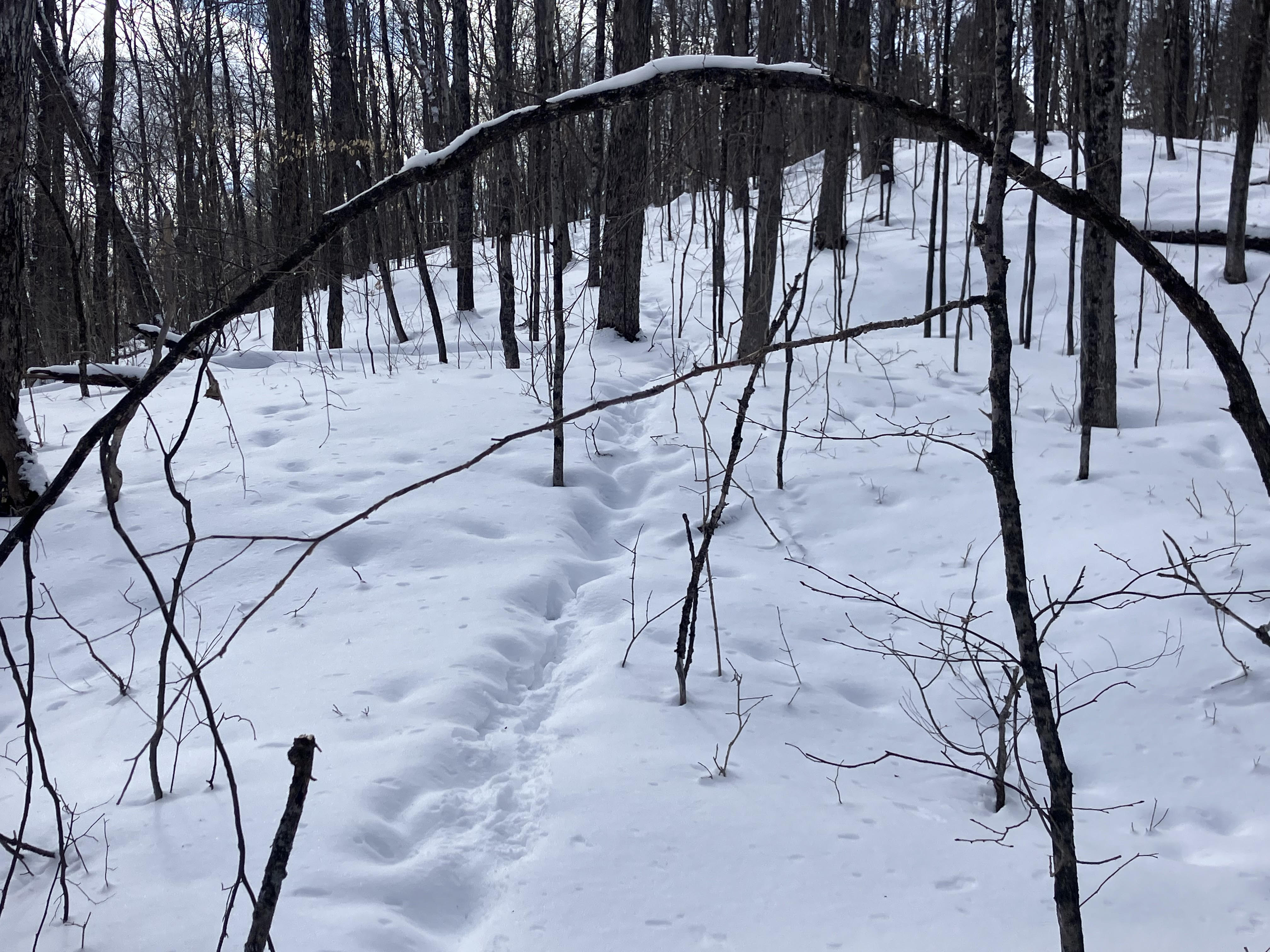
Nearby, a smaller tree bent over in a storm creates a magic arch for the deer to pass under on their journey.

I’d assumed the creek would be frozen solid in February, but with recent thaws it is carrying off a fair bit of water from the surrounding valley. In Ali’s pond, I catch the reflection of the bare tree tops and a small conifer upstream.

I’ve been reading a bit about “vernal” ponds like this, which swell in spring and often dry out in summer. Because they are not big enough for fish, many provide habitat for amphibians such as frogs, toads and salamanders, as well as fairy shrimp (a crustacean) and insects. I make a note to check out areas of the creek next summer for more signs of aquatic life.

Using my ski poles for balance, I tramp up to the hydro tower, which has its own strange geometry, not to mention a warning about voltage. It’s minus 10 Celsius this afternoon, and I recall our teachers warning us in winter not to lick the metal fence next to our elementary school. I have no plans to touch this particular hydro tower today, mostly because up above it is carrying 220,000 volts.

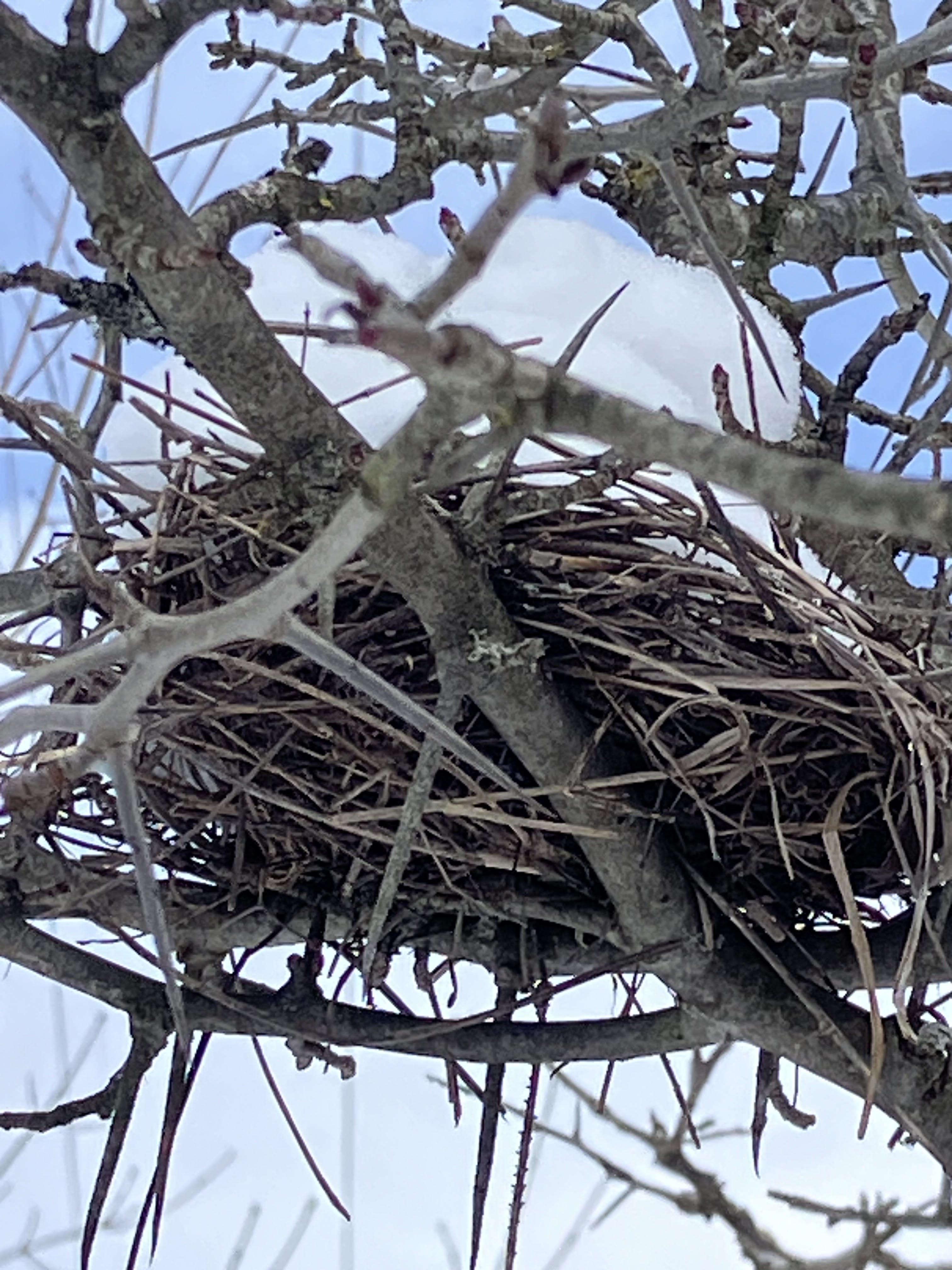
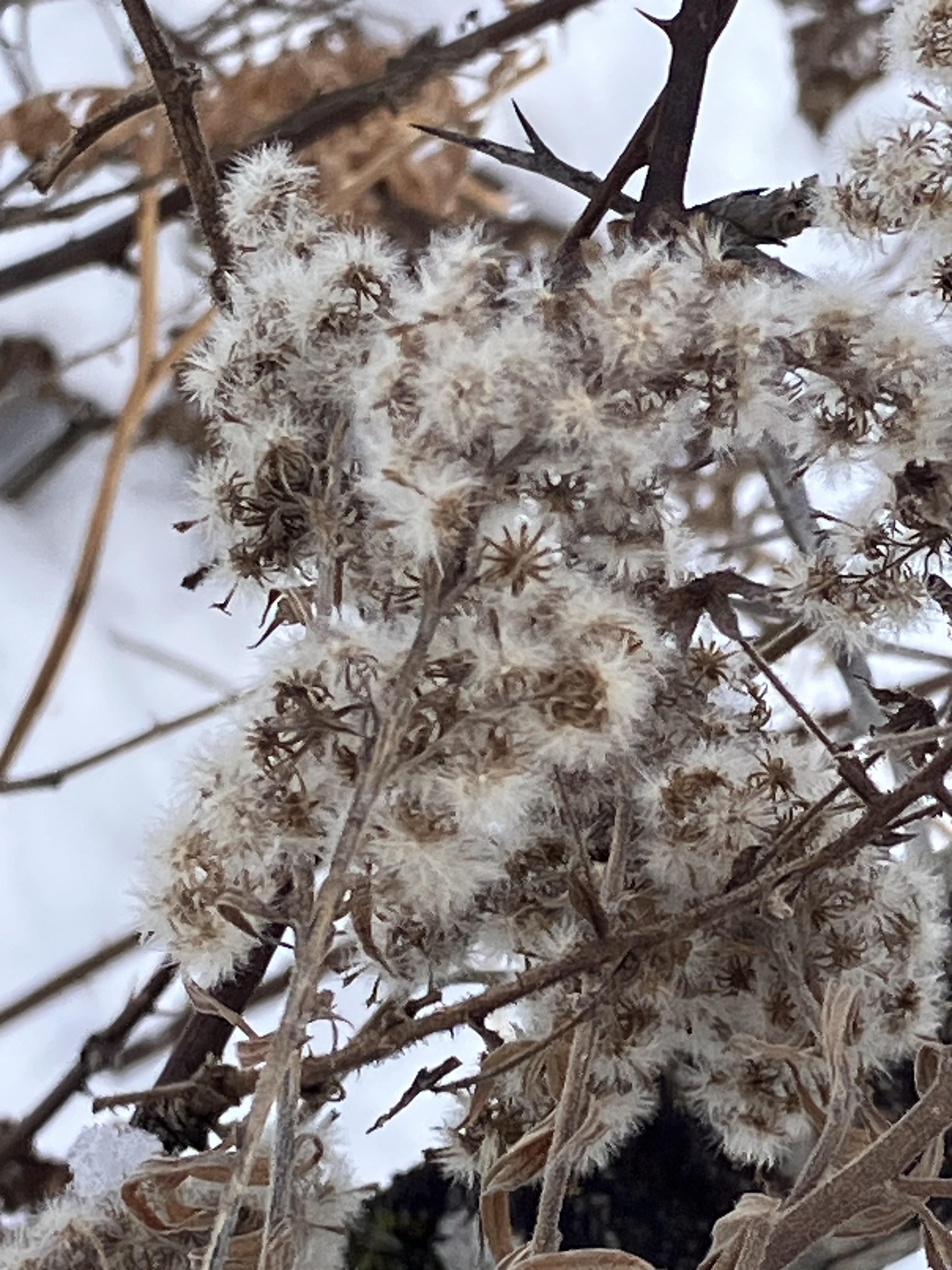
On the way down the hill, I spot a few more interesting shapes and textures — a dense bird’s nest woven into the spikey branches of a thorn-apple tree, and some wildflower seeds waiting to take flight above the snow pack — nature’s art.

The Appaloosa in winter

A walk in the woods is easier in winter.

For one, no bugs. No blackflies or mosquitos to crawl in your ears, or ticks to fasten themselves to your ankles.

No blackberry canes to claw at your jeans. Today, in the open area on the hydro line, those canes are mostly flattened by a few inches of snow cover.

So far this season, the snow’s still shallow enough to walk anywhere in a pair of boots and not get your feet wet.

Best of all, with the trees bare and the forest floor white, you can appreciate the bigger picture — the contours of the forest, ridges of rocky Canadian shield, and the shape of the watershed feeding my little getaway at Kinross Creek.

I use a ski pole to help navigate my way up the hill from the road, and immediately find deer tracks. Deer blaze proven trails in the woods, often finding the flatter routes and paths of least resistance through obstacles like rocks, trees and valleys. In winter, their hoofprints in the snow are evidence of these ancient superhighways.

I follow the deer tracks over to the little creek, which, despite the minus-5 temperature this January morning, is flowing steadily in the area connecting Ali and Colleen’s ponds. The drystone work I did last summer catches the flow into the two ponds but also directs it through central run-downs where the creek continues downriver.

The water’s burbling soothes the soul in this quite woodland. No birdsong today except for the odd caustic commentary of two crows in the treetops.

And no stonework tasks on my ramble today. I can just potter around the creek, and take a look down the hill at the farmland sprawling to the east. Several draft horses are munching hay next to a small shed.

Yesterday while driving along the road, Nadine and I caught sight of an old horse wearing a quilted coat for warmth. He was wandering solo, munching shrubs at the roadside. Was it the Appaloosa? Hard to tell. His head was grey but the coat camouflaged his body.

Appaloosa horses have origins in the US Pacific Northwest and are known for their versatility, speed and distinctive leopard spotting. They are handsome beasts.

The last time I saw the Appaloosa was in 2021. He was already 28 years old then and not long for this world. His spotted coat was still gorgeous but he was moving stiffly and had some vision trouble.

On my trek today, I chance upon Casey, the 3rd generation farmer at this beef cattle operation. His tractor plows are lined up awaiting more snow expected in the next few days. In winter, he and family run a snowplow business, earning seasonal income while keeping local roads and laneways open. I chat with Casey for a few minutes and inquire about the mystery horse with the coat.

Indeed, it’s the Appaloosa! He’s hanging in there! The older horse had started to shy away from the younger horses but had helped out by fostering a colt in the barn, out of sight of the road. Then this fall, Casey told me, the Appaloosa perked up a bit and was let back into his old field.

We’ve had our cottage on Minden Lake nearby since 2011 and I’ve seen the Appaloosa in the field each year whenever we pass by, so I guess I’m a little sentimental. I’m not the only one. A local gent who runs in this area said he’s always been cheered by the spotted horse when he jogs past the farm. Likewise our daughters enjoyed catching sight of the Appaloosa as he roamed his favourite field. I took a pic of the horse a few years ago in his prime…

He’s 30 years old now, well into his golden years, and wearing a coat for warmth in winter. But wandering the field perks him up, the same as a walk in the woods puts a kick in the step of the guy visiting Kinross Creek.

Winter wildlife at Kinross Creek

The first big snowfall in Minden Hills reveals the trails of wild creatures. Going up the hill towards Kinross Creek in December, I find the paw-tracks of a coyote and the hoof-prints of a deer on my route. To those, I add the boot-prints of a late-middle-aged man.

Looking back down the hill from the hydro tower, I can see our blue cottage on Minden Lake. Cows still roam the farm field nearby, nibbling the last of the taller grass and a few shrubs. Their territory will shrink soon with more snow and colder temperatures. The farmer has put away a long line of hay bales and a mound of sileage to get the herd through the winter.

I amble over to Kinross Creek, which is still running and trickling into new ponds named after Ali and Colleen. I’d wondered what wildlife the ponds would attract over time, and it appears that their first visitor has been a thirsty deer. Its tracks run parallel to the creek, then make a sharp right turn to the edge of Ali’s pond. I hope this wild creature had a cool drink and refreshing pause on its journey.

It would be interesting to test the water in this creek. I expect it would be about as clean and fresh as you can get anywhere. The creek bubbles up from a spring surrounded by boulders, about 200 yards north of the ponds. It meanders through mixed forest and around a few thorn-apple trees then drops into a sinkhole, passing under a massive granite formation on the hydro line.

Just south of that solid rock, after disappearing completely, the creek springs up again in a tiny, grassy marsh. From the marsh, Kinross Creek burbles through Ali and Colleen’s ponds.

And when the current is strong during spring run-off, it will gush downriver over a cliff into another creek valley below, feeding Minden Lake.

Now I’m standing in the woods imagining Paddle to the Sea, the short film by Canadian artist and canoe tripper Bill Mason. His film tracks the journey of a boy’s carved canoe during spring run-off and raises flags about the perils to the natural world of industrial pollution. Kinross Creek does not have the scale of Ontario’s Great Lakes, featured in the classic film, but I find the natural world and small watercourse here to be a beautiful microcosm, and deserving of care.

With the recent snow cover, most of my stonework for the ponds is done for this year, so today I can just keep my eyes and ears open, hike about and enjoy this peaceful spot.

Only one bird keeps me company here today — I can hear the “dee-dee-dee-dee” of a chickadee up in a bare hardwood tree. I’m overheated, so take off my toque and jacket for a few minutes and munch a granola bar. My own mellow roast moment.

On my way back down the hill, I spot a group of young Blue Jays cavorting and screeching in the treetops of conifers. They will need that energy to get through the deep cold of winter in Minden Hills.

Most colours in the great outdoors are muted now, except for some brilliant-green moss on the forest floor and a hint of pink in the morning sky, next to the farmer’s hay bales.

Following the road back home, I spot two more sets of tracks — tiny ones in the snow from a squirrel making his last stash of food, and the hefty hoofprints of the cows next door.

Building a foundation for Colleen’s pond

A touch of frost overnight in mid-November. On my walk over to Kinross creek, the morning sun is low, casting long shadows off a horse in the pasture next to the road. He’s nibbling the last of the grass before the snow flies.

With the longer nights, heavier dew and recent rains, Kinross Creek has now filled up Ali’s new pond!

To boot, the creek is now gurgling downriver again, towards the future site of Colleen’s pond. (This stretch had mostly dried out for a couple of months in summer.)

When I was here in October, I discovered a pile of larger stones nearby. My task today is to get them over to the creek to start the foundation for Colleen’s pond. With help from a spade, I pry up the big stones and send them rolling down the small hill to the creek. They are too heavy to lift, so they get rolled end-over-end the rest of the way.

In the bare canopy of the hardwood forest, two Blue Jays keep an eye on me, and confer in a call-and-response screech. The prettier song of a chickadee can be heard faintly, too.

Both bird species are survivors — they find or stash enough food to get them through the cold winters in Minden Hills, when most other birds have migrated south. Tiny Chickadees squirrel away seeds in the cracks of trees — even in the cracks of siding on our cottage next to Minden Lake. This gives them little caches of food to visit throughout the winter. The bigger and bolder Blue Jays seem to enjoy the canopy of conifers like Balsam, which provide shelter and likely some seeds and berries that are easier to find when the snow falls.

I wrestle the larger stones into the creek bed and begin to build out the foundation of Colleen’s pond. Basically I’m enlarging a pond already created in this spot by an enormous fallen tree. The rotting tree limbs have been moved aside, and a stone semi-circle is going in at the downriver half of the pond.

I stand on stepping stones in the creek to consider my work in progress, and note my next tasks: smaller stones on the west side, and some bigger stones to bring the east side into symmetry.

It’s getting warm in this tiny river valley. Protected from the wind and with the deep frost still about a month away, the creek area still features lush green moss. Fallen maple leaves drift and swirl in the water.

My balance is not great. After moving the big stones, I am getting achy, impatient and slightly fuzzy-brained. I want to do some more work but risk slipping off a rock and having to make an embarrassing cell phone call to Nadine. “Help, I’m flat on my back, up on the hydro corridor.”

I wander up to Ali’s pond to wash my hands and admire the stillness of this spot.

On the hike back down the hill, I scout out some stone for my next visit. I squirrel away a couple of small piles and note their locations. These will be used to finish up the foundation for Colleen’s pond.

The forest fungi enjoy this time of year. On a huge fallen poplar tree, the strange shapes and subtle greys of a fungi remind me of a forest Banksie. Just like an urban Banksie painting, the beauty of the natural world can flash and vanish.

On second glance, each individual fungi looks like a little toque.

Back at the road, my horse friend is still nibbling — to beat the next frost.