Interview with SIRCH Repair Café volunteer Joanne Yano
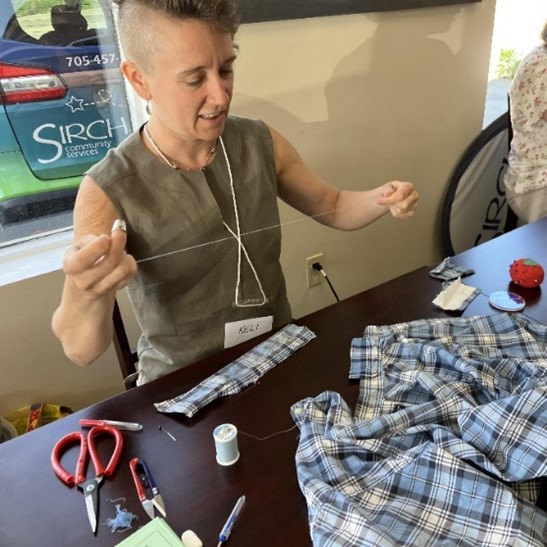
Joanne Yano carefully hand-stitches the sleeve hems of a grey casual blazer. The goal is to shorten the sleeves slightly. To get this far, Joanne’s already had to remove buttons before folding back the hems to the correct length. From her stash of sewing supplies, she has found a needle and thread suitable to the task, and continues making her expert repair.
Joanne’s profession is project management in the packaging industry, but she also finds time to volunteer at repair cafes both in Haliburton and Toronto.
Today, she’s one of about a dozen volunteers at this July 2026 repair café at the SIRCH Bistro in Haliburton. With splendid summer weather outside, it’s a quieter day at the repair event, but volunteer fixers are hard at work on repairs to items ranging from chairs to lamps, garments, bikes, and even a tube amplifier.
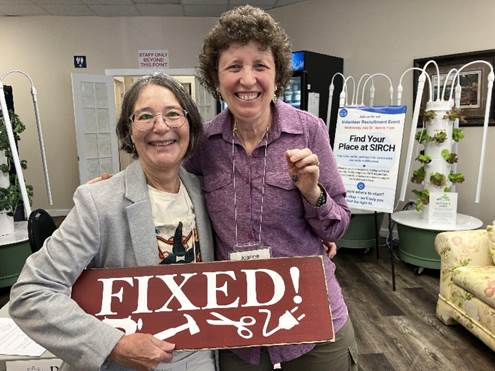
Joanne (at right in photo above) finishes the hemming job and returns the blazer to its owner, Gail.
Fixed!
In fact, since the pandemic, this talented team has supported sustainability by fixing more than 800 items ranging from small appliances and electronics to furniture, jewelry, ceramics, clothing and more. “Our program has helped many guests preserve heirlooms and functional items, and save many items from local landfills,” says Program Coordinator Dianne Woodcock.
At the July event, we spoke further to Joanne about her sewing skills, as well as her focus on paying it forward – to those who want to learn how to sew themselves.
Where did you get your sewing skills and inspiration?
From my Mom, Verna. She was a stay-at-home Mom in the 1960s. She liked to dress well. She loved nice dresses and hats for special occasions, and she made them herself. So I grew up with that, and learned some basic sewing skills from my Mom, and used her 1960s White sewing machine.
When I had my own kids, I would make sewing repairs to their clothes. That was a training ground to develop my skills with sewing repairs and mending. I have a vintage 1960s sewing machine and one from the 1990s with more stitch selection. But I enjoy hand-sewing the most, and try to specialize in that at the repair cafes.
Can you give an example of a sewing repair you found rewarding?
Last year, a guest brought in a hassock (a footrest also known as an ottoman). The cover had been ripped badly. She was upset because it was a favourite of hers.
The cover material was quite thick, but I had some strong tapestry thread on hand, and a heavy gauge needle. I was able to sew it back together and she was very happy.
How do you see your role at the repair café?
There’s a high value when you can repair a personal item like clothing. It’s the opposite of today’s trends towards fast fashion and disposable garments. I also want to share my skills with others who want to learn to sew.
I volunteer here at the SIRCH Repair Café in Haliburton and also at a Repair Café in the west end of Toronto, where I am part of a team that teaches sewing skills to groups. The students include people of all ages who want to learn to sew. Sometimes it’s kids with their parents, someone who wants support using their sewing machine, or a senior who wants a new craft in retirement. Over the years I’ve been able to share my sewing knowledge with perhaps 150 students who attended our workshops.
In a world where clothing is cheaper than ever, why do people want to learn how to sew?
Some have a favourite item, and they want to mend it so they can keep it.
Others want to learn how to sew a new garment for themselves or family.
I don’t make my own clothing but I do try to buy quality that will last — and I mend those garments to extend their life.
How else do you connect with other menders?
I follow a Facebook group called the Modern Mending Club, where we share sewing knowledge and experiences. It was started by an author, Erin Lewis-Fitzgerald, and helps people who are interested in mending.
It’s rewarding to learn, share and help others — and to contribute to sustainability.
For more on SIRCH and its amazing Repair Café, please visit sirch.on.ca
 kinrosscordless