The gears on Harry’s bike shift smoothly going up — but they bump and jump while shifting down.
At today’s SIRCH Repair Café in Haliburton, volunteer Dave Paddock clamps Harry’s bike into his repair stand and chats with him about the problem. Dave checks the gear cable and discovers some rust. He talks through the repair with Harry as he installs new sections of gear cabling and housing.
Putting the icing on the cake of this bike tune-up, Dave also adjusts the brakes, inflates the tires, and lubricates the chain.
“This guy is Dr. Bike!” exclaims Harry, as he gets his bike back, ready for the road.
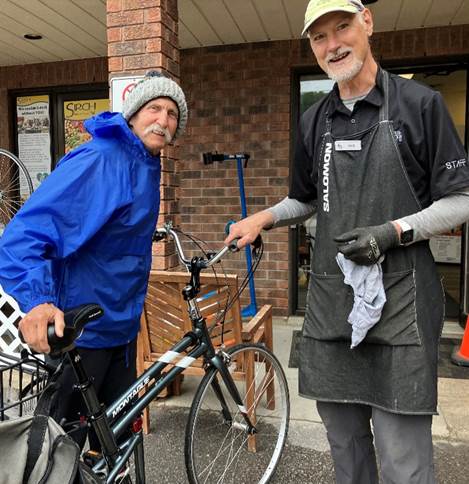
Dave Paddock (at right) with Repair Café guest Harry
Dave’s actually a retired high school physics/chemistry teacher who knows his way around bikes. As a teenager, he worked in a bike shop, mostly fixing tires. Later in life, he volunteered at a community bike hub and completed a two-week bike mechanic course through Conestoga College. In retirement, he now works part-time as a sports technician at Haliburton’s Alquonquin Outfitters, fixing bikes and ski gear.
Most of all, with his lifelong focus on education, Dave likes to share knowledge and find teachable moments.
He’s one of about a dozen volunteers at this June 2026 repair café at the SIRCH Bistro in Haliburton. By the end of today’s event, the team will have repaired about 30 of 40 items brought in, ranging from a vacuum cleaner to a sewing machine, a pair of jeans to an electric dog grooming tool, lamps, jewelry, an umbrella and more.
Not every item can be repaired, but since the pandemic, this talented team has fixed more than 800, notes Program Coordinator Dianne Woodcock. “Along the way, our program has helped many guests preserve family heirlooms and functional items, and reduce the volume of material going to local landfills.”
“The Repair Café is sustainability in action,” she adds.
At the June 2026 Repair Café event, we spoke further to Dave about his fix-it skills and focus on learning.
What was one of your favourite bike repairs at the SIRCH Repair Café?
When you can share knowledge it’s even more rewarding.
We had a group of four young women visit the Repair Café with their bikes on a school outing. Some of the bikes had cable problems. One of the young women was really interested in observing and understanding the repairs I was making. She was then able to help fix a similar problem on her friend’s bike. With her help, the group could then set off again on their trip.
What kind of bikes do guests bring in for repairs?
We see everything from a high-end bike with carbon fibre components, to a Canadian Tire special, from brand-new to vintage bikes.
Some bikes are well cared for, others can be pretty beat up.
One of the fun aspects is problem-solving. I originally took engineering at university, so diagnosing and repairing a problem is a challenge and a reward.
How is bicycle technology changing?
We’ve seen the introduction of mechanical changes like hydraulic disc brakes, compared to the traditional cabled caliper style, and the return to single chain rings in the front, from three.
And now digital technology is also being incorporated into bicycle design – like the use of Bluetooth to transmit signals from the shifter to the gears. This innovation replaces the mechanical gear cable and housing.
Technology is also changing how we repair bikes. Along with our experience and knowledge, digital sources like YouTube and AI can provide valuable shared knowledge. For a specific mechanical problem, AI can sometimes point you towards an issue you did not think about.
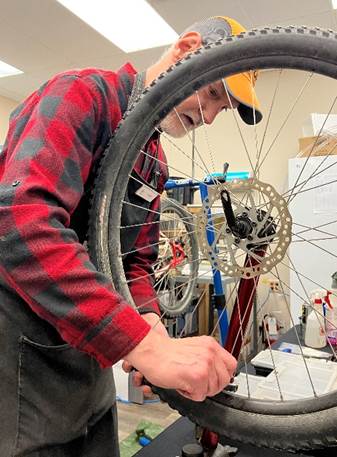
Dave trues a bike wheel at the April 2026 Repair Cafe
Do you enjoying cycling yourself?
I like to cycle on local roads that are less busy, and try to avoid big hills. One of my roundtrips is about 36K from Haliburton to Ingoldsby and back along the Kashagawigamog Road. Parts of the rail trail nearby are good for cycling on packed gravel. Also when highways are rebuilt in this area, they are now creating a safer lane for cyclists outside the white line.
It has also been fun to participate with some local cycling groups to advocate for safer cycling and share some cycling education.
How do you see the Repair Café’s role in today’s world?
It’s hard to get things fixed these days in our consumer society – there’s nowhere to go. When you see a functional and valued item get repaired, instead of thrown away, that’s what it’s all about.
This spring we had several lamps come in for repair. Some of them were one-of-a-kind designs and family heirlooms. The fixers went the extra mile to make repairs – diagnosing the issues and finding the right tools, parts and solutions. We even had a volunteer take off to visit the hardware store to get a needed part, for example.
The look of joy on the face of some of the guests when they were leaving with their lamps working again makes it all worth it.
For more on SIRCH Community Services and its amazing Repair Café, please visit sirch.on.ca

